USA Lobbying on ICT & Cybersecurity - Washington (Q4 2025)





CTIA, Verizon Communications, AT&T Inc, NCTA The Internet & Television Assn, and Google Inc were unusually active lobbyists this quarter.
View the interactive network in Queen Street Analytics →
Each quarter we track movements in US federal lobbying, channel by channel. This edition covers ICT & Cybersecurity for Q4 of 2025, ranking the organizations, government entities, issues, and lobbyists whose disclosed spend moved most.
Central Themes in this Quarter’s Lobby Data
FCC Cybersecurity Rule Reversal Sparks Uncertainty and Lobbying Surge
Following the FCC’s adoption of rigorous cybersecurity mandates for telecom operators in early 2025, intense industry lobbying—most notably by AT&T Inc before the Senate and House of Representatives—contributed to a November rollback in favor of voluntary guidelines. The rapid change in direction—just months after high-profile breaches—has left providers, including the Competitive Carriers Assn and AT&T Inc, pushing to shape what comes next, including efforts to block new mandates and secure flexible compliance frameworks.
📎 Adopted: January 15, 2025 Released: January 16, 2025 · FCC Reverses Telecom Cybersecurity Rules After 2025 Vote – What It ... · Protecting the Nation's Communications Systems From Cybersecurity Threats
Congressional Focus on AI-Driven Cyber Defense Drives Advocacy
The introduction of bills such as the Digital Economy Cybersecurity Advisory Act (H.R. 1495) and proposed legislation promoting AI for telecom security aligned with a spike in industry advocacy during 2025, with organizations like Verizon Communications and Microsoft Corp engaging with the House of Representatives and the Department of Defense. Providers are working to influence the structure and authority of proposed advisory boards and shape the technical standards emerging from these federal debates, while groups such as the Competitive Carriers Assn and AT&T Inc are also actively involved.
📎 H.R. 1495: Digital Economy Cybersecurity Advisory Act of 2025 - GovTrack.us · Legislation introduced to strengthen telecommunications cybersecurity ...
Presidential Orders on Critical Infrastructure Security Intensify Lobbying
A pair of high-profile executive orders in 2025 emphasized telecommunications and ICT networks as national security priorities, naming foreign adversaries as threats. These directives have motivated industry associations including Verizon Communications, AT&T Inc, Competitive Carriers Assn, and NCTA The Internet & Television Assn to coordinate lobbying around infrastructure protection, spectrum allocation, and emergency network initiatives before the Executive Office of the President and the Federal Communications Commission that could be shaped by federal actions.
📎 Sustaining Select Efforts to Strengthen the Nation's Cybersecurity and ... · Adopted: January 15, 2025 Released: January 16, 2025
Patchwork of State Cyber Laws Spurs Push for Federal Standards
Record-setting waves of state-level cybersecurity laws targeting telecom and technology created a fragmented regulatory landscape in 2025. Lobbyists for national carriers and ICT firms, including AT&T Inc and Red Hat Inc, have responded by pressing the House of Representatives, the Senate, and the Executive Office of the President (EOP) for federal preemption and harmonized rules to ease compliance and standardize network security obligations.
📎 Cybersecurity 2025 Legislation - National Conference of State Legislatures · Tracking Cybersecurity Policy Developments Across State Legislatures ...
Spectrum, Broadband, and Mergers: Key Issues Dominate Industry Lobbying
Major federal debates over broadband funding, 5G spectrum auctions, and telecom industry consolidation saw sharp lobbying upticks by sector leaders in late 2025, including CTIA and NCTA The Internet & Television Assn, both of which engaged with the Federal Communications Commission (FCC) and the House of Representatives. Regulatory uncertainty around spectrum allocation and infrastructure modernization appears to have fueled advocacy efforts from wireless and cable companies, such as AT&T Inc and Competitive Carriers Assn, seeking to secure favorable terms.
📎 Communications: 2025 Recent Developments - American Bar Association · Orders TOC by Paragraph - docs.fcc.gov

Section A: Lobbying Spend by Industry
How much each industry in this channel spent on federal lobbying in Q4 of 2025, compared with its average over the prior six quarters.
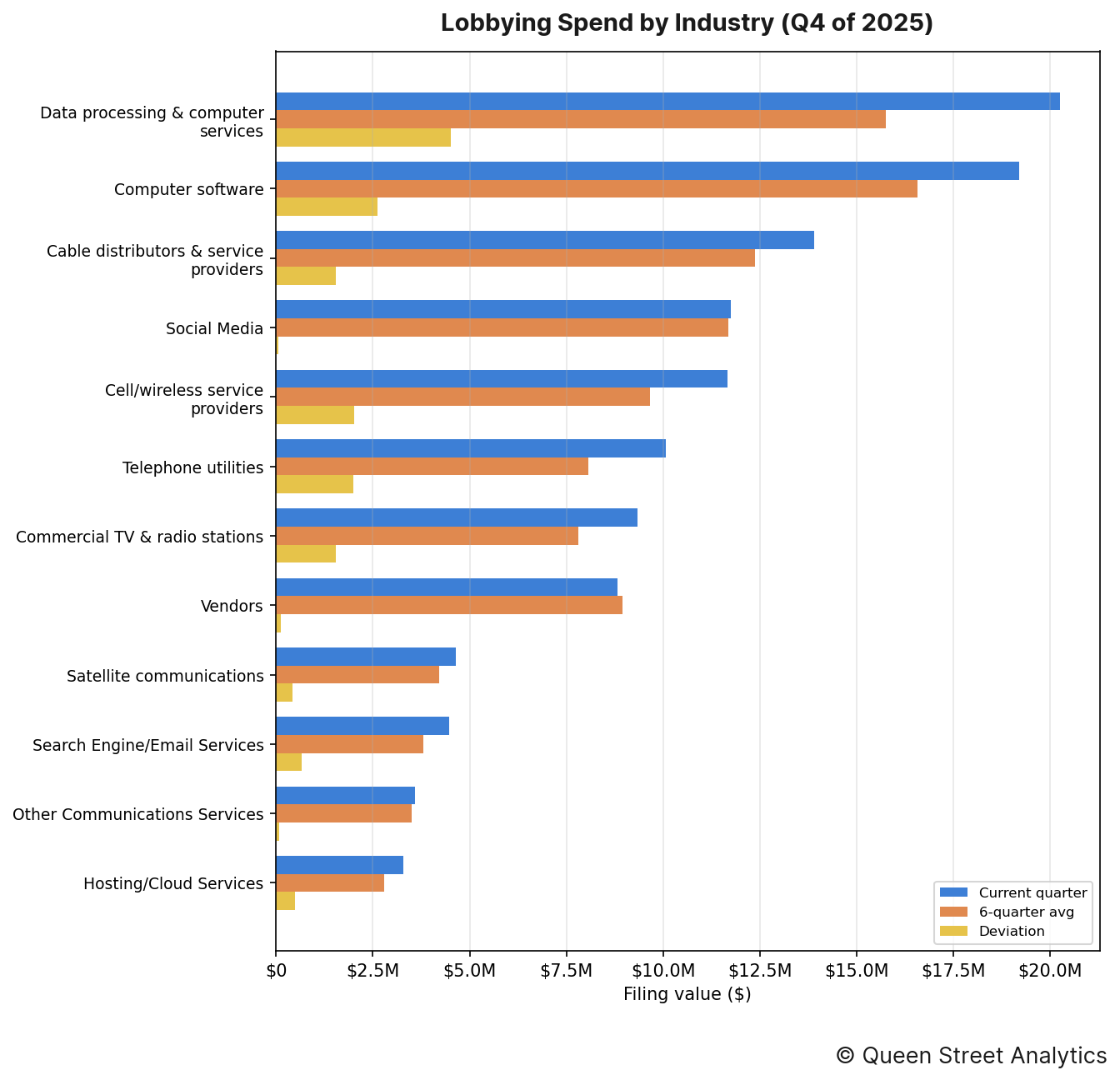
In Q4 of 2025, there was $131.2M worth of disclosed lobbying activity on ICT & Cybersecurity, 14% higher than the recent quarterly average of $115.1M. This activity can be broken down by industry as follows:
↳ There was $20.3M worth of Data processing & computer services lobbying, 29% higher than the recent quarterly average of $15.7M.
↳ There was $19.2M worth of Computer software lobbying, 16% higher than the recent quarterly average of $16.6M.
↳ There was $13.9M worth of Cable distributors & service providers lobbying, 12% higher than the recent quarterly average of $12.4M.
↳ There was $11.8M worth of Social Media lobbying, roughly in line with the recent quarterly average of $11.7M.
↳ There was $11.7M worth of Cell/wireless service providers lobbying, 21% higher than the recent quarterly average of $9.7M.
↳ There was $10.1M worth of Telephone utilities lobbying, 25% higher than the recent quarterly average of $8.1M.
Section B: Lobbying Spend Trend
This channel's total disclosed lobbying spend across recent quarters, aggregated over all of its industries.
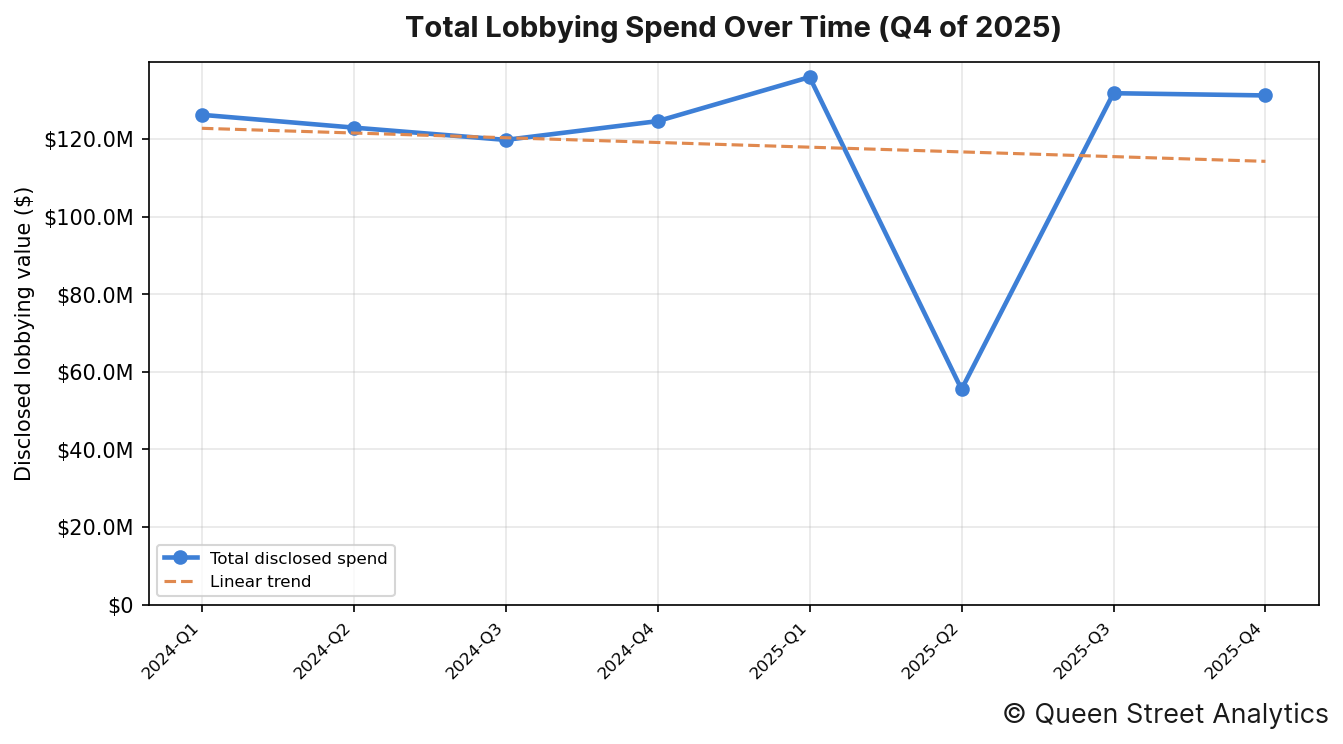
In Q4 of 2025, there was $131.2M worth of disclosed lobbying activity on ICT & Cybersecurity. Across the 8 quarters shown, the channel's total disclosed spend has held roughly steady over this period.
Organizations' Lobby Spend
The image below shows the organizations whose lobbying spend moved most from their six-quarter average.
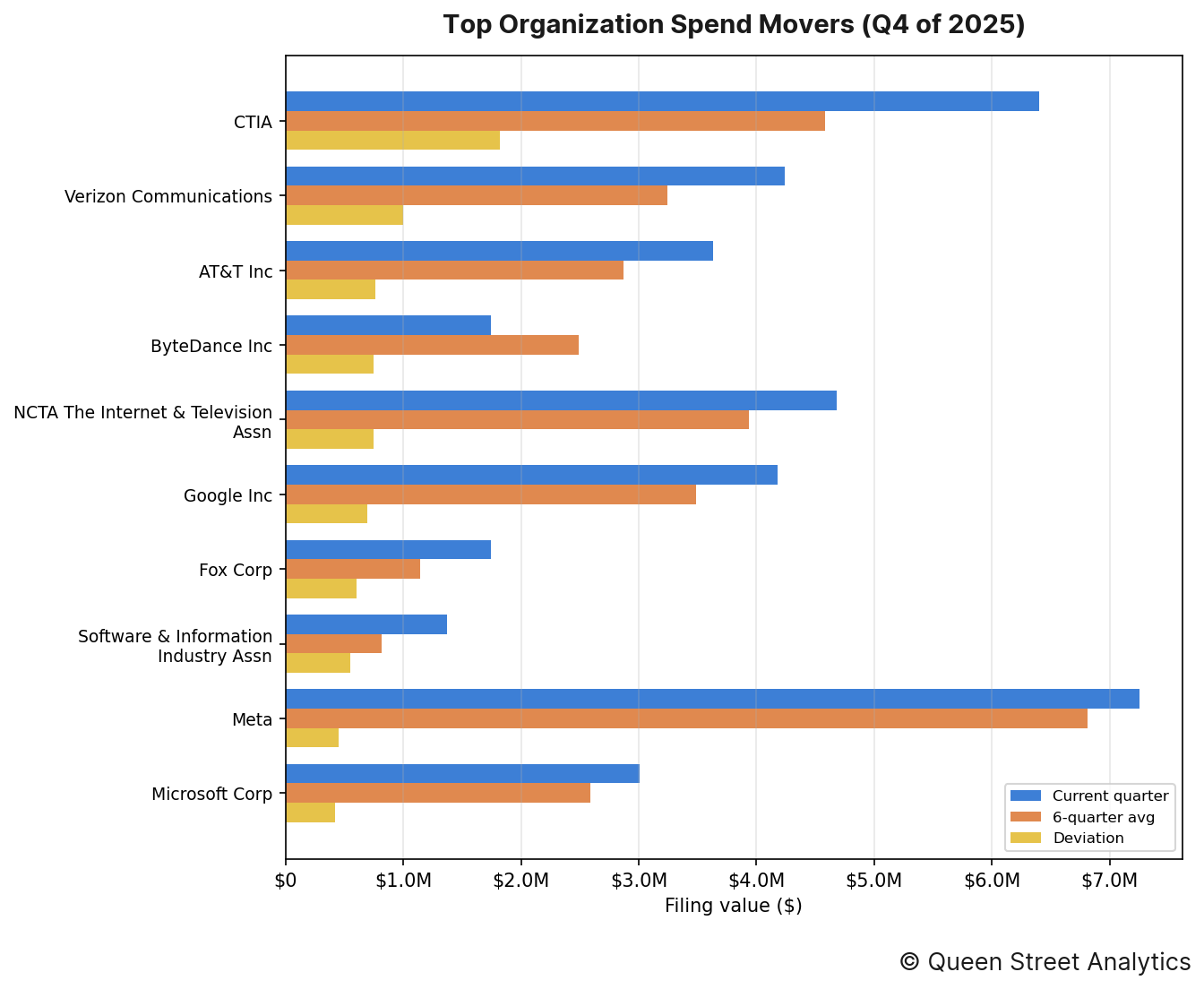
The organizations whose spending moved most from their own recent quarterly average were as follows:
↳ CTIA accounted for $6.4M in disclosed lobbying, 40% higher than the recent quarterly average of $4.6M.
↳ Verizon Communications accounted for $4.2M in disclosed lobbying, 31% higher than the recent quarterly average of $3.2M.
↳ AT&T Inc accounted for $3.6M in disclosed lobbying, 27% higher than the recent quarterly average of $2.9M.
↳ ByteDance Inc accounted for $1.7M in disclosed lobbying, 30% lower than the recent quarterly average of $2.5M.
↳ NCTA The Internet & Television Assn accounted for $4.7M in disclosed lobbying, 19% higher than the recent quarterly average of $3.9M.
↳ Google Inc accounted for $4.2M in disclosed lobbying, 20% higher than the recent quarterly average of $3.5M.
Section D: Government Entities Lobbied
This section documents this quarter's most lobbied federal government departments.
By industry
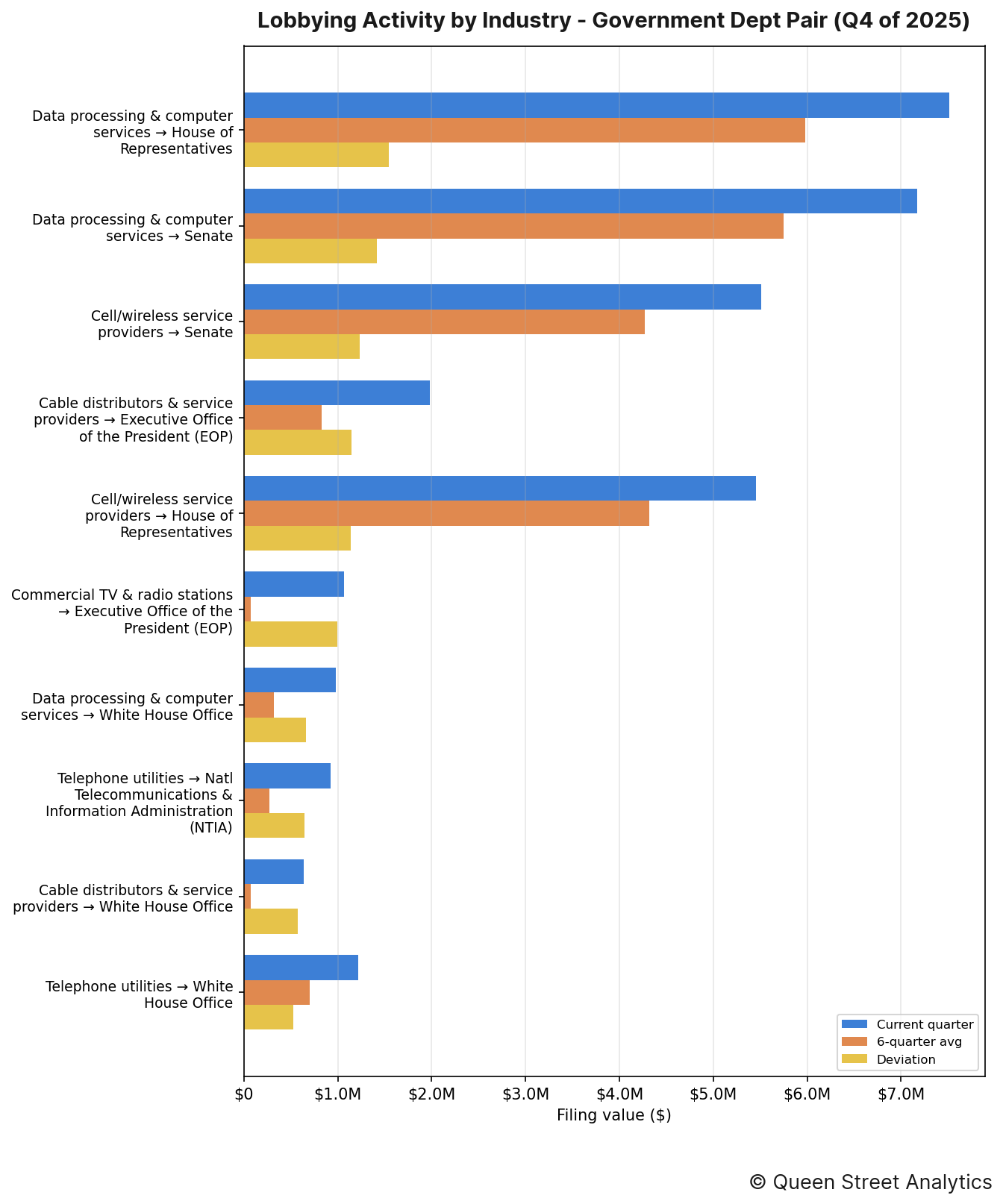
The industry–entity pairings that moved most this quarter were as follows:
↳ Data processing & computer services directed $7.5M of lobbying toward House of Representatives, 26% higher than the recent quarterly average of $6.0M.
↳ Data processing & computer services directed $7.2M of lobbying toward Senate, 25% higher than the recent quarterly average of $5.7M.
↳ Cell/wireless service providers directed $5.5M of lobbying toward Senate, 29% higher than the recent quarterly average of $4.3M.
By organization
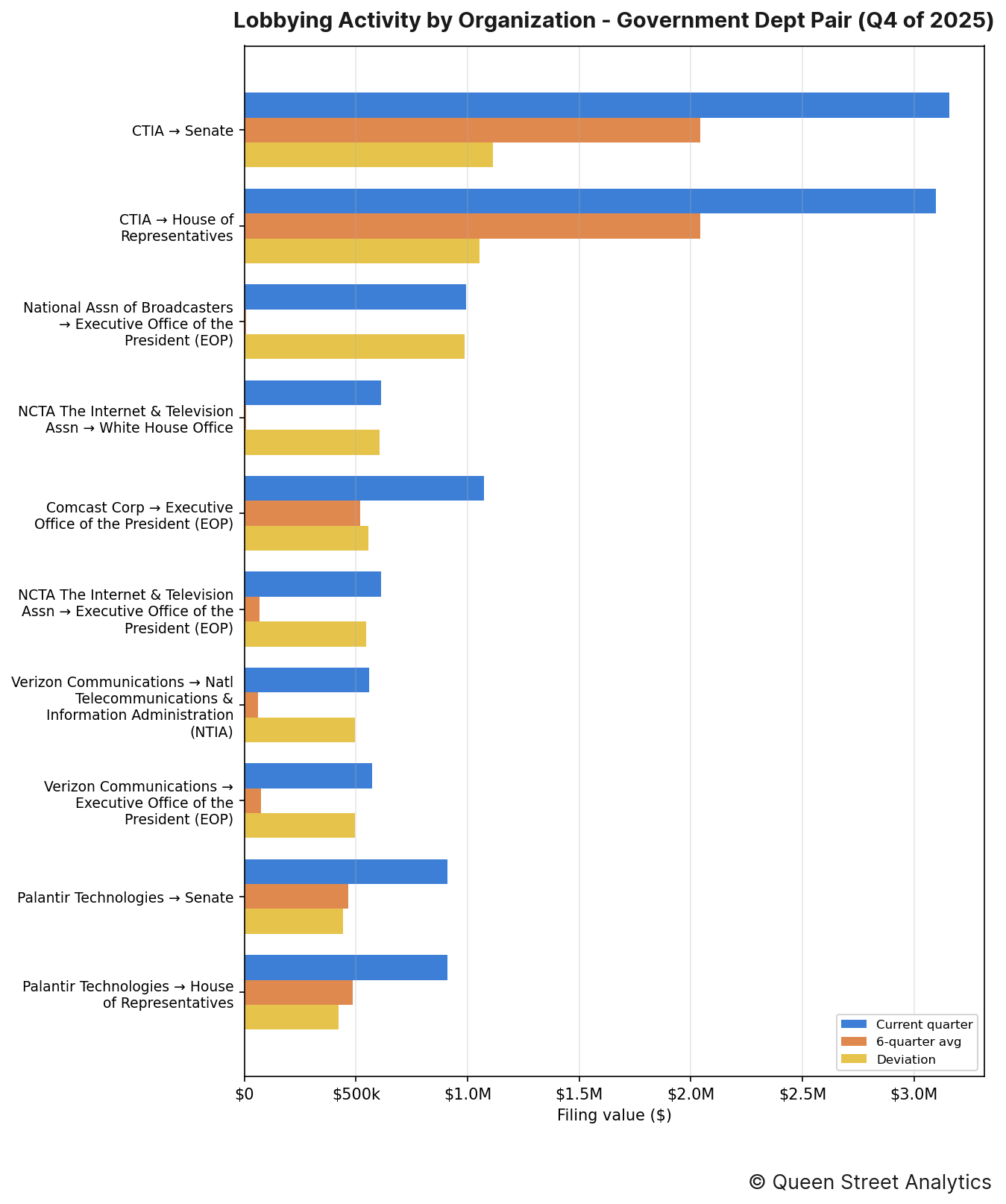
The organization–entity pairings that moved most this quarter were as follows:
↳ CTIA directed $3.2M of lobbying toward Senate, 55% higher than the recent quarterly average of $2.0M.
↳ CTIA directed $3.1M of lobbying toward House of Representatives, 52% higher than the recent quarterly average of $2.0M.
↳ National Assn of Broadcasters directed $993k of lobbying toward Executive Office of the President (EOP), 11820% higher than the recent quarterly average of $8k.
Section E: Lobbying Issues
This section documents this quarter's most lobbied-on issues.
By industry
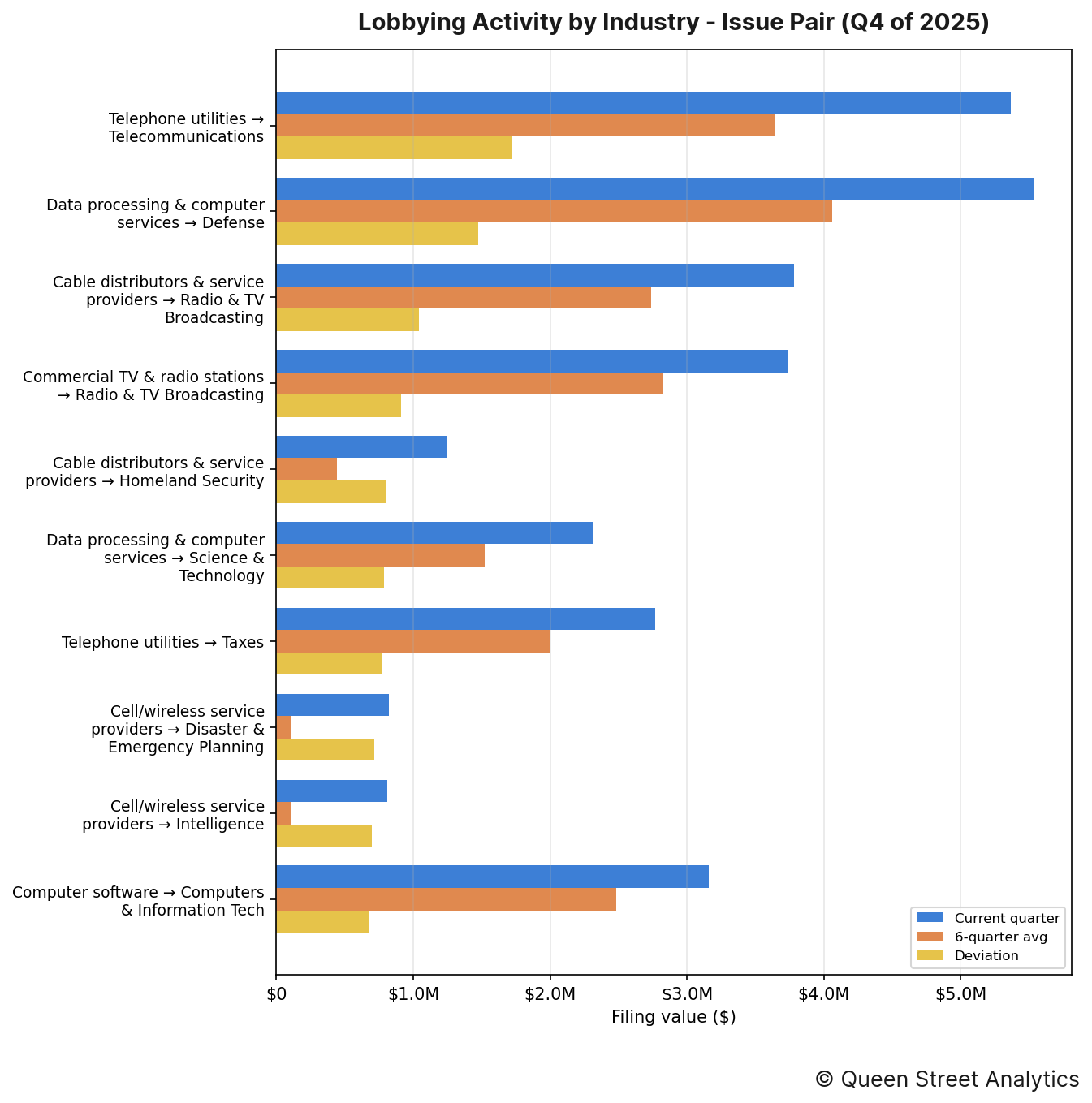
The industry–issue pairings that moved most this quarter were as follows:
↳ Telephone utilities put $5.4M toward lobbying on Telecommunications, 47% higher than the recent quarterly average of $3.6M.
↳ Data processing & computer services put $5.5M toward lobbying on Defense, 37% higher than the recent quarterly average of $4.1M.
↳ Cable distributors & service providers put $3.8M toward lobbying on Radio & TV Broadcasting, 38% higher than the recent quarterly average of $2.7M.
By organization
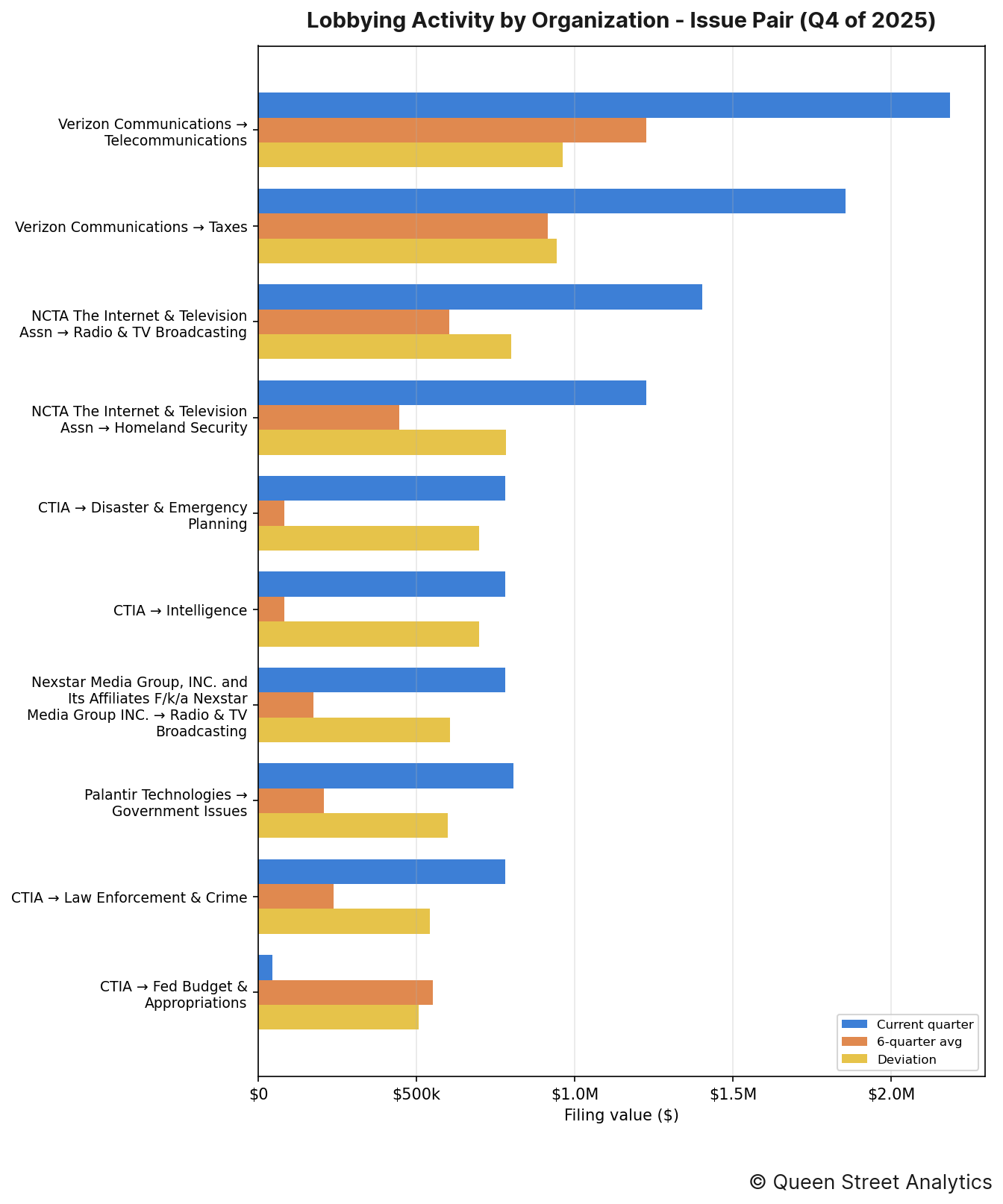
The organization–issue pairings that moved most this quarter were as follows:
↳ Verizon Communications put $2.2M toward lobbying on Telecommunications, 79% higher than the recent quarterly average of $1.2M.
↳ Verizon Communications put $1.9M toward lobbying on Taxes, 103% higher than the recent quarterly average of $914k.
↳ NCTA The Internet & Television Assn put $1.4M toward lobbying on Radio & TV Broadcasting, 133% higher than the recent quarterly average of $602k.
Section F: Most-Active Lobbyists
The figure below lists the lobbyists who managed the most imputed lobbying value this quarter, alongside their firm or organization. Because a filing's value is split evenly across the lobbyists it names, these dollar figures are imputed rather than directly disclosed.
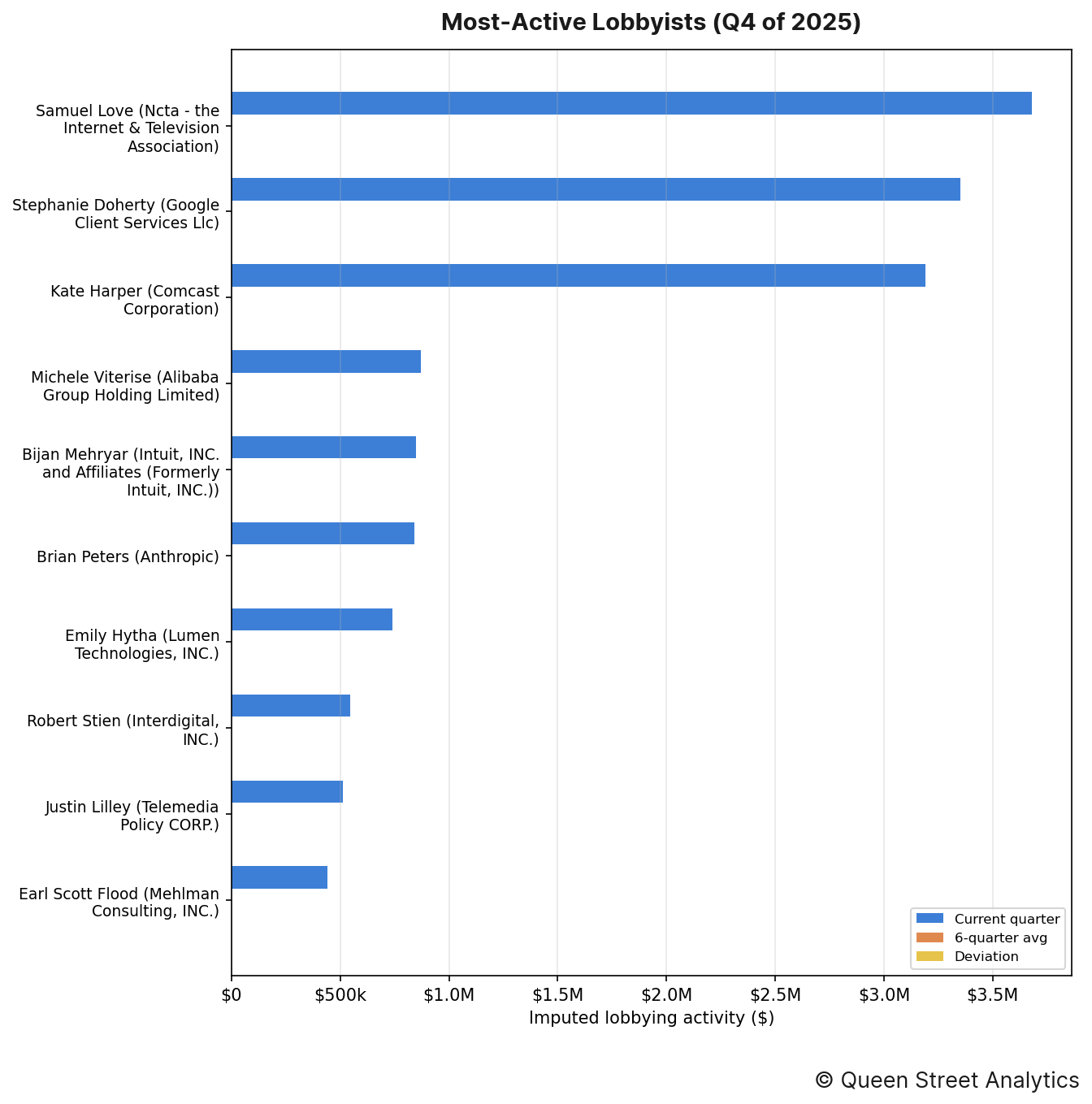
The lobbyists who managed the most imputed lobbying value this quarter were as follows:
↳ Samuel Love (Ncta - the Internet & Television Association) was credited with an imputed $3.7M in lobbying activity.
↳ Stephanie Doherty (Google Client Services Llc) was credited with an imputed $3.4M in lobbying activity.
↳ Kate Harper (Comcast Corporation) was credited with an imputed $3.2M in lobbying activity.
↳ Michele Viterise (Alibaba Group Holding Limited) was credited with an imputed $870k in lobbying activity.
↳ Bijan Mehryar (Intuit, INC. and Affiliates (Formerly Intuit, INC.)) was credited with an imputed $850k in lobbying activity.
Section G: Organization Network
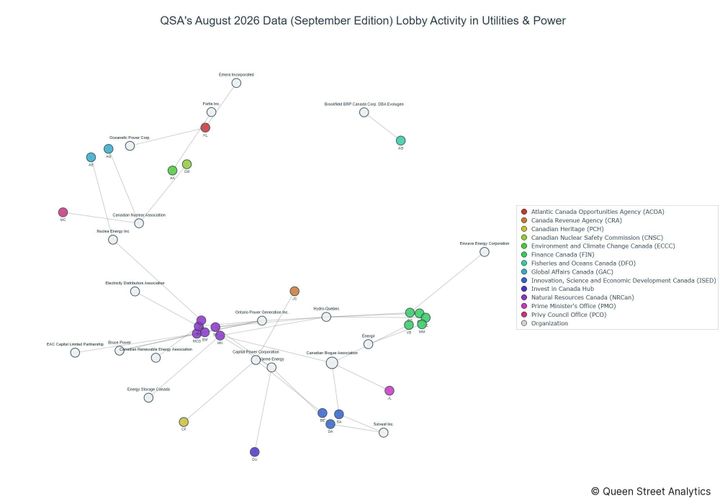
The header image for this edition maps how this channel's organizations (neutral nodes) connect to the federal entities they lobbied (colored nodes) this quarter. A link's weight is the filing value directed to that entity, and node size reflects total value; the House and Senate are excluded (nearly every organization lobbies them) so the specialized targets stand out.
The most widely lobbied entity this quarter was Dept of Commerce (DOC), which was lobbied by 15 organizations.
Methodology
Every figure in this report starts from one number: the disclosed value of each lobbying filing, which we take as the income a registrant reported plus any in-house expenses (income + expenses) on its quarterly US Senate and House LDA disclosure. Before totalling anything we clean the filings — applying each amendment over the original it replaces, removing duplicates, and setting aside non-standard records such as registrations and terminations — and map every filing to a lobbying channel and industry using the organization's CRP industry code.
How the money is divided. A filing's full value counts once toward the organization that paid it and that organization's industry, so the industry and organization rankings (Sections A–C) reflect whole dollars. But a single filing usually names several government entities, several issue areas, and several lobbyists at once, and the disclosure never says how the fee was split among them. Rather than credit the full amount to each — which would count the same dollars over and over — we divide a filing's value evenly across the distinct items it names. So a $200,000 filing that lists four agencies contributes $50,000 to each in Section D, and the same even split is applied across issues in Section E and across lobbyists in Section F. That way every section's totals trace back to the same underlying money without double-counting.
Reading the movements. A “deviation” compares the quarter's value to the average of the prior six quarters, so a rise or fall is measured against an entity's own recent norm rather than against the rest of the field. Section B takes the wider view: it sums every industry into one channel total and plots it quarter by quarter, with a fitted line showing the overall direction of travel. Source: US Senate and House LDA disclosures.