USA Lobbying on ICT & Cybersecurity - Washington (Q2 2026)





Anthropic, Google Inc, National Association of Broadcasters, Telekom Srbija, NCTA The Internet & Television Assn, Palantir Technologies were unusually active lobbyists this quarter.
View the interactive network in Queen Street Analytics →
Each quarter we track movements in US federal lobbying, channel by channel. This edition covers ICT & Cybersecurity for Q2 of 2026, ranking the organizations, government entities, issues, and lobbyists whose disclosed spend moved most.
Central Themes in this Quarter’s Lobby Data
Federal AI Orders Spark Industry Lobbying Surge Amid Preemption Push
Recent White House actions, including an executive order and legislative framework, are generating significant uncertainty for AI companies navigating both federal and state AI regulations. Major players—such as Anthropic, Microsoft, and Google—are reportedly intensifying efforts to shape standards, preemption rules, and child-safety legislation through direct policy advocacy, with Microsoft Corp lobbying the Executive Office of the President and the Department of Health & Human Services.
📎 White House Executive Order: Promoting Advanced Artificial Intelligence Innovation and Security (June 2026) · White House National Policy Framework for Artificial Intelligence—Legislative Recommendations (March 2026) · Federal AI Regulation Landscape: Where Things Stand in 2026
Cyber Strategy Promotes Offensive Operations, Cuts Compliance Red Tape
The new national cyber strategy, introduced in March 2026, signals a marked shift toward less prescriptive regulation and a fuller role for private sector operators such as Verizon Communications and Microsoft Corp in cyber defense and offensive activity. Infrastructure providers—including major cloud and telecom firms—are seen responding to these signals by increasing outreach and advocacy regarding regulatory latitude, procurement, and critical sector recognition, with active lobbying by Verizon Communications to the Executive Office of the President, the Federal Communications Commission (FCC), and the House of Representatives, as well as engagement by Microsoft Corp with the Department of Defense and Department of Commerce.
📎 White House Cyber Strategy for America—March 2026 · White House Releases New National Cyber Strategy and Executive Order · White House’s New Cyber Strategy and Executive Order Seek to Deter Adversaries and Strengthen Resilience
Broadband Policy Shift Sparks Regulatory Tensions at Local and State Level
Recent changes in FCC and NTIA direction emphasize deregulation and infrastructure expansion, reducing focus on affordability and digital equity. This has heightened conflict over deployment barriers, especially in multifamily housing, and provoked new lobbying pressure from cable and telecom interests such as Charter Communications and the Competitive Carriers Assn, who are responding to state preemption debates and federal program guardrails by engaging the Federal Communications Commission and Department of Commerce.
📎 From "100 Percent Broadband" to "Build America": What the FCC's New ... · NAA, NMHC, and RETTC Submit Comments Urging the FCC to Support Bulk ... · The Role of State Broadband Policy in 2026 | The Pew Charitable Trusts
AI Sector Filing Boom Driven by Federal Export Controls, Standards, and Child Safety Priorities
Lobbying activity by leading AI vendors such as Anthropic and Oracle Corp reportedly spiked sharply in Q2 2026 as Washington debates national security, technical standards, and the scope of federal authority preempting patchwork state regulations, with both organizations engaging the Dept of Commerce (DOC), Dept of Treasury, and the Dept of State (DOS). Some filings highlight specific engagement on export controls and use of AI in sensitive sectors like healthcare and education.
📎 2026 AI Laws Update: Key Regulations and Practical Guidance
Record Lobbying by Cloud, Telecom, and Media Sectors Reflects New Critical Infrastructure Focus
Spending data indicates a surge in advocacy from cloud, cable, and telecom interests as new executive orders and strategic plans assign these sectors an expanded role in national resilience and cyber defense. This uptick is reflected in lobbying by Verizon Communications and NCTA The Internet & Television Assn targeting the Executive Office of the President, White House Office, and House of Representatives as well as efforts by Competitive Carriers Assn directed at the Department of Commerce and Federal Communications Commission. These developments are prompting companies to engage directly with federal agencies to influence evolving definitions of critical infrastructure and procurement norms.
📎 Trump Cyber Strategy 2026: Executive Order and National Strategy · White House’s New Cyber Strategy and Executive Order Seek to Deter Adversaries and Strengthen Resilience

Section A: Lobbying Spend by Industry
How much each industry in this channel spent on federal lobbying in Q2 of 2026, compared with its average over the prior six quarters.
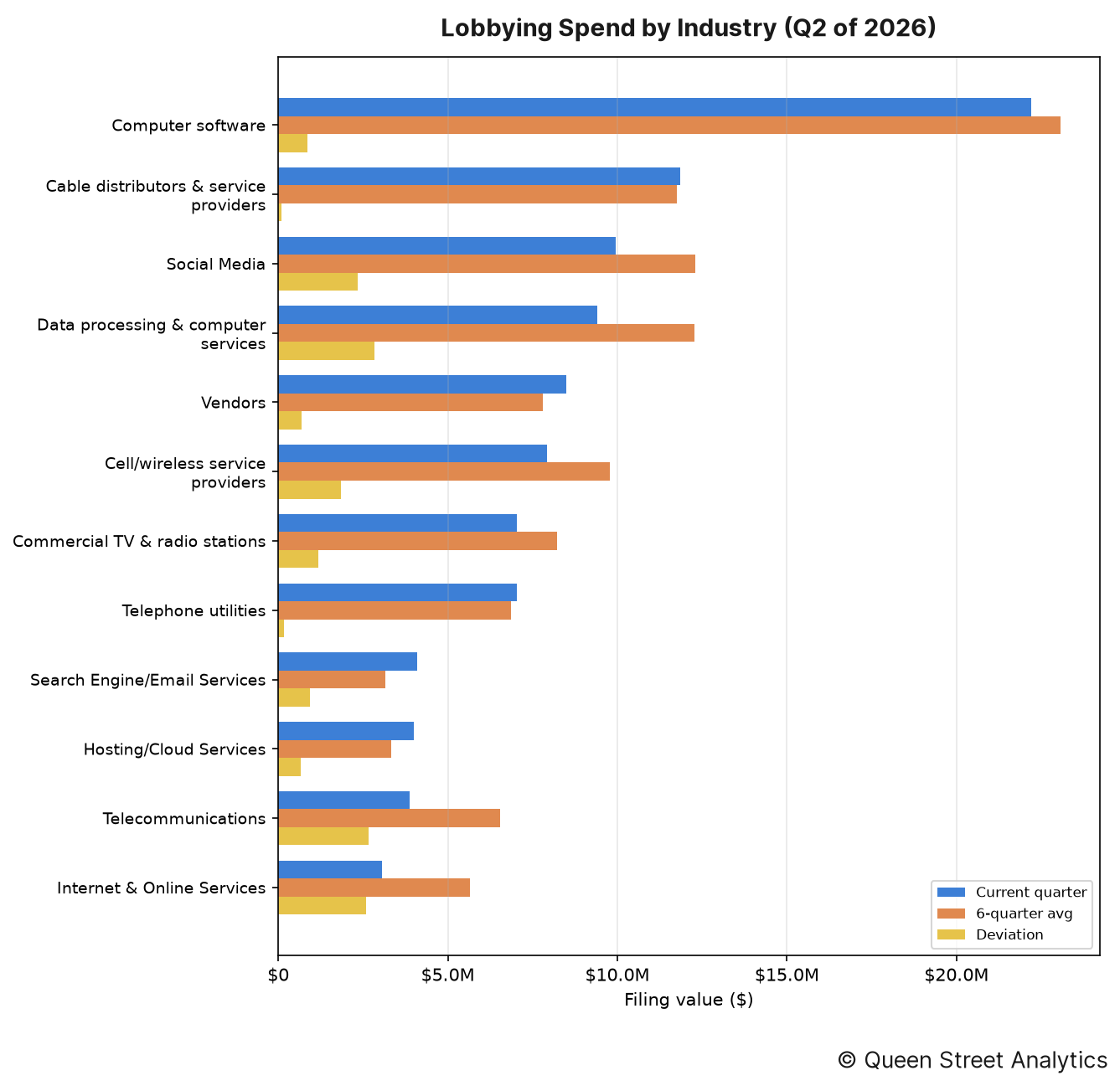
In Q2 of 2026, there was $108.0M worth of disclosed lobbying activity on ICT & Cybersecurity, 11% lower than the recent quarterly average of $120.7M. This activity can be broken down by industry as follows:
↳ There was $22.2M worth of Computer software lobbying, roughly in line with the recent quarterly average of $23.1M.
↳ There was $11.8M worth of Cable distributors & service providers lobbying, roughly in line with the recent quarterly average of $11.8M.
↳ There was $10.0M worth of Social Media lobbying, 19% lower than the recent quarterly average of $12.3M.
↳ There was $9.4M worth of Data processing & computer services lobbying, 23% lower than the recent quarterly average of $12.3M.
↳ There was $8.5M worth of Vendors lobbying, roughly in line with the recent quarterly average of $7.8M.
↳ There was $7.9M worth of Cell/wireless service providers lobbying, 19% lower than the recent quarterly average of $9.8M.
Section B: Lobbying Spend Trend
This channel's total disclosed lobbying spend across recent quarters, aggregated over all of its industries.

In Q2 of 2026, there was $108.0M worth of disclosed lobbying activity on ICT & Cybersecurity. Across the 10 quarters shown, the channel's total disclosed spend has fallen over this period.
Organizations' Lobby Spend
The image below shows the organizations whose lobbying spend moved most from their six-quarter average.

The organizations whose spending moved most from their own recent quarterly average were as follows:
↳ Salesforce, INC. accounted for $80k in disclosed lobbying, 96% lower than the recent quarterly average of $2.1M.
↳ Palantir Technologies accounted for $560k in disclosed lobbying, 76% lower than the recent quarterly average of $2.3M.
↳ CTIA - The Wireless Association accounted for $80k in disclosed lobbying, 95% lower than the recent quarterly average of $1.5M.
↳ Meta Platforms, INC. and Various Subsidiaries accounted for $0 in disclosed lobbying, 100% lower than the recent quarterly average of $1.2M.
↳ Anthropic accounted for $2.0M in disclosed lobbying, 144% higher than the recent quarterly average of $840k.
↳ Google Inc accounted for $4.0M in disclosed lobbying, 40% higher than the recent quarterly average of $2.9M.
Section D: Government Entities Lobbied
This section documents this quarter's most lobbied federal government departments.
By industry

The industry–entity pairings that moved most this quarter were as follows:
↳ Computer software directed $4.6M of lobbying toward House of Representatives, 24% lower than the recent quarterly average of $6.0M.
↳ Computer software directed $4.6M of lobbying toward Senate, 23% lower than the recent quarterly average of $5.9M.
↳ Data processing & computer services directed $3.2M of lobbying toward House of Representatives, 28% lower than the recent quarterly average of $4.4M.
By organization
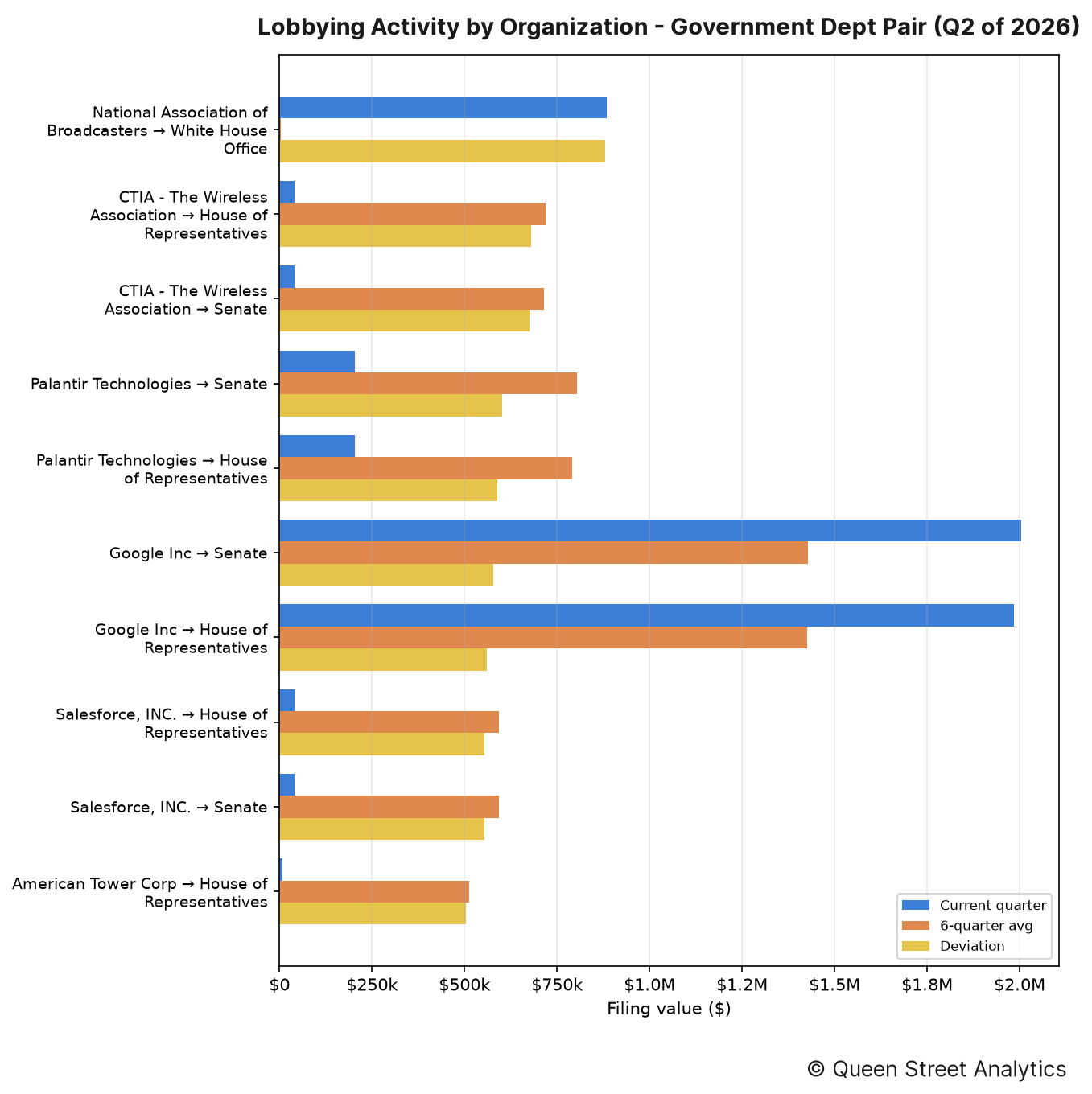
The organization–entity pairings that moved most this quarter were as follows:
↳ National Association of Broadcasters directed $883k of lobbying toward White House Office, 26400% higher than the recent quarterly average of $3k.
↳ CTIA - The Wireless Association directed $40k of lobbying toward House of Representatives, 94% lower than the recent quarterly average of $720k.
↳ CTIA - The Wireless Association directed $40k of lobbying toward Senate, 94% lower than the recent quarterly average of $715k.
Section E: Lobbying Issues
This section documents this quarter's most lobbied-on issues.
By industry

The industry–issue pairings that moved most this quarter were as follows:
↳ Data processing & computer services put $1.6M toward lobbying on Defense, 49% lower than the recent quarterly average of $3.1M.
↳ Cable distributors & service providers put $3.1M toward lobbying on Telecommunications, 29% lower than the recent quarterly average of $4.4M.
↳ Telecommunications put $32k toward lobbying on Taxes, 97% lower than the recent quarterly average of $1.1M.
By organization
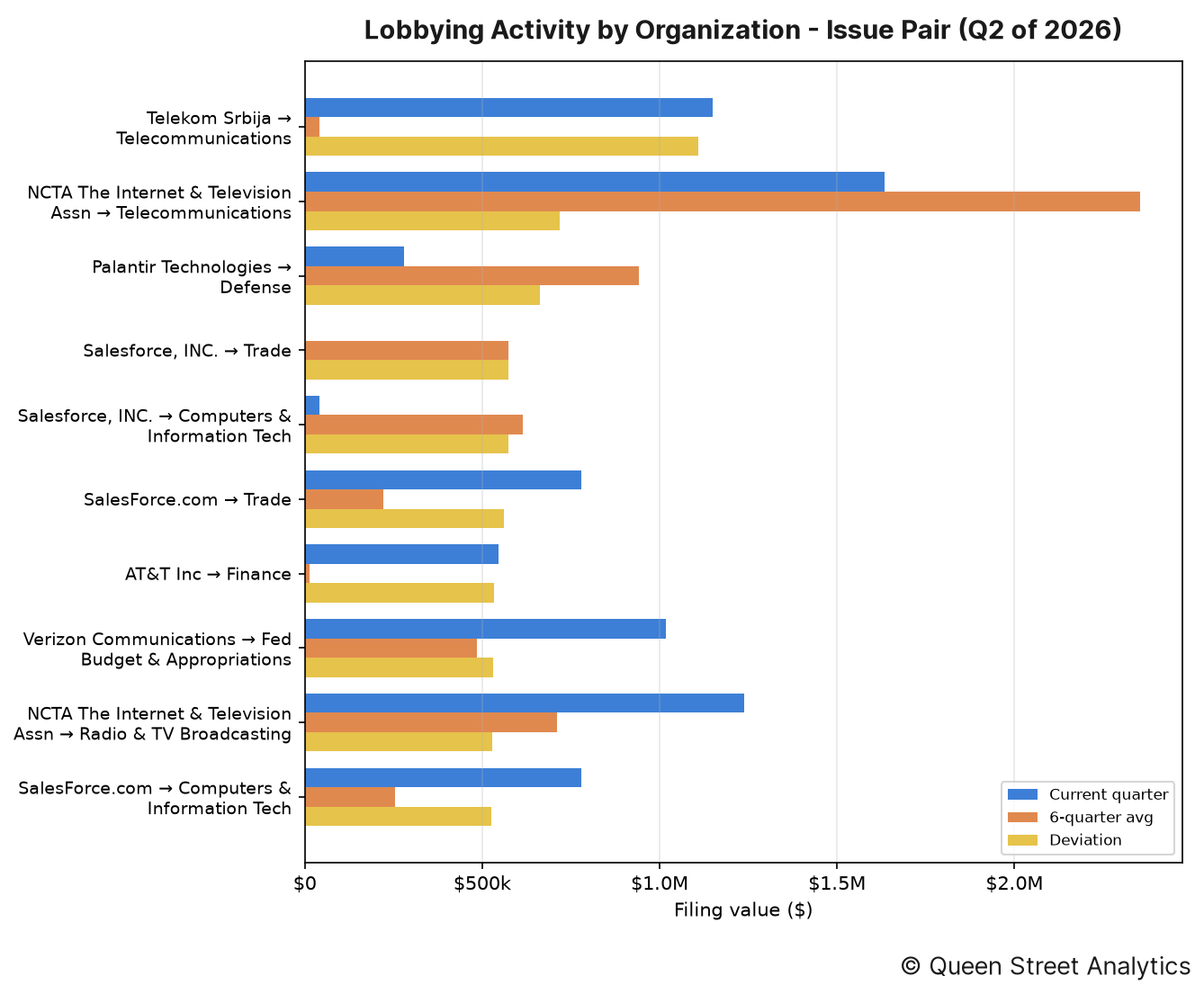
The organization–issue pairings that moved most this quarter were as follows:
↳ Telekom Srbija put $1.1M toward lobbying on Telecommunications, 2752% higher than the recent quarterly average of $40k.
↳ NCTA The Internet & Television Assn put $1.6M toward lobbying on Telecommunications, 31% lower than the recent quarterly average of $2.4M.
↳ Palantir Technologies put $280k toward lobbying on Defense, 70% lower than the recent quarterly average of $942k.
Section F: Most-Active Lobbyists
The figure below lists the lobbyists who managed the most imputed lobbying value this quarter, alongside their firm or organization. Because a filing's value is split evenly across the lobbyists it names, these dollar figures are imputed rather than directly disclosed.
No lobbyist activity to report this quarter.
Section G: Organization Network
The header image for this edition maps how this channel's organizations (neutral nodes) connect to the federal entities they lobbied (colored nodes) this quarter. A link's weight is the filing value directed to that entity, and node size reflects total value; the House and Senate are excluded (nearly every organization lobbies them) so the specialized targets stand out.
The most widely lobbied entity this quarter was Dept of Commerce (DOC), which was lobbied by 16 organizations.
Methodology
Every figure in this report starts from one number: the disclosed value of each lobbying filing, which we take as the income a registrant reported plus any in-house expenses (income + expenses) on its quarterly US Senate and House LDA disclosure. Before totalling anything we clean the filings — applying each amendment over the original it replaces, removing duplicates, and setting aside non-standard records such as registrations and terminations — and map every filing to a lobbying channel and industry using the organization's CRP industry code.
How the money is divided. A filing's full value counts once toward the organization that paid it and that organization's industry, so the industry and organization rankings (Sections A–C) reflect whole dollars. But a single filing usually names several government entities, several issue areas, and several lobbyists at once, and the disclosure never says how the fee was split among them. Rather than credit the full amount to each — which would count the same dollars over and over — we divide a filing's value evenly across the distinct items it names. So a $200,000 filing that lists four agencies contributes $50,000 to each in Section D, and the same even split is applied across issues in Section E and across lobbyists in Section F. That way every section's totals trace back to the same underlying money without double-counting.
Reading the movements. A “deviation” compares the quarter's value to the average of the prior six quarters, so a rise or fall is measured against an entity's own recent norm rather than against the rest of the field. Section B takes the wider view: it sums every industry into one channel total and plots it quarter by quarter, with a fitted line showing the overall direction of travel. Source: US Senate and House LDA disclosures.


