USA Lobbying on Foreign Affairs - Washington (Q1 2026)





Fdd Action; Akin Gump Strauss Hauer & Field Llp on Behalf of Tp-link Systems INC; Bae Kim & Lee Llc on Behalf of Kcih & Ypc; J Street; Hadassah the Women's Zionist Organization of America INC; U.S. Global Leadership Campaign were unusually active lobbyists this quarter.
View the interactive network in Queen Street Analytics →
Each quarter we track movements in US federal lobbying, channel by channel. This edition covers Foreign Affairs for Q1 of 2026, ranking the organizations, government entities, issues, and lobbyists whose disclosed spend moved most.
Central Themes in this Quarter’s Lobby Data
Critical Minerals Trade Policy Changes Stoke Lobbying Surge
Federal actions adjusting critical minerals imports in early 2026 have intensified lobbying around tariffs, industrial policy, and bilateral cooperation, with organizations such as Bae, Kim & Lee Llc on Behalf of Kcih & Ypc engaging the Department of Defense (DOD) and Fdd Action approaching both the Senate and the House of Representatives. The new frameworks appear to be a major driver for foreign agents and clients seeking access to federal grants and favorable trade remedies amidst heightened US-China tensions.
📎 Adjusting Imports of Processed Critical Minerals and Their Derivative ... · New Executive Order Ties U.S. Critical Minerals Security to ... - CSIS · Federal Register :: Adjusting Imports of Processed Critical Minerals ...
Major Ministerial Spurs ‘Pax Silica’ Collaboration Frenzy
The US-led Critical Minerals Ministerial in February 2026 has prompted a wave of international lobbying efforts, with J Street and the U.S. Global Leadership Campaign engaging with the House of Representatives and other federal entities, focused on global supply chain resiliency. The launch of ‘Pax Silica’ and allied resource partnerships seem to coincide with increased filings referencing grants, tariffs, and strategic industrial cooperation, including outreach from Hadassah, the Women's Zionist Organization of America, INC. to the Senate regarding medical technology provisions.
📎 2026 Critical Minerals Ministerial - United States Department of State · US critical-minerals diplomacy: from America-First deals to Pax Silica · America’s New Critical Minerals Playbook - TIME
Expanded Sanctions Intensify Foreign Affairs Lobbying
The Treasury’s OFAC rolled out new sanctions targeting multiple countries in Q1, reportedly spurring client advocacy on Iran sanctions, Russia-related trade, and counterintelligence reform, with Fdd Action engaging the House of Representatives, Senate, and White House Office. These moves may have led to an uptick in lobbying related to secondary sanctions and law enforcement authorities, reflected in expanded efforts by J Street before the House of Representatives and the National Security Council.
📎 Recent Actions - Office of Foreign Assets Control · Press Releases - United States Department of State · US: What the New White House AI Action Plan and Executive Order Mean ...
AI Executive Order Drives Tech-Centric Lobbying
A new presidential order prioritizing advanced AI innovation and security has coincided with a spike in lobbying filings mentioning open-weight AI models, cybersecurity, and terrorism risk assessment, including engagement from Fdd Action with both the House of Representatives and the Senate. Firms and agents, such as Hadassah, the Women's Zionist Organization of America, INC., and the U.S. Global Leadership Campaign, appear to be increasingly concerned about AI-enabled national security and data protection.
📎 Promoting Advanced Artificial Intelligence Innovation and Security ... · U.S. Economic Security - Council on Foreign Relations · US: What the New White House AI Action Plan and Executive Order Mean ...
US Trade Representative Actions Spark Tariff-Related Advocacy
Recent USTR announcements of new tariffs and Section 301 investigations have triggered lobbying efforts from Fdd Action directed at both the House of Representatives and the Senate, focused on trade transparency, forced labor issues, and intellectual property. The moves have reportedly driven US manufacturers and foreign clients to seek reforms in information sharing and counterintelligence policy.
📎 Home | United States Trade Representative

Section A: Lobbying Spend by Industry
How much each industry in this channel spent on federal lobbying in Q1 of 2026, compared with its average over the prior six quarters.
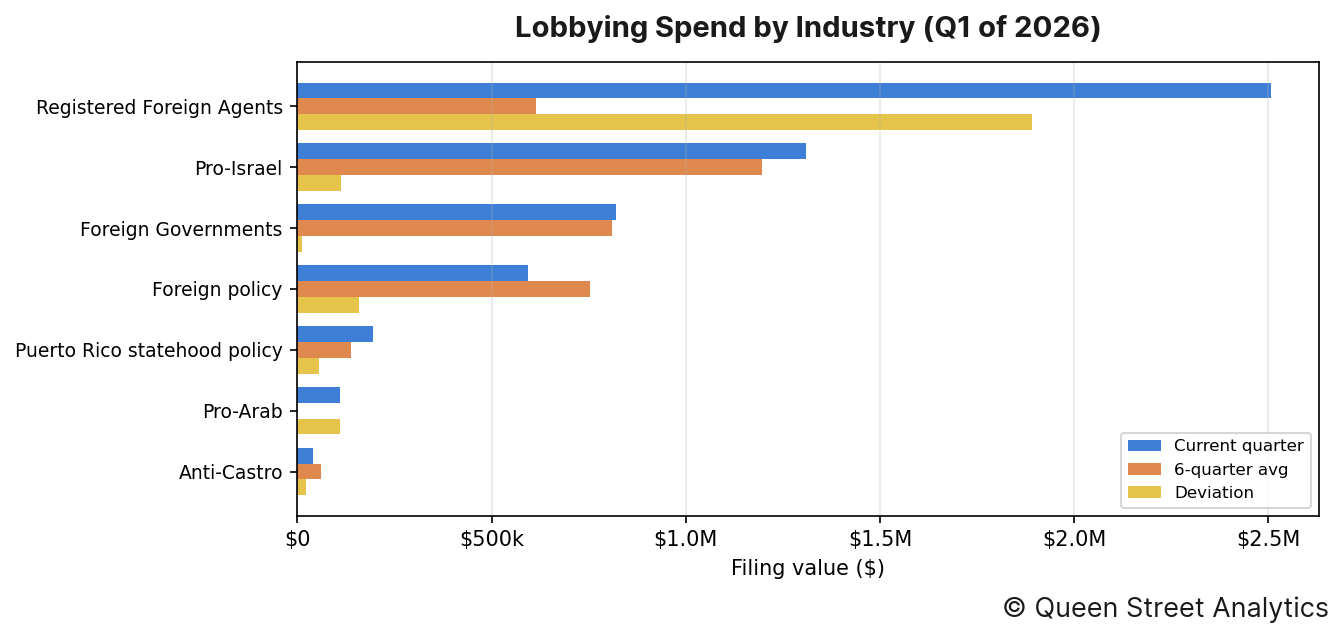
In Q1 of 2026, there was $5.6M worth of disclosed lobbying activity on Foreign Affairs, 56% higher than the recent quarterly average of $3.6M. This activity can be broken down by industry as follows:
↳ There was $2.5M worth of Registered Foreign Agents lobbying, 308% higher than the recent quarterly average of $614k.
↳ There was $1.3M worth of Pro-Israel lobbying, roughly in line with the recent quarterly average of $1.2M.
↳ There was $820k worth of Foreign Governments lobbying, roughly in line with the recent quarterly average of $809k.
↳ There was $593k worth of Foreign policy lobbying, 21% lower than the recent quarterly average of $752k.
↳ There was $195k worth of Puerto Rico statehood policy lobbying, 41% higher than the recent quarterly average of $138k.
↳ There was $110k worth of Pro-Arab lobbying, a new area of activity with no comparable spend in recent quarters.
Section B: Lobbying Spend Trend
This channel's total disclosed lobbying spend across recent quarters, aggregated over all of its industries.
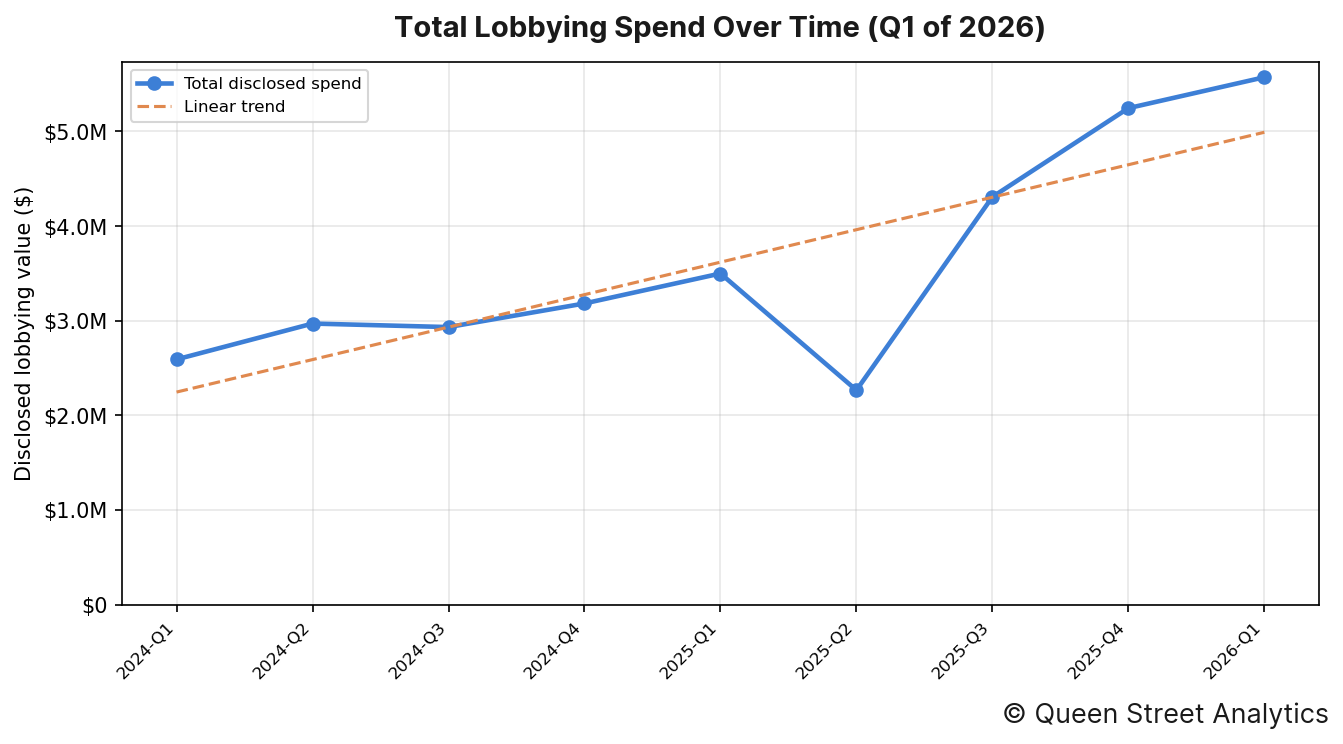
In Q1 of 2026, there was $5.6M worth of disclosed lobbying activity on Foreign Affairs. Across the 9 quarters shown, the channel's total disclosed spend has risen over this period.
Organizations' Lobby Spend
The image below shows the organizations whose lobbying spend moved most from their six-quarter average.
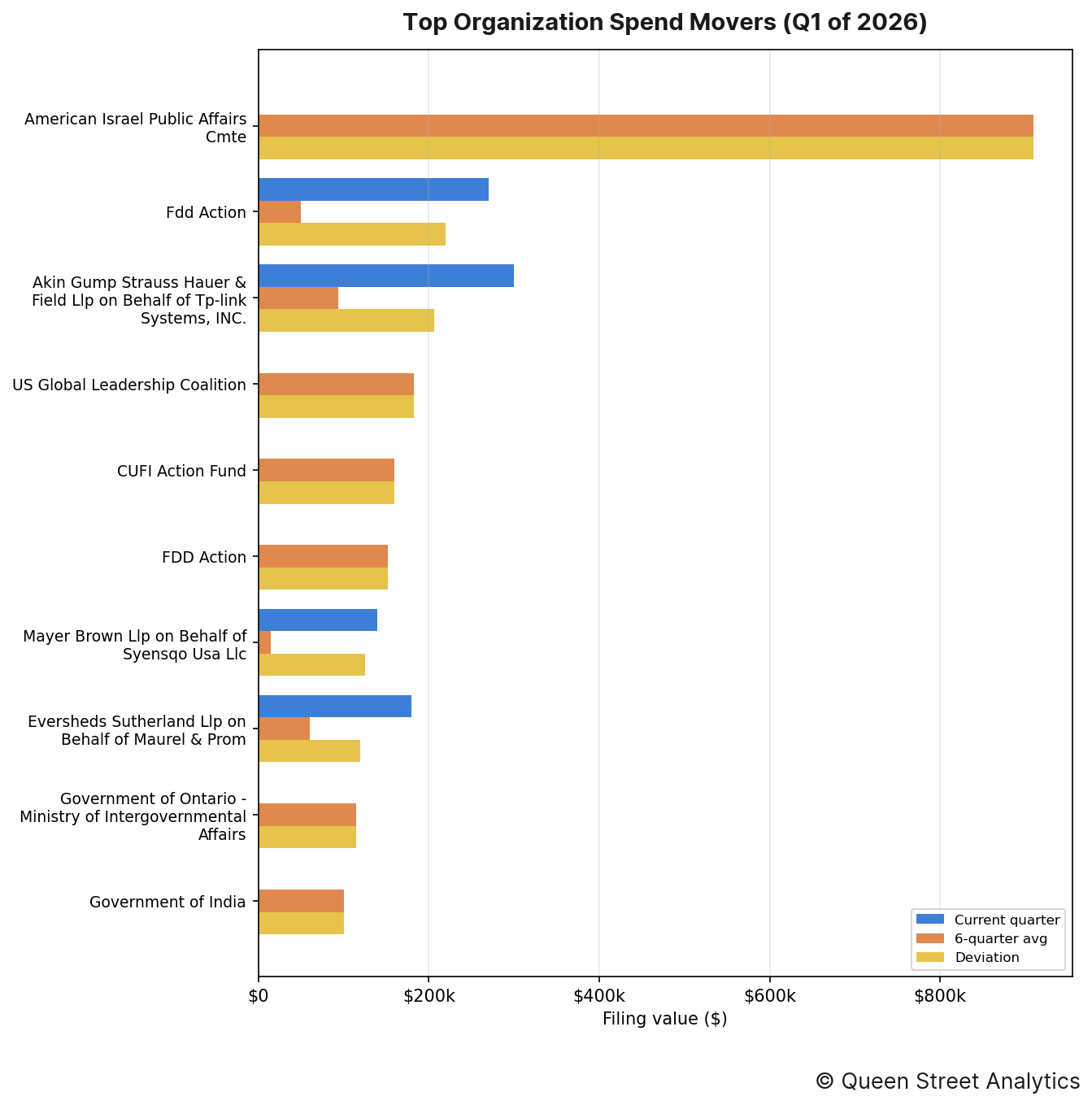
The organizations whose spending moved most from their own recent quarterly average were as follows:
↳ American Israel Public Affairs Cmte accounted for $0 in disclosed lobbying, 100% lower than the recent quarterly average of $909k.
↳ Fdd Action accounted for $270k in disclosed lobbying, 440% higher than the recent quarterly average of $50k.
↳ Akin Gump Strauss Hauer & Field Llp on Behalf of Tp-link Systems, INC. accounted for $300k in disclosed lobbying, 221% higher than the recent quarterly average of $93k.
↳ US Global Leadership Coalition accounted for $0 in disclosed lobbying, 100% lower than the recent quarterly average of $182k.
↳ CUFI Action Fund accounted for $0 in disclosed lobbying, 100% lower than the recent quarterly average of $160k.
↳ FDD Action accounted for $0 in disclosed lobbying, 100% lower than the recent quarterly average of $152k.
Section D: Government Entities Lobbied
This section documents this quarter's most lobbied federal government departments.
By industry
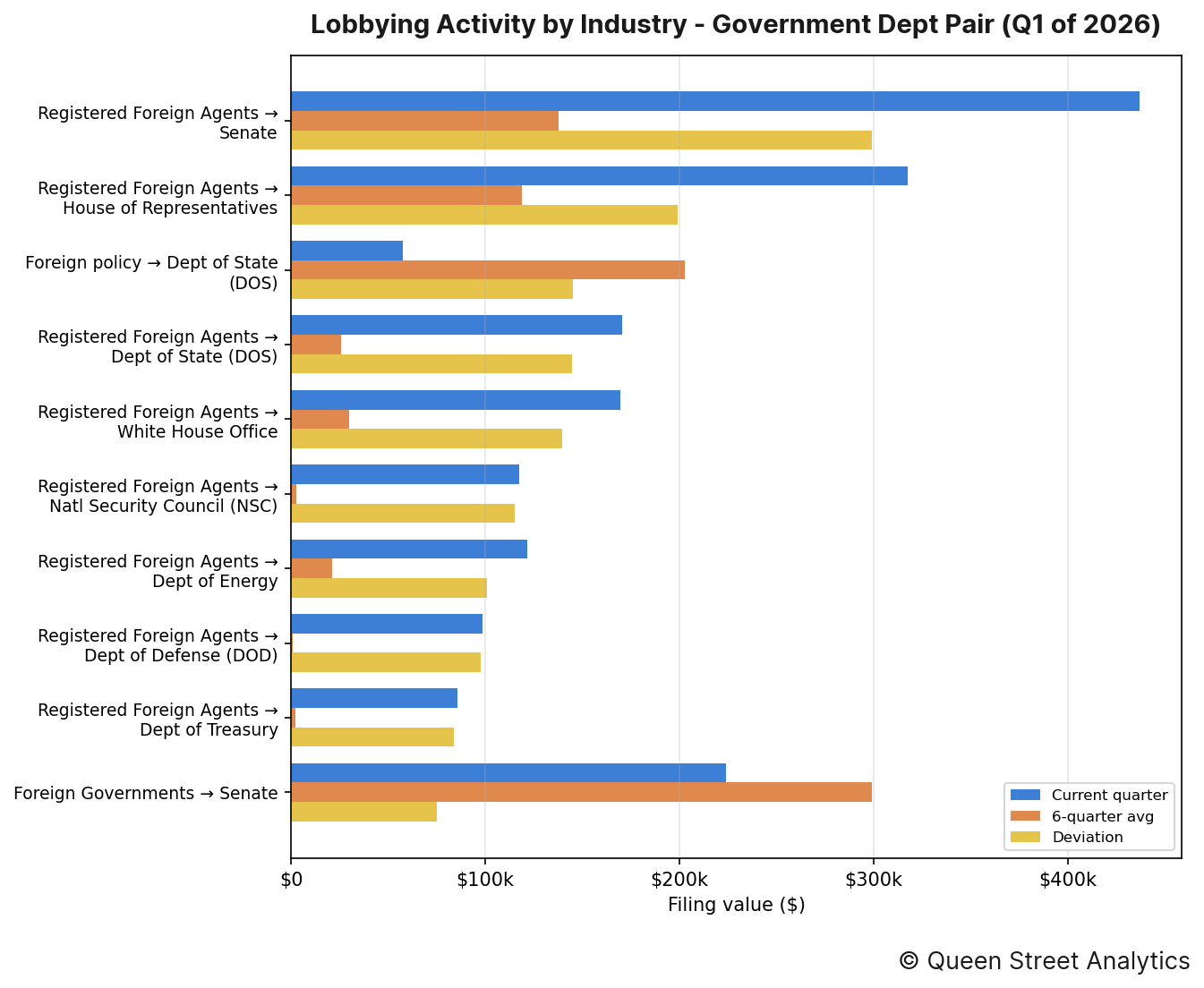
The industry–entity pairings that moved most this quarter were as follows:
↳ Registered Foreign Agents directed $437k of lobbying toward Senate, 217% higher than the recent quarterly average of $138k.
↳ Registered Foreign Agents directed $318k of lobbying toward House of Representatives, 168% higher than the recent quarterly average of $119k.
↳ Foreign policy directed $58k of lobbying toward Dept of State (DOS), 72% lower than the recent quarterly average of $203k.
By organization
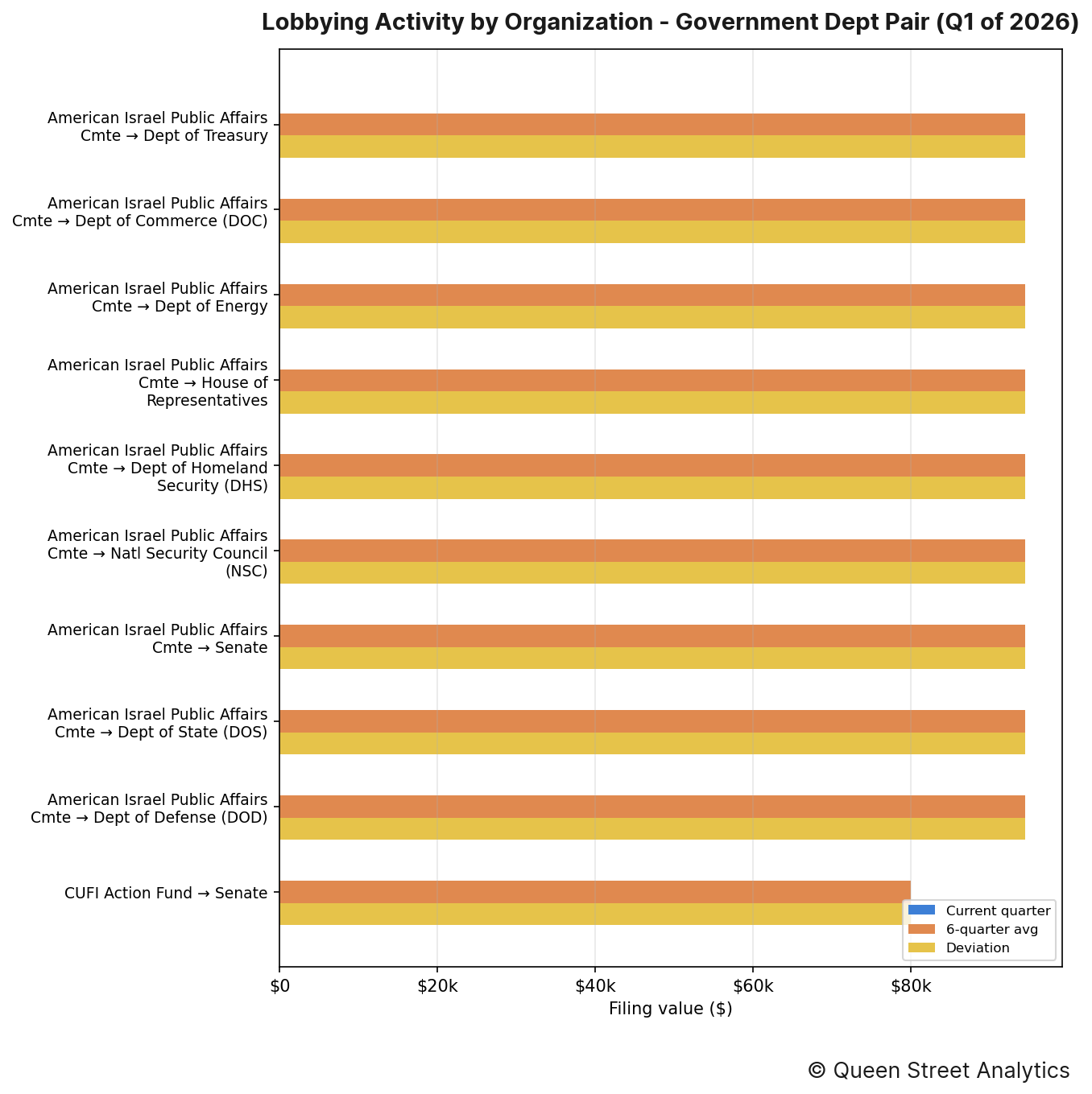
The organization–entity pairings that moved most this quarter were as follows:
↳ American Israel Public Affairs Cmte directed $0 of lobbying toward Dept of Treasury, 100% lower than the recent quarterly average of $94k.
↳ American Israel Public Affairs Cmte directed $0 of lobbying toward Dept of Commerce (DOC), 100% lower than the recent quarterly average of $94k.
↳ American Israel Public Affairs Cmte directed $0 of lobbying toward Dept of Energy, 100% lower than the recent quarterly average of $94k.
Section E: Lobbying Issues
This section documents this quarter's most lobbied-on issues.
By industry
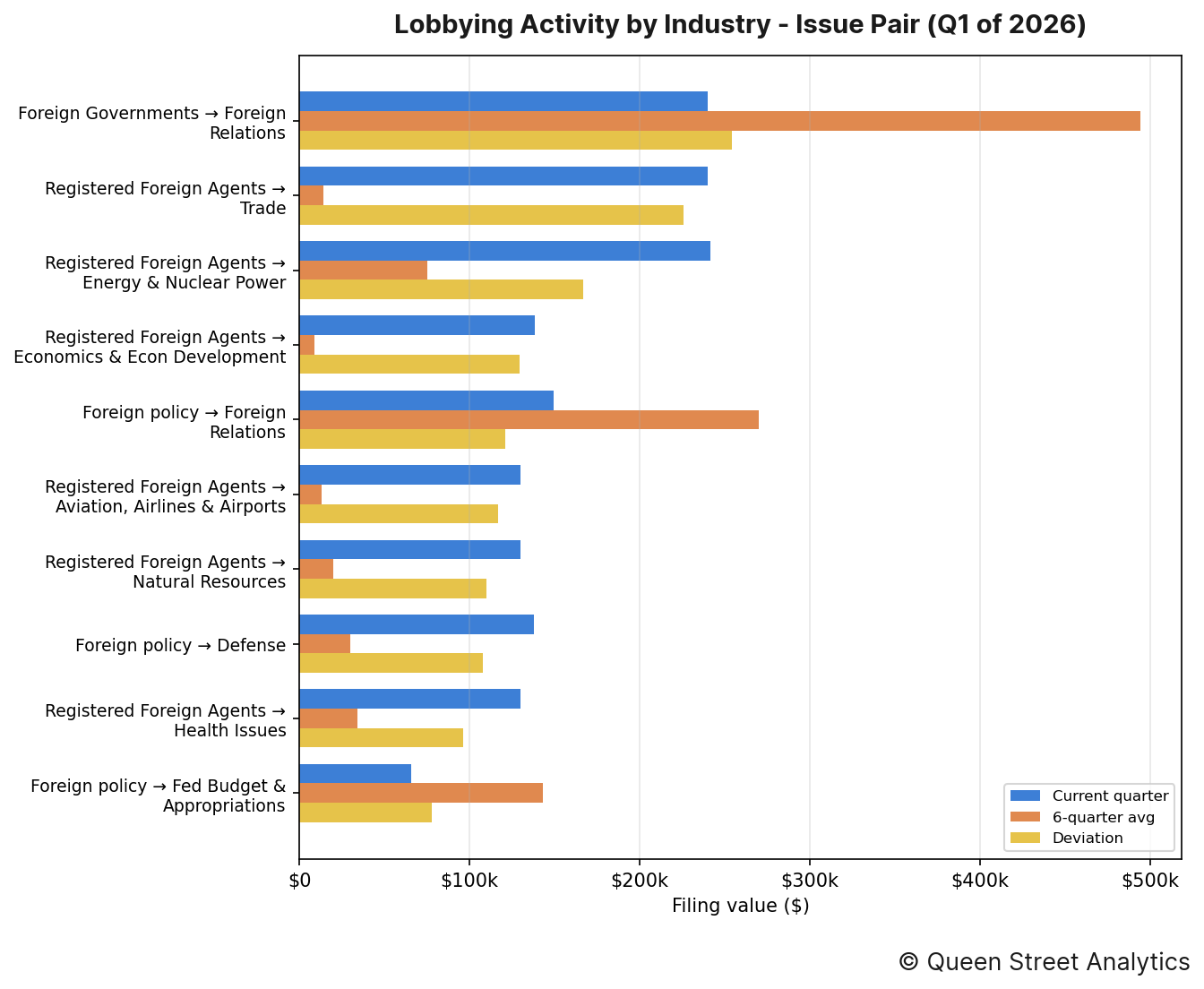
The industry–issue pairings that moved most this quarter were as follows:
↳ Foreign Governments put $240k toward lobbying on Foreign Relations, 51% lower than the recent quarterly average of $494k.
↳ Registered Foreign Agents put $240k toward lobbying on Trade, 1616% higher than the recent quarterly average of $14k.
↳ Registered Foreign Agents put $242k toward lobbying on Energy & Nuclear Power, 222% higher than the recent quarterly average of $75k.
By organization
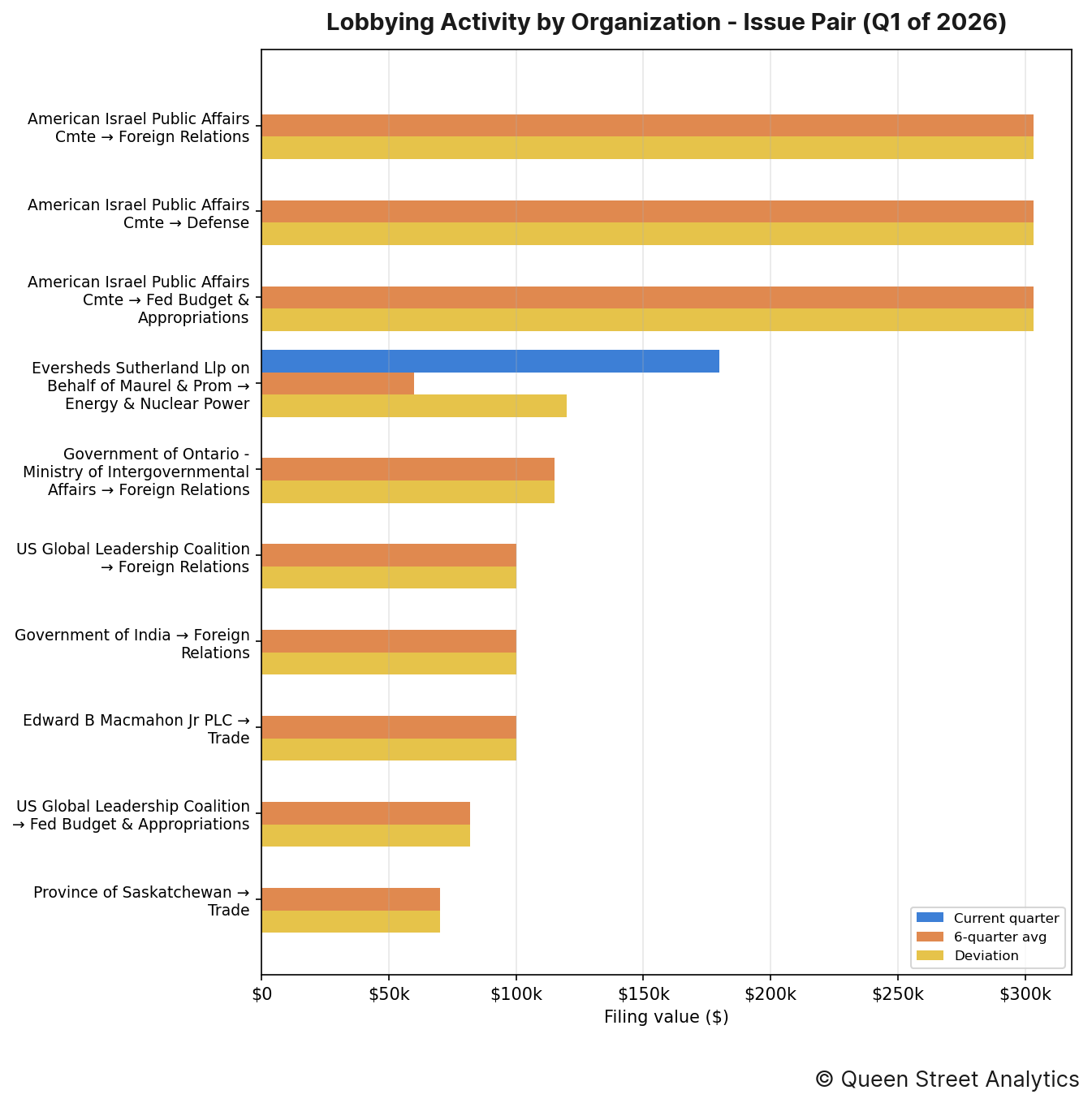
The organization–issue pairings that moved most this quarter were as follows:
↳ American Israel Public Affairs Cmte put $0 toward lobbying on Foreign Relations, 100% lower than the recent quarterly average of $303k.
↳ American Israel Public Affairs Cmte put $0 toward lobbying on Defense, 100% lower than the recent quarterly average of $303k.
↳ American Israel Public Affairs Cmte put $0 toward lobbying on Fed Budget & Appropriations, 100% lower than the recent quarterly average of $303k.
Section F: Most-Active Lobbyists
The figure below lists the lobbyists who managed the most imputed lobbying value this quarter, alongside their firm or organization. Because a filing's value is split evenly across the lobbyists it names, these dollar figures are imputed rather than directly disclosed.
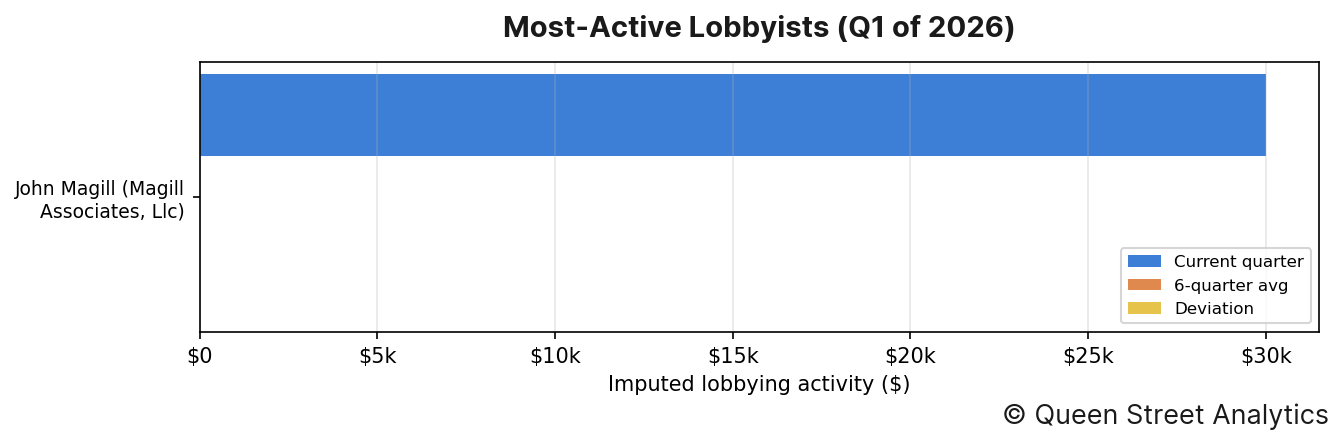
The lobbyists who managed the most imputed lobbying value this quarter were as follows:
↳ John Magill (Magill Associates, Llc) was credited with an imputed $30k in lobbying activity.
Section G: Organization Network
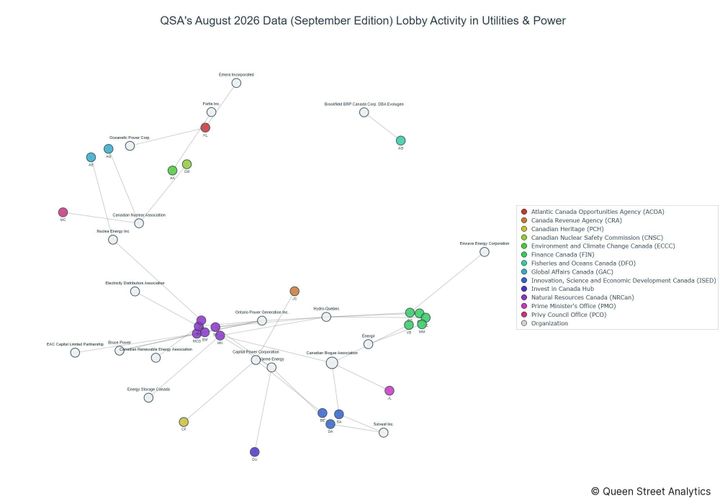
The header image for this edition maps how this channel's organizations (neutral nodes) connect to the federal entities they lobbied (colored nodes) this quarter. A link's weight is the filing value directed to that entity, and node size reflects total value; the House and Senate are excluded (nearly every organization lobbies them) so the specialized targets stand out.
The most widely lobbied entity this quarter was White House Office, which was lobbied by 9 organizations.
Methodology
Every figure in this report starts from one number: the disclosed value of each lobbying filing, which we take as the income a registrant reported plus any in-house expenses (income + expenses) on its quarterly US Senate and House LDA disclosure. Before totalling anything we clean the filings — applying each amendment over the original it replaces, removing duplicates, and setting aside non-standard records such as registrations and terminations — and map every filing to a lobbying channel and industry using the organization's CRP industry code.
How the money is divided. A filing's full value counts once toward the organization that paid it and that organization's industry, so the industry and organization rankings (Sections A–C) reflect whole dollars. But a single filing usually names several government entities, several issue areas, and several lobbyists at once, and the disclosure never says how the fee was split among them. Rather than credit the full amount to each — which would count the same dollars over and over — we divide a filing's value evenly across the distinct items it names. So a $200,000 filing that lists four agencies contributes $50,000 to each in Section D, and the same even split is applied across issues in Section E and across lobbyists in Section F. That way every section's totals trace back to the same underlying money without double-counting.
Reading the movements. A “deviation” compares the quarter's value to the average of the prior six quarters, so a rise or fall is measured against an entity's own recent norm rather than against the rest of the field. Section B takes the wider view: it sums every industry into one channel total and plots it quarter by quarter, with a fitted line showing the overall direction of travel. Source: US Senate and House LDA disclosures.