USA Lobbying on Defense - Washington (Q1 2026)





Association of the United States Army, Leidos Inc, Science Applications International Corporation, Metrea Llc, L3harris Technologies Inc, Anduril Industries were unusually active lobbyists this quarter.
View the interactive network in Queen Street Analytics →
Each quarter we track movements in US federal lobbying, channel by channel. This edition covers Defense for Q1 of 2026, ranking the organizations, government entities, issues, and lobbyists whose disclosed spend moved most.
Central Themes in this Quarter’s Lobby Data
Record-Setting Defense Funding Spurs Intense Policy Lobbying
The first quarter of 2026 saw a surge in industry lobbying as the FY27 National Defense Authorization Act moved through key House milestones, with Association of the United States Army, (INC.) and Leidos Inc actively engaging the House of Representatives and Senate on procurement reforms, force structure modernization, and contentious amendments. Widely-reported disputes on service member rights and health coverage were closely tracked in lobbying filings referencing NDAA and appropriations priorities, with Science Applications International Corporation and Metrea Llc also advocating before relevant committees and federal entities.
📎 Rules Committee summary and bill text · Breaking Defense coverage: House passes NDAA, Senate stalled · Out in National Security: Policy, amendments, LGBTQ+ provisions
Unprecedented Appropriations for Munitions and Next-Gen Systems
Rapid increases in Q1 lobbying by defense contractors such as L3harris Technologies Inc, the Munitions Industrial Base Task Force, and Fortem Technologies, INC., engaging with the House of Representatives, Senate, and the Department of Defense, align with FY27 appropriations bills, which directed major boosts toward munitions procurement, industrial base expansion, and emerging technologies like autonomous systems. Official committee summaries highlight substantial new allocations for industrial base and drone/counter-UAS initiatives, echoing the top-line issues cited by industry filers.
📎 House Appropriations Committee summary · Bill summary: Innovation, counter-drone, industrial base · Breaking Defense: House appropriators release $1 trillion defense bill
Federal Push on Drone Dominance Triggers Policy and Procurement Advocacy
Several large defense contractors, including Anduril Industries, INC. and D-fend Solutions, INC., referenced counter-drone and C-UAS aviation issues in their Q1 filings with the House of Representatives and the Senate, amid the launch of new Pentagon efforts including the JIATF 401 task force and the expansion of autonomous systems programs. Science Applications International Corporation also lobbied both the House of Representatives and the Senate on procurement matters relevant to these developments, which are documented in government releases and industry headlines tracking the restructuring of unmanned acquisition and rapid procurement moves.
📎 Drone Dominance | U.S. Department of War · JIATF 401 Explained: How the Pentagon’s New Counter-UAS Task Force Is ... · New Pentagon Unmanned Czar Will Oversee Most Drone Programs, Memo Reads
Targeted Federal R&D Increases Fuel Tech Contractor Lobbying
Q1 saw marked lobbying from R&D and electronics contractors, including North Star Scientific Corporation and Anduril Industries, INC., as the House of Representatives and the Department of Defense were approached regarding double-digit increases in Department of Defense applied and advanced research, along with notable DARPA funding spikes. Policy blogs and appropriations trackers confirm these priorities, focusing attention on unmanned systems, AI, and networked C4ISR as hot-button lobbying concerns, all reflected in filings made by Anduril Industries, INC. to both the House of Representatives and the Department of Defense.
📎 GovAffairs/Computing Research Policy Blog: FY27 R&D account increases · Appropriations Watch FY27
Regulatory Moves on U.S. Drone Supply Chain Intensify Industry Responses
Executive orders and new regulations issued by the FCC and Pentagon have set stricter guardrails for domestic drone manufacturing and limited use of foreign-made UAVs, spurring heightened Q1 lobbying on supply chain and procurement policy from organizations such as Science Applications International Corporation and Elbit Systems of America, Llc in their respective engagements with the House of Representatives and Senate. Public notices and spotlighted federal initiatives indicate rapid changes with potential implications for a wide range of defense technology providers, as illustrated by recent advocacy efforts from Fortem Technologies, INC. around the deployment and domestic use of counter-UAS systems.
📎 DA 26-314 Released: April 1, 2026 · Drone Dominance | U.S. Department of War · Pentagon Replicator Program 2026: Inside America's $1B+ Drone Swarm ...

Section A: Lobbying Spend by Industry
How much each industry in this channel spent on federal lobbying in Q1 of 2026, compared with its average over the prior six quarters.
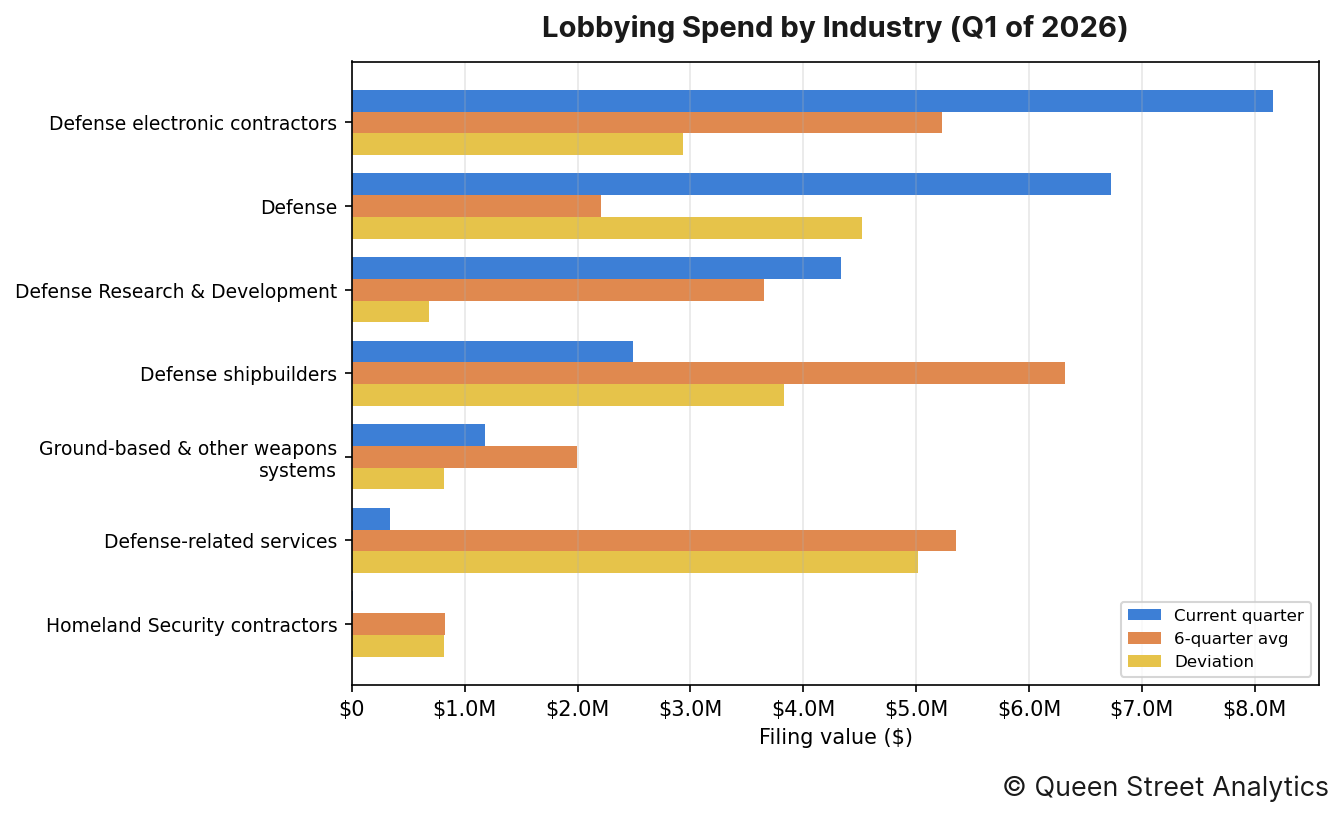
In Q1 of 2026, there was $23.2M worth of disclosed lobbying activity on Defense, roughly in line with the recent quarterly average of $25.6M. This activity can be broken down by industry as follows:
↳ There was $8.2M worth of Defense electronic contractors lobbying, 56% higher than the recent quarterly average of $5.2M.
↳ There was $6.7M worth of Defense lobbying, 205% higher than the recent quarterly average of $2.2M.
↳ There was $4.3M worth of Defense Research & Development lobbying, 19% higher than the recent quarterly average of $3.6M.
↳ There was $2.5M worth of Defense shipbuilders lobbying, 61% lower than the recent quarterly average of $6.3M.
↳ There was $1.2M worth of Ground-based & other weapons systems lobbying, 41% lower than the recent quarterly average of $2.0M.
↳ There was $340k worth of Defense-related services lobbying, 94% lower than the recent quarterly average of $5.4M.
Section B: Lobbying Spend Trend
This channel's total disclosed lobbying spend across recent quarters, aggregated over all of its industries.
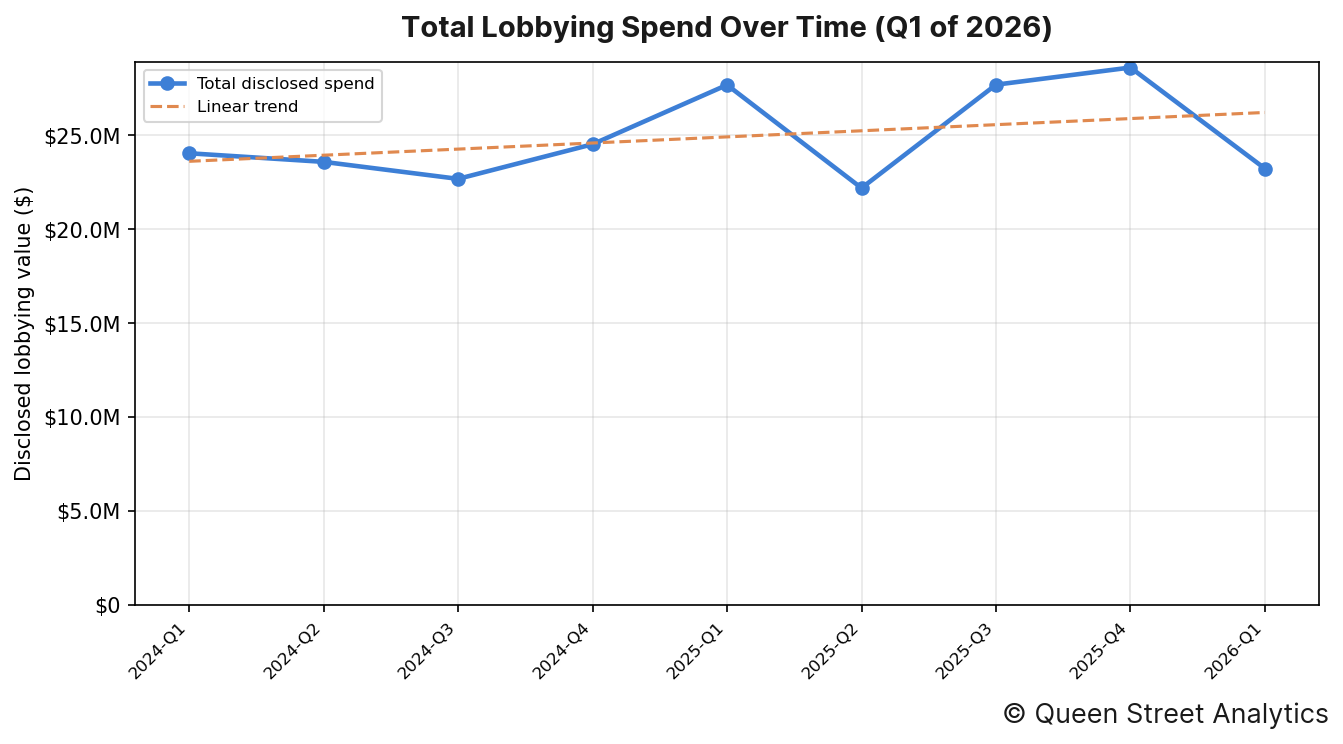
In Q1 of 2026, there was $23.2M worth of disclosed lobbying activity on Defense. Across the 9 quarters shown, the channel's total disclosed spend has held roughly steady over this period.
Organizations' Lobby Spend
The image below shows the organizations whose lobbying spend moved most from their six-quarter average.
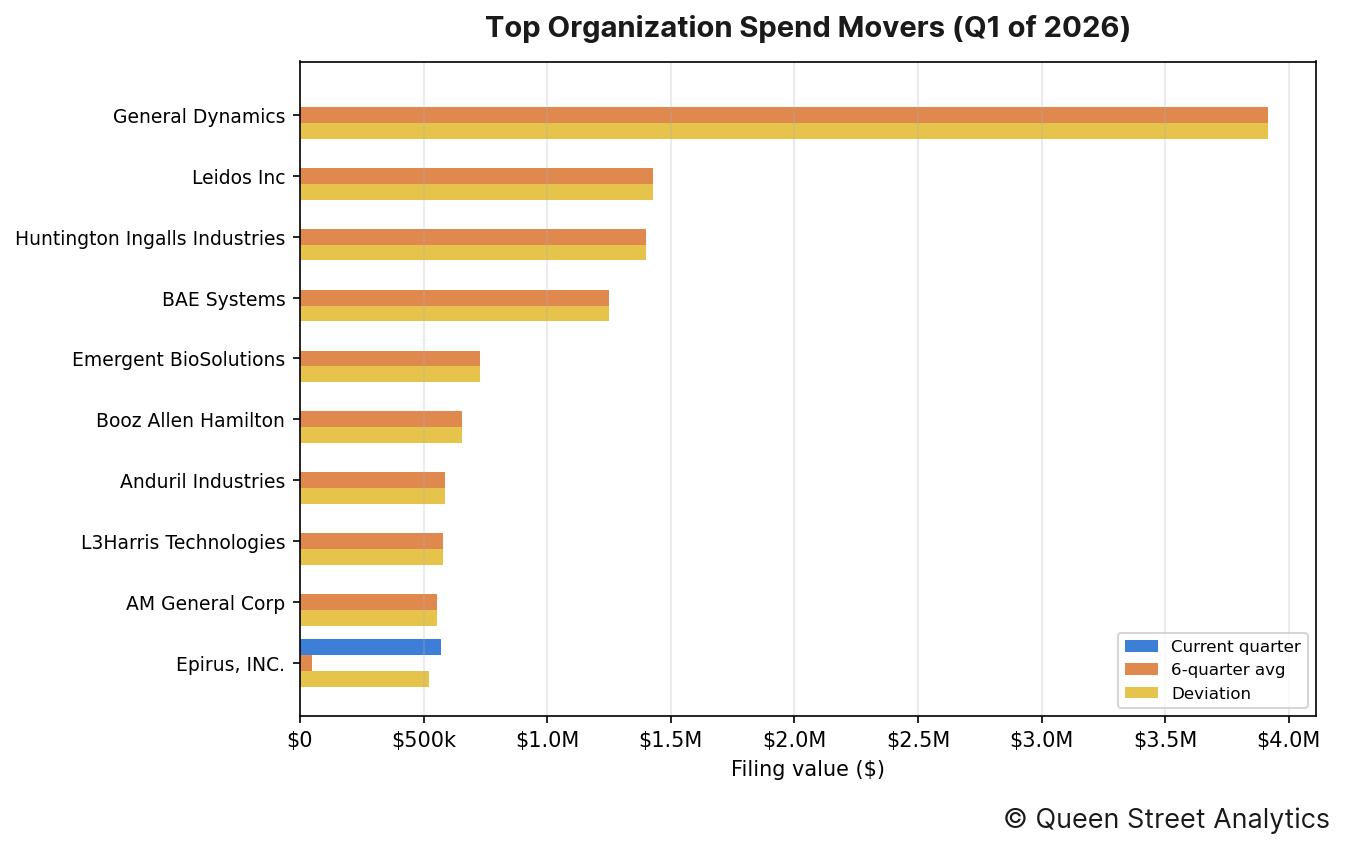
The organizations whose spending moved most from their own recent quarterly average were as follows:
↳ General Dynamics accounted for $0 in disclosed lobbying, 100% lower than the recent quarterly average of $3.9M.
↳ Leidos Inc accounted for $0 in disclosed lobbying, 100% lower than the recent quarterly average of $1.4M.
↳ Huntington Ingalls Industries accounted for $0 in disclosed lobbying, 100% lower than the recent quarterly average of $1.4M.
↳ BAE Systems accounted for $0 in disclosed lobbying, 100% lower than the recent quarterly average of $1.2M.
↳ Emergent BioSolutions accounted for $0 in disclosed lobbying, 100% lower than the recent quarterly average of $727k.
↳ Booz Allen Hamilton accounted for $0 in disclosed lobbying, 100% lower than the recent quarterly average of $655k.
Section D: Government Entities Lobbied
This section documents this quarter's most lobbied federal government departments.
By industry
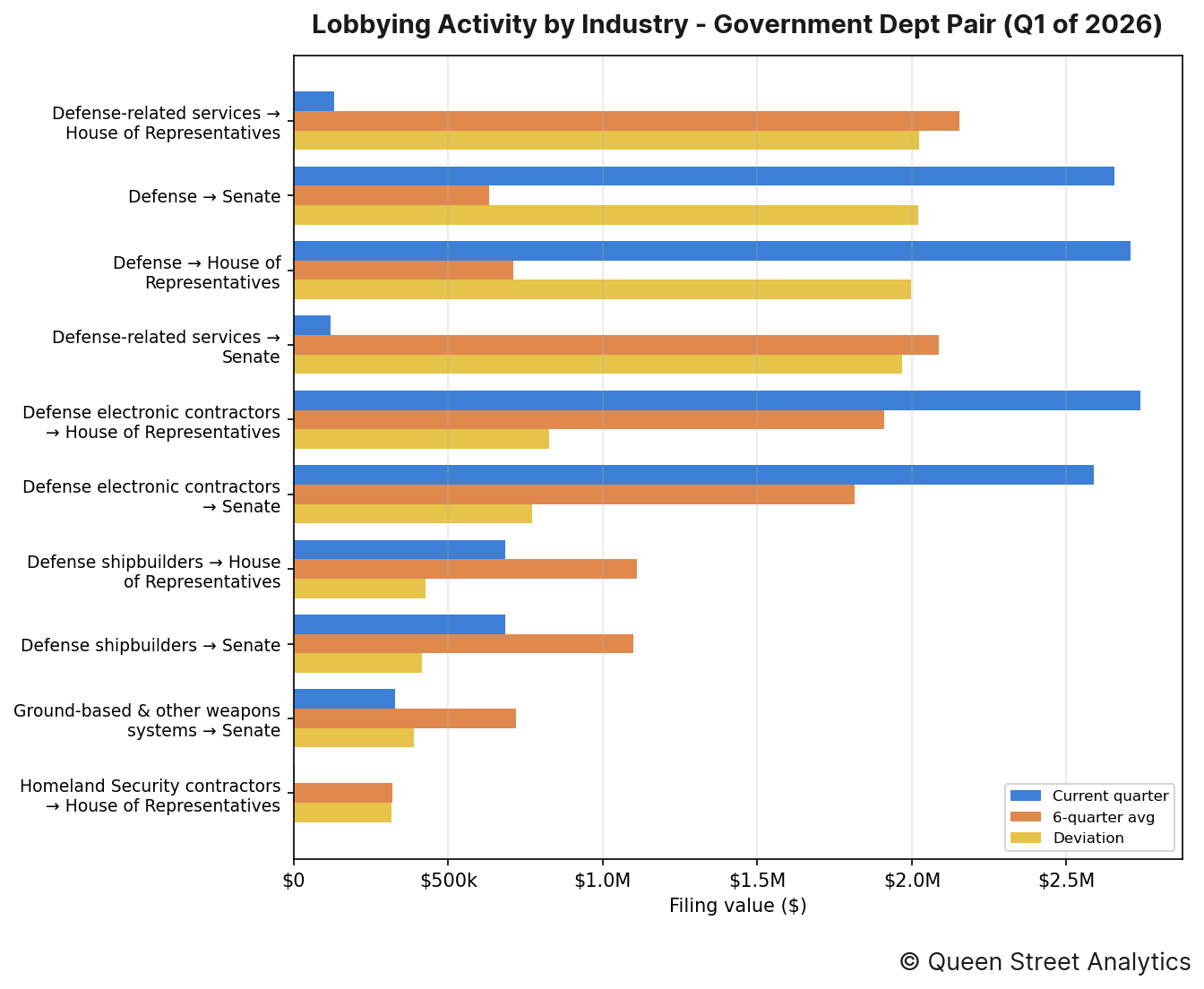
The industry–entity pairings that moved most this quarter were as follows:
↳ Defense-related services directed $132k of lobbying toward House of Representatives, 94% lower than the recent quarterly average of $2.2M.
↳ Defense directed $2.7M of lobbying toward Senate, 319% higher than the recent quarterly average of $633k.
↳ Defense directed $2.7M of lobbying toward House of Representatives, 282% higher than the recent quarterly average of $709k.
By organization
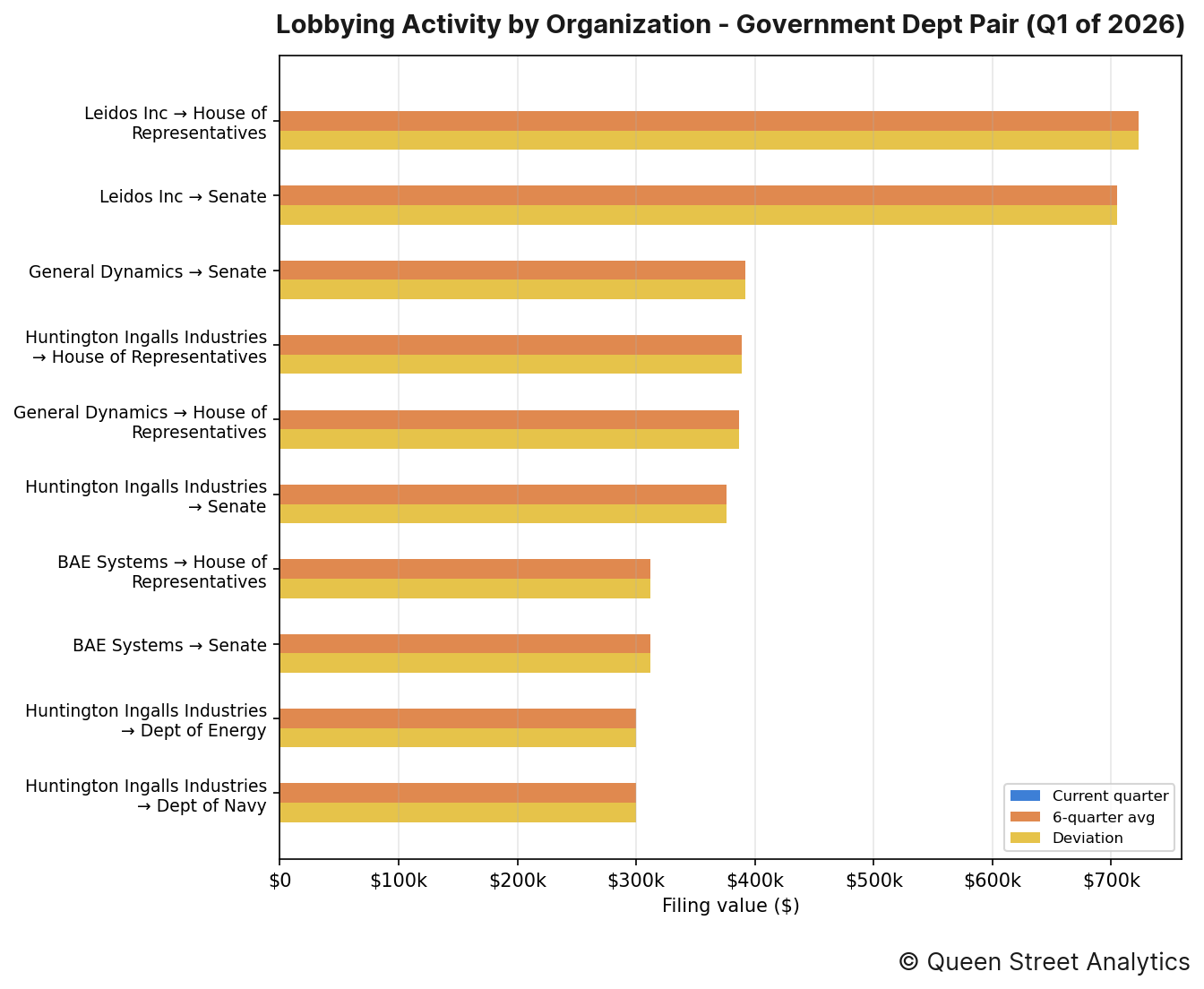
The organization–entity pairings that moved most this quarter were as follows:
↳ Leidos Inc directed $0 of lobbying toward House of Representatives, 100% lower than the recent quarterly average of $723k.
↳ Leidos Inc directed $0 of lobbying toward Senate, 100% lower than the recent quarterly average of $705k.
↳ General Dynamics directed $0 of lobbying toward Senate, 100% lower than the recent quarterly average of $392k.
Section E: Lobbying Issues
This section documents this quarter's most lobbied-on issues.
By industry
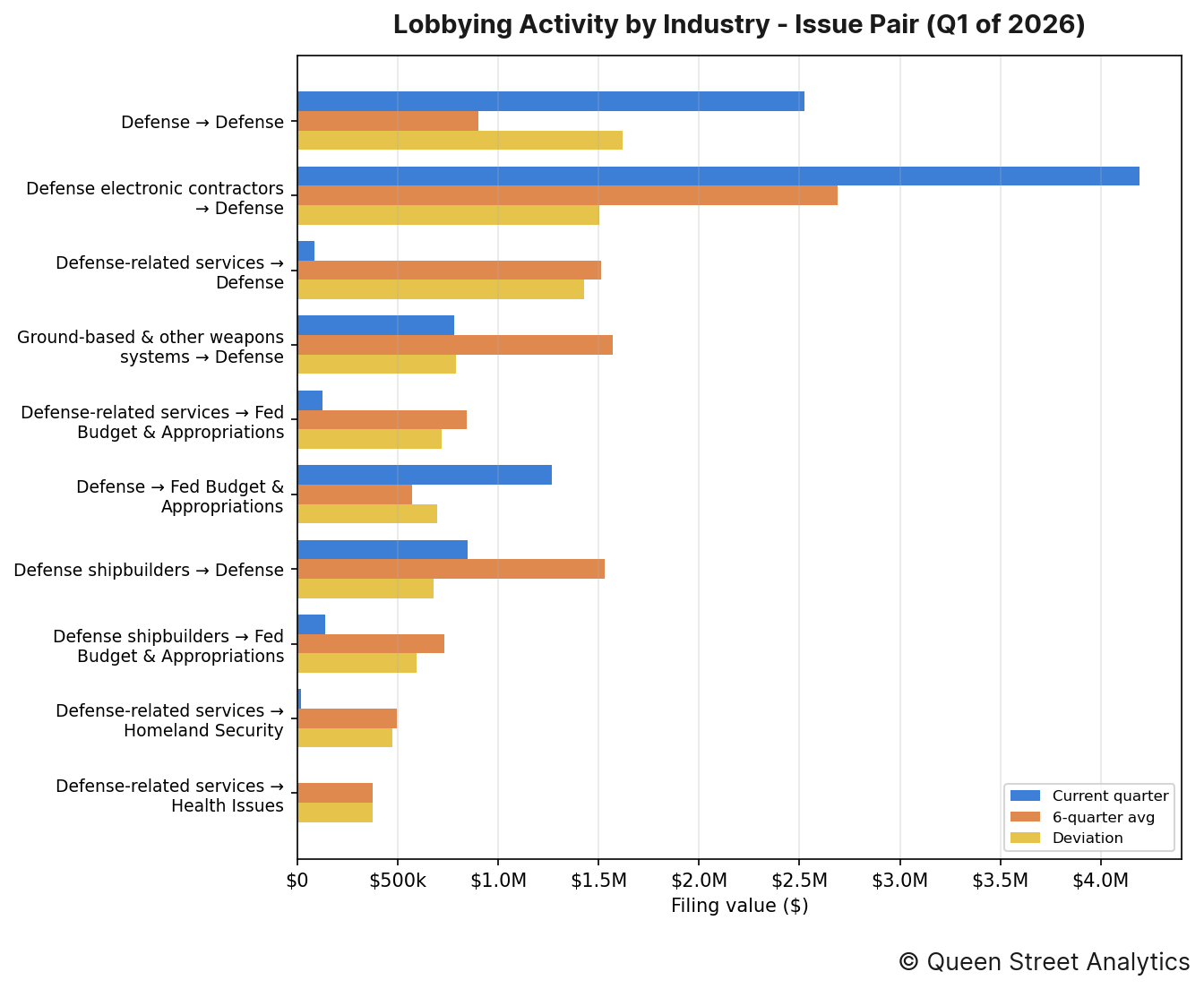
The industry–issue pairings that moved most this quarter were as follows:
↳ Defense put $2.5M toward lobbying on Defense, 180% higher than the recent quarterly average of $902k.
↳ Defense electronic contractors put $4.2M toward lobbying on Defense, 56% higher than the recent quarterly average of $2.7M.
↳ Defense-related services put $85k toward lobbying on Defense, 94% lower than the recent quarterly average of $1.5M.
By organization
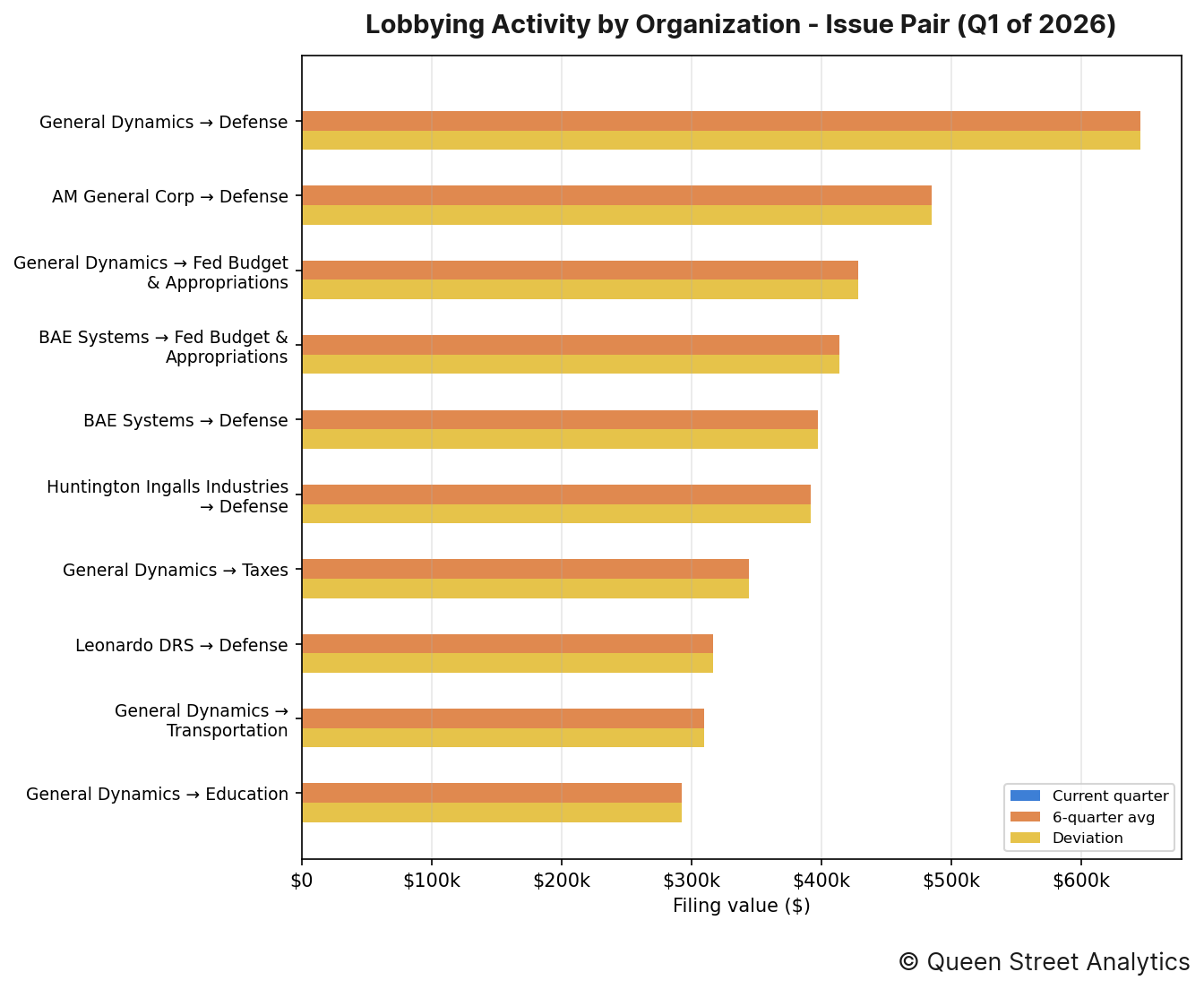
The organization–issue pairings that moved most this quarter were as follows:
↳ General Dynamics put $0 toward lobbying on Defense, 100% lower than the recent quarterly average of $645k.
↳ AM General Corp put $0 toward lobbying on Defense, 100% lower than the recent quarterly average of $485k.
↳ General Dynamics put $0 toward lobbying on Fed Budget & Appropriations, 100% lower than the recent quarterly average of $429k.
Section F: Most-Active Lobbyists
The figure below lists the lobbyists who managed the most imputed lobbying value this quarter, alongside their firm or organization. Because a filing's value is split evenly across the lobbyists it names, these dollar figures are imputed rather than directly disclosed.
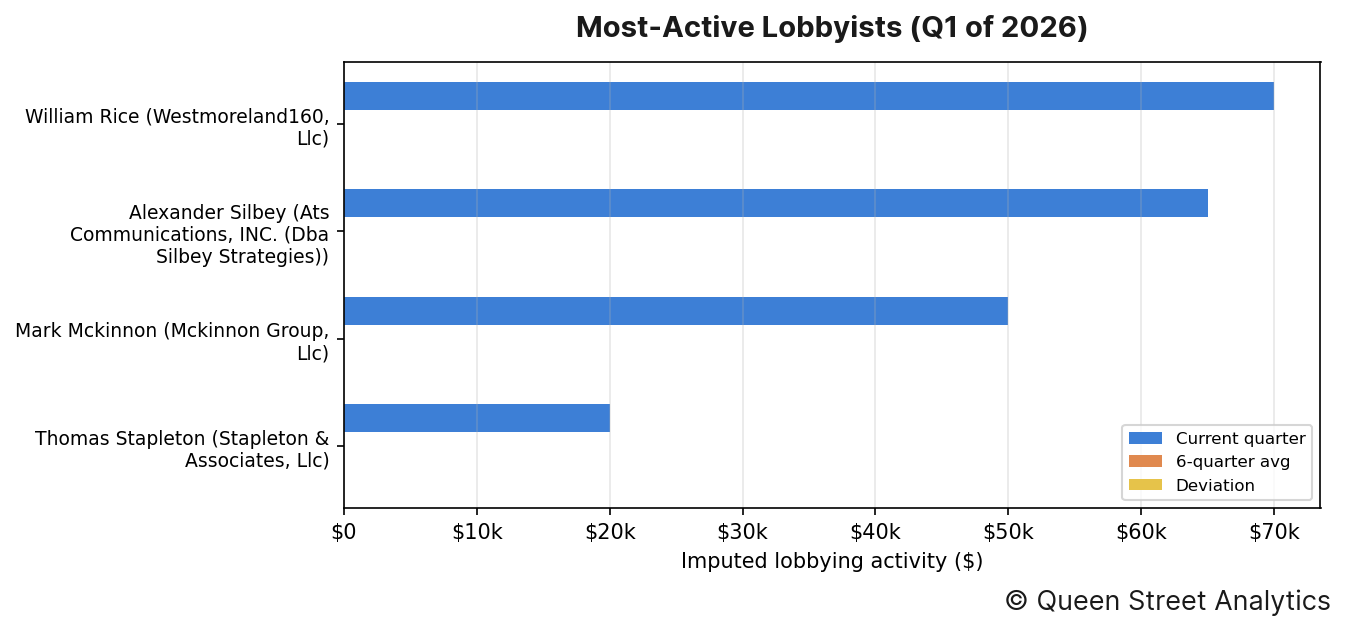
The lobbyists who managed the most imputed lobbying value this quarter were as follows:
↳ William Rice (Westmoreland160, Llc) was credited with an imputed $70k in lobbying activity.
↳ Alexander Silbey (Ats Communications, INC. (Dba Silbey Strategies)) was credited with an imputed $65k in lobbying activity.
↳ Mark Mckinnon (Mckinnon Group, Llc) was credited with an imputed $50k in lobbying activity.
↳ Thomas Stapleton (Stapleton & Associates, Llc) was credited with an imputed $20k in lobbying activity.
Section G: Organization Network
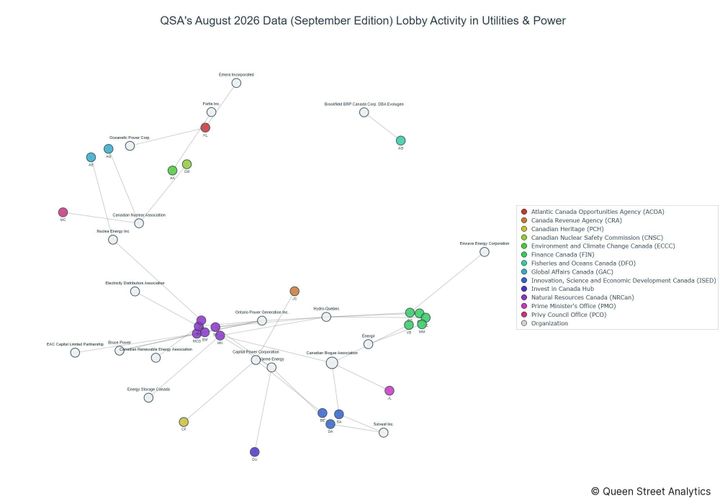
The header image for this edition maps how this channel's organizations (neutral nodes) connect to the federal entities they lobbied (colored nodes) this quarter. A link's weight is the filing value directed to that entity, and node size reflects total value; the House and Senate are excluded (nearly every organization lobbies them) so the specialized targets stand out.
The most widely lobbied entity this quarter was Dept of Defense (DOD), which was lobbied by 15 organizations.
Methodology
Every figure in this report starts from one number: the disclosed value of each lobbying filing, which we take as the income a registrant reported plus any in-house expenses (income + expenses) on its quarterly US Senate and House LDA disclosure. Before totalling anything we clean the filings — applying each amendment over the original it replaces, removing duplicates, and setting aside non-standard records such as registrations and terminations — and map every filing to a lobbying channel and industry using the organization's CRP industry code.
How the money is divided. A filing's full value counts once toward the organization that paid it and that organization's industry, so the industry and organization rankings (Sections A–C) reflect whole dollars. But a single filing usually names several government entities, several issue areas, and several lobbyists at once, and the disclosure never says how the fee was split among them. Rather than credit the full amount to each — which would count the same dollars over and over — we divide a filing's value evenly across the distinct items it names. So a $200,000 filing that lists four agencies contributes $50,000 to each in Section D, and the same even split is applied across issues in Section E and across lobbyists in Section F. That way every section's totals trace back to the same underlying money without double-counting.
Reading the movements. A “deviation” compares the quarter's value to the average of the prior six quarters, so a rise or fall is measured against an entity's own recent norm rather than against the rest of the field. Section B takes the wider view: it sums every industry into one channel total and plots it quarter by quarter, with a fitted line showing the overall direction of travel. Source: US Senate and House LDA disclosures.