USA Lobbying on Healthcare - Washington (Q3 2026)


Bristol-Myers Squibb, American Academy of Dermatology Assn, Select Medical Corp, Biotechnology Innovation Organization, and HCA Inc were unusually active lobbyists this quarter.
View the interactive network in Queen Street Analytics →
Each quarter we track movements in US federal lobbying, channel by channel. This edition covers Healthcare for Q3 of 2026, ranking the organizations, government entities, issues, and lobbyists whose disclosed spend moved most.
Central Themes in this Quarter’s Lobby Data
Coverage Challenges Spur Hospital and HMO Lobbying After ACA Subsidy Expiration
Following the expiration of enhanced ACA premium tax credits at the end of 2025, many marketplace enrollees are facing higher costs, with projections of significant coverage losses and increased uncompensated care impacting hospitals such as those represented by the American Hospital Assn and Greater New York Hospital Assn. These shifts have reportedly prompted elevated lobbying activity from hospitals, HMOs, and healthcare consultants, with organizations like the American Hospital Assn and Greater New York Hospital Assn directing efforts toward the House of Representatives, the Senate, and the Dept of Health & Human Services, particularly focused on coverage matters and federal health funding provisions amid legislative deadlock on subsidy extensions.
📎 Notable healthcare policies taking effect in 2026 - Becker's Hospital ...
Major Medicaid and ACA Reforms Under 'One Big Beautiful Bill' Drive Sector Lobbying
Key provisions from the One Big Beautiful Bill Act are now unfolding, including stricter Medicaid eligibility, new work requirements, and tighter funding. These reforms have led to notably increased lobbying spend by hospitals, pharmaceutical makers, and medical organizations such as the American College of Physicians, which has actively engaged with federal entities like the Centers For Medicare and Medicaid Services and the House of Representatives as the sector adapts to revised Medicare payments, provider taxes, and regulatory changes—especially given only temporary updates to payment systems.
📎 Changes to Medicaid, the ACA and other key provisions of the One Big ... · Healthcare policy 2026: navigate change and challenges | EY - US · 4 “Big, Beautiful Bill” changes that will reshape care in 2026
Medicare Drug Price Negotiation Reforms Fuel Pharma and Biotech Lobbying Surge
The start of Medicare drug price negotiations alongside changes in CMS guidance and IRA-related policies has intensified lobbying by pharmaceutical and biotech firms, exemplified by the American College of Physicians engaging with the Centers For Medicare and Medicaid Services (CMS) to address Medicare payments to physicians. Firms have expressed concern over price applicability rules, reimbursement processes, and manufacturing incentives as regulatory shifts put sector players in a volatile environment; lobbying filings detail challenges around site-neutral payments and 340B program reforms, with the American College of Physicians also communicating with the Food & Drug Administration (FDA) and the Senate regarding these evolving issues.
📎 Notable healthcare policies taking effect in 2026 - Becker's Hospital ... · Healthcare policy 2026: navigate change and challenges | EY - US · 4 “Big, Beautiful Bill” changes that will reshape care in 2026
Updated Federal Rules on Price Transparency and Prior Authorization Prompt Compliance Lobbying
Federal regulators have implemented new rules in 2026, mandating enhanced price transparency, stricter prior authorization, and updated patient billing requirements for hospitals and insurers. These compliance changes are reportedly driving lobbying efforts from organizations such as the American Hospital Assn and the American Medical Assn, with the American Hospital Assn focusing on issues before the Dept of Health & Human Services and the American Medical Assn engaging with the Centers for Medicare and Medicaid Services. Efforts are centered on workflow impacts, reimbursement concerns, and technology integration as sector leaders adjust to ongoing cost pressures and patient protection objectives.
📎 2026 Health Policy Outlook - EY
Healthcare Cybersecurity Bill Sparks Device and Consultant Lobbying Amid Regulatory Uncertainty
The proposed Healthcare Cybersecurity and Resiliency Act of 2026, currently under Senate debate and drawing the attention of organizations such as the American College of Physicians, has coincided with a rise in lobbying by medical device and supply firms as well as healthcare consultants. The legislation addresses cyber threats in healthcare, including safe harbor protections and operational standards; industry engagement, including outreach by the American College of Physicians to both the Senate and the Centers For Medicare and Medicaid Services (CMS), reportedly centers on compliance requirements and technology investments as firms seek clarity and adaptation strategies.
📎 US healthcare policy outlook for the 2026 midterms: PwC · Healthcare policy 2026: navigate change and challenges | EY - US
State Policy Fragmentation Drives Targeted Lobbying in Run-Up to 2026 Elections
Intensified debates over healthcare affordability and coverage are pushing states to pursue or revise mandates, such as insulin copay caps and Medicaid expansions, against the backdrop of fragmented federal policy. This trend has fueled increased lobbying activity focused on both state and federal programs, with sector filings referencing TRICARE and continuing appropriations as firms such as American College of Physicians seek engagement on diverging regulatory requirements through direct advocacy to Centers For Medicare and Medicaid Services (CMS) and the House of Representatives.
📎 US healthcare policy outlook for the 2026 midterms: PwC · Notable healthcare policies taking effect in 2026 - Becker's Hospital ...

Section A: Lobbying Spend by Industry
How much each industry in this channel spent on federal lobbying in Q3 of 2026, compared with its average over the prior six quarters.
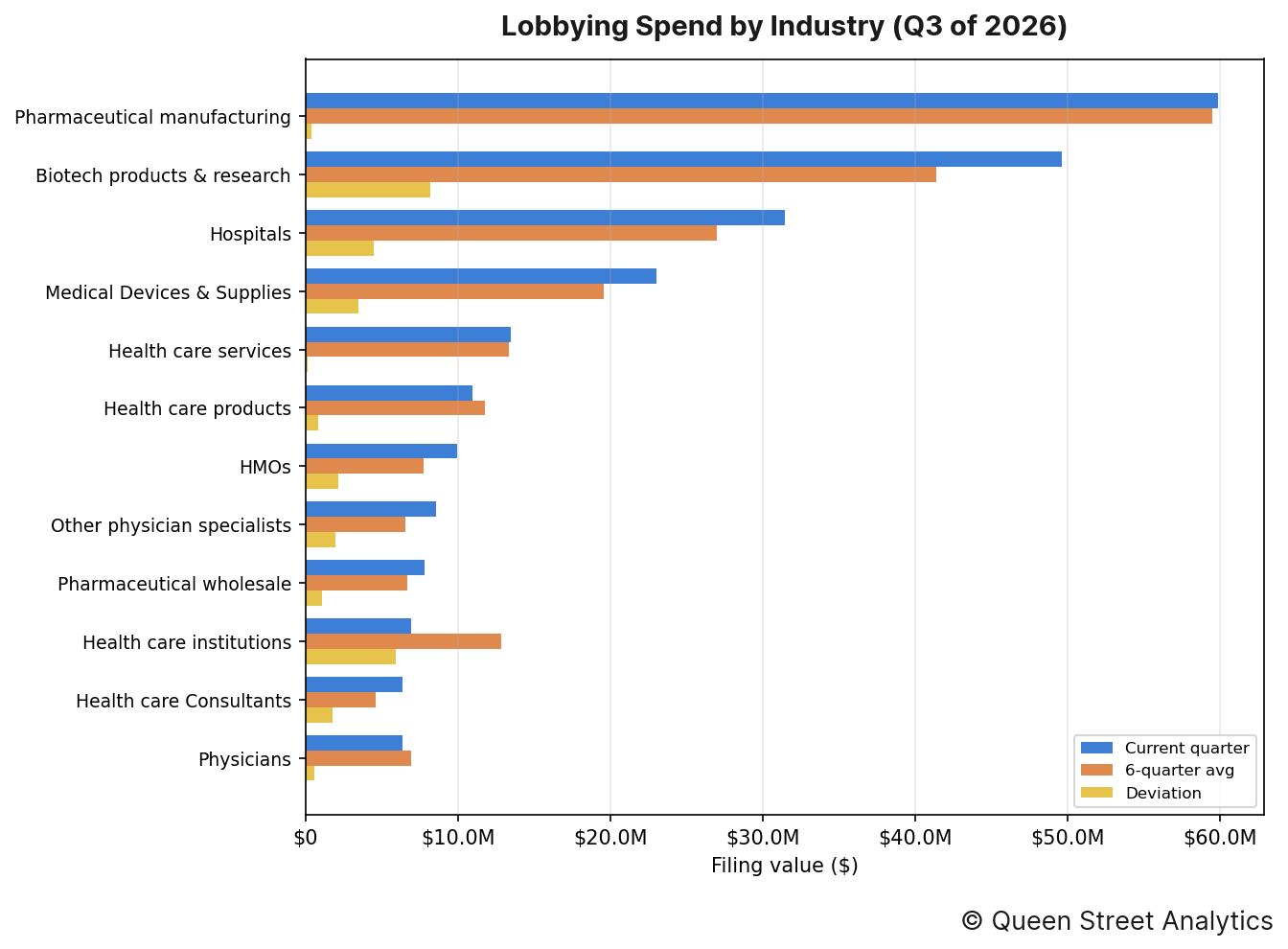
In Q3 of 2026, there was $266.1M worth of disclosed lobbying activity on Healthcare, roughly in line with the recent quarterly average of $249.0M. This activity can be broken down by industry as follows:
↳ There was $59.9M worth of Pharmaceutical manufacturing lobbying, roughly in line with the recent quarterly average of $59.5M.
↳ There was $49.6M worth of Biotech products & research lobbying, 20% higher than the recent quarterly average of $41.4M.
↳ There was $31.5M worth of Hospitals lobbying, 17% higher than the recent quarterly average of $27.0M.
↳ There was $23.1M worth of Medical Devices & Supplies lobbying, 18% higher than the recent quarterly average of $19.6M.
↳ There was $13.5M worth of Health care services lobbying, roughly in line with the recent quarterly average of $13.3M.
↳ There was $11.0M worth of Health care products lobbying, roughly in line with the recent quarterly average of $11.8M.
Section B: Lobbying Spend Trend
This channel's total disclosed lobbying spend across recent quarters, aggregated over all of its industries.
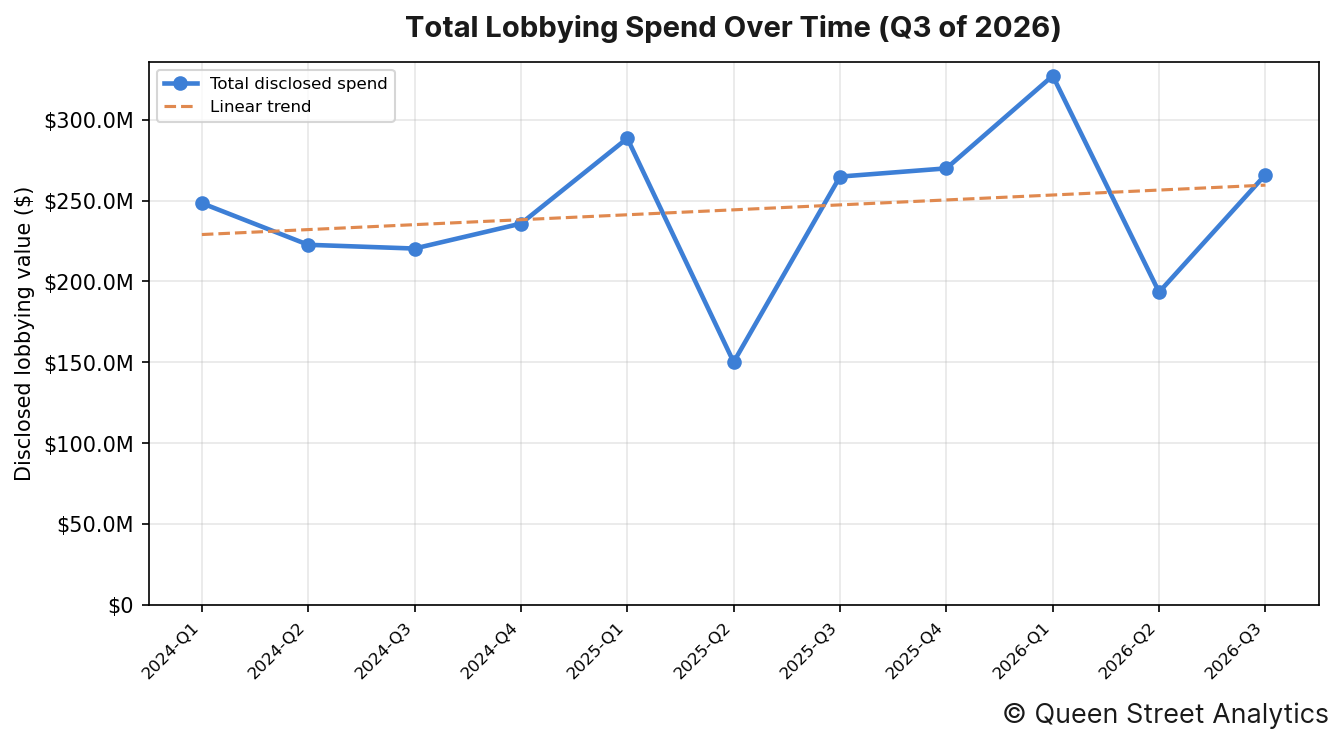
In Q3 of 2026, there was $266.1M worth of disclosed lobbying activity on Healthcare. Across the 11 quarters shown, the channel's total disclosed spend has held roughly steady over this period.
Organizations' Lobby Spend
The image below shows the organizations whose lobbying spend moved most from their six-quarter average.
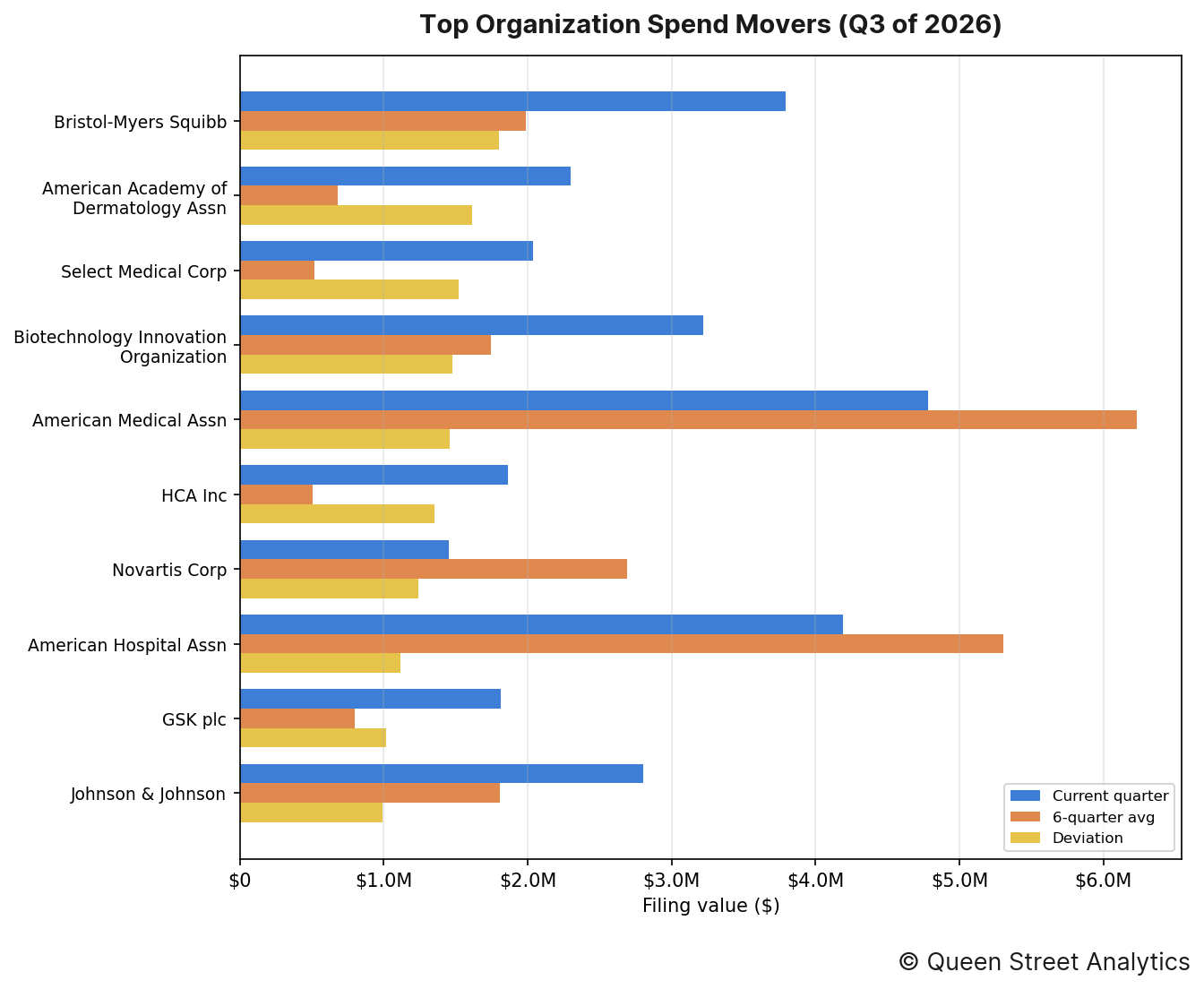
The organizations whose spending moved most from their own recent quarterly average were as follows:
↳ Bristol-Myers Squibb accounted for $3.8M in disclosed lobbying, 90% higher than the recent quarterly average of $2.0M.
↳ American Academy of Dermatology Assn accounted for $2.3M in disclosed lobbying, 237% higher than the recent quarterly average of $682k.
↳ Select Medical Corp accounted for $2.0M in disclosed lobbying, 294% higher than the recent quarterly average of $518k.
↳ Biotechnology Innovation Organization accounted for $3.2M in disclosed lobbying, 85% higher than the recent quarterly average of $1.7M.
↳ American Medical Assn accounted for $4.8M in disclosed lobbying, 23% lower than the recent quarterly average of $6.2M.
↳ HCA Inc accounted for $1.9M in disclosed lobbying, 267% higher than the recent quarterly average of $507k.
Section D: Government Entities Lobbied
This section documents this quarter's most lobbied federal government departments.
By industry
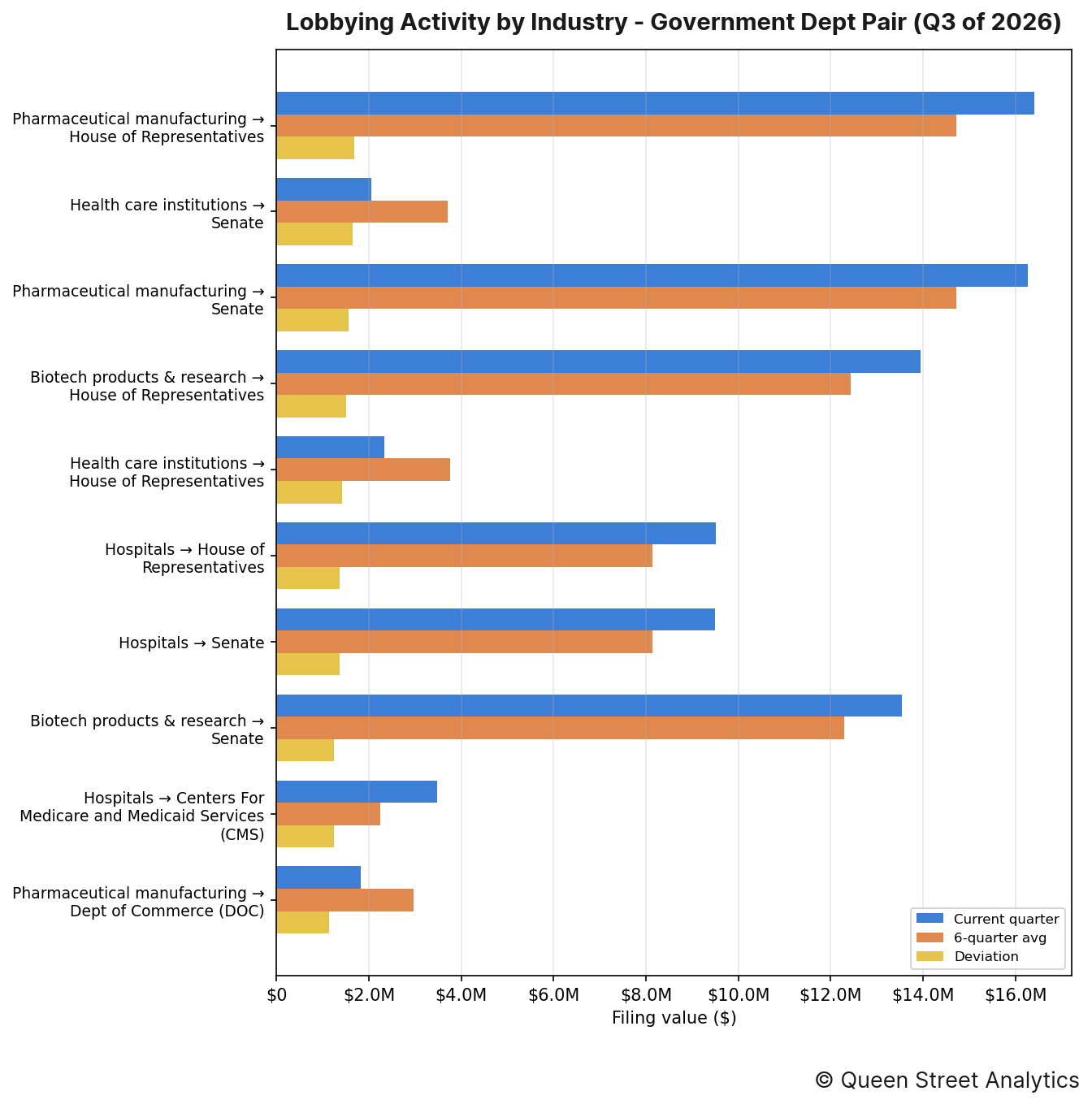
The industry–entity pairings that moved most this quarter were as follows:
↳ Pharmaceutical manufacturing directed $16.4M of lobbying toward House of Representatives, 11% higher than the recent quarterly average of $14.7M.
↳ Health care institutions directed $2.1M of lobbying toward Senate, 45% lower than the recent quarterly average of $3.7M.
↳ Pharmaceutical manufacturing directed $16.3M of lobbying toward Senate, 11% higher than the recent quarterly average of $14.7M.
By organization
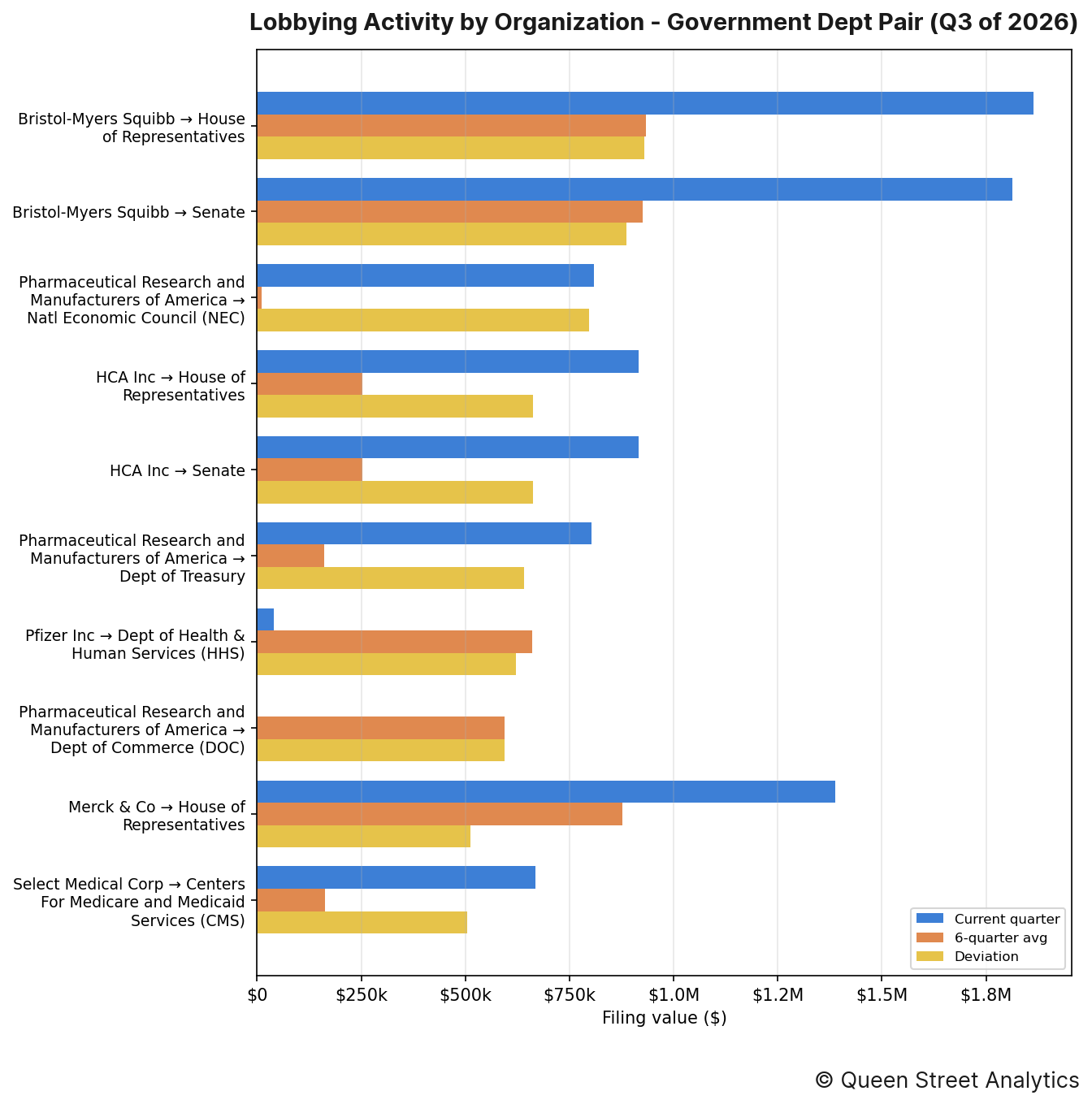
The organization–entity pairings that moved most this quarter were as follows:
↳ Bristol-Myers Squibb directed $1.9M of lobbying toward House of Representatives, 99% higher than the recent quarterly average of $934k.
↳ Bristol-Myers Squibb directed $1.8M of lobbying toward Senate, 96% higher than the recent quarterly average of $926k.
↳ Pharmaceutical Research and Manufacturers of America directed $809k of lobbying toward Natl Economic Council (NEC), 7180% higher than the recent quarterly average of $11k.
Section E: Lobbying Issues
This section documents this quarter's most lobbied-on issues.
By industry
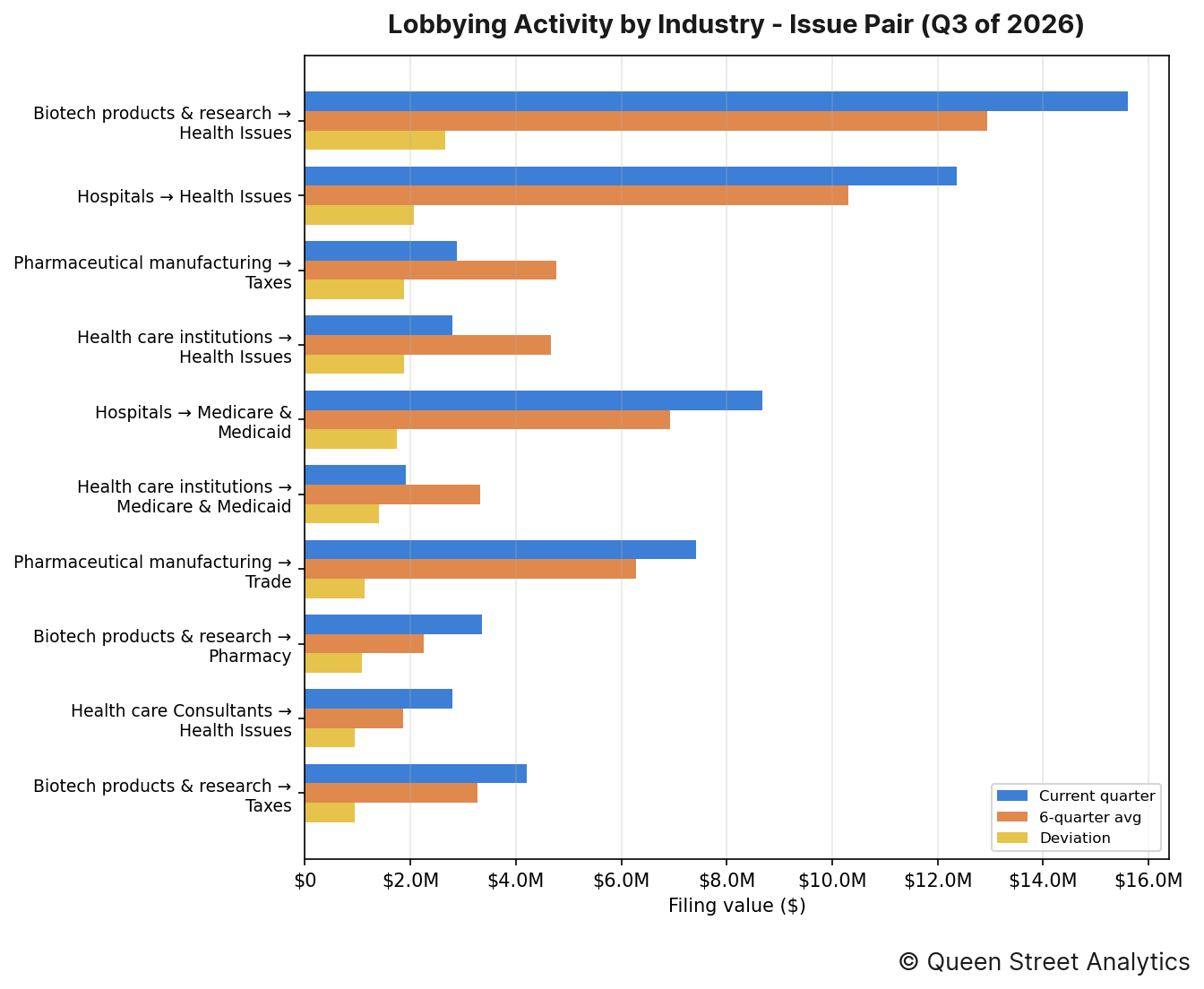
The industry–issue pairings that moved most this quarter were as follows:
↳ Biotech products & research put $15.6M toward lobbying on Health Issues, 21% higher than the recent quarterly average of $12.9M.
↳ Hospitals put $12.4M toward lobbying on Health Issues, 20% higher than the recent quarterly average of $10.3M.
↳ Pharmaceutical manufacturing put $2.9M toward lobbying on Taxes, 40% lower than the recent quarterly average of $4.8M.
By organization
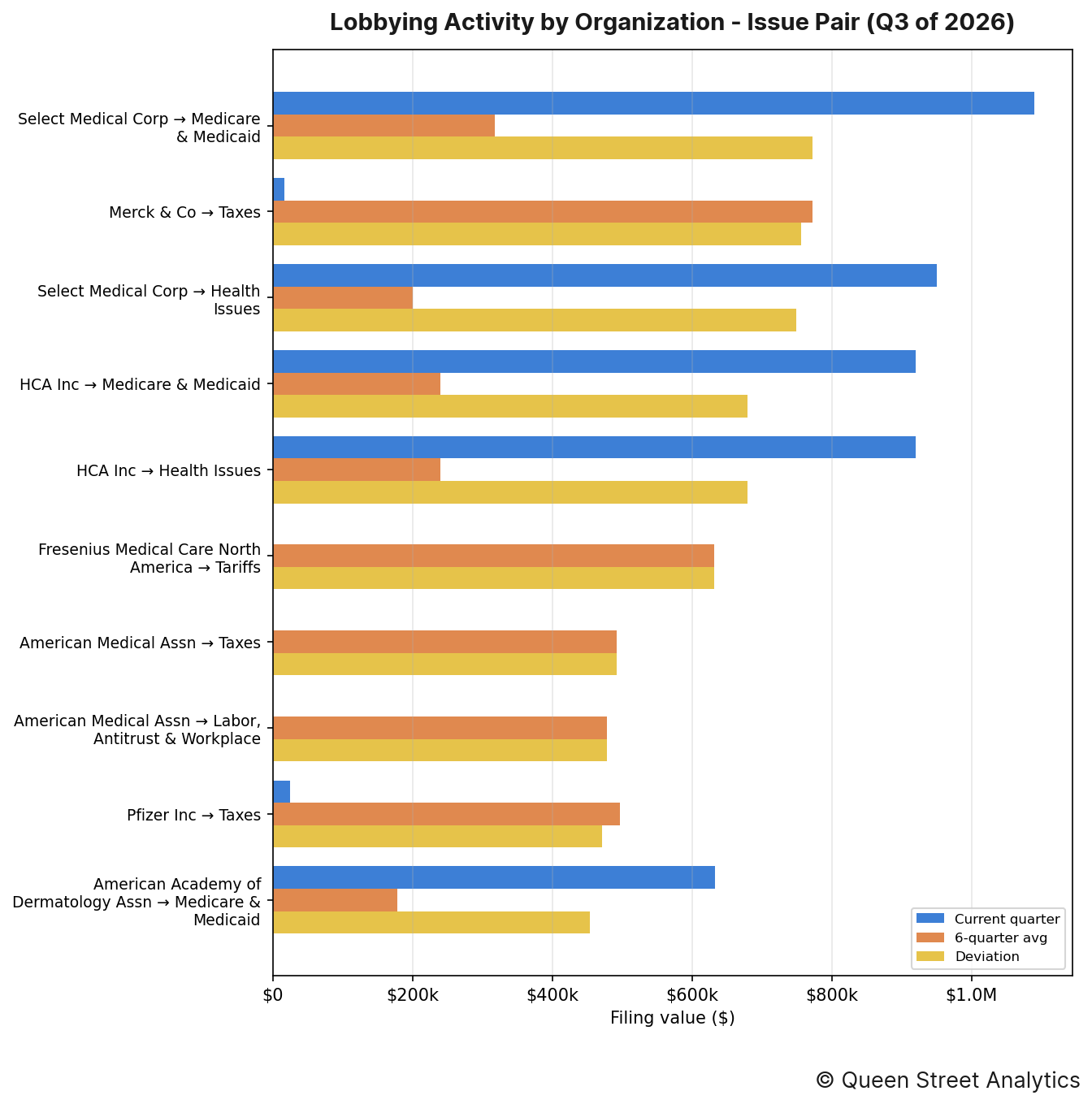
The organization–issue pairings that moved most this quarter were as follows:
↳ Select Medical Corp put $1.1M toward lobbying on Medicare & Medicaid, 243% higher than the recent quarterly average of $318k.
↳ Merck & Co put $16k toward lobbying on Taxes, 98% lower than the recent quarterly average of $773k.
↳ Select Medical Corp put $950k toward lobbying on Health Issues, 373% higher than the recent quarterly average of $201k.
Section F: Most-Active Lobbyists
The figure below lists the lobbyists who managed the most imputed lobbying value this quarter, alongside their firm or organization. Because a filing's value is split evenly across the lobbyists it names, these dollar figures are imputed rather than directly disclosed.
No lobbyist activity to report this quarter.
Section G: Organization Network
The header image for this edition maps how this channel's organizations (neutral nodes) connect to the federal entities they lobbied (colored nodes) this quarter. A link's weight is the filing value directed to that entity, and node size reflects total value; the House and Senate are excluded (nearly every organization lobbies them) so the specialized targets stand out.
The most widely lobbied entity this quarter was Dept of Health & Human Services (HHS), which was lobbied by 20 organizations.
Methodology
Every figure in this report starts from one number: the disclosed value of each lobbying filing, which we take as the income a registrant reported plus any in-house expenses (income + expenses) on its quarterly US Senate and House LDA disclosure. Before totalling anything we clean the filings — applying each amendment over the original it replaces, removing duplicates, and setting aside non-standard records such as registrations and terminations — and map every filing to a lobbying channel and industry using the organization's CRP industry code.
How the money is divided. A filing's full value counts once toward the organization that paid it and that organization's industry, so the industry and organization rankings (Sections A–C) reflect whole dollars. But a single filing usually names several government entities, several issue areas, and several lobbyists at once, and the disclosure never says how the fee was split among them. Rather than credit the full amount to each — which would count the same dollars over and over — we divide a filing's value evenly across the distinct items it names. So a $200,000 filing that lists four agencies contributes $50,000 to each in Section D, and the same even split is applied across issues in Section E and across lobbyists in Section F. That way every section's totals trace back to the same underlying money without double-counting.
Reading the movements. A “deviation” compares the quarter's value to the average of the prior six quarters, so a rise or fall is measured against an entity's own recent norm rather than against the rest of the field. Section B takes the wider view: it sums every industry into one channel total and plots it quarter by quarter, with a fitted line showing the overall direction of travel. Source: US Senate and House LDA disclosures.


