USA Lobbying on Social Issues - Washington (Q4 2025)





AARP, ACS Cancer Action Network, Nature Conservancy, Tobacco-Free Kids Action Fund, American Federation of Government Employees, Gun Owners of America were unusually active lobbyists this quarter.
View the interactive network in Queen Street Analytics →
Each quarter we track movements in US federal lobbying, channel by channel. This edition covers Social Issues for Q4 of 2025, ranking the organizations, government entities, issues, and lobbyists whose disclosed spend moved most.
Central Themes in this Quarter’s Lobby Data
Family Caregiver Tax Relief Advances Amid Record Advocacy
Legislation to create a federal tax credit for working family caregivers gained momentum in late 2025, driven by sustained lobbying from AARP, the National Cmte to Preserve Social Security, and allied organizations targeting the House of Representatives and the Social Security Administration. Efforts were also seen to secure Social Security credits for unpaid caregivers, with notable advocacy spend coinciding with these bills’ progression through Congress.
📎 Report on Caregiver Tax Credit (ASPE/HHS, Jan 2026) · AARP Calls for Congress Action (Mar 2025) · Lawmakers Reintroduce Family Caregiver Credit Bill (TaxNotes, Mar 2025) · Social Security Retirement Protection Bill (Senate Aging Committee, Apr 2026) · CBS News Coverage Credit for Caring Act (Nov 2025)
Labor-HHS FY26 Funding Debates Energize Social Program Defense
Negotiations around the FY26 Labor-HHS appropriations package in late 2025 prompted heightened advocacy to defend funding for Social Security, Medicaid, mental health, and child welfare programs, with the National Cmte to Preserve Social Security engaging the Dept of Health & Human Services (HHS) to oppose proposed changes. Lobbyists such as the American Civil Liberties Union also focused on resisting deep cuts and contentious new requirements, with notable advocacy targeting bipartisan deadlock and threats of government shutdowns.
📎 CRS Federal Program Summary (May 2026) · Senate Appropriations FY26 Bill Summary (Jan 2026) · Federal Budget IQ: HHS Funding Outlook (Feb 2026) · House Democrats Press Release FY26 Funding (Jan 2026)
Medicaid/Medicare Policy Shifts Fuel Health Advocacy Surge
Advocates responded to new work requirements and funding threat proposals for Medicaid and Medicare, engaging in robust lobbying targeting Congress and the Centers For Medicare and Medicaid Services (CMS). Groups like ACS Cancer Action Network, which lobbied the House of Representatives and CMS, urged protection for patient access and objected to possible cuts, with simultaneous outreach on updated cancer screening and reimbursement rules.
📎 ACS CAN Medicaid Policy Resource · ACS CAN Letter to CMS on Work Requirements (Nov 2025) · OpenSecrets: Federal Lobbying ACS CAN Issues 2025 · ACS Letter on Medicare CY2025 Policy (Sep 2024)
Environmental Groups Adjust Tactics for Congressional Deregulation
Environmental organizations, notably The Nature Conservancy, Defenders of Wildlife, and World Wildlife Fund, stepped up lobbying in response to congressional efforts to roll back protections for public lands and clean energy incentives, engaging with entities such as the House of Representatives and the Department of the Interior. The recruitment of former GOP aides reflects a strategic shift to navigate the new Republican-led Congress and maintain federal support for conservation programs.
📎 POLITICO Pro/E&E News Coverage Green Group Lobbying (Nov 2025) · E&E News Green Group Congressional Lobby (Nov 2025) · OpenSecrets Lobbying: Fed Budget & Appropriations (2025)
Teachers and Labor Unions Intensify Advocacy Amid FY26 Debates
Late-2025 saw union spending climb amid federal debates on education funding, collective bargaining, and workplace standards. The National Education Association and labor unions, joined by the American Civil Liberties Union, focused their lobbying on contesting restrictive policy riders and advancing protections for teachers and workers in the final FY26 Labor-HHS appropriations bill, with advocacy spanning the Dept of Education and Dept of Labor.
📎 Senate Appropriations FY26 Bill Summary (Jan 2026) · OpenSecrets: NEA Issues 2025

Section A: Lobbying Spend by Industry
How much each industry in this channel spent on federal lobbying in Q4 of 2025, compared with its average over the prior six quarters.
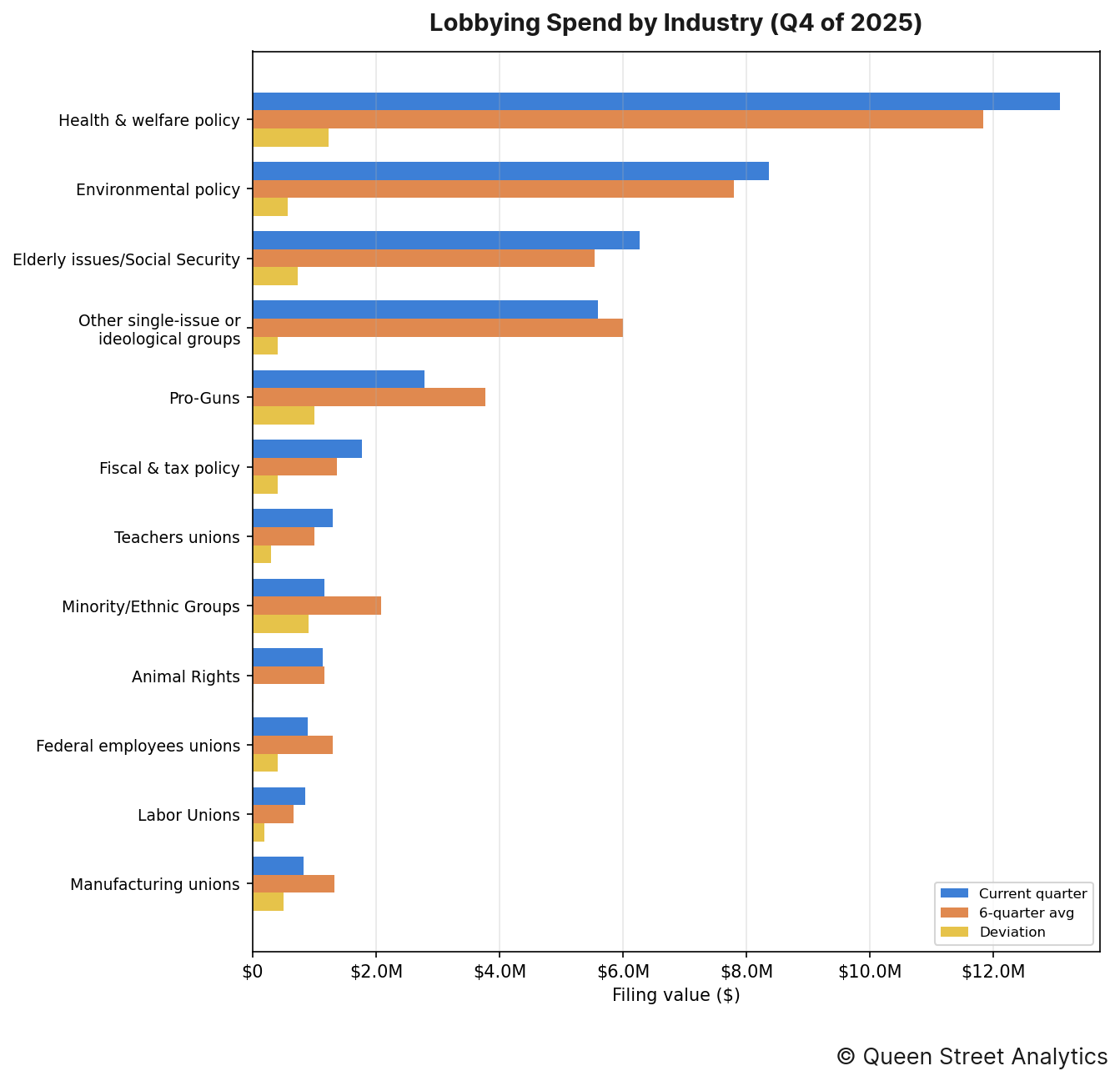
In Q4 of 2025, there was $52.6M worth of disclosed lobbying activity on Social Issues, roughly in line with the recent quarterly average of $52.5M. This activity can be broken down by industry as follows:
↳ There was $13.1M worth of Health & welfare policy lobbying, 10% higher than the recent quarterly average of $11.8M.
↳ There was $8.4M worth of Environmental policy lobbying, roughly in line with the recent quarterly average of $7.8M.
↳ There was $6.3M worth of Elderly issues/Social Security lobbying, 13% higher than the recent quarterly average of $5.5M.
↳ There was $5.6M worth of Other single-issue or ideological groups lobbying, roughly in line with the recent quarterly average of $6.0M.
↳ There was $2.8M worth of Pro-Guns lobbying, 26% lower than the recent quarterly average of $3.8M.
↳ There was $1.8M worth of Fiscal & tax policy lobbying, 30% higher than the recent quarterly average of $1.4M.
Section B: Lobbying Spend Trend
This channel's total disclosed lobbying spend across recent quarters, aggregated over all of its industries.
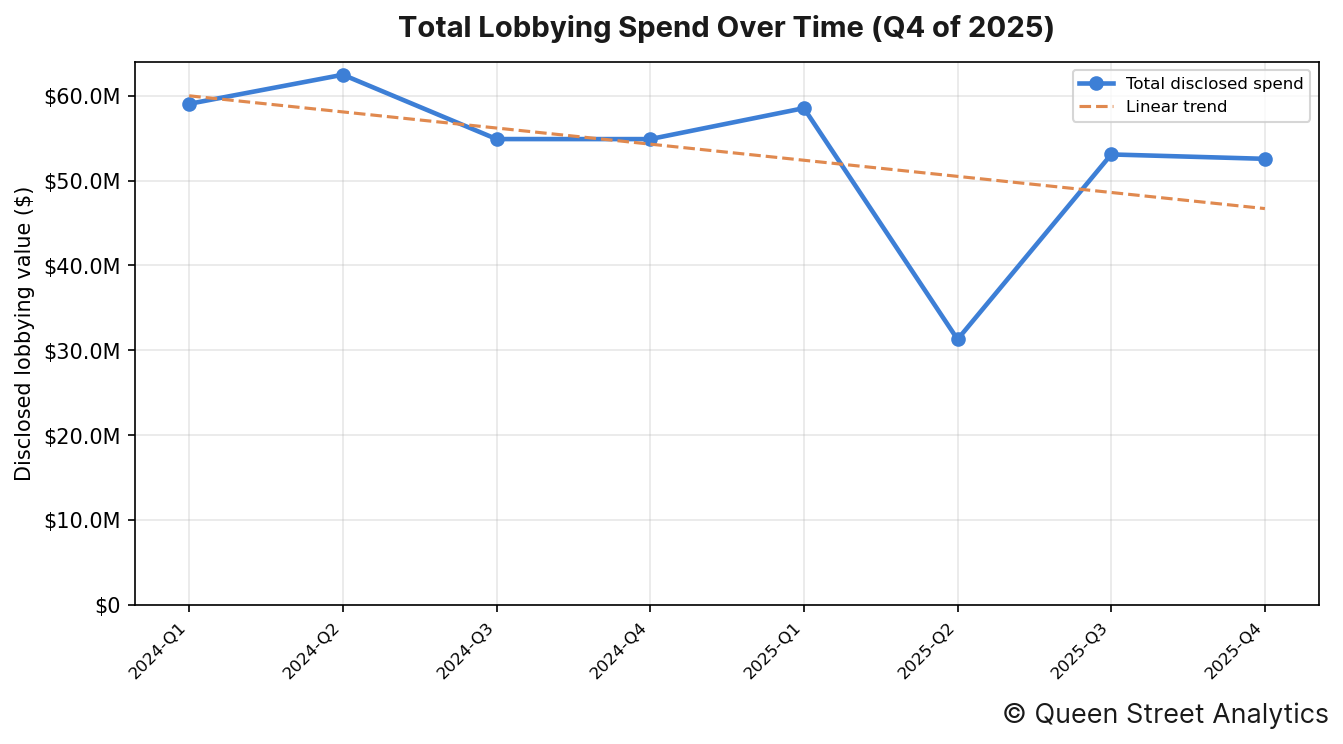
In Q4 of 2025, there was $52.6M worth of disclosed lobbying activity on Social Issues. Across the 8 quarters shown, the channel's total disclosed spend has fallen over this period.
Organizations' Lobby Spend
The image below shows the organizations whose lobbying spend moved most from their six-quarter average.
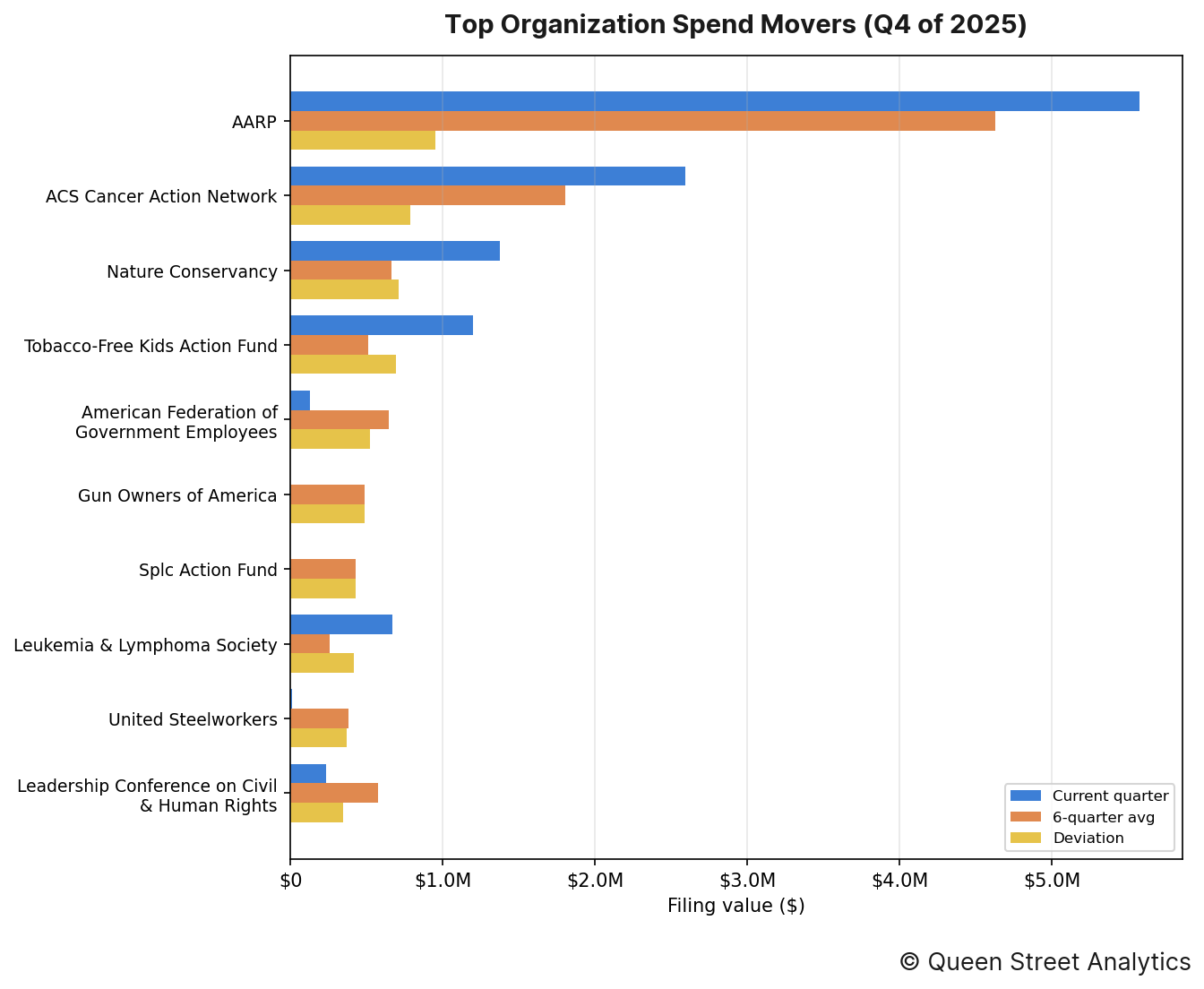
The organizations whose spending moved most from their own recent quarterly average were as follows:
↳ AARP accounted for $5.6M in disclosed lobbying, 21% higher than the recent quarterly average of $4.6M.
↳ ACS Cancer Action Network accounted for $2.6M in disclosed lobbying, 44% higher than the recent quarterly average of $1.8M.
↳ Nature Conservancy accounted for $1.4M in disclosed lobbying, 107% higher than the recent quarterly average of $663k.
↳ Tobacco-Free Kids Action Fund accounted for $1.2M in disclosed lobbying, 137% higher than the recent quarterly average of $507k.
↳ American Federation of Government Employees accounted for $126k in disclosed lobbying, 81% lower than the recent quarterly average of $647k.
↳ Gun Owners of America accounted for $0 in disclosed lobbying, 100% lower than the recent quarterly average of $484k.
Section D: Government Entities Lobbied
This section documents this quarter's most lobbied federal government departments.
By industry
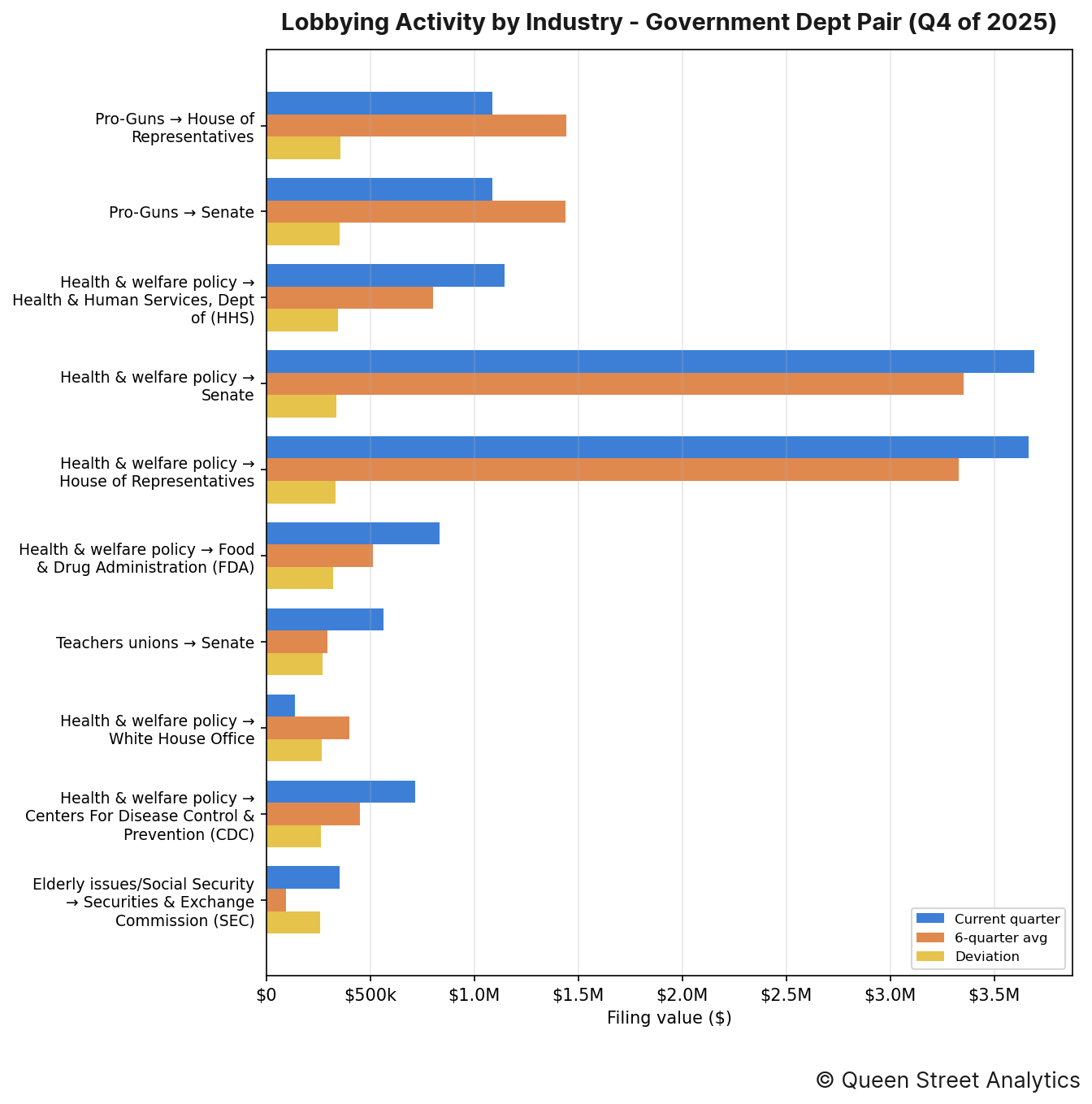
The industry–entity pairings that moved most this quarter were as follows:
↳ Pro-Guns directed $1.1M of lobbying toward House of Representatives, 25% lower than the recent quarterly average of $1.4M.
↳ Pro-Guns directed $1.1M of lobbying toward Senate, 24% lower than the recent quarterly average of $1.4M.
↳ Health & welfare policy directed $1.1M of lobbying toward Dept of Health & Human Services (HHS), 43% higher than the recent quarterly average of $800k.
By organization
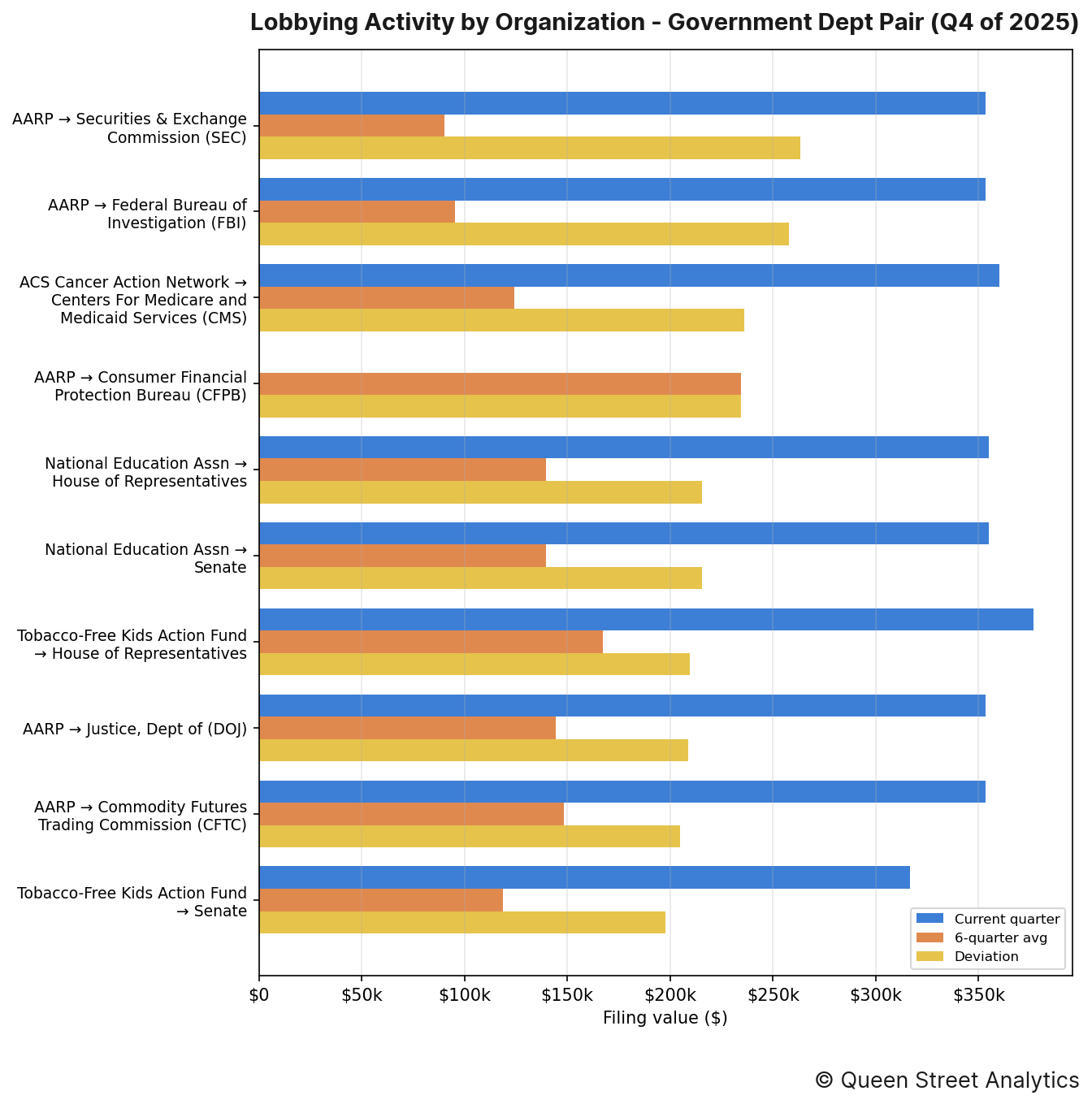
The organization–entity pairings that moved most this quarter were as follows:
↳ AARP directed $353k of lobbying toward Securities & Exchange Commission (SEC), 292% higher than the recent quarterly average of $90k.
↳ AARP directed $353k of lobbying toward Federal Bureau of Investigation (FBI), 270% higher than the recent quarterly average of $96k.
↳ ACS Cancer Action Network directed $360k of lobbying toward Centers For Medicare and Medicaid Services (CMS), 190% higher than the recent quarterly average of $124k.
Section E: Lobbying Issues
This section documents this quarter's most lobbied-on issues.
By industry
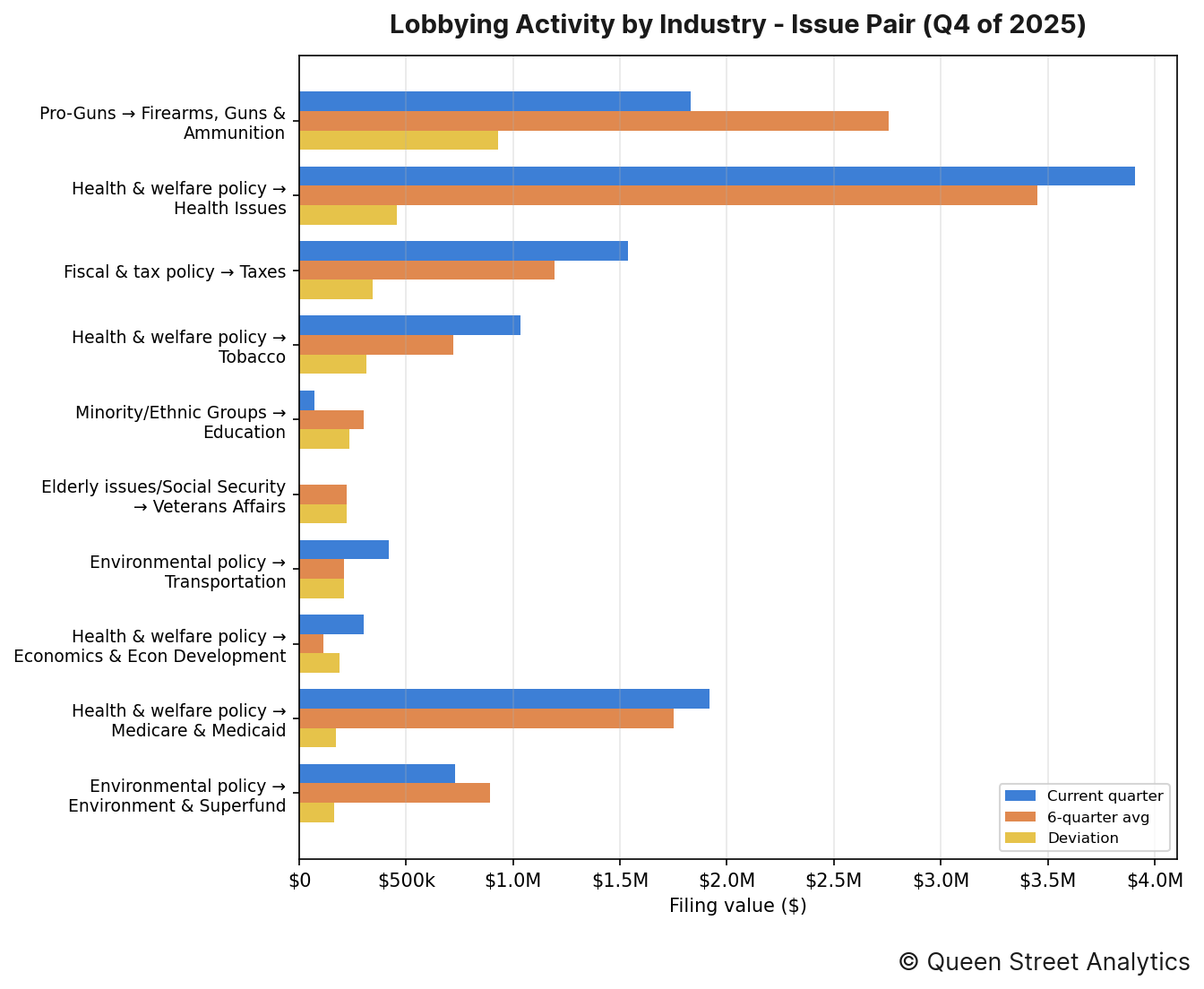
The industry–issue pairings that moved most this quarter were as follows:
↳ Pro-Guns put $1.8M toward lobbying on Firearms, Guns & Ammunition, 34% lower than the recent quarterly average of $2.8M.
↳ Health & welfare policy put $3.9M toward lobbying on Health Issues, 13% higher than the recent quarterly average of $3.5M.
↳ Fiscal & tax policy put $1.5M toward lobbying on Taxes, 29% higher than the recent quarterly average of $1.2M.
By organization
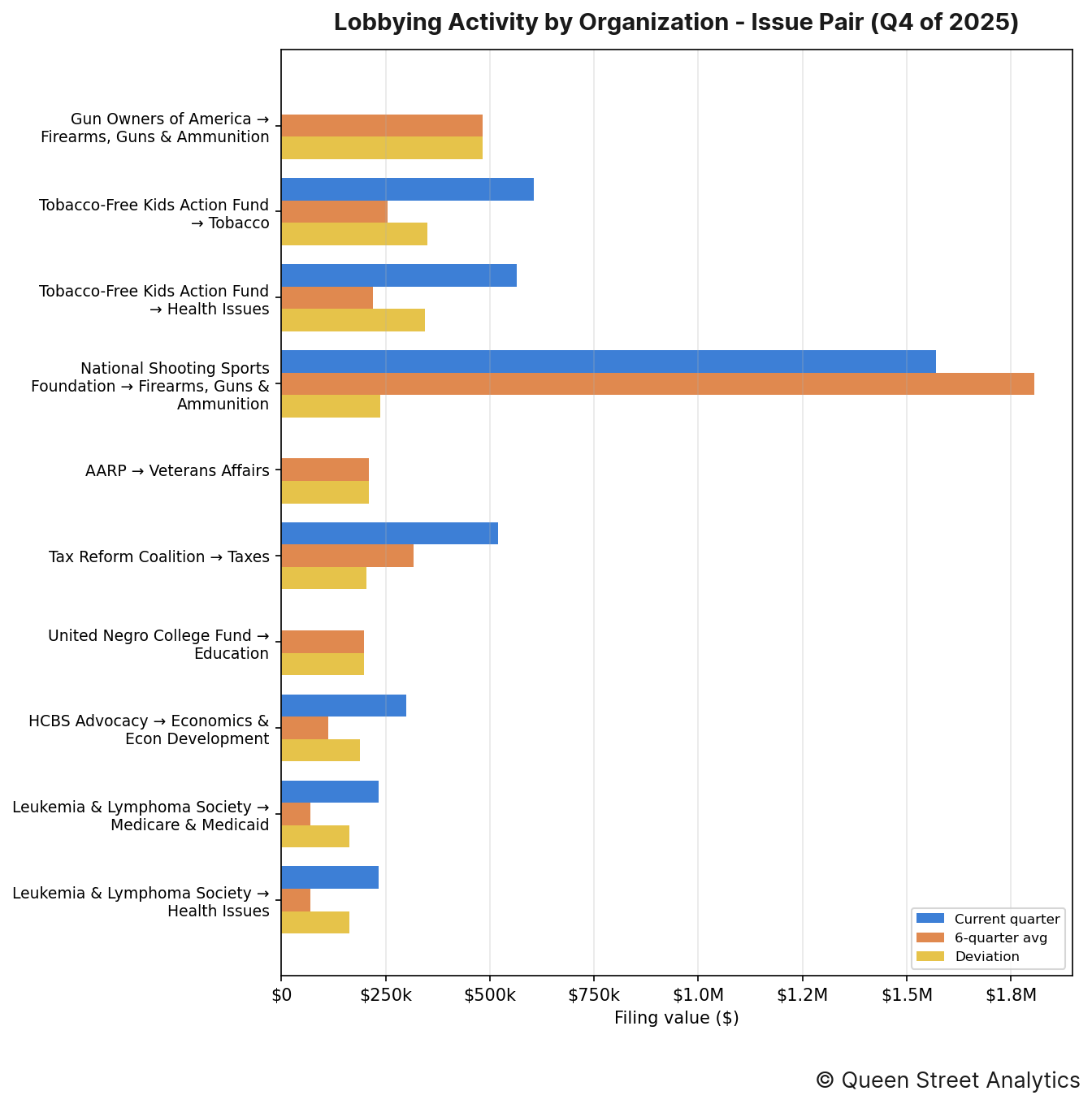
The organization–issue pairings that moved most this quarter were as follows:
↳ Gun Owners of America put $0 toward lobbying on Firearms, Guns & Ammunition, 100% lower than the recent quarterly average of $484k.
↳ Tobacco-Free Kids Action Fund put $605k toward lobbying on Tobacco, 138% higher than the recent quarterly average of $254k.
↳ Tobacco-Free Kids Action Fund put $565k toward lobbying on Health Issues, 157% higher than the recent quarterly average of $220k.
Section F: Most-Active Lobbyists
The figure below lists the lobbyists who managed the most imputed lobbying value this quarter, alongside their firm or organization. Because a filing's value is split evenly across the lobbyists it names, these dollar figures are imputed rather than directly disclosed.
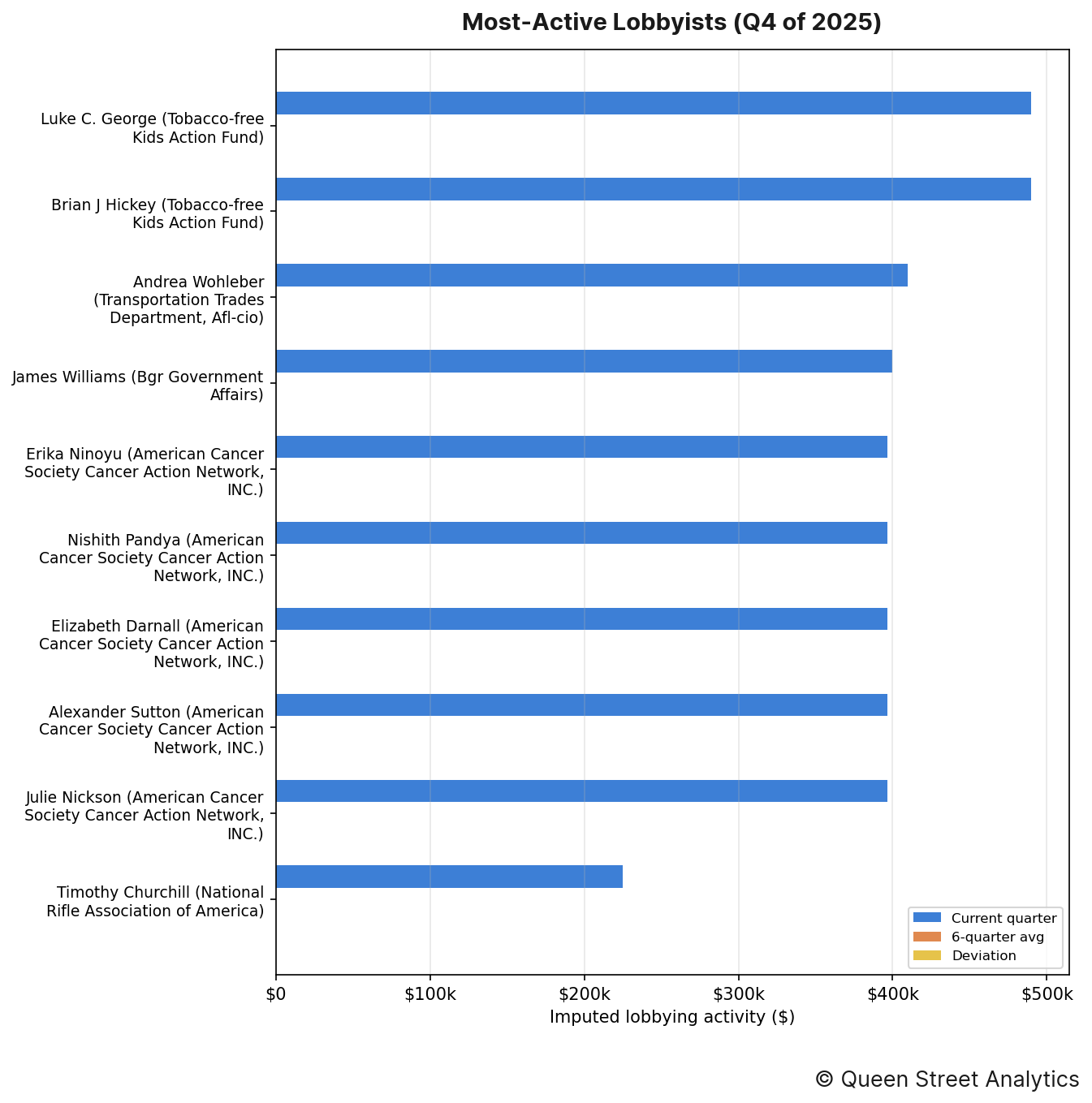
The lobbyists who managed the most imputed lobbying value this quarter were as follows:
↳ Luke C. George (Tobacco-free Kids Action Fund) was credited with an imputed $490k in lobbying activity.
↳ Brian J Hickey (Tobacco-free Kids Action Fund) was credited with an imputed $490k in lobbying activity.
↳ Andrea Wohleber (Transportation Trades Department, Afl-cio) was credited with an imputed $410k in lobbying activity.
↳ James Williams (Bgr Government Affairs) was credited with an imputed $400k in lobbying activity.
↳ Erika Ninoyu (American Cancer Society Cancer Action Network, INC) was credited with an imputed $397k in lobbying activity.
Section G: Organization Network
The header image for this edition maps how this channel's organizations (neutral nodes) connect to the federal entities they lobbied (colored nodes) this quarter. A link's weight is the filing value directed to that entity, and node size reflects total value; the House and Senate are excluded (nearly every organization lobbies them) so the specialized targets stand out.
The most widely lobbied entity this quarter was Dept of Health & Human Services (HHS), which was lobbied by 11 organizations.
Methodology
Every figure in this report starts from one number: the disclosed value of each lobbying filing, which we take as the income a registrant reported plus any in-house expenses (income + expenses) on its quarterly US Senate and House LDA disclosure. Before totalling anything we clean the filings — applying each amendment over the original it replaces, removing duplicates, and setting aside non-standard records such as registrations and terminations — and map every filing to a lobbying channel and industry using the organization's CRP industry code.
How the money is divided. A filing's full value counts once toward the organization that paid it and that organization's industry, so the industry and organization rankings (Sections A–C) reflect whole dollars. But a single filing usually names several government entities, several issue areas, and several lobbyists at once, and the disclosure never says how the fee was split among them. Rather than credit the full amount to each — which would count the same dollars over and over — we divide a filing's value evenly across the distinct items it names. So a $200,000 filing that lists four agencies contributes $50,000 to each in Section D, and the same even split is applied across issues in Section E and across lobbyists in Section F. That way every section's totals trace back to the same underlying money without double-counting.
Reading the movements. A “deviation” compares the quarter's value to the average of the prior six quarters, so a rise or fall is measured against an entity's own recent norm rather than against the rest of the field. Section B takes the wider view: it sums every industry into one channel total and plots it quarter by quarter, with a fitted line showing the overall direction of travel. Source: US Senate and House LDA disclosures.