USA Lobbying on Social Issues - Washington (Q2 2026)





Reform Action Fund, Everytown for Gun Safety Action Fund, and Planned Parenthood were unusually active lobbyists this quarter.
View the interactive network in Queen Street Analytics →
Each quarter we track movements in US federal lobbying, channel by channel. This edition covers Social Issues for Q2 of 2026, ranking the organizations, government entities, issues, and lobbyists whose disclosed spend moved most.
Central Themes in this Quarter’s Lobby Data
Gun Policy Showdowns Intensify as Federal and State Legislation Advance
An outsized rise in gun policy lobbying is aligned with new sweeping federal and state proposals, such as the 'Virginia Plan to Reduce Gun Violence Act of 2026,' aimed at expanding red flag laws and tightening background checks. This period also saw intensified counter-efforts, with several Republican bills introduced to roll back gun restrictions, and notable regulatory reforms from the DOJ and ATF targeting gun dealer oversight, drawing attention from groups like Common Cause in their interactions with the Department of Justice (DOJ). Advocacy groups on both sides, including Common Cause and the YWCA of the USA through lobbying efforts in the House of Representatives and the Senate, responded with escalated Senate and House lobbying calls.
📎 S.4339 — Virginia Plan to Reduce Gun Violence Act of 2026 · 2026 Gun Laws: Bills to Watch · Gun policies overview: US state & federal laws · DOJ and ATF announce regulatory reforms to reduce burdens · House Democrats pass sweeping gun control package · Guns in the news 2026
Abortion Policy Advocacy Spikes Amid Court Battles and Ballot Initiatives
Heightened lobbying on abortion policy coincides with active disputes in federal courts over medication abortion access, including reinstated in-person requirements for mifepristone and ongoing litigation targeting abortion pill protocols, with the YWCA of the USA advocating before both the House of Representatives and the Senate. Alongside, Congress is deliberating restrictions on abortion medication, and states are seeing new ballot measures that could reshape abortion rights in places like Nevada and Missouri. This multifront fight is prompting robust advocacy efforts across the spectrum, notably from organizations such as YWCA of the USA.
📎 What is the law on abortion in 2026? · 2026’s abortion battles will be fought more in courthouses and FDA offices · Litigation Involving Reproductive Health and Rights in the Federal Courts · Hawley, Mifepristone Ban & Abortion Pill Legislation · New status of abortion in the United States 2026 report · Abortion on the 2026 Ballot: The Evolving Landscape
Criminal Justice Reform Bills Return as DOJ Funding and Sentencing Debated
A surge in criminal justice lobbying, including heightened activity from Common Cause engaging the Department of Justice (DOJ), coincides with the introduction of bipartisan proposals targeting sentencing and pretrial reforms, as well as significant shifts in Department of Justice funding priorities. The U.S. Sentencing Commission's pending amendments to federal sentencing guidelines, and a pivot toward earmark-driven DOJ funding, have fueled active engagement by reform advocates, reflecting ongoing contention over the future direction of federal criminal policy.
📎 Durbin, Lee Introduce Bipartisan Criminal Justice Reform Bills · Durbin, Grassley Introduce Criminal Justice Reform Bills · DOJ Budget in Focus: Earmarks, Grants, and Congressional Priorities in 2026 · US Sentencing Commission: 2026 Amendments
Union Advocacy Climbs With New Bargaining Laws and Agency Shifts
Union and worker advocacy have intensified amid fresh federal legislation such as the Faster Labor Contracts Act, which aims to expedite first-time contract settlements through required mediation or arbitration. Communications Workers of America have taken particular interest at the Federal Aviation Administration as these changes unfold. Simultaneously, federal agencies and the NLRB are set to revisit standards on union organizing, and an unusually high volume of contract negotiations and strike threats is fueling the policy debate. Labor groups like YWCA of the USA are leveraging this environment to push for more pro-worker rules before both the House of Representatives and the Senate.
📎 Top Five Labor Law Developments May 2026 · Continued Labor Reform Dialogue in the 119th Congress · The Year Ahead 2026: Agencies Are Off and Running · One Battle After Another: Big Contract Fights Coming in 2026 · Don’t Sleep On 2026’s Union Contract Battles
Social Policy and Safety Net Programs See Renewed Congressional Scrutiny
Lobbyist activity relating to Medicaid, housing, and social programs trended above norms as Congress considered new legislation like the Know Your Customer Act and No Welfare for Non-Citizens Act. Organizations such as the National Cmte to Preserve Social Security were highly active, engaging both the House of Representatives and the Office of Management & Budget as shifting Medicaid funding formulas and ongoing state experimentation with eligibility waivers kept health and welfare advocates especially active. The evolving regulatory climate is fueling coalition campaigns on both sides of these debates, involving entities like the Executive Office of the President as federal attention intensified.
📎 Congress.gov · Medicaid

Section A: Lobbying Spend by Industry
How much each industry in this channel spent on federal lobbying in Q2 of 2026, compared with its average over the prior six quarters.
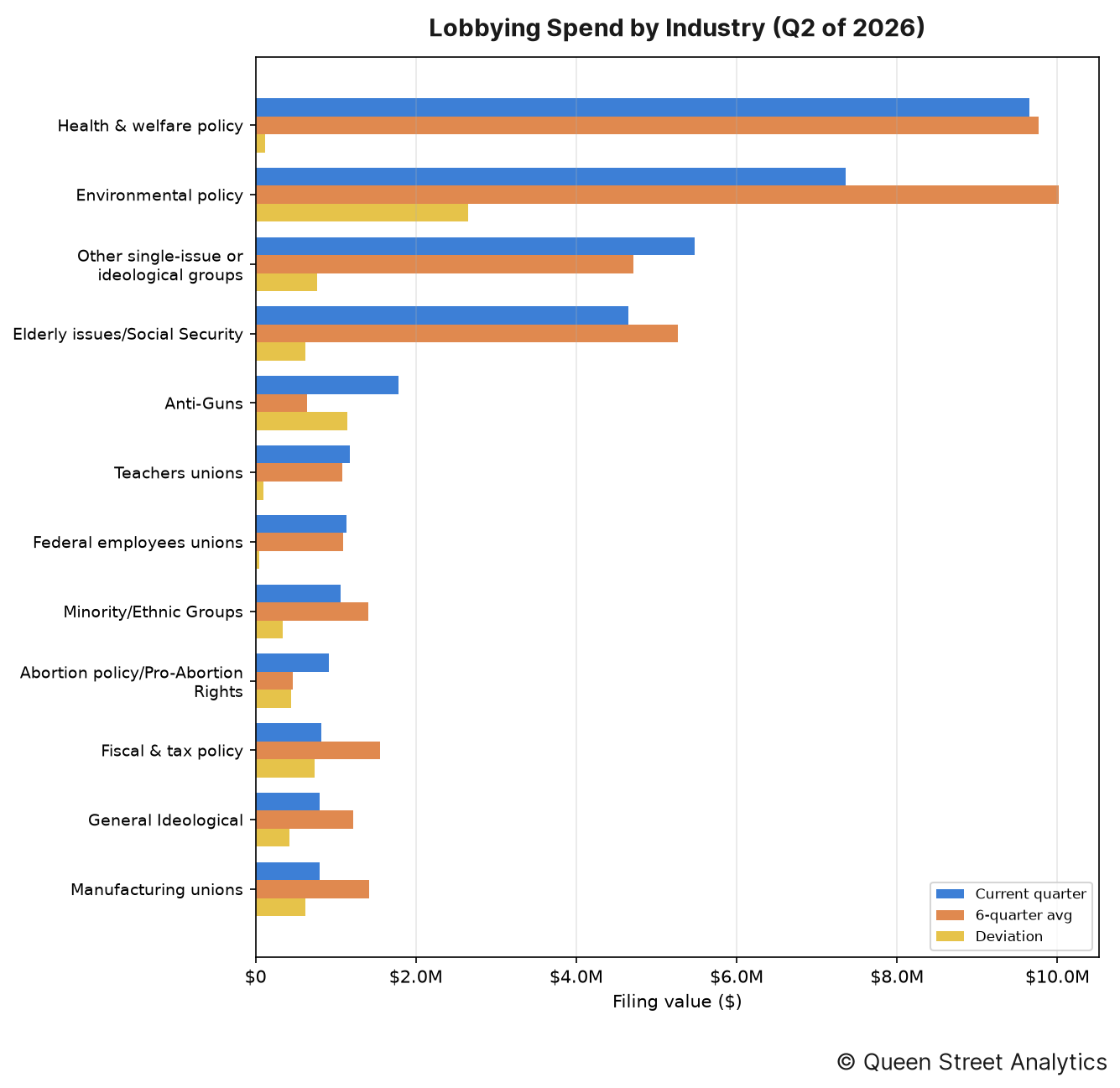
In Q2 of 2026, there was $43.7M worth of disclosed lobbying activity on Social Issues, 17% lower than the recent quarterly average of $52.3M. This activity can be broken down by industry as follows:
↳ There was $9.6M worth of Health & welfare policy lobbying, roughly in line with the recent quarterly average of $9.8M.
↳ There was $7.4M worth of Environmental policy lobbying, 26% lower than the recent quarterly average of $10.0M.
↳ There was $5.5M worth of Other single-issue or ideological groups lobbying, 16% higher than the recent quarterly average of $4.7M.
↳ There was $4.7M worth of Elderly issues/Social Security lobbying, 12% lower than the recent quarterly average of $5.3M.
↳ There was $1.8M worth of Anti-Guns lobbying, 179% higher than the recent quarterly average of $639k.
↳ There was $1.2M worth of Teachers unions lobbying, roughly in line with the recent quarterly average of $1.1M.
Section B: Lobbying Spend Trend
This channel's total disclosed lobbying spend across recent quarters, aggregated over all of its industries.
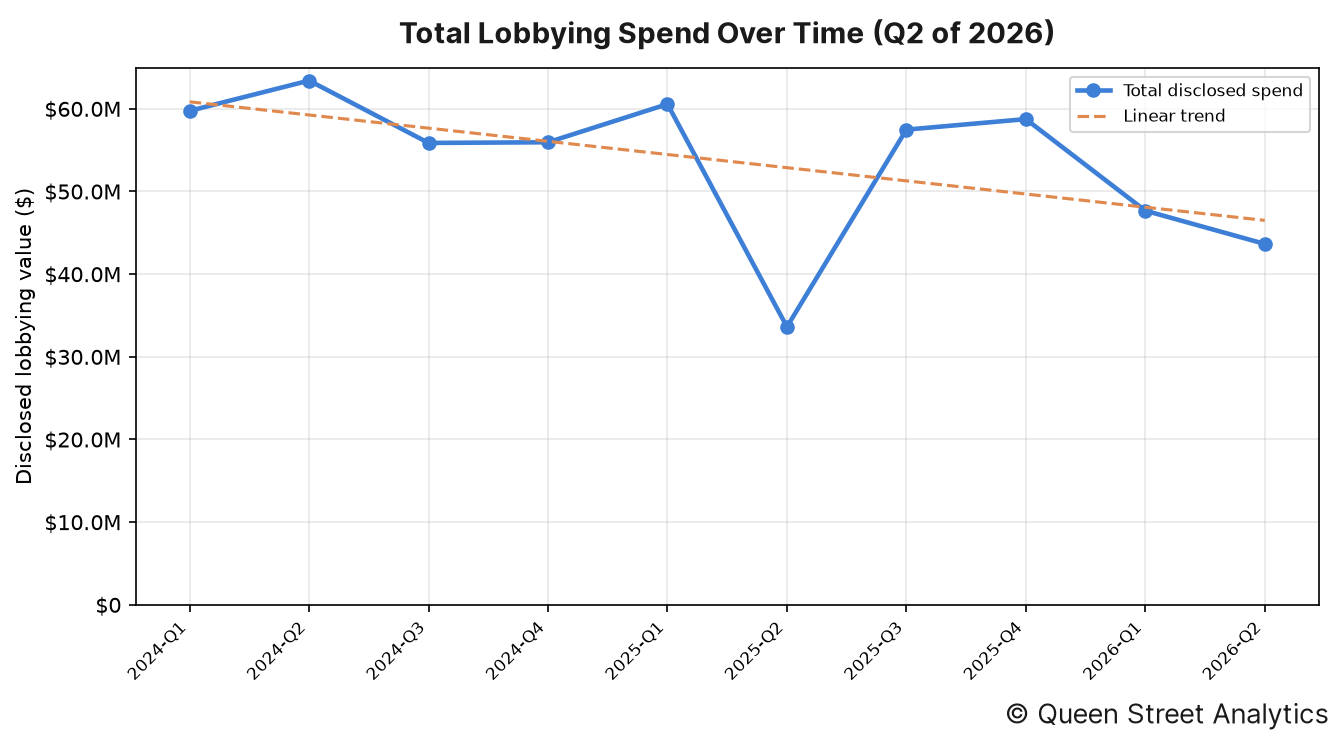
In Q2 of 2026, there was $43.7M worth of disclosed lobbying activity on Social Issues. Across the 10 quarters shown, the channel's total disclosed spend has fallen over this period.
Organizations' Lobby Spend
The image below shows the organizations whose lobbying spend moved most from their six-quarter average.
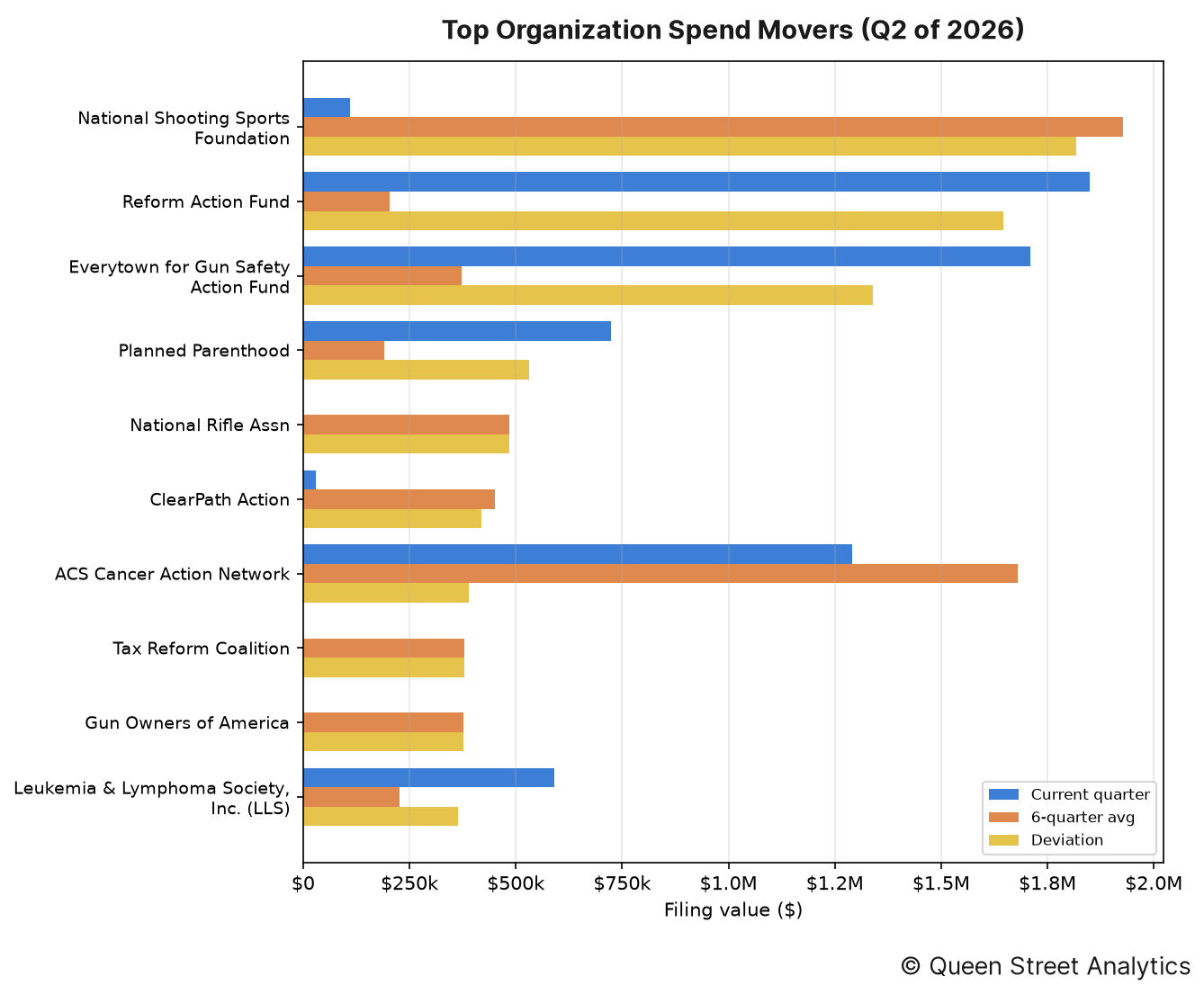
The organizations whose spending moved most from their own recent quarterly average were as follows:
↳ National Shooting Sports Foundation accounted for $110k in disclosed lobbying, 94% lower than the recent quarterly average of $1.9M.
↳ Reform Action Fund accounted for $1.9M in disclosed lobbying, 810% higher than the recent quarterly average of $203k.
↳ Everytown for Gun Safety Action Fund accounted for $1.7M in disclosed lobbying, 360% higher than the recent quarterly average of $372k.
↳ Planned Parenthood accounted for $723k in disclosed lobbying, 278% higher than the recent quarterly average of $191k.
↳ National Rifle Assn accounted for $0 in disclosed lobbying, 100% lower than the recent quarterly average of $485k.
↳ ClearPath Action accounted for $30k in disclosed lobbying, 93% lower than the recent quarterly average of $450k.
Section D: Government Entities Lobbied
This section documents this quarter's most lobbied federal government departments.
By industry
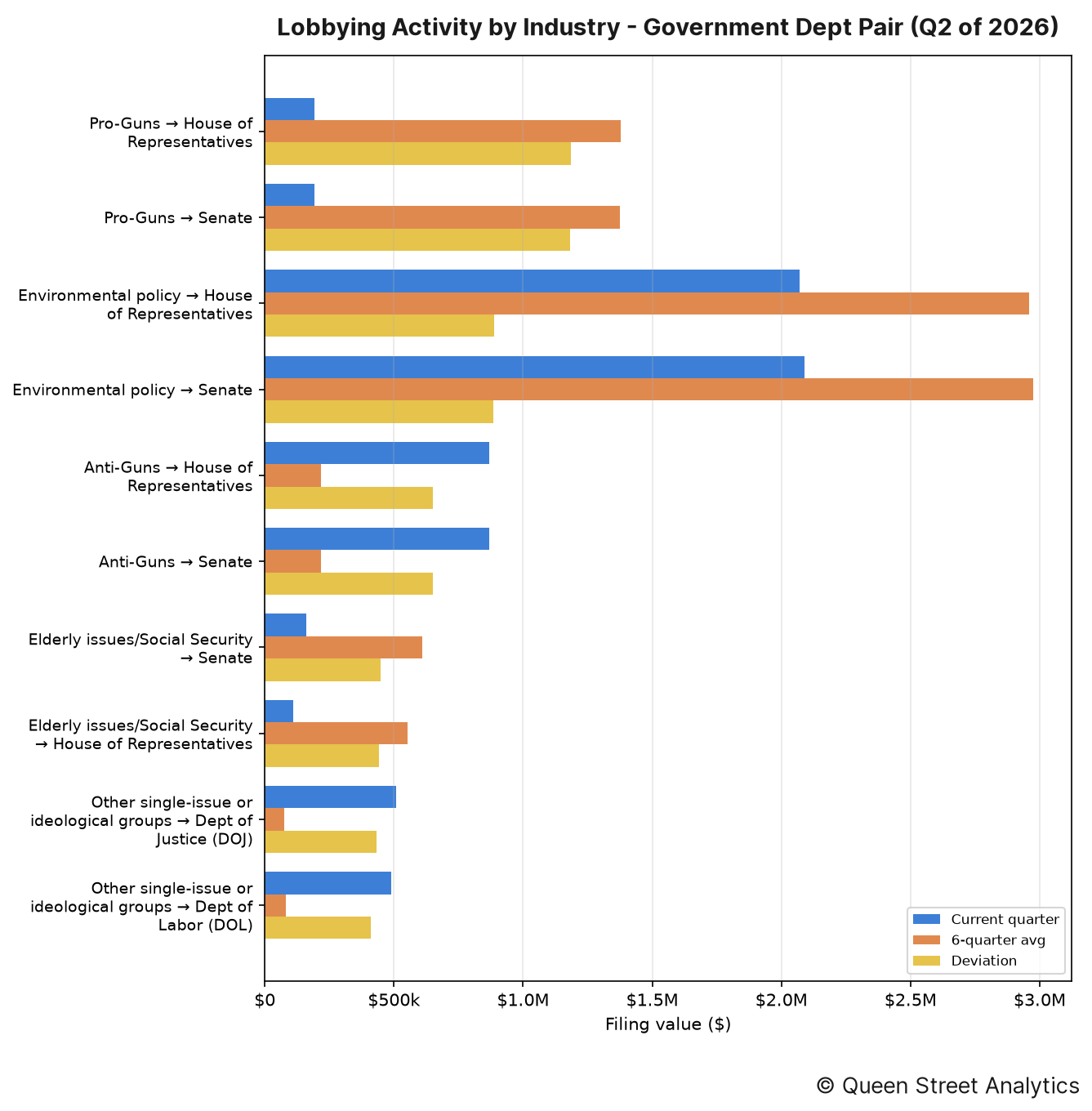
The industry–entity pairings that moved most this quarter were as follows:
↳ Pro-Guns directed $193k of lobbying toward House of Representatives, 86% lower than the recent quarterly average of $1.4M.
↳ Pro-Guns directed $193k of lobbying toward Senate, 86% lower than the recent quarterly average of $1.4M.
↳ Environmental policy directed $2.1M of lobbying toward House of Representatives, 30% lower than the recent quarterly average of $3.0M.
By organization
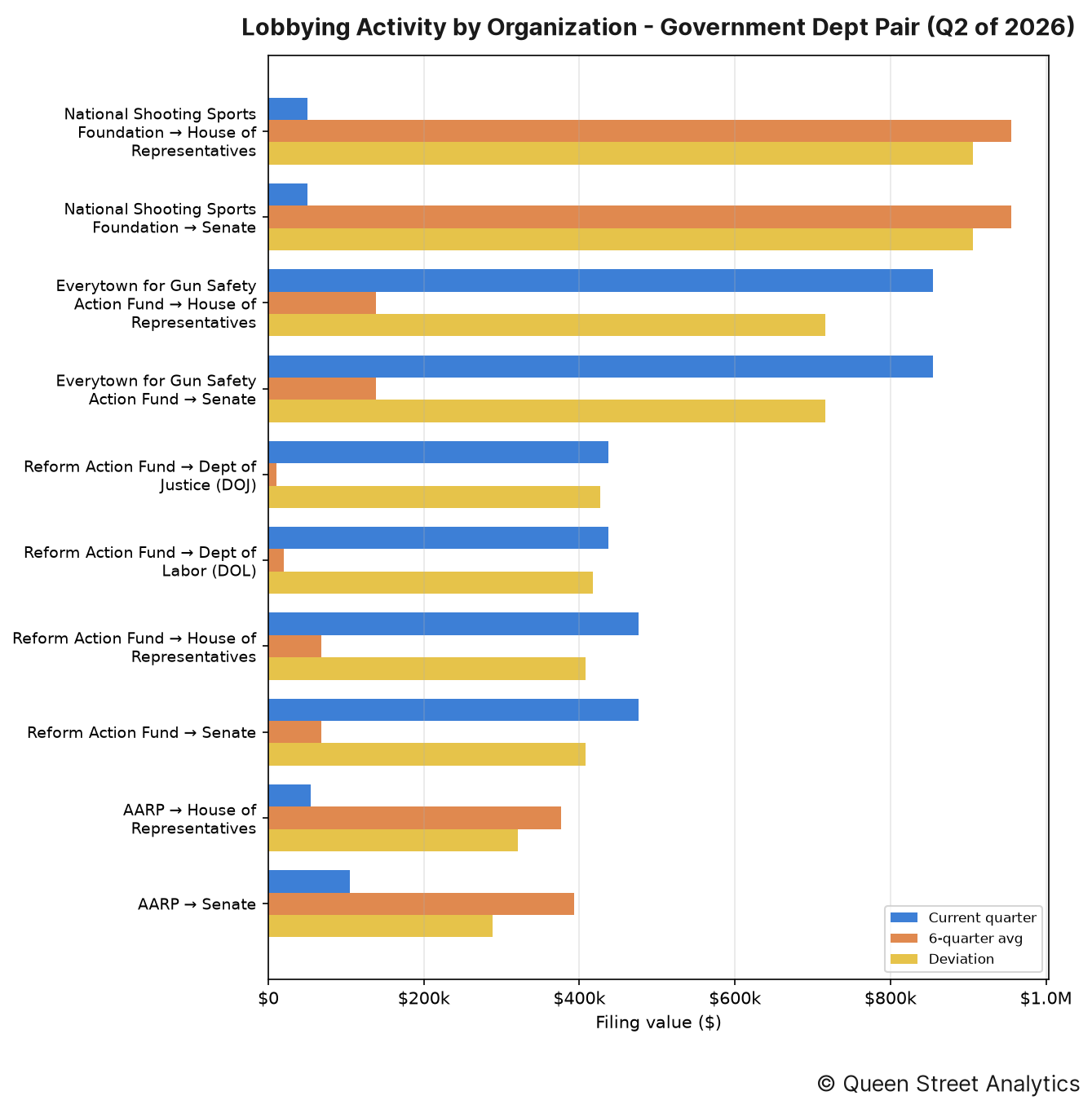
The organization–entity pairings that moved most this quarter were as follows:
↳ National Shooting Sports Foundation directed $50k of lobbying toward House of Representatives, 95% lower than the recent quarterly average of $956k.
↳ National Shooting Sports Foundation directed $50k of lobbying toward Senate, 95% lower than the recent quarterly average of $956k.
↳ Everytown for Gun Safety Action Fund directed $855k of lobbying toward House of Representatives, 518% higher than the recent quarterly average of $138k.
Section E: Lobbying Issues
This section documents this quarter's most lobbied-on issues.
By industry
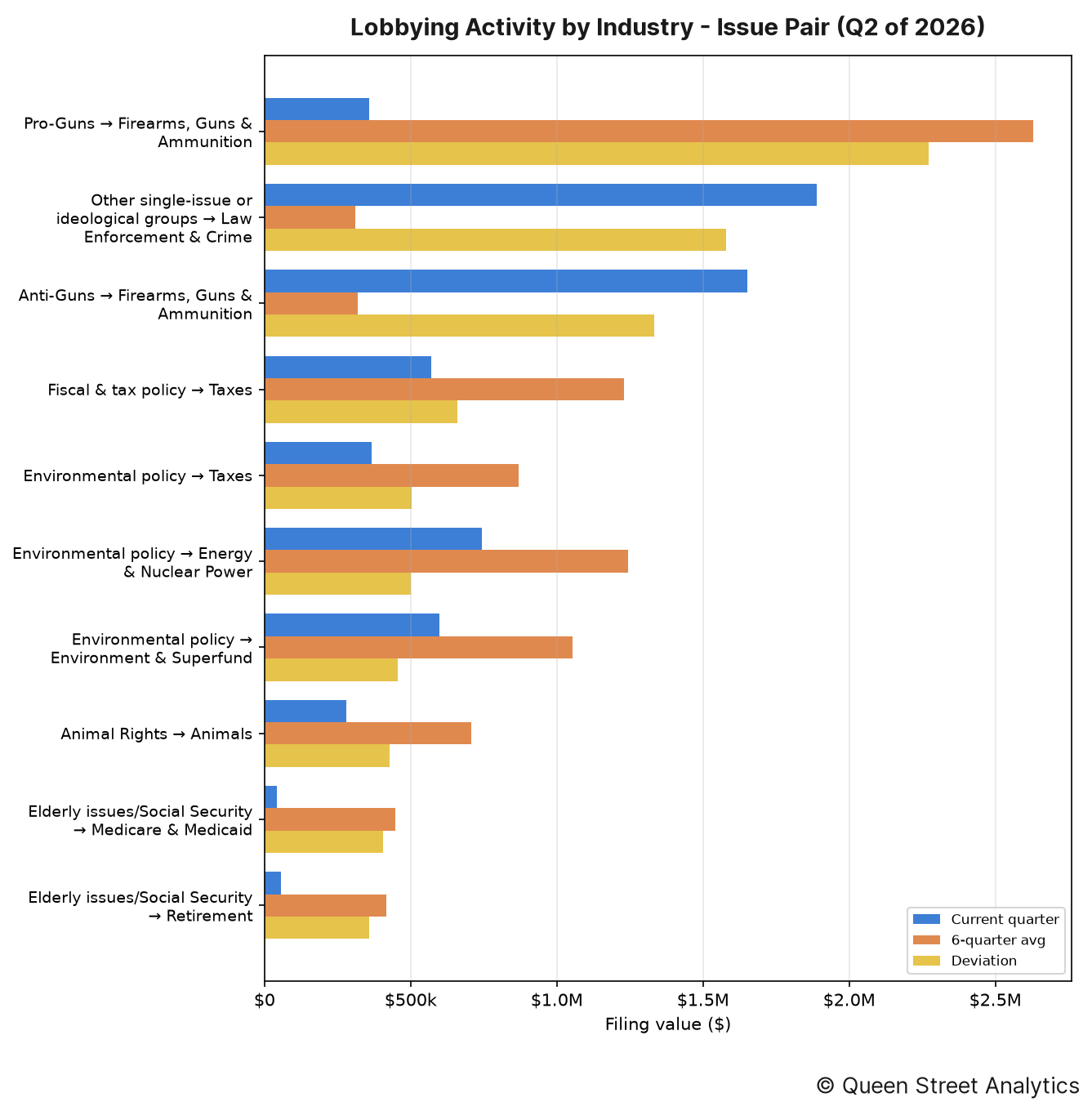
The industry–issue pairings that moved most this quarter were as follows:
↳ Pro-Guns put $358k toward lobbying on Firearms, Guns & Ammunition, 86% lower than the recent quarterly average of $2.6M.
↳ Other single-issue or ideological groups put $1.9M toward lobbying on Law Enforcement & Crime, 509% higher than the recent quarterly average of $310k.
↳ Anti-Guns put $1.7M toward lobbying on Firearms, Guns & Ammunition, 419% higher than the recent quarterly average of $318k.
By organization
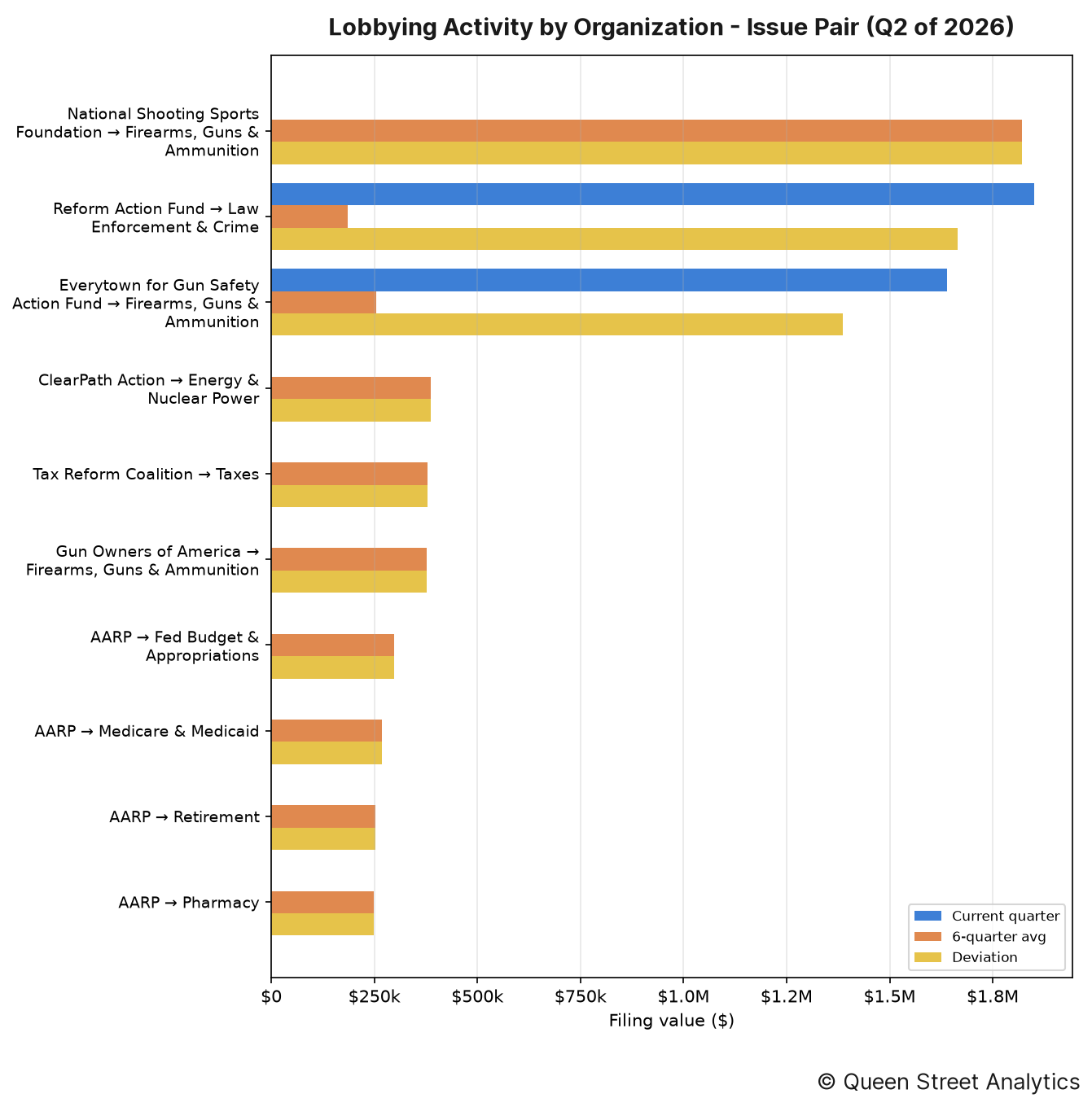
The organization–issue pairings that moved most this quarter were as follows:
↳ National Shooting Sports Foundation put $0 toward lobbying on Firearms, Guns & Ammunition, 100% lower than the recent quarterly average of $1.8M.
↳ Reform Action Fund put $1.9M toward lobbying on Law Enforcement & Crime, 896% higher than the recent quarterly average of $186k.
↳ Everytown for Gun Safety Action Fund put $1.6M toward lobbying on Firearms, Guns & Ammunition, 547% higher than the recent quarterly average of $254k.
Section F: Most-Active Lobbyists
The figure below lists the lobbyists who managed the most imputed lobbying value this quarter, alongside their firm or organization. Because a filing's value is split evenly across the lobbyists it names, these dollar figures are imputed rather than directly disclosed.
No lobbyist activity to report this quarter.
Section G: Organization Network
The header image for this edition maps how this channel's organizations (neutral nodes) connect to the federal entities they lobbied (colored nodes) this quarter. A link's weight is the filing value directed to that entity, and node size reflects total value; the House and Senate are excluded (nearly every organization lobbies them) so the specialized targets stand out.
The most widely lobbied entity this quarter was Dept of Health & Human Services (HHS), which was lobbied by 8 organizations.
Methodology
Every figure in this report starts from one number: the disclosed value of each lobbying filing, which we take as the income a registrant reported plus any in-house expenses (income + expenses) on its quarterly US Senate and House LDA disclosure. Before totalling anything we clean the filings — applying each amendment over the original it replaces, removing duplicates, and setting aside non-standard records such as registrations and terminations — and map every filing to a lobbying channel and industry using the organization's CRP industry code.
How the money is divided. A filing's full value counts once toward the organization that paid it and that organization's industry, so the industry and organization rankings (Sections A–C) reflect whole dollars. But a single filing usually names several government entities, several issue areas, and several lobbyists at once, and the disclosure never says how the fee was split among them. Rather than credit the full amount to each — which would count the same dollars over and over — we divide a filing's value evenly across the distinct items it names. So a $200,000 filing that lists four agencies contributes $50,000 to each in Section D, and the same even split is applied across issues in Section E and across lobbyists in Section F. That way every section's totals trace back to the same underlying money without double-counting.
Reading the movements. A “deviation” compares the quarter's value to the average of the prior six quarters, so a rise or fall is measured against an entity's own recent norm rather than against the rest of the field. Section B takes the wider view: it sums every industry into one channel total and plots it quarter by quarter, with a fitted line showing the overall direction of travel. Source: US Senate and House LDA disclosures.


