USA Lobbying on Manufacturing - Washington (Q4 2025)





American Chemistry Council, US Steel, Advanced Micro Devices, Intel Corp, Nvidia Corporation, National Assn of Manufacturers were unusually active lobbyists this quarter.
View the interactive network in Queen Street Analytics →
Each quarter we track movements in US federal lobbying, channel by channel. This edition covers Manufacturing for Q4 of 2025, ranking the organizations, government entities, issues, and lobbyists whose disclosed spend moved most.
Central Themes in this Quarter’s Lobby Data
Chemical Industry Mobilizes Around PFAS Regulatory Overhaul
Industry groups, including the American Chemistry Council and the American Apparel & Footwear Assn, have sharply increased their advocacy in response to the EPA's major shakeup around PFAS regulation in late 2025. The American Chemistry Council, in particular, intensified its lobbying at several federal offices, while the American Apparel & Footwear Assn specifically engaged with the Environmental Protection Agency (EPA) amid unsettled regulatory and court activity impacting chemical management and reporting obligations.
📎 EPA Actions on PFAS · BCLP regulatory analysis · Federal Register rulemaking
NDAA Reforms Spark Surge in Electronics and Sensor Technology Advocacy
The 2026 National Defense Authorization Act’s push for domestic technology investment coincides with a distinct spike in electronics sector lobbying, especially on issues like aviation safety, sensor innovation, and digital engineering, with the American Apparel & Footwear Assn engaging the Defense Logistics Agency and the Dept of Commerce (DOC) to advance their positions. Industry filings highlight efforts to shape R&D budgets and supply chain policies in alignment with new defense procurement and industrial base resilience provisions, as seen in the association’s outreach to the Executive Office of the President (EOP) and the Federal Trade Commission (FTC).
📎 Full NDAA text · ETI NDAA innovation summary
Semiconductor Incentive Rollout Draws Record Lobbying From Chipmakers
Major federal outlays for semiconductor manufacturing facilities in 2025 drove a pronounced uptick in advocacy by firms like AMD, Apple, and Cisco, alongside trade-focused groups such as the American Apparel & Footwear Assn. These efforts often focus on shaping the rules around CHIPS Act implementation, trade restrictions, and long-term R&D funding, with the American Apparel & Footwear Assn in particular engaging the Dept of Commerce (DOC) and Federal Trade Commission (FTC), as U.S. firms aim to expand their edge in advanced chip production.
📎 GAO report on semiconductor supply chain funding · SIA 2025 Factbook
State and Federal Plastics Policy Face Manufacturing Pushback
Efforts to set new national standards for plastics recycling and advanced recycling methods have prompted strong industry lobbying, with Lyondell Chemical actively engaging with the Environmental Protection Agency, the Department of State, and both chambers of Congress. Coalition activity, which includes involvement from the American Apparel & Footwear Assn in discussions with the Department of Commerce and the EPA, centers on permitting reform and seeking regulatory consistency in the face of evolving debates over producer responsibility and recycling mandates in Congress and state legislatures.
📎 HR 9676: Accelerating a Circular Economy for Plastics · EPA Advanced Recycling Overview · ADI policy summary
Tech Companies Expand Lobbying on App Markets and Digital Competition
There has been notable growth in tech sector lobbying around proposals like the Open App Markets Act, which targets competition in online ecosystems and innovation policy. Organizations such as the American Apparel & Footwear Assn have engaged with federal entities including the Federal Trade Commission (FTC) as electronic and component firms are increasingly advocating on trade, privacy, antitrust, and R&D funding as part of a broader push to influence software and hardware market regulation.
📎 S.2153 Open App Markets Act · SIA 2025 Factbook

Section A: Lobbying Spend by Industry
How much each industry in this channel spent on federal lobbying in Q4 of 2025, compared with its average over the prior six quarters.
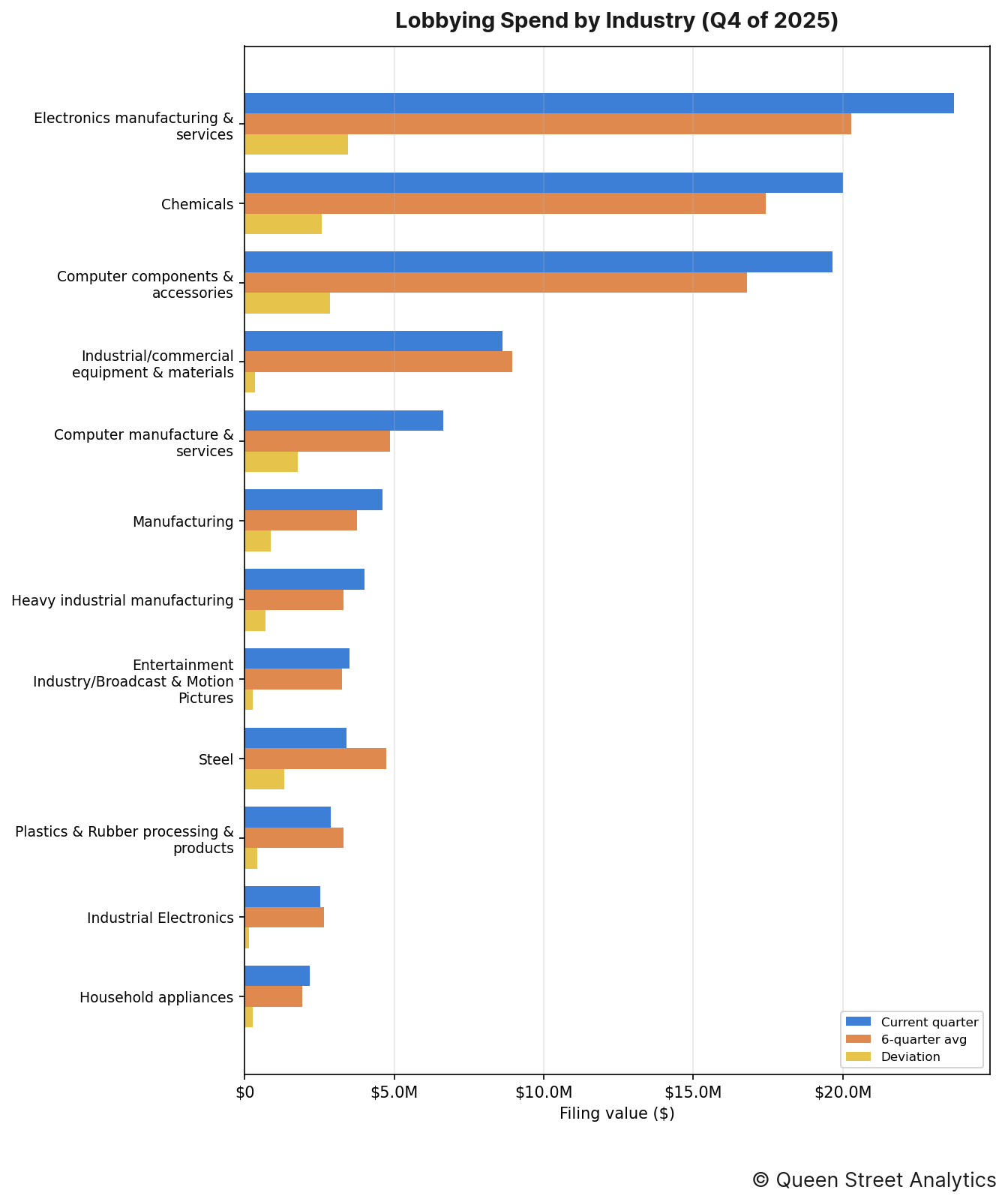
In Q4 of 2025, there was $122.6M worth of disclosed lobbying activity on Manufacturing, 10% higher than the recent quarterly average of $111.3M. This activity can be broken down by industry as follows:
↳ There was $23.7M worth of Electronics manufacturing & services lobbying, 17% higher than the recent quarterly average of $20.3M.
↳ There was $20.0M worth of Chemicals lobbying, 15% higher than the recent quarterly average of $17.4M.
↳ There was $19.6M worth of Computer components & accessories lobbying, 17% higher than the recent quarterly average of $16.8M.
↳ There was $8.6M worth of Industrial/commercial equipment & materials lobbying, roughly in line with the recent quarterly average of $8.9M.
↳ There was $5.2M worth of Computer manufacture & services lobbying, roughly in line with the recent quarterly average of $4.9M.
↳ There was $4.6M worth of Manufacturing lobbying, 23% higher than the recent quarterly average of $3.8M.
Section B: Lobbying Spend Trend
This channel's total disclosed lobbying spend across recent quarters, aggregated over all of its industries.
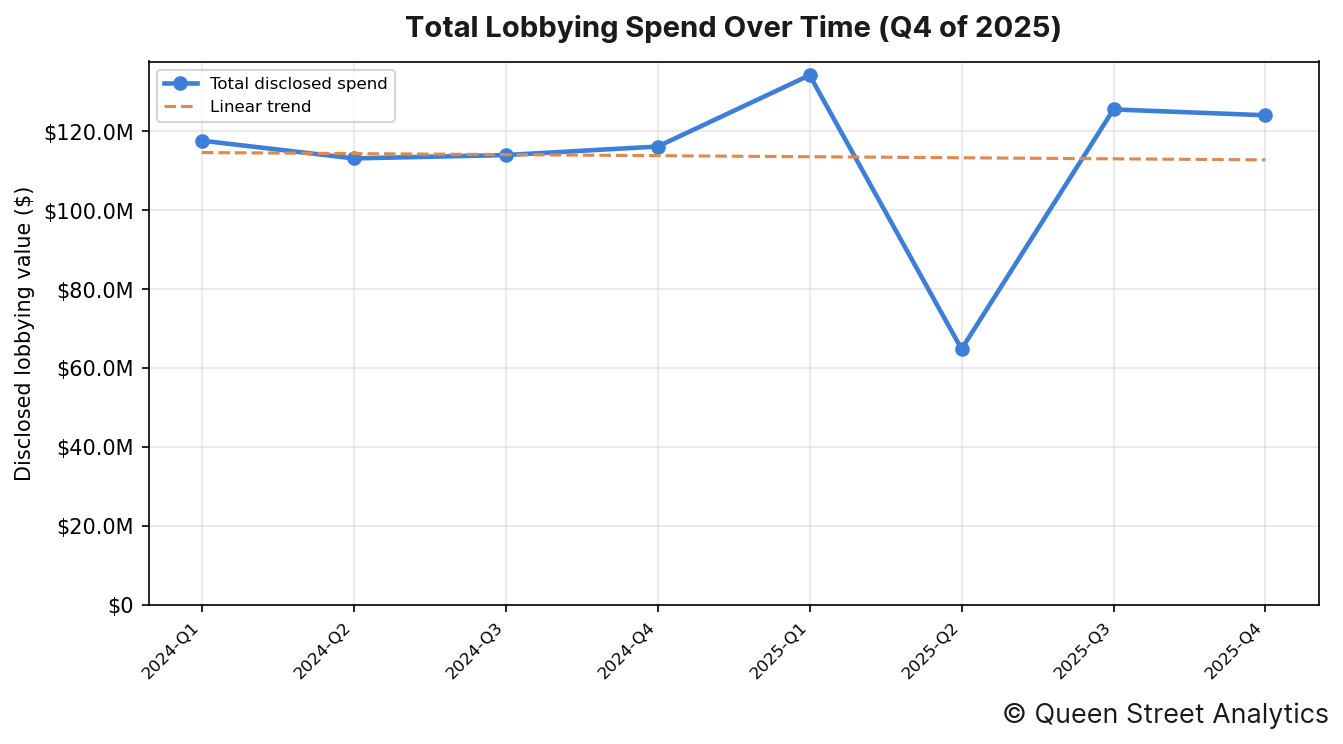
In Q4 of 2025, there was $122.6M worth of disclosed lobbying activity on Manufacturing. Across the 8 quarters shown, the channel's total disclosed spend has held roughly steady over this period.
Organizations' Lobby Spend
The image below shows the organizations whose lobbying spend moved most from their six-quarter average.
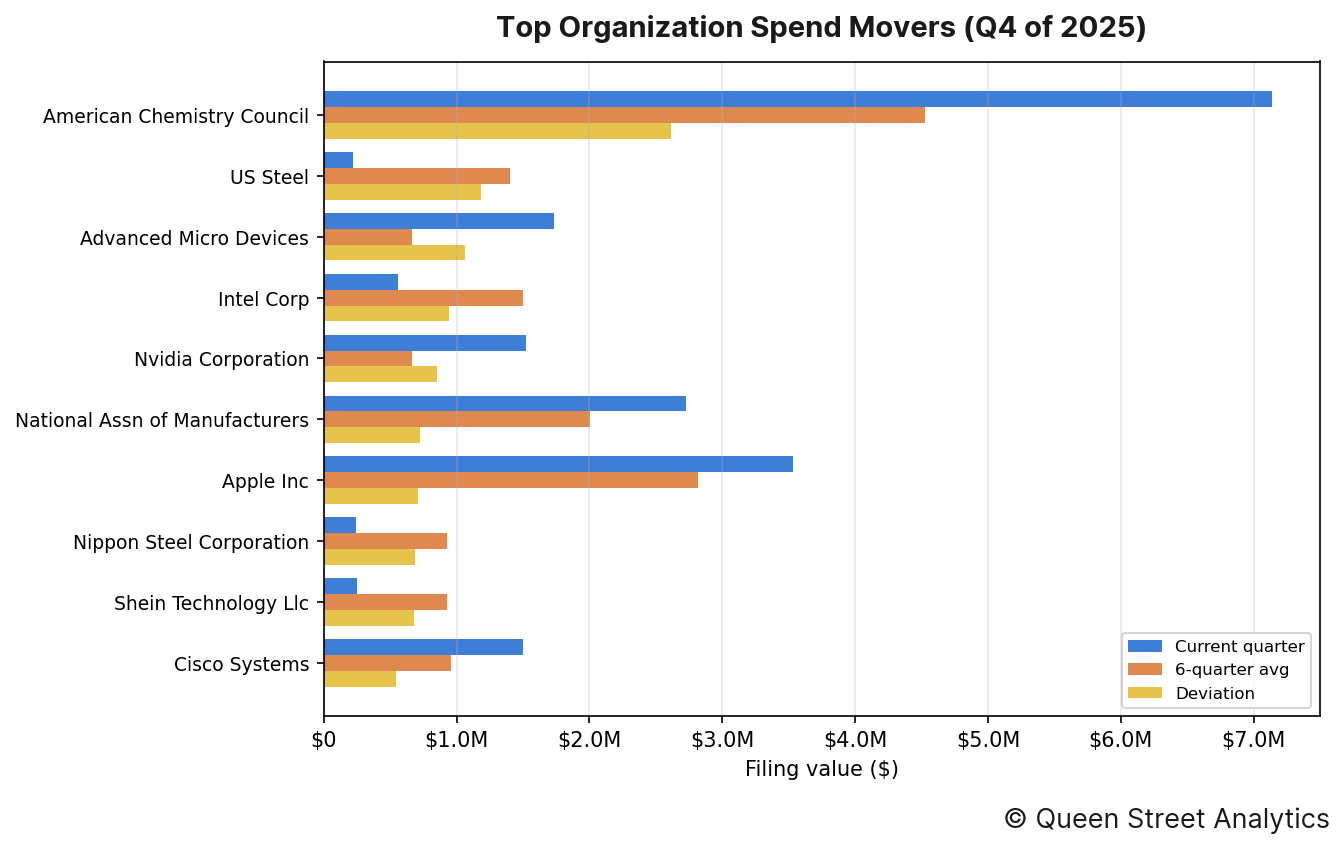
The organizations whose spending moved most from their own recent quarterly average were as follows:
↳ American Chemistry Council accounted for $7.1M in disclosed lobbying, 58% higher than the recent quarterly average of $4.5M.
↳ US Steel accounted for $220k in disclosed lobbying, 84% lower than the recent quarterly average of $1.4M.
↳ Advanced Micro Devices accounted for $1.7M in disclosed lobbying, 160% higher than the recent quarterly average of $667k.
↳ Intel Corp accounted for $560k in disclosed lobbying, 63% lower than the recent quarterly average of $1.5M.
↳ National Assn of Manufacturers accounted for $2.7M in disclosed lobbying, 36% higher than the recent quarterly average of $2.0M.
↳ Apple Inc accounted for $3.5M in disclosed lobbying, 25% higher than the recent quarterly average of $2.8M.
Section D: Government Entities Lobbied
This section documents this quarter's most lobbied federal government departments.
By industry
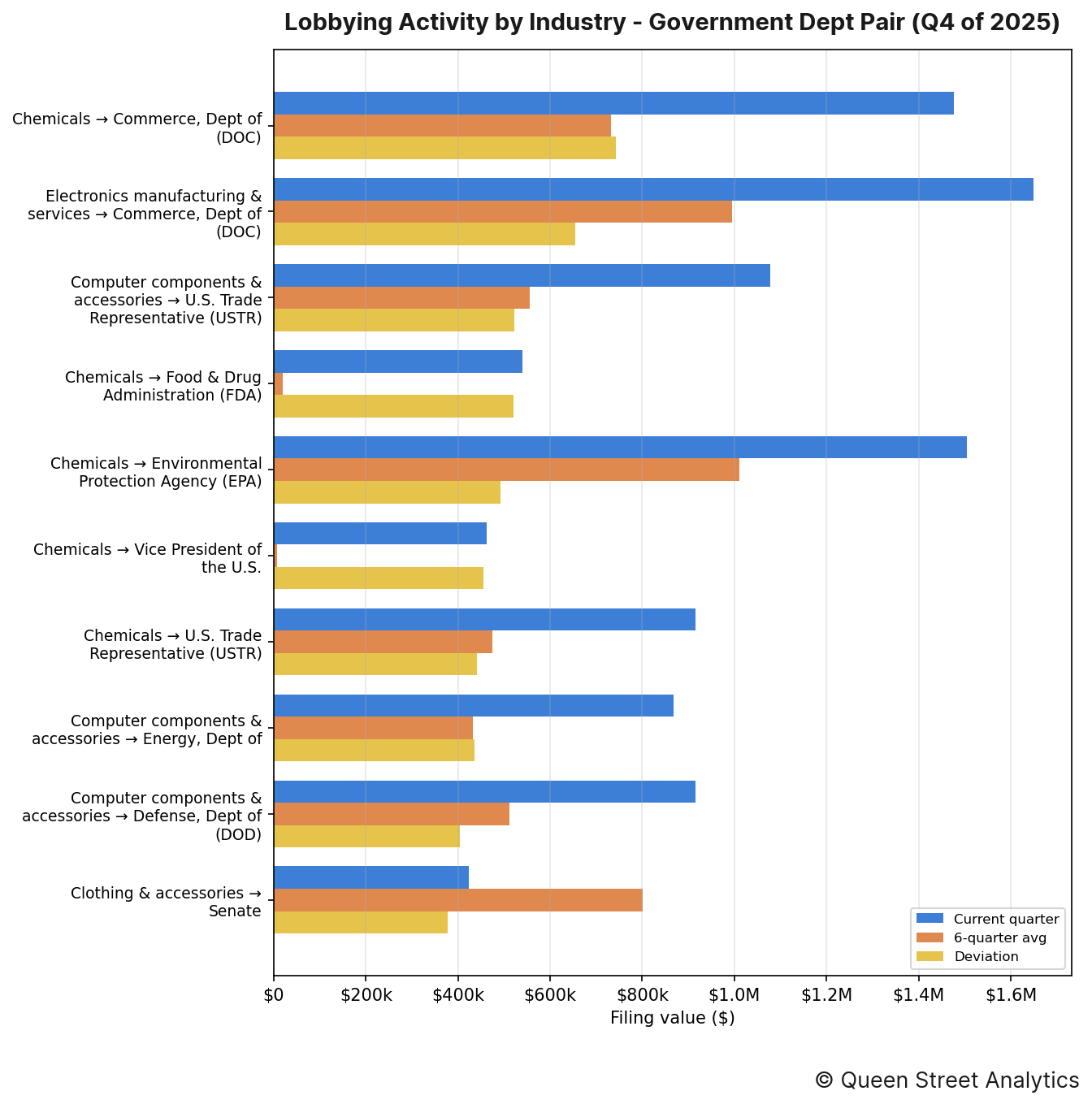
The industry–entity pairings that moved most this quarter were as follows:
↳ Chemicals directed $1.5M of lobbying toward Dept of Commerce (DOC), 101% higher than the recent quarterly average of $733k.
↳ Electronics manufacturing & services directed $1.7M of lobbying toward Dept of Commerce (DOC), 66% higher than the recent quarterly average of $995k.
↳ Computer components & accessories directed $1.1M of lobbying toward U.S. Trade Representative (USTR), 94% higher than the recent quarterly average of $556k.
By organization
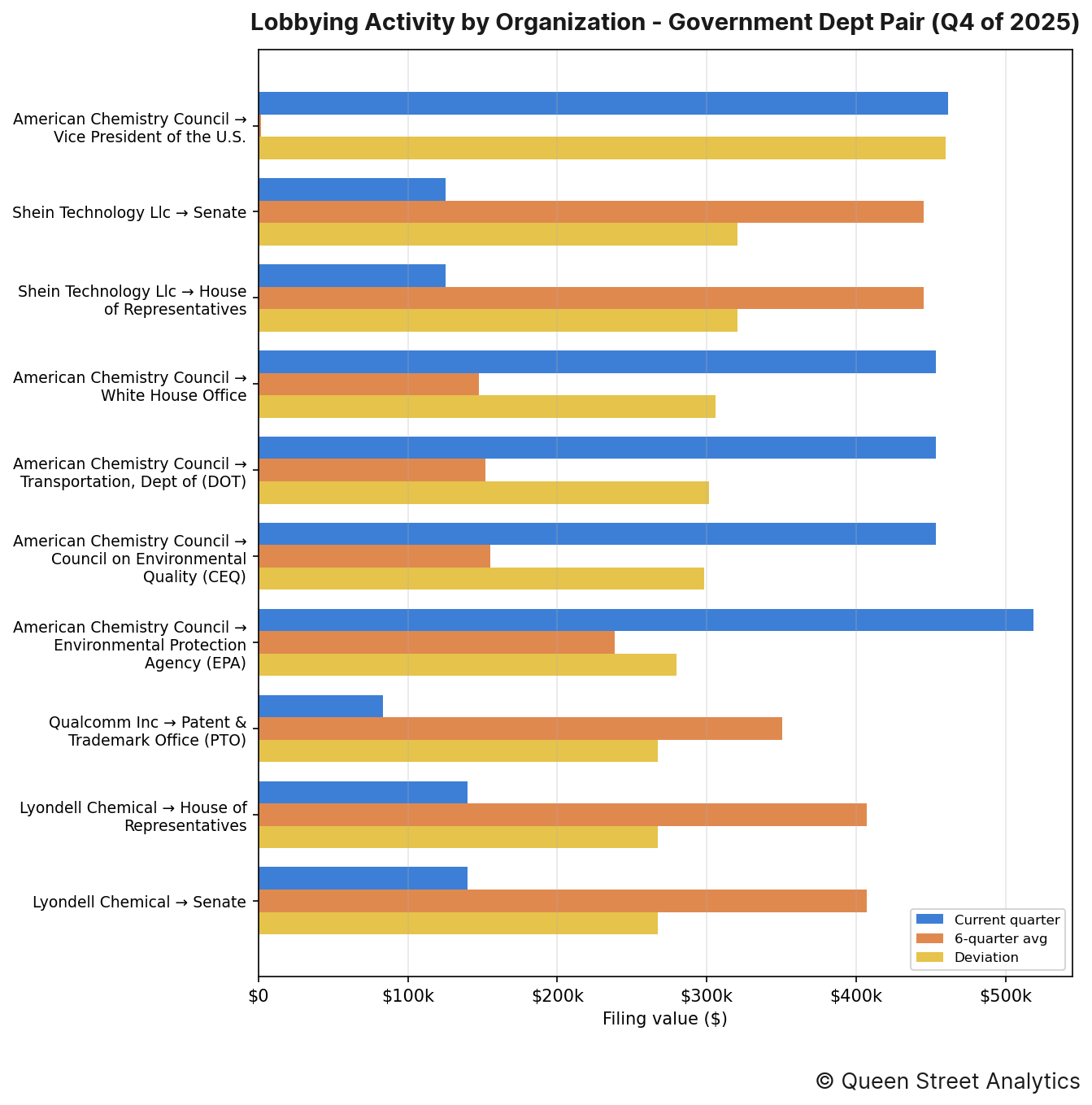
The organization–entity pairings that moved most this quarter were as follows:
↳ American Chemistry Council directed $462k of lobbying toward Vice President of the U.S., 27600% higher than the recent quarterly average of $2k.
↳ Shein Technology Llc directed $125k of lobbying toward House of Representatives, 72% lower than the recent quarterly average of $446k.
↳ Shein Technology Llc directed $125k of lobbying toward Senate, 72% lower than the recent quarterly average of $446k.
Section E: Lobbying Issues
This section documents this quarter's most lobbied-on issues.
By industry
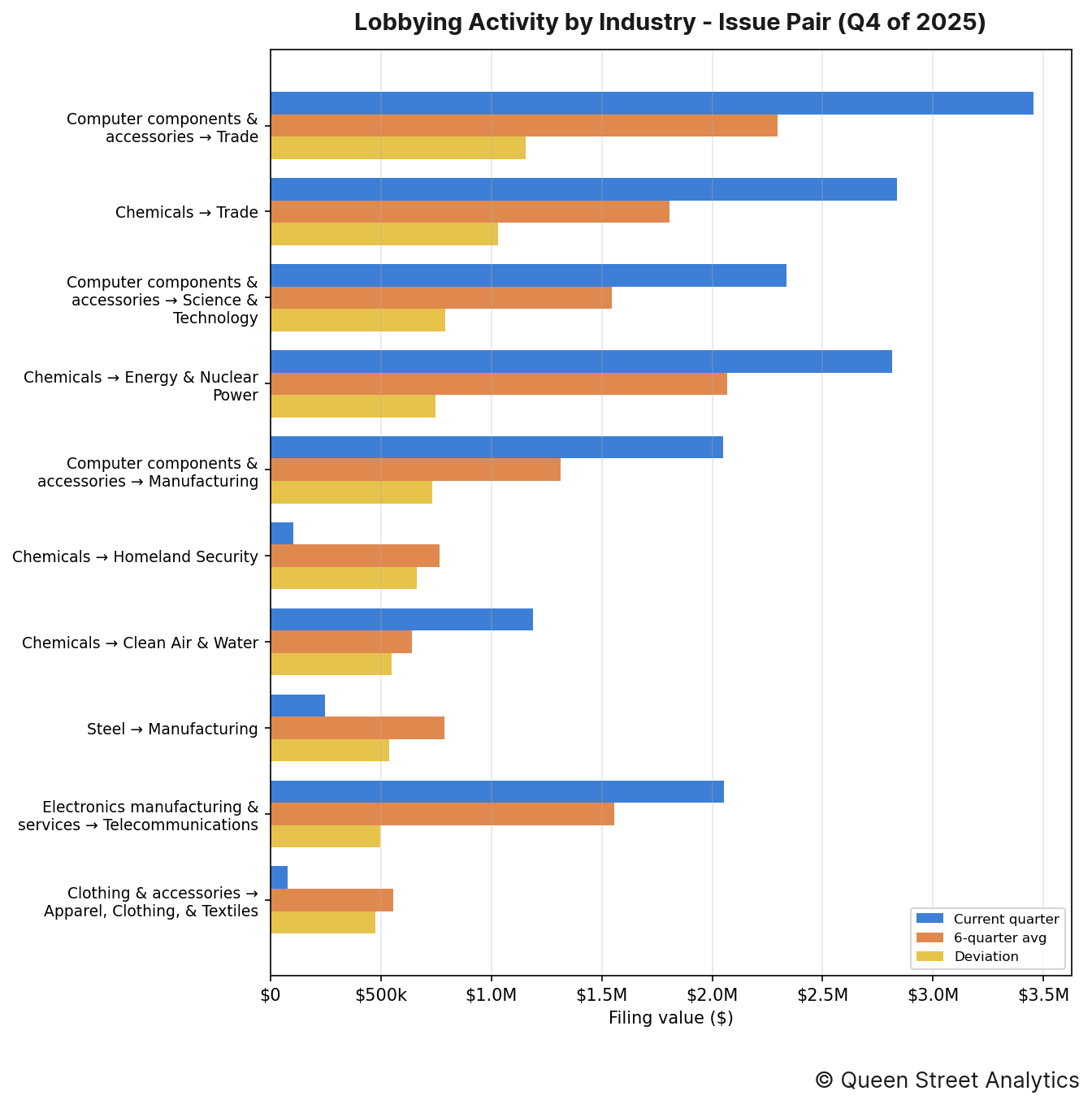
The industry–issue pairings that moved most this quarter were as follows:
↳ Computer components & accessories put $3.5M toward lobbying on Trade, 50% higher than the recent quarterly average of $2.3M.
↳ Chemicals put $2.8M toward lobbying on Trade, 57% higher than the recent quarterly average of $1.8M.
↳ Computer components & accessories put $2.3M toward lobbying on Science & Technology, 51% higher than the recent quarterly average of $1.5M.
By organization
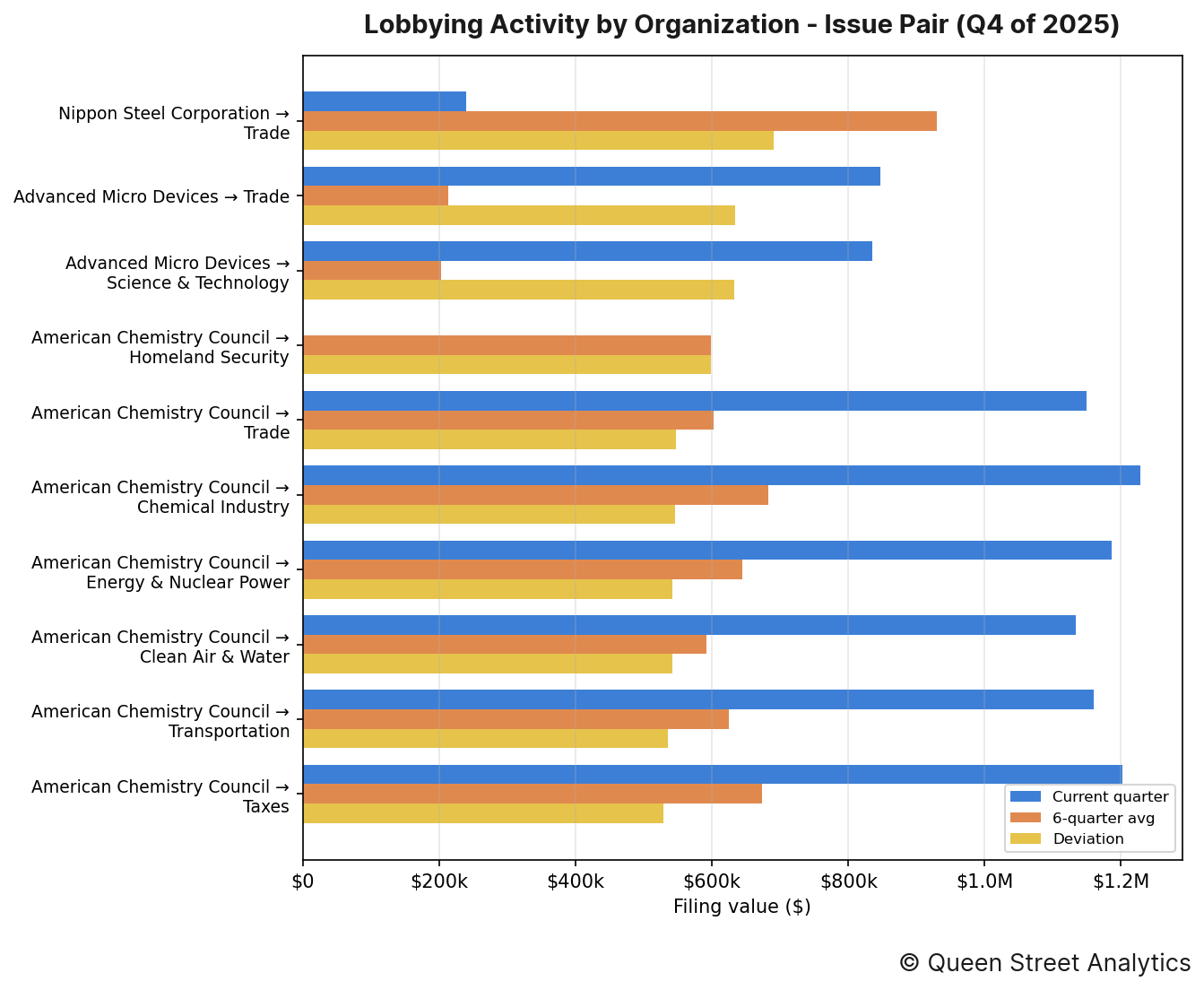
The organization–issue pairings that moved most this quarter were as follows:
↳ Nippon Steel Corporation put $240k toward lobbying on Trade, 74% lower than the recent quarterly average of $930k.
↳ Advanced Micro Devices put $847k toward lobbying on Trade, 297% higher than the recent quarterly average of $213k.
↳ Advanced Micro Devices put $835k toward lobbying on Science & Technology, 313% higher than the recent quarterly average of $202k.
Section F: Most-Active Lobbyists
The figure below lists the lobbyists who managed the most imputed lobbying value this quarter, alongside their firm or organization. Because a filing's value is split evenly across the lobbyists it names, these dollar figures are imputed rather than directly disclosed.
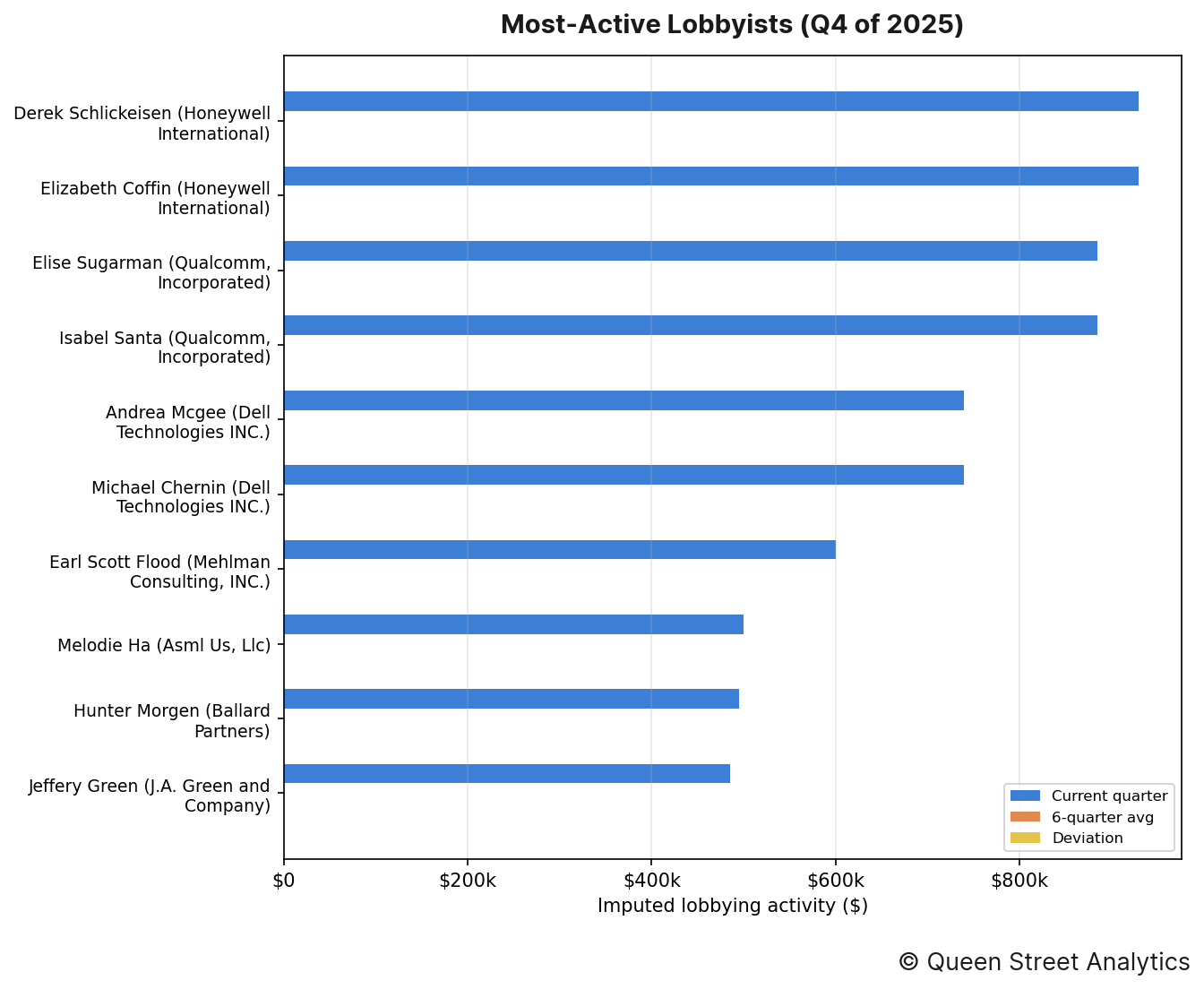
The lobbyists who managed the most imputed lobbying value this quarter were as follows:
↳ Derek Schlickeisen (Honeywell International) was credited with an imputed $930k in lobbying activity.
↳ Elizabeth Coffin (Honeywell International) was credited with an imputed $930k in lobbying activity.
↳ Isabel Santa (Qualcomm, Incorporated) was credited with an imputed $885k in lobbying activity.
↳ Elise Sugarman (Qualcomm, Incorporated) was credited with an imputed $885k in lobbying activity.
↳ Andrea Mcgee (Dell Technologies INC) was credited with an imputed $740k in lobbying activity.
Section G: Organization Network
The header image for this edition maps how this channel's organizations (neutral nodes) connect to the federal entities they lobbied (colored nodes) this quarter. A link's weight is the filing value directed to that entity, and node size reflects total value; the House and Senate are excluded (nearly every organization lobbies them) so the specialized targets stand out.
The most widely lobbied entity this quarter was U.S. Trade Representative (USTR), which was lobbied by 19 organizations.
Methodology
Every figure in this report starts from one number: the disclosed value of each lobbying filing, which we take as the income a registrant reported plus any in-house expenses (income + expenses) on its quarterly US Senate and House LDA disclosure. Before totalling anything we clean the filings — applying each amendment over the original it replaces, removing duplicates, and setting aside non-standard records such as registrations and terminations — and map every filing to a lobbying channel and industry using the organization's CRP industry code.
How the money is divided. A filing's full value counts once toward the organization that paid it and that organization's industry, so the industry and organization rankings (Sections A–C) reflect whole dollars. But a single filing usually names several government entities, several issue areas, and several lobbyists at once, and the disclosure never says how the fee was split among them. Rather than credit the full amount to each — which would count the same dollars over and over — we divide a filing's value evenly across the distinct items it names. So a $200,000 filing that lists four agencies contributes $50,000 to each in Section D, and the same even split is applied across issues in Section E and across lobbyists in Section F. That way every section's totals trace back to the same underlying money without double-counting.
Reading the movements. A “deviation” compares the quarter's value to the average of the prior six quarters, so a rise or fall is measured against an entity's own recent norm rather than against the rest of the field. Section B takes the wider view: it sums every industry into one channel total and plots it quarter by quarter, with a fitted line showing the overall direction of travel. Source: US Senate and House LDA disclosures.


