USA Lobbying on Foreign Affairs - Washington (Q3 2026)


Bae Kim and Lee LLC on Behalf of Kcih and Ypc; Akin Gump Strauss Hauer and Field LLP on Behalf of Tp-link Systems INC; CUFI Action Fund were unusually active lobbyists this quarter.
View the interactive network in Queen Street Analytics →
Each quarter we track movements in US federal lobbying, channel by channel. This edition covers Foreign Affairs for Q3 of 2026, ranking the organizations, government entities, issues, and lobbyists whose disclosed spend moved most.
Central Themes in this Quarter’s Lobby Data
DOJ’s Public Warning Spurs Foreign Agent Lobbying Spike
The Department of Justice’s unusual public warning in September 2026 about stricter enforcement under the Foreign Agents Registration Act (FARA) appears to have prompted a sharp surge in lobbying spend by registered foreign agents such as the American Israel Public Affairs Cmte engaging with the House of Representatives and Dept of Defense, as well as FDD Action lobbying the Senate, according to recent filings. Legal scrutiny is intensifying on ‘public activity’ for foreign principals and may be driving new compliance efforts and registrations.
📎 DOJ Issues Unusual Warning on the Foreign Agents Registration Act · DOJ’s FARA Press Release: Reacting to Congressional Demands for FARA ... · Foreign Agent Enforcement Back in Focus: DOJ Issues Public Warning
Congress Eyes Expansion of Foreign Agent Disclosure Rules
Congressional debate has intensified around expanding the definition of 'foreign principal' and tightening disclosure obligations for foreign agent lobbying, with several bills under consideration alongside NDAA amendments. These policy shifts parallel notable increases in lobbying activity and compliance spending among both traditional foreign principals and nonprofits, including recent efforts by FDD Action and the American Israel Public Affairs Cmte targeting the House of Representatives and the Senate.
📎 Congress Weighs Foreign Agent Disclosure and Registration Bills · FARA's Future: DOJ Signals Regulatory Revisions and Heightened ...
High-Profile Sanctions, Minerals, and Asia Policy Moves Drive Lobbying Surge
Recent lobbying disclosures align with a wave of policy actions on sanctions against Russia and Iran, as seen in filings from FDD Action to the House of Representatives and Senate as well as from American Israel Public Affairs Cmte to the Department of Commerce, Department of Defense, and Department of Energy, strengthening U.S.-Taiwan partnerships, and federal moves related to critical minerals—such as a new minerals security agreement with Finland. These developments may have prompted a flurry of filings on foreign investment, trade, and security, particularly regarding Congressional sanctions acts and minerals supply chain issues.
📎 Foreign Policy Archives - United States Department of State · Home | Office of Foreign Assets Control · Press Releases - United States Department of State
Lobbying Intensifies on Antisemitism Legislation Amid Campus Speech Debate
A marked increase in advocacy group lobbying, notably by FDD Action and the Zionist Organization of America before the House of Representatives and the Department of Education, has accompanied legislative pushes on antisemitism, including the Antisemitism Awareness Act and related bills. This trend tracks sustained Congressional focus on rising campus controversy and has led to escalating spend by pro-Israel organizations, as reflected in recent lobbying reports.
📎 Press Releases - United States Department of State · FARA's Future: DOJ Signals Regulatory Revisions and Heightened ...
Puerto Rico Statehood Lobbying Reaches New Highs as Congressional Debate Heats Up
Lobbying spend on Puerto Rico statehood policy posted an outsized quarterly gain, coinciding with revived congressional consideration of statehood and related status measures, as the Puerto Rico Statehood Council intensified activity on both the House of Representatives and Senate floors. Pro-statehood and status-quo advocates appear to be escalating their efforts in response to renewed legislative and media focus this quarter, with federal entities like the House of Representatives and Senate receiving increased attention from organizations such as the Puerto Rico Statehood Council.
📎 Press Releases - United States Department of State · Congress Weighs Foreign Agent Disclosure and Registration Bills

Section A: Lobbying Spend by Industry
How much each industry in this channel spent on federal lobbying in Q3 of 2026, compared with its average over the prior six quarters.
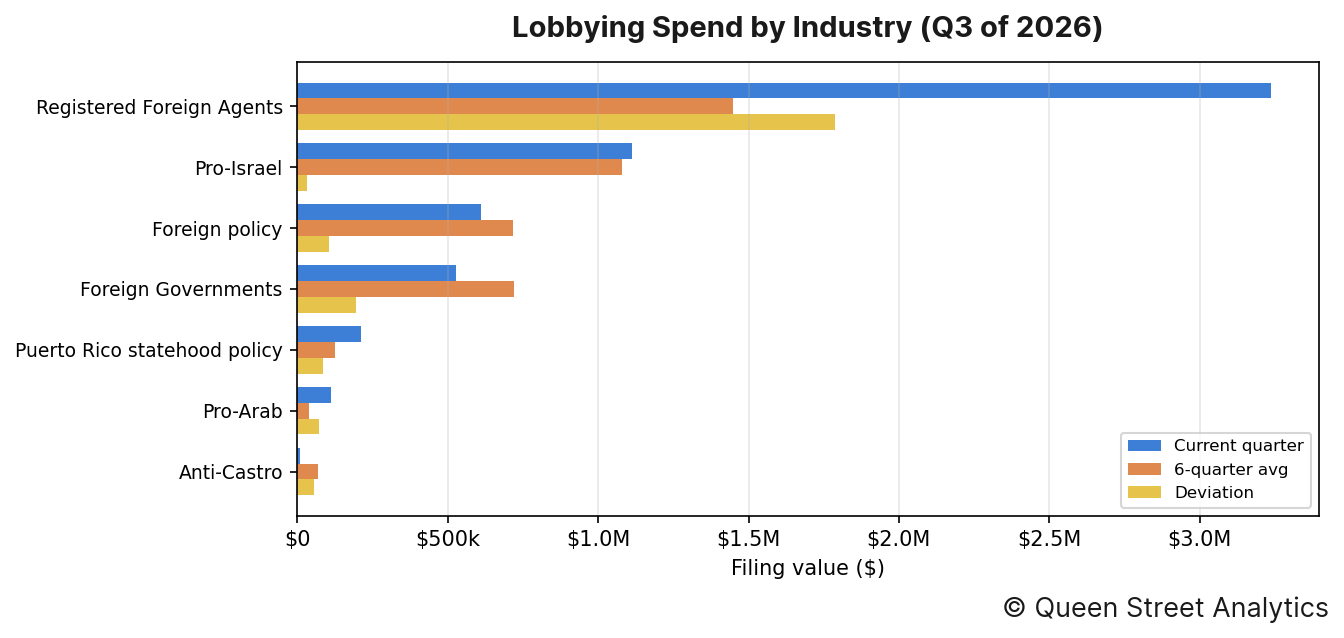
In Q3 of 2026, there was $5.8M worth of disclosed lobbying activity on Foreign Affairs, 39% higher than the recent quarterly average of $4.2M. This activity can be broken down by industry as follows:
↳ There was $3.2M worth of Registered Foreign Agents lobbying, 123% higher than the recent quarterly average of $1.4M.
↳ There was $1.1M worth of Pro-Israel lobbying, roughly in line with the recent quarterly average of $1.1M.
↳ There was $610k worth of Foreign policy lobbying, 15% lower than the recent quarterly average of $716k.
↳ There was $528k worth of Foreign Governments lobbying, 27% lower than the recent quarterly average of $721k.
↳ There was $210k worth of Puerto Rico statehood policy lobbying, 67% higher than the recent quarterly average of $126k.
↳ There was $110k worth of Pro-Arab lobbying, 175% higher than the recent quarterly average of $40k.
Section B: Lobbying Spend Trend
This channel's total disclosed lobbying spend across recent quarters, aggregated over all of its industries.
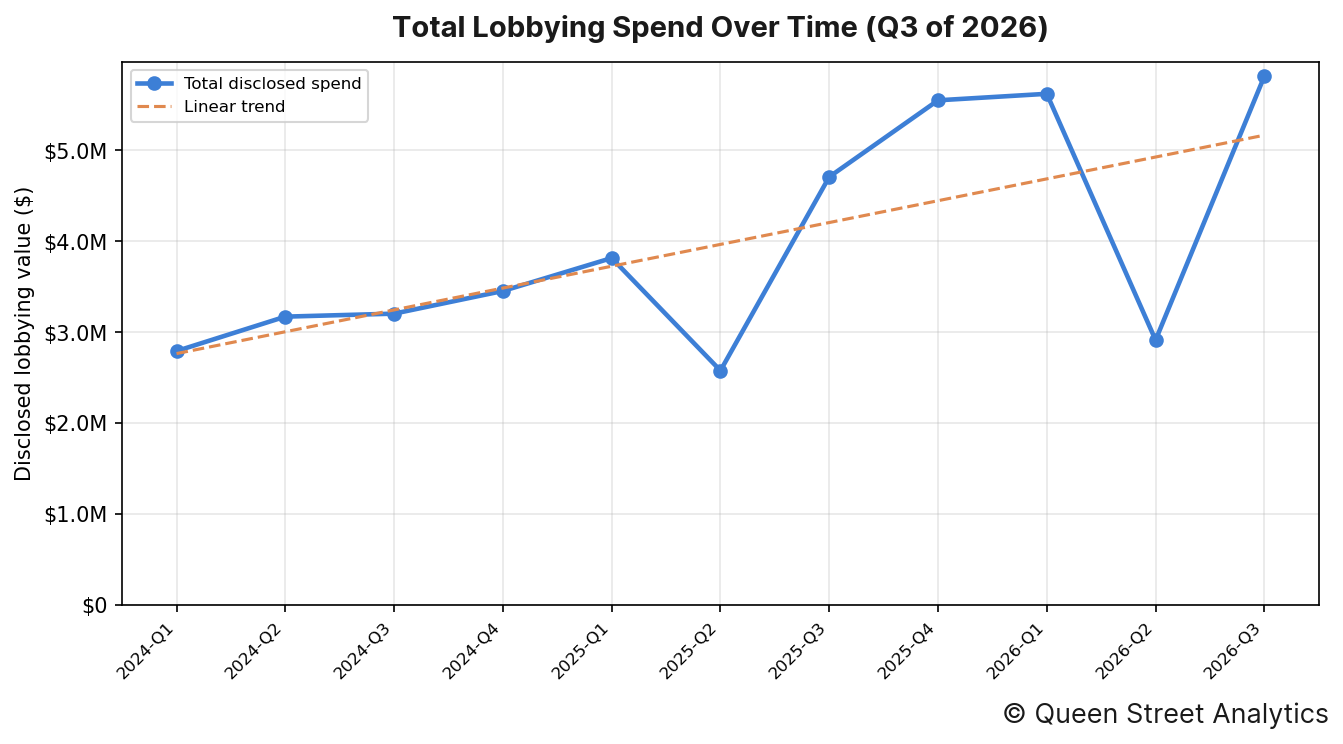
In Q3 of 2026, there was $5.8M worth of disclosed lobbying activity on Foreign Affairs. Across the 11 quarters shown, the channel's total disclosed spend has risen over this period.
Organizations' Lobby Spend
The image below shows the organizations whose lobbying spend moved most from their six-quarter average.
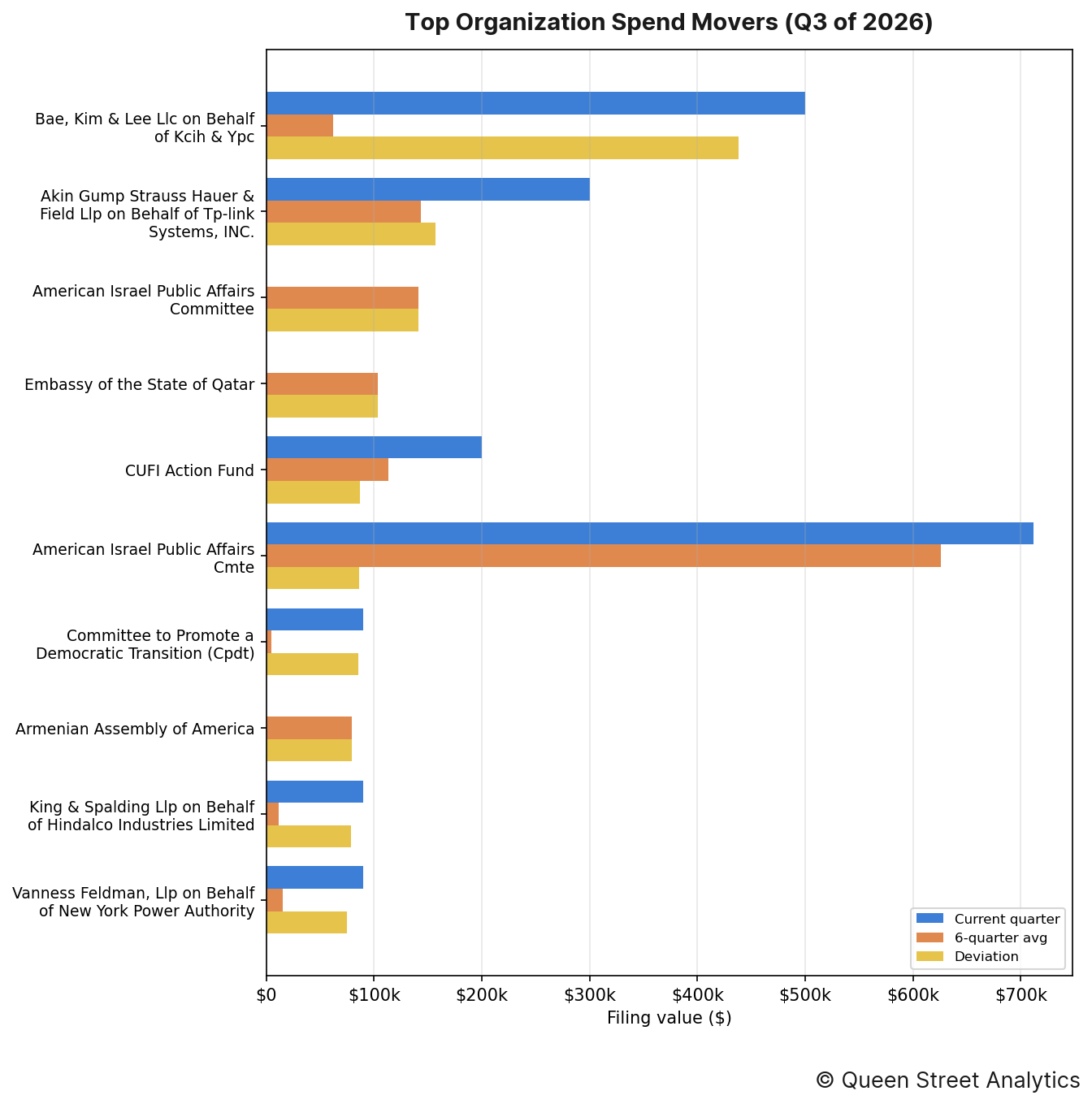
The organizations whose spending moved most from their own recent quarterly average were as follows:
↳ Bae, Kim & Lee Llc on Behalf of Kcih & Ypc accounted for $500k in disclosed lobbying, 711% higher than the recent quarterly average of $62k.
↳ Akin Gump Strauss Hauer & Field Llp on Behalf of Tp-link Systems, INC. accounted for $300k in disclosed lobbying, 109% higher than the recent quarterly average of $143k.
↳ American Israel Public Affairs Committee accounted for $0 in disclosed lobbying, 100% lower than the recent quarterly average of $141k.
↳ Embassy of the State of Qatar accounted for $0 in disclosed lobbying, 100% lower than the recent quarterly average of $103k.
↳ CUFI Action Fund accounted for $200k in disclosed lobbying, 77% higher than the recent quarterly average of $113k.
↳ American Israel Public Affairs Cmte accounted for $712k in disclosed lobbying, 14% higher than the recent quarterly average of $626k.
Section D: Government Entities Lobbied
This section documents this quarter's most lobbied federal government departments.
By industry
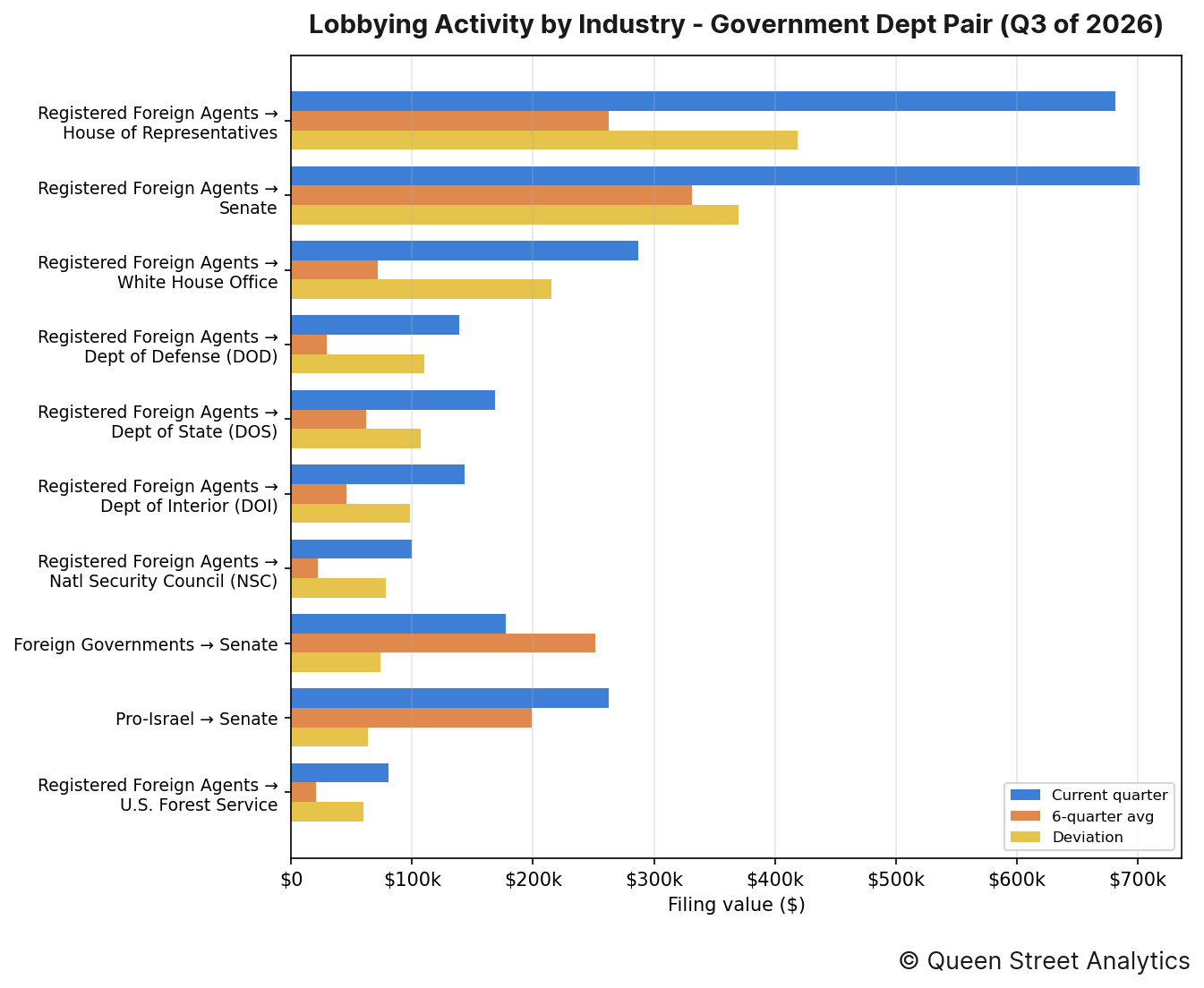
The industry–entity pairings that moved most this quarter were as follows:
↳ Registered Foreign Agents directed $681k of lobbying toward House of Representatives, 160% higher than the recent quarterly average of $263k.
↳ Registered Foreign Agents directed $701k of lobbying toward Senate, 112% higher than the recent quarterly average of $332k.
↳ Registered Foreign Agents directed $287k of lobbying toward White House Office, 300% higher than the recent quarterly average of $72k.
By organization
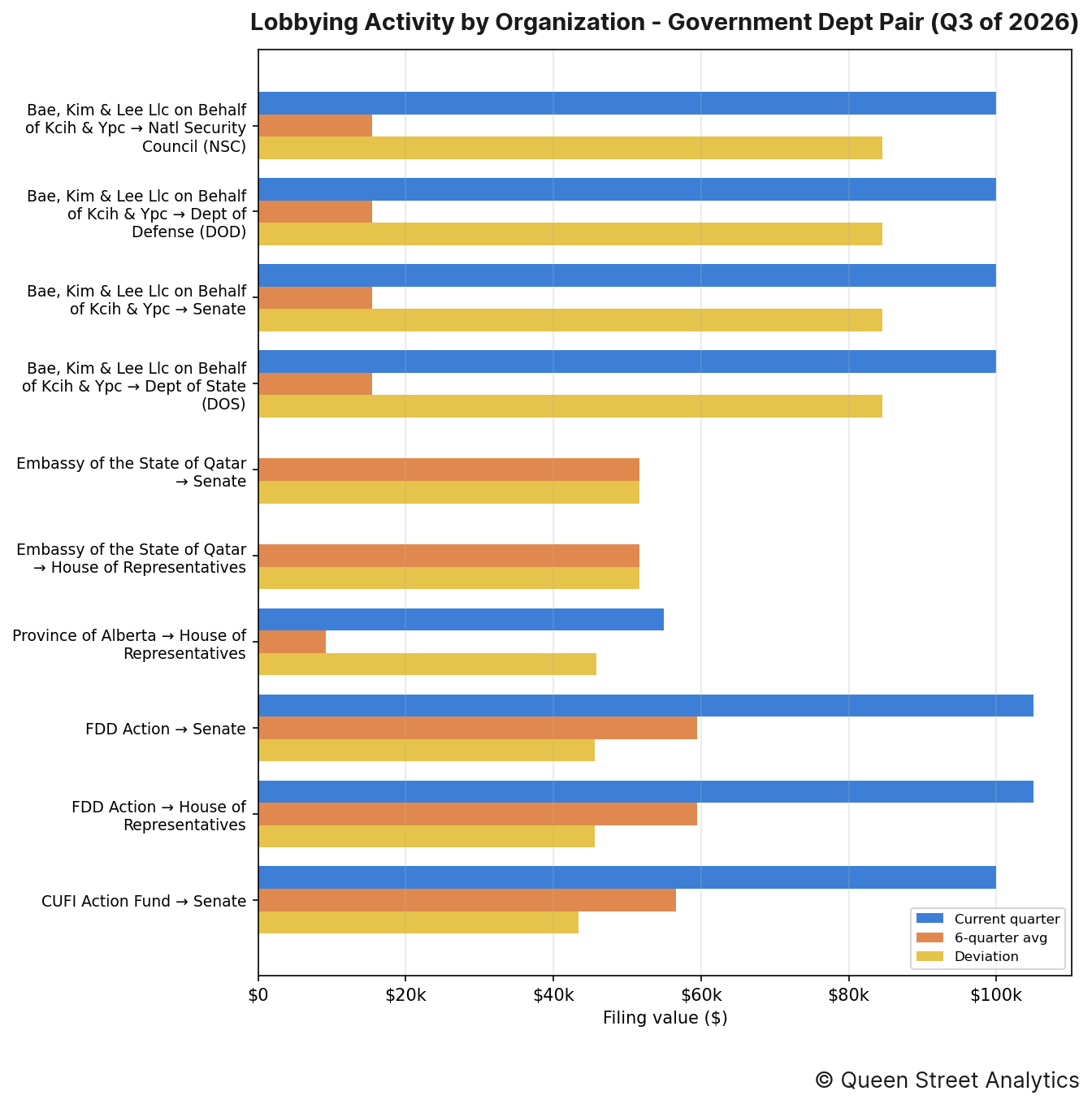
The organization–entity pairings that moved most this quarter were as follows:
↳ Bae, Kim & Lee Llc on Behalf of Kcih & Ypc directed $100k of lobbying toward Natl Security Council (NSC), 549% higher than the recent quarterly average of $15k.
↳ Bae, Kim & Lee Llc on Behalf of Kcih & Ypc directed $100k of lobbying toward Dept of Defense (DOD), 549% higher than the recent quarterly average of $15k.
↳ Bae, Kim & Lee Llc on Behalf of Kcih & Ypc directed $100k of lobbying toward Senate, 549% higher than the recent quarterly average of $15k.
Section E: Lobbying Issues
This section documents this quarter's most lobbied-on issues.
By industry
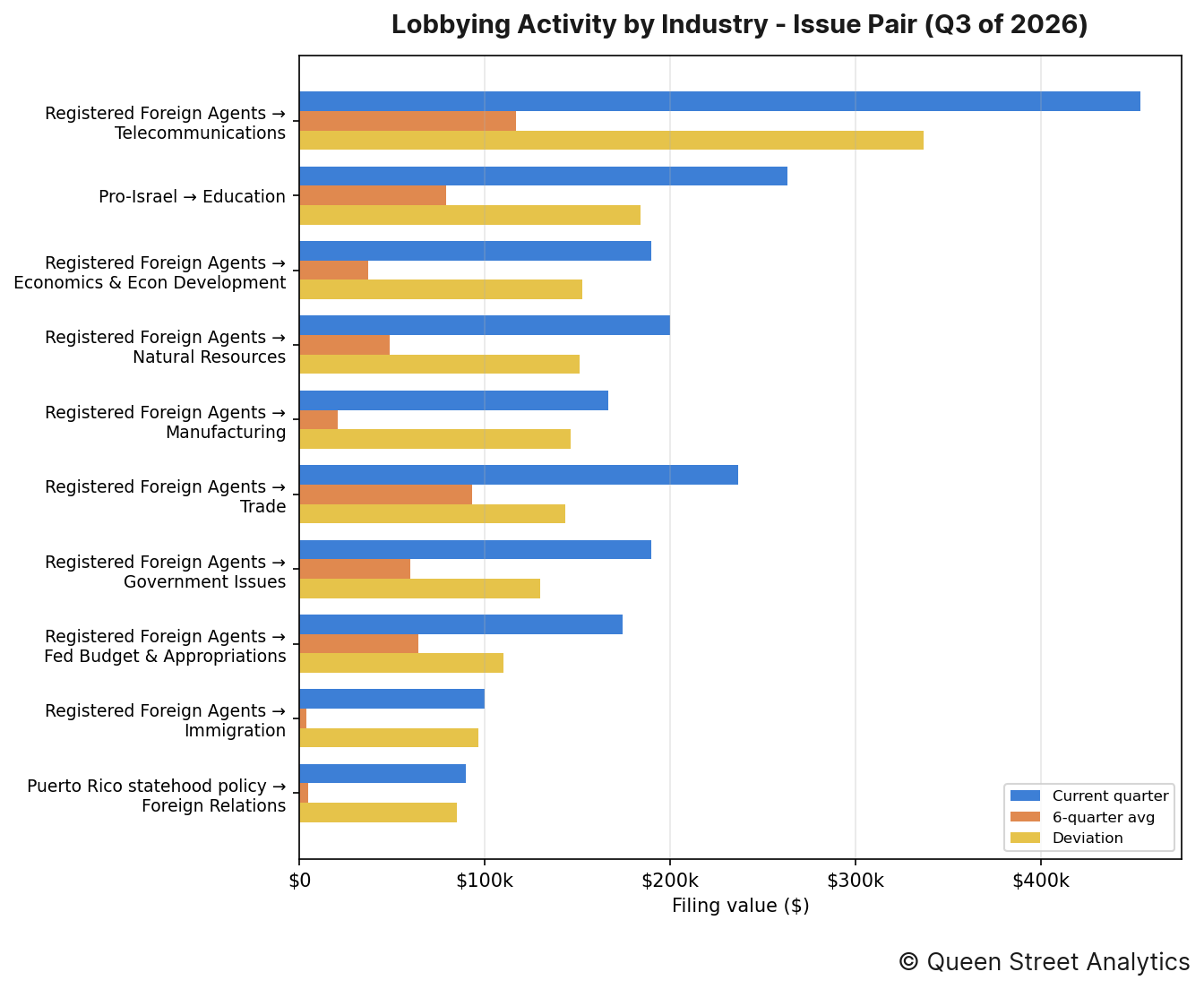
The industry–issue pairings that moved most this quarter were as follows:
↳ Registered Foreign Agents put $453k toward lobbying on Telecommunications, 289% higher than the recent quarterly average of $117k.
↳ Pro-Israel put $263k toward lobbying on Education, 233% higher than the recent quarterly average of $79k.
↳ Registered Foreign Agents put $190k toward lobbying on Economics & Econ Development, 410% higher than the recent quarterly average of $37k.
By organization
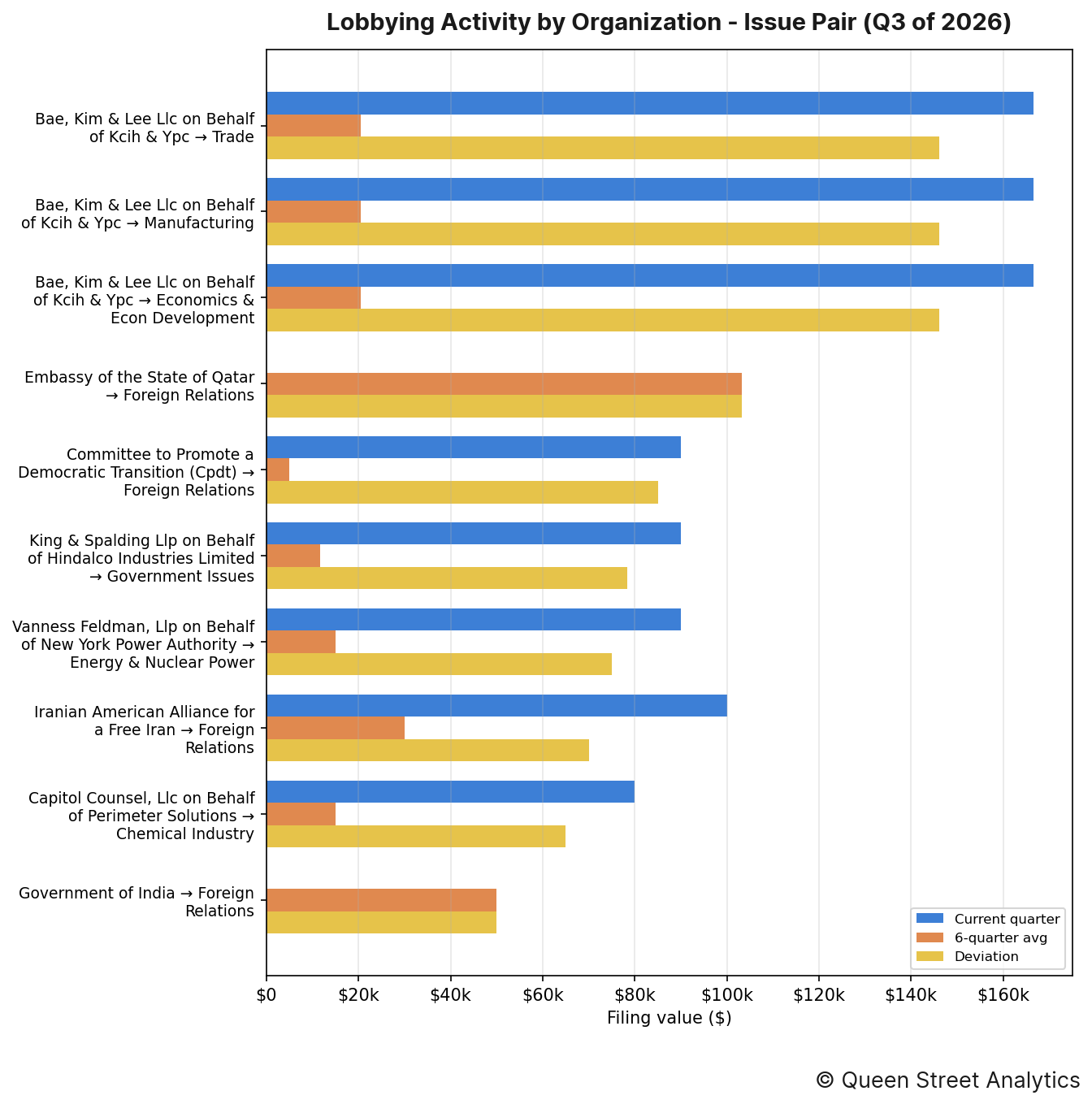
The organization–issue pairings that moved most this quarter were as follows:
↳ Bae, Kim & Lee Llc on Behalf of Kcih & Ypc put $167k toward lobbying on Trade, 711% higher than the recent quarterly average of $21k.
↳ Bae, Kim & Lee Llc on Behalf of Kcih & Ypc put $167k toward lobbying on Manufacturing, 711% higher than the recent quarterly average of $21k.
↳ Bae, Kim & Lee Llc on Behalf of Kcih & Ypc put $167k toward lobbying on Economics & Econ Development, 711% higher than the recent quarterly average of $21k.
Section F: Most-Active Lobbyists
The figure below lists the lobbyists who managed the most imputed lobbying value this quarter, alongside their firm or organization. Because a filing's value is split evenly across the lobbyists it names, these dollar figures are imputed rather than directly disclosed.
No lobbyist activity to report this quarter.
Section G: Organization Network
The header image for this edition maps how this channel's organizations (neutral nodes) connect to the federal entities they lobbied (colored nodes) this quarter. A link's weight is the filing value directed to that entity, and node size reflects total value; the House and Senate are excluded (nearly every organization lobbies them) so the specialized targets stand out.
The most widely lobbied entity this quarter was Dept of State (DOS), which was lobbied by 12 organizations.
Methodology
Every figure in this report starts from one number: the disclosed value of each lobbying filing, which we take as the income a registrant reported plus any in-house expenses (income + expenses) on its quarterly US Senate and House LDA disclosure. Before totalling anything we clean the filings — applying each amendment over the original it replaces, removing duplicates, and setting aside non-standard records such as registrations and terminations — and map every filing to a lobbying channel and industry using the organization's CRP industry code.
How the money is divided. A filing's full value counts once toward the organization that paid it and that organization's industry, so the industry and organization rankings (Sections A–C) reflect whole dollars. But a single filing usually names several government entities, several issue areas, and several lobbyists at once, and the disclosure never says how the fee was split among them. Rather than credit the full amount to each — which would count the same dollars over and over — we divide a filing's value evenly across the distinct items it names. So a $200,000 filing that lists four agencies contributes $50,000 to each in Section D, and the same even split is applied across issues in Section E and across lobbyists in Section F. That way every section's totals trace back to the same underlying money without double-counting.
Reading the movements. A “deviation” compares the quarter's value to the average of the prior six quarters, so a rise or fall is measured against an entity's own recent norm rather than against the rest of the field. Section B takes the wider view: it sums every industry into one channel total and plots it quarter by quarter, with a fitted line showing the overall direction of travel. Source: US Senate and House LDA disclosures.


