USA Lobbying on Fisheries - Washington (Q1 2026)





Center for Sportfishing Policy, At-sea Processors Association, Norpac Fisheries Export, Bonefish and Tarpon Trust were unusually active lobbyists this quarter.
View the interactive network in Queen Street Analytics →
Each quarter we track movements in US federal lobbying, channel by channel. This edition covers Fisheries for Q1 of 2026, ranking the organizations, government entities, issues, and lobbyists whose disclosed spend moved most.
Central Themes in this Quarter’s Lobby Data
Surge in Recreational Fisheries Lobbying Amid NOAA Policy Update
Several trade groups, including the Center for Sportfishing Policy, National Fisheries Institute, and Southern Shrimp Alliance, have sharply stepped up federal advocacy as NOAA released a major policy update in April 2026—including efforts focused on the Magnuson-Stevens Act, vessel speed restrictions, and data modernization. The Center for Sportfishing Policy, in particular, appears increasingly engaged with both NOAA and the Department of Commerce on regulatory reforms and management priorities.
📎 National Saltwater Recreational Fisheries Policy 2026 · National Saltwater Recreational Fisheries Policy 2026 · Fisheries Policy Report – Spring 2026 - Ocean Strategies
Executive Order on Seafood Competitiveness Fuels Extra Industry Advocacy
Federal requirements following E.O. 14276—mandating action to boost U.S. seafood exports and address the seafood trade deficit—may be amplifying industry advocacy. Export-focused associations such as At-sea Processors Association, which has recently increased its lobbying efforts in Congress and with the U.S. Trade Representative (USTR), and Norpac Fisheries Export are among those substantially increasing their federal lobbying investments. National Fisheries Institute is also active, directing advocacy on international trade issues to the U.S. International Trade Commission and the Executive Office of the President.
📎 Updated June 24, 2026 President Trump’s April 2025 Executive Order on ... · Fisheries Policy Report – Spring 2026 - Ocean Strategies
Federal and State Agencies Finalize New 2026 Fishing Regulations Amid Intense Advocacy
Several new fishing laws—including harvest limits and species-specific quotas—took effect across jurisdictions in early 2026, reportedly prompting a wave of targeted lobbying by groups such as Lunds Fisheries, Ocean Peace, Llc, and Pacific States Marine Fisheries Commission with agencies like the U.S. Fish & Wildlife Service and the National Oceanic & Atmospheric Administration. Observers note that rapid regulatory updates are encouraging significant engagement by sportfishing, wildlife, and seafood trade groups, including Opes Oceani Llc, seeking clarity or changes.
📎 New Fishing Laws & Regulation Changes Taking Effect in 2026 · 2026 Fishing Regulation Changes: Every Major New Rule This Season · Latest Fishing Industry Regulations Anglers Should Know in 2026
NOAA Advances Data Modernization and Vessel Speed Review as Lobbying Climbs
NOAA’s new initiatives—including data modernization under RAPID and a high-profile review of vessel speed rules—have drawn significant advocacy from recreational and conservation sectors, with the Center for Sportfishing Policy engaging directly with the National Oceanic & Atmospheric Administration, the Department of Commerce, and both chambers of Congress. These policy moves, especially around state-federal management and technology, are a focus of filings by groups like the Center for Sportfishing Policy and the Pacific States Marine Fisheries Commission.
📎 NOAA Leadership Announces Major Reforms State-Led Fisheries Management ... · Fisheries Policy Report – Spring 2026 - Ocean Strategies
Endangered Species Act Rule Changes Heighten Fisheries Advocacy
The finalization of ESA regulatory revisions—including changes to definitions of 'harm' and critical habitat—may have intensified lobbying by both fishery and wildlife interests. These agency actions have implications for fisheries management, permitting, and grant programs frequently cited in recent advocacy filings.
📎 Endangered Species Act Regulation Revisions - U.S. Fish & Wildlife Service · FWS Regulatory Agenda 2026 - Regulation Roundup

Section A: Lobbying Spend by Industry
How much each industry in this channel spent on federal lobbying in Q1 of 2026, compared with its average over the prior six quarters.
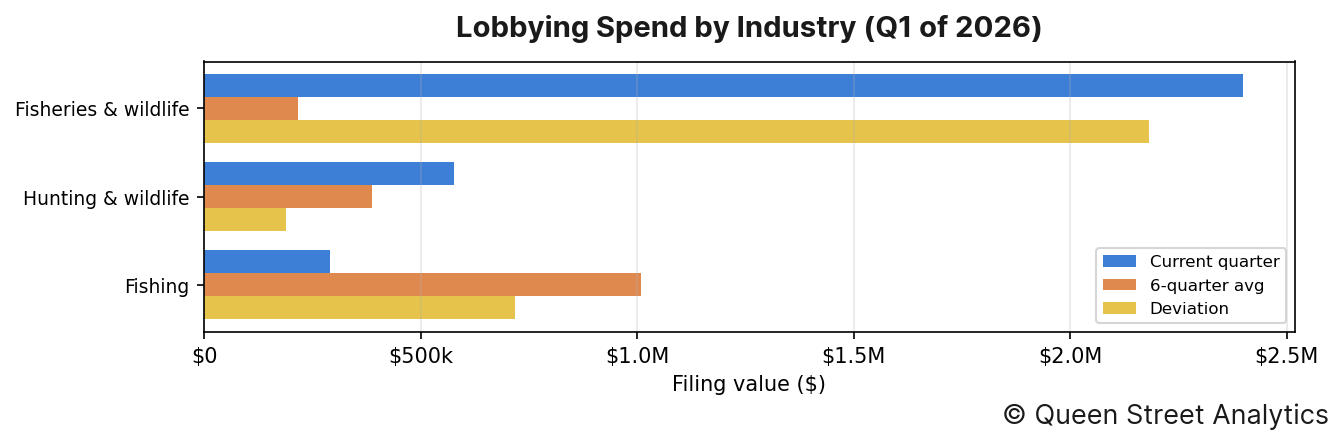
In Q1 of 2026, there was $3.3M worth of disclosed lobbying activity on Fisheries, 102% higher than the recent quarterly average of $1.6M. This activity can be broken down by industry as follows:
↳ There was $2.4M worth of Fisheries & wildlife lobbying, 1006% higher than the recent quarterly average of $217k.
↳ There was $577k worth of Hunting & wildlife lobbying, 49% higher than the recent quarterly average of $387k.
↳ There was $291k worth of Fishing lobbying, 71% lower than the recent quarterly average of $1.0M.
Section B: Lobbying Spend Trend
This channel's total disclosed lobbying spend across recent quarters, aggregated over all of its industries.
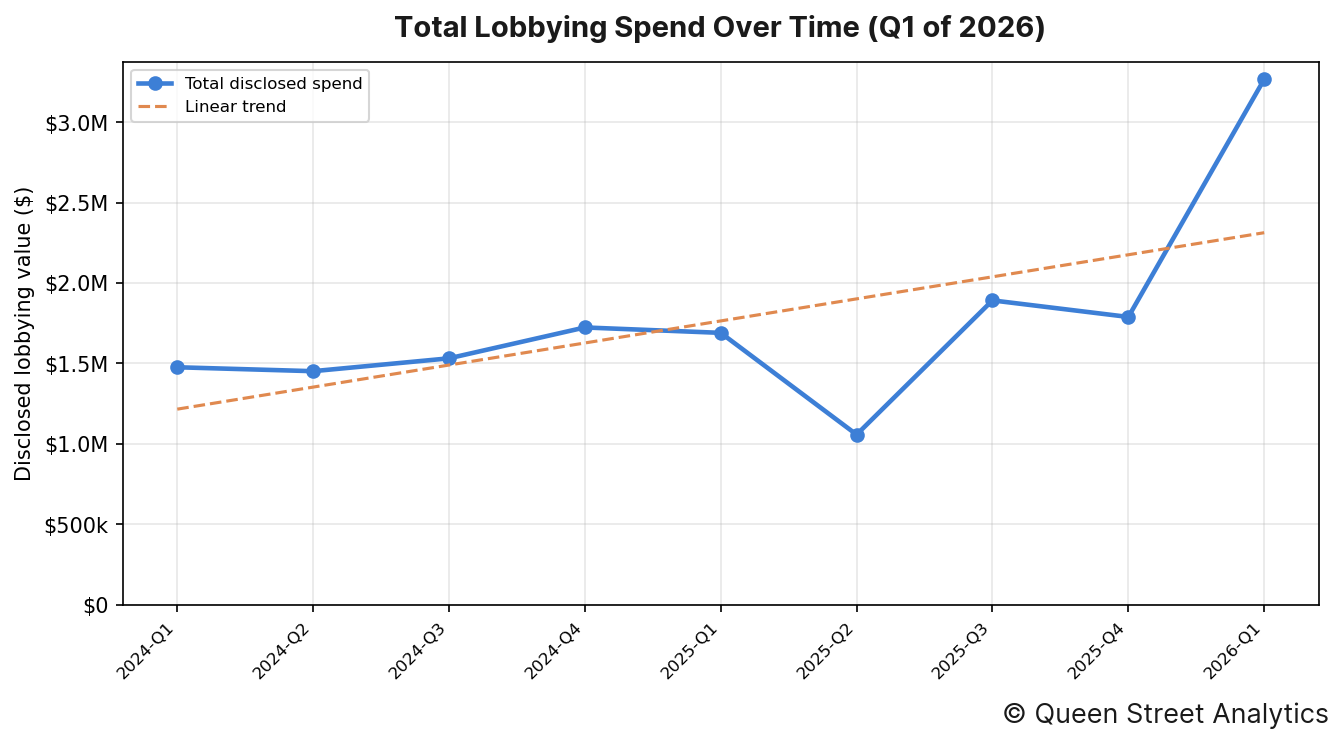
In Q1 of 2026, there was $3.3M worth of disclosed lobbying activity on Fisheries. Across the 9 quarters shown, the channel's total disclosed spend has risen over this period.
Organizations' Lobby Spend
The image below shows the organizations whose lobbying spend moved most from their six-quarter average.
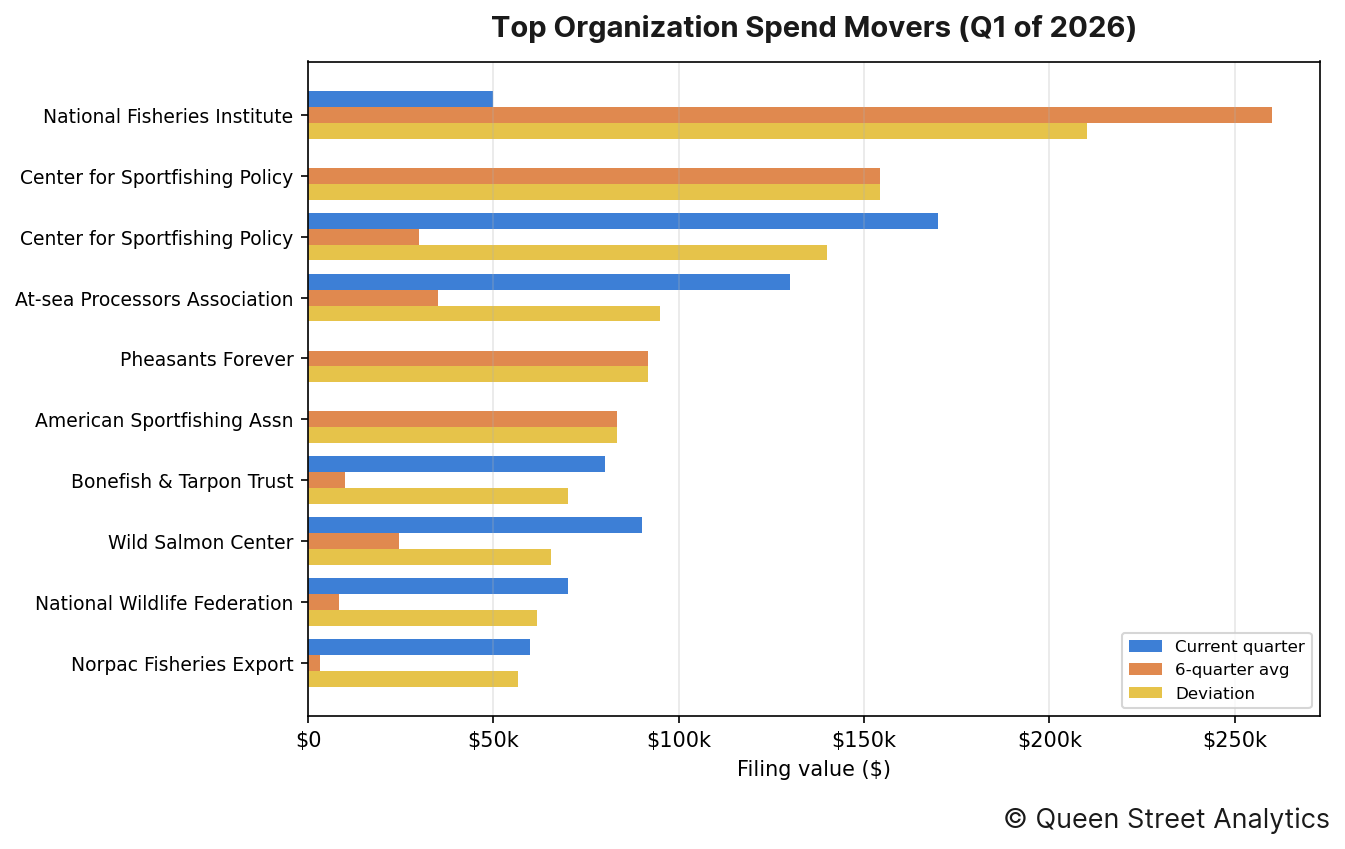
The organizations whose spending moved most from their own recent quarterly average were as follows:
↳ National Fisheries Institute accounted for $50k in disclosed lobbying, 81% lower than the recent quarterly average of $260k.
↳ Center for Sportfishing Policy accounted for $0 in disclosed lobbying, 100% lower than the recent quarterly average of $154k.
↳ Center for Sportfishing Policy accounted for $170k in disclosed lobbying, 467% higher than the recent quarterly average of $30k.
↳ At-sea Processors Association accounted for $130k in disclosed lobbying, 271% higher than the recent quarterly average of $35k.
↳ Pheasants Forever accounted for $0 in disclosed lobbying, 100% lower than the recent quarterly average of $92k.
↳ American Sportfishing Assn accounted for $0 in disclosed lobbying, 100% lower than the recent quarterly average of $83k.
Section D: Government Entities Lobbied
This section documents this quarter's most lobbied federal government departments.
By industry
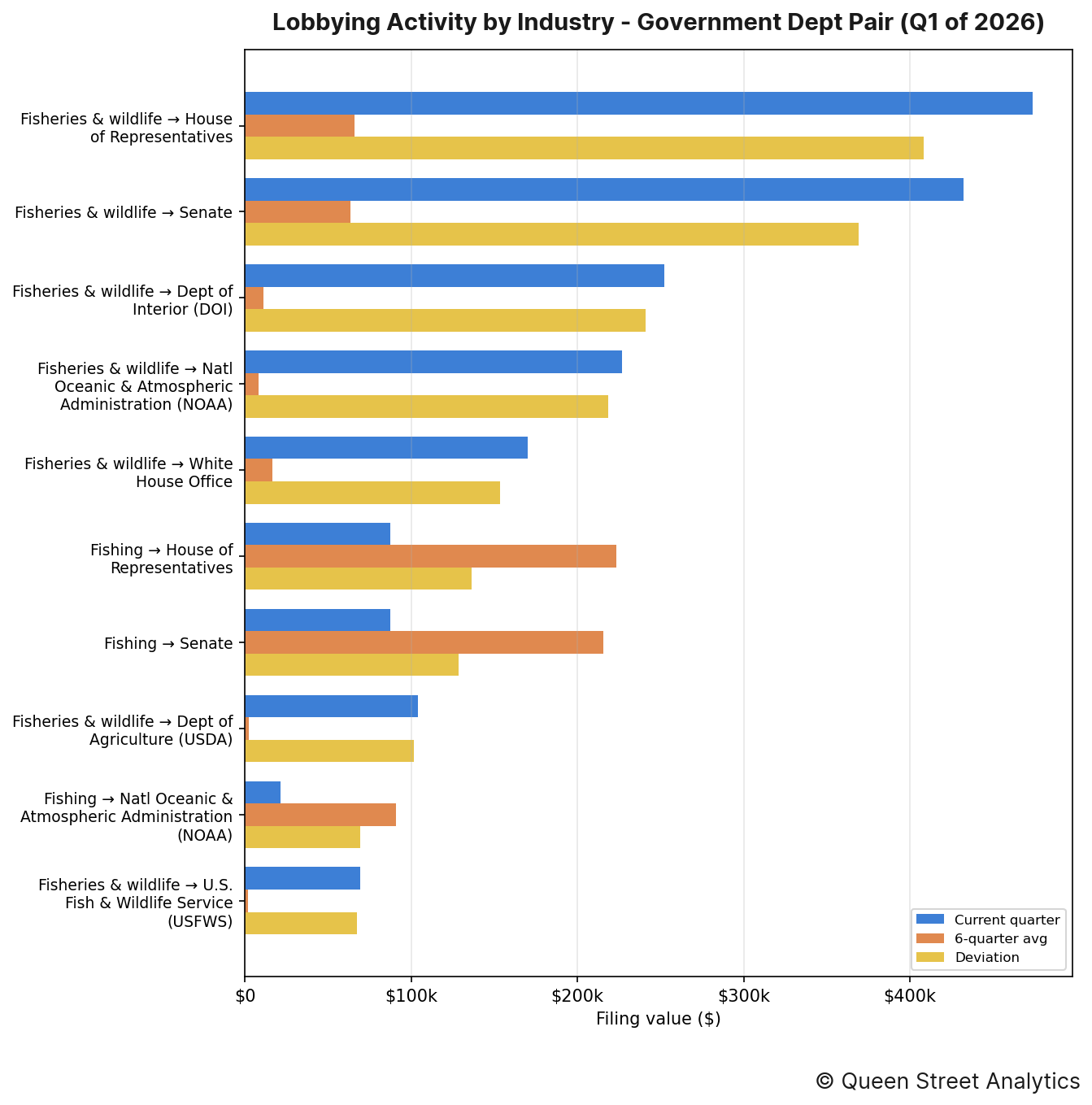
The industry–entity pairings that moved most this quarter were as follows:
↳ Fisheries & wildlife directed $474k of lobbying toward House of Representatives, 620% higher than the recent quarterly average of $66k.
↳ Fisheries & wildlife directed $432k of lobbying toward Senate, 583% higher than the recent quarterly average of $63k.
↳ Fisheries & wildlife directed $252k of lobbying toward Dept of Interior (DOI), 2137% higher than the recent quarterly average of $11k.
By organization
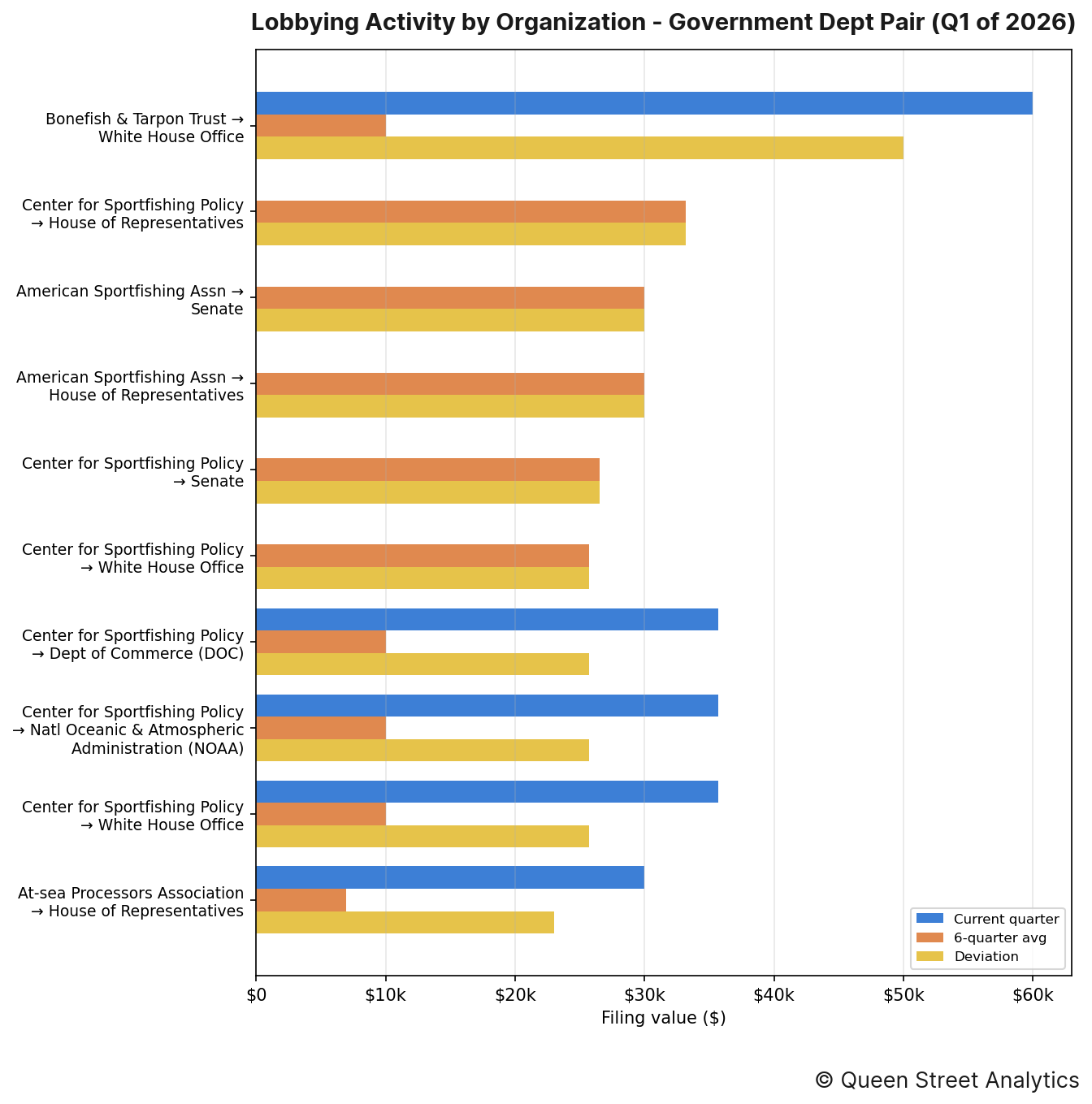
The organization–entity pairings that moved most this quarter were as follows:
↳ Bonefish & Tarpon Trust directed $60k of lobbying toward White House Office, 500% higher than the recent quarterly average of $10k.
↳ Center for Sportfishing Policy directed $0 of lobbying toward House of Representatives, 100% lower than the recent quarterly average of $33k.
↳ American Sportfishing Assn directed $0 of lobbying toward Senate, 100% lower than the recent quarterly average of $30k.
Section E: Lobbying Issues
This section documents this quarter's most lobbied-on issues.
By industry
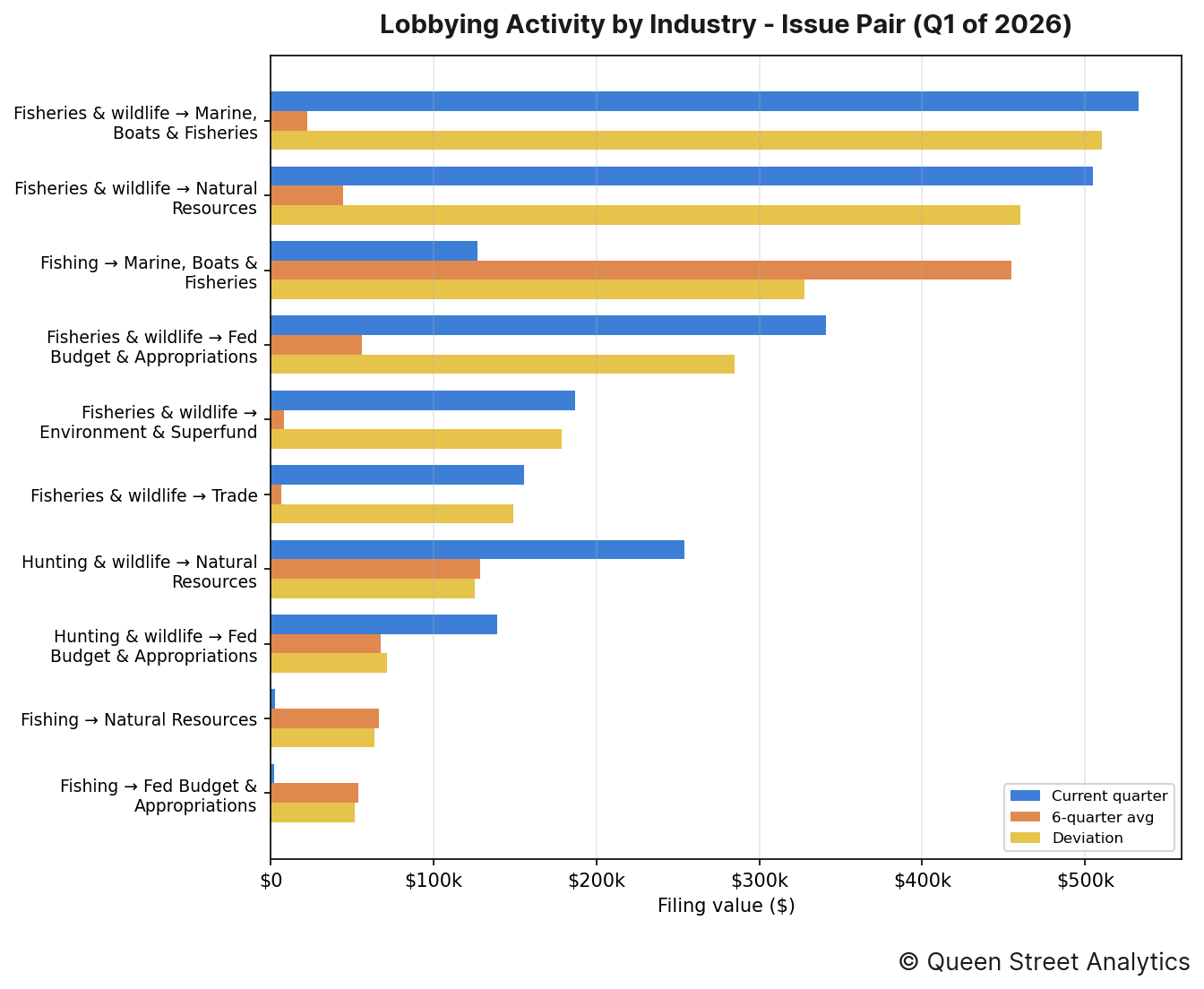
The industry–issue pairings that moved most this quarter were as follows:
↳ Fisheries & wildlife put $533k toward lobbying on Marine, Boats & Fisheries, 2282% higher than the recent quarterly average of $22k.
↳ Fisheries & wildlife put $505k toward lobbying on Natural Resources, 1029% higher than the recent quarterly average of $45k.
↳ Fishing put $127k toward lobbying on Marine, Boats & Fisheries, 72% lower than the recent quarterly average of $455k.
By organization
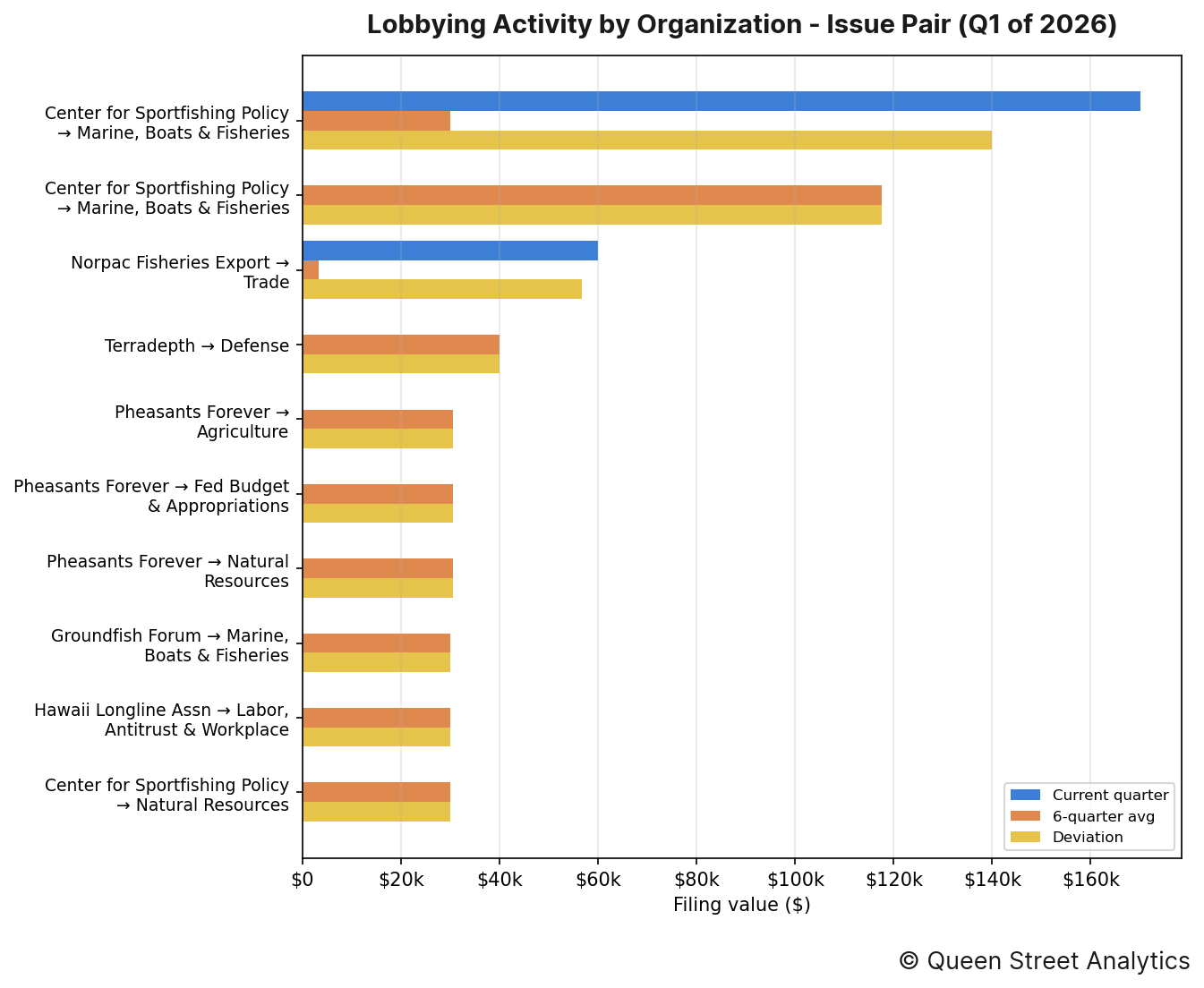
The organization–issue pairings that moved most this quarter were as follows:
↳ Center for Sportfishing Policy put $170k toward lobbying on Marine, Boats & Fisheries, 467% higher than the recent quarterly average of $30k.
↳ Center for Sportfishing Policy put $0 toward lobbying on Marine, Boats & Fisheries, 100% lower than the recent quarterly average of $118k.
↳ Norpac Fisheries Export put $60k toward lobbying on Trade, 1700% higher than the recent quarterly average of $3k.
Section F: Most-Active Lobbyists
The figure below lists the lobbyists who managed the most imputed lobbying value this quarter, alongside their firm or organization. Because a filing's value is split evenly across the lobbyists it names, these dollar figures are imputed rather than directly disclosed.

The lobbyists who managed the most imputed lobbying value this quarter were as follows:
Section G: Organization Network
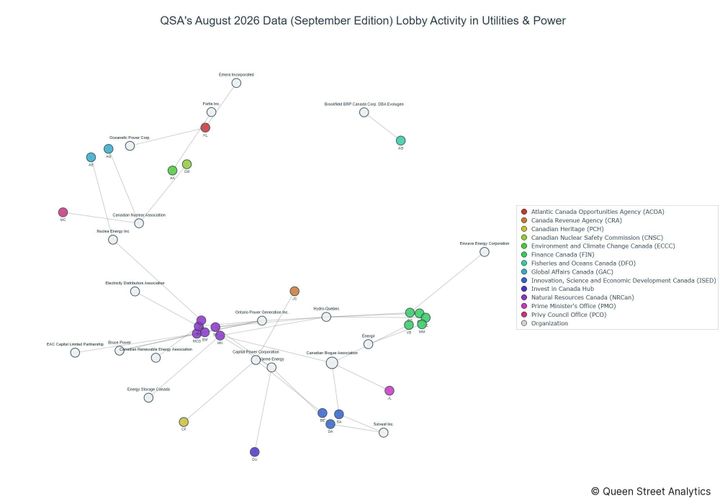
The header image for this edition maps how this channel's organizations (neutral nodes) connect to the federal entities they lobbied (colored nodes) this quarter. A link's weight is the filing value directed to that entity, and node size reflects total value; the House and Senate are excluded (nearly every organization lobbies them) so the specialized targets stand out.
The most widely lobbied entity this quarter was Dept of Interior (DOI), which was lobbied by 11 organizations.
Methodology
Every figure in this report starts from one number: the disclosed value of each lobbying filing, which we take as the income a registrant reported plus any in-house expenses (income + expenses) on its quarterly US Senate and House LDA disclosure. Before totalling anything we clean the filings — applying each amendment over the original it replaces, removing duplicates, and setting aside non-standard records such as registrations and terminations — and map every filing to a lobbying channel and industry using the organization's CRP industry code.
How the money is divided. A filing's full value counts once toward the organization that paid it and that organization's industry, so the industry and organization rankings (Sections A–C) reflect whole dollars. But a single filing usually names several government entities, several issue areas, and several lobbyists at once, and the disclosure never says how the fee was split among them. Rather than credit the full amount to each — which would count the same dollars over and over — we divide a filing's value evenly across the distinct items it names. So a $200,000 filing that lists four agencies contributes $50,000 to each in Section D, and the same even split is applied across issues in Section E and across lobbyists in Section F. That way every section's totals trace back to the same underlying money without double-counting.
Reading the movements. A “deviation” compares the quarter's value to the average of the prior six quarters, so a rise or fall is measured against an entity's own recent norm rather than against the rest of the field. Section B takes the wider view: it sums every industry into one channel total and plots it quarter by quarter, with a fitted line showing the overall direction of travel. Source: US Senate and House LDA disclosures.