USA Lobbying on Construction & Housing - Washington (Q3 2026)


Tipco Asphalt Public Company Limited, Vulcan Materials, Metcon INC., Acciona Infrastructure Usa Corp, and CEMEX Inc were unusually active lobbyists this quarter.
View the interactive network in Queen Street Analytics →
Each quarter we track movements in US federal lobbying, channel by channel. This edition covers Construction & Housing for Q3 of 2026, ranking the organizations, government entities, issues, and lobbyists whose disclosed spend moved most.
Central Themes in this Quarter’s Lobby Data
EPA PFAS Rules Trigger Heightened Sector Uncertainty
Recent EPA moves to rescind national standards for several PFAS chemicals, while strengthening others, are generating substantial uncertainty for construction players. Industry lobbying has reportedly intensified in response to shifting federal and state rules that directly affect liability and site operations, as stakeholders seek clarity and relief amid complex compliance demands.
📎 EPA Proposed PFAS Rescission Rule · DLA Piper PFAS Update · IHMM PFAS Regulation Update
Tariff Surges Spark Industry Pushback and Price Volatility
Substantial increases to Section 232 tariffs on steel, aluminum, and copper, as well as expanded duties on kitchen cabinets and HVAC equipment in 2026, have stoked volatile materials prices and costs. Lobbying by Associated Builders & Contractors with the Dept of Commerce and the Executive Office of the President, Southwire Co with the House of Representatives, and National Assn of Home Builders with the Dept of Agriculture has reportedly ramped up sharply as groups pursue relief or exemptions, with steeper tariffs cited as a direct factor influencing project bids and procurement strategies.
📎 Construction Supply Magazine tariff guide · AGC Tariff Resource Center · BuilderMuse Analysis
Congress Debates Highway Bill, Construction Firms Seek Influence
Congressional negotiations on the BUILD America 250 Act are prompting heightened lobbying from contractors and public works groups, including Independent Electrical Contractors who have engaged with the House of Representatives and the Senate. The bill seeks significant investments and reforms in surface transportation, with industry stakeholders such as Independent Electrical Contractors aiming to shape provisions affecting federal project funding and operating conditions amid broader fiscal and regulatory uncertainties.
📎 House T&I Committee — BUILD America 250 Act · CRS Surface Transportation Reauthorization report (July 2026) · AASHTO Journal on CR and Funding Extension
Venezuelan Crude Import Licenses Fuel Asphalt Industry Lobbying
Following a partial lifting of U.S. restrictions on Venezuelan crude imports, firms in the asphalt sector, such as Tipco Asphalt Public Company Limited, are escalating their advocacy around Treasury and State licensing by engaging with the Dept of Treasury and Dept of State. The evolving framework is widely believed to impact procurement and compliance for U.S. infrastructure projects, with lobbying surges reportedly focused on improving access and mitigating regulatory hurdles.
📎 Issuance of Venezuela-related General Licenses and Amended Frequently ... · U.S. Government Issues General License Authorizing Transactions ... · The New Licensing Framework and the Reopening of Venezuela's Energy Sector
Legislation Targeting Mexican Trade Disputes Activates U.S. Materials Lobby
The passage of H.R. 7084, aimed at barring entry to U.S. ports for vessels tied to expropriated infrastructure abroad, has drawn significant lobbying from aggregates and construction material producers, including Independent Electrical Contractors, concerned with property rights and USMCA tensions. In particular, disputes involving Vulcan Materials and Mexican port facilities appear to be motivating industry groups, with Independent Electrical Contractors engaging the House of Representatives and the Dept of Commerce, to seek legislative remedies for fair trade and cross-border protection.
📎 House Rules Committee — H.R. 7084 · CBO Cost Estimate · Vulcan dispute coverage

Section A: Lobbying Spend by Industry
How much each industry in this channel spent on federal lobbying in Q3 of 2026, compared with its average over the prior six quarters.
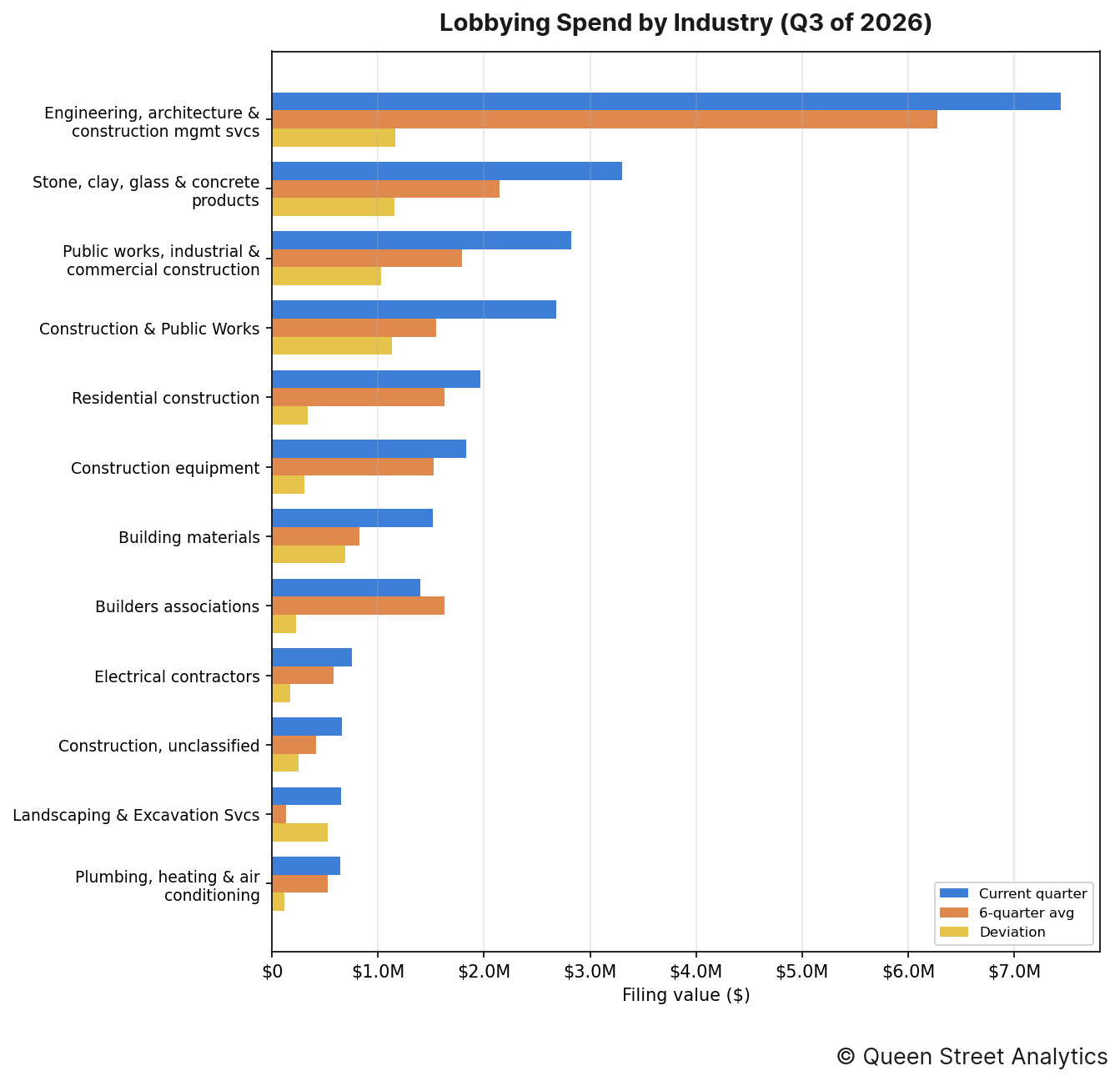
In Q3 of 2026, there was $28.9M worth of disclosed lobbying activity on Construction & Housing, 33% higher than the recent quarterly average of $21.7M. This activity can be broken down by industry as follows:
↳ There was $7.4M worth of Engineering, architecture & construction mgmt svcs lobbying, 19% higher than the recent quarterly average of $6.3M.
↳ There was $3.3M worth of Stone, clay, glass & concrete products lobbying, 54% higher than the recent quarterly average of $2.1M.
↳ There was $2.8M worth of Public works, industrial & commercial construction lobbying, 57% higher than the recent quarterly average of $1.8M.
↳ There was $2.7M worth of Construction & Public Works lobbying, 73% higher than the recent quarterly average of $1.5M.
↳ There was $2.0M worth of Residential construction lobbying, 21% higher than the recent quarterly average of $1.6M.
↳ There was $1.8M worth of Construction equipment lobbying, 20% higher than the recent quarterly average of $1.5M.
Section B: Lobbying Spend Trend
This channel's total disclosed lobbying spend across recent quarters, aggregated over all of its industries.
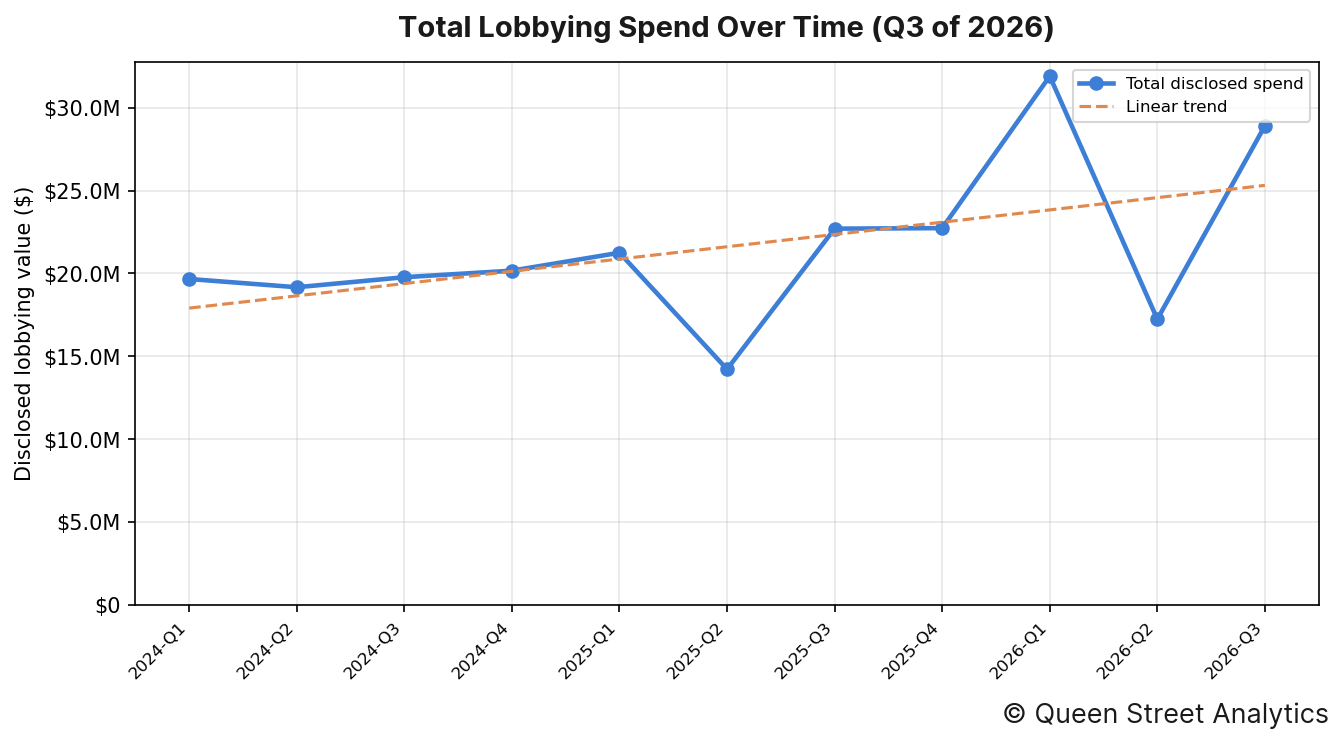
In Q3 of 2026, there was $28.9M worth of disclosed lobbying activity on Construction & Housing. Across the 11 quarters shown, the channel's total disclosed spend has risen over this period.
Organizations' Lobby Spend
The image below shows the organizations whose lobbying spend moved most from their six-quarter average.
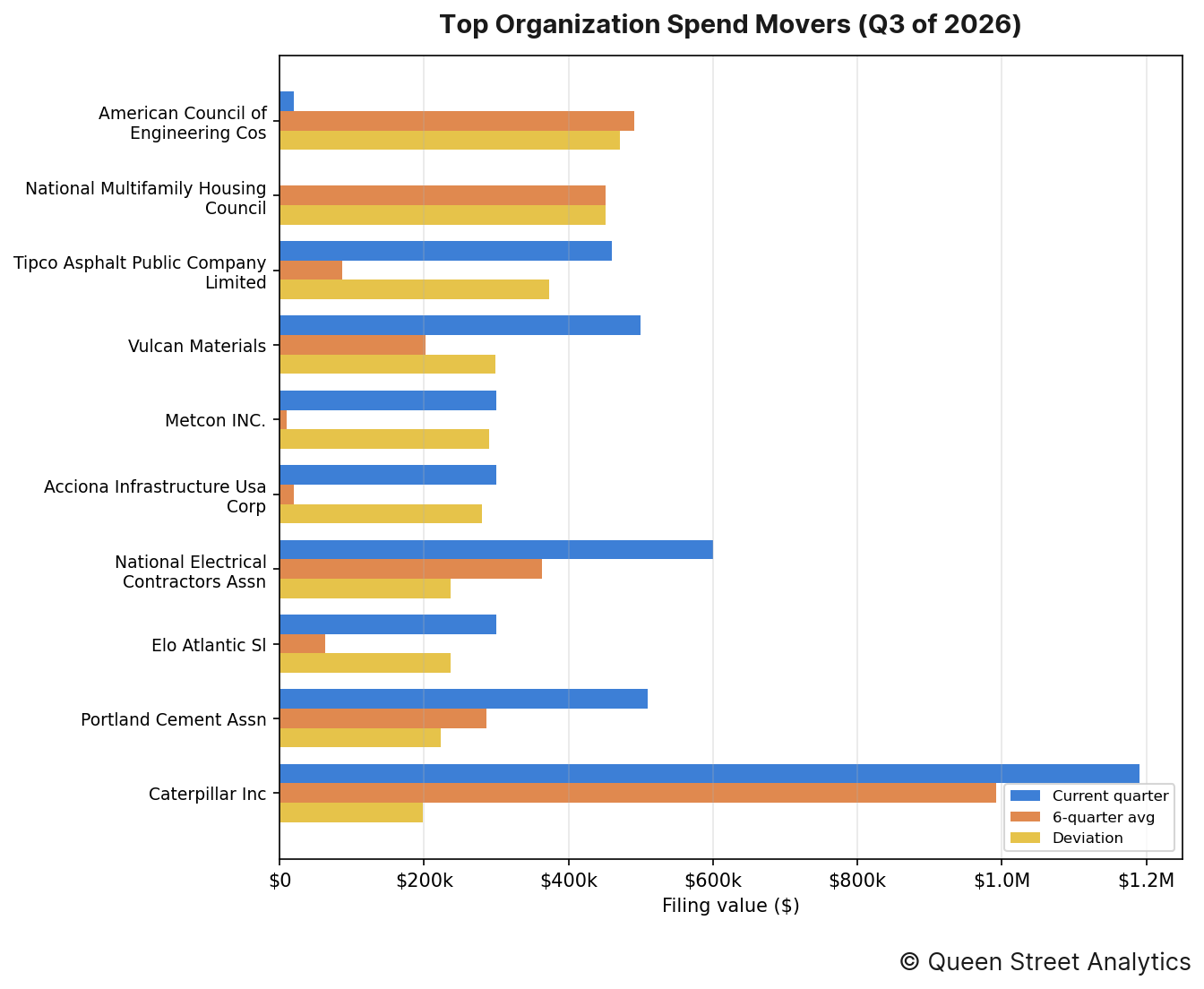
The organizations whose spending moved most from their own recent quarterly average were as follows:
↳ American Council of Engineering Cos accounted for $20k in disclosed lobbying, 96% lower than the recent quarterly average of $491k.
↳ National Multifamily Housing Council accounted for $0 in disclosed lobbying, 100% lower than the recent quarterly average of $452k.
↳ Tipco Asphalt Public Company Limited accounted for $460k in disclosed lobbying, 431% higher than the recent quarterly average of $87k.
↳ Vulcan Materials accounted for $500k in disclosed lobbying, 148% higher than the recent quarterly average of $202k.
↳ Metcon INC. accounted for $300k in disclosed lobbying, 2900% higher than the recent quarterly average of $10k.
↳ Acciona Infrastructure Usa Corp accounted for $300k in disclosed lobbying, 1400% higher than the recent quarterly average of $20k.
Section D: Government Entities Lobbied
This section documents this quarter's most lobbied federal government departments.
By industry
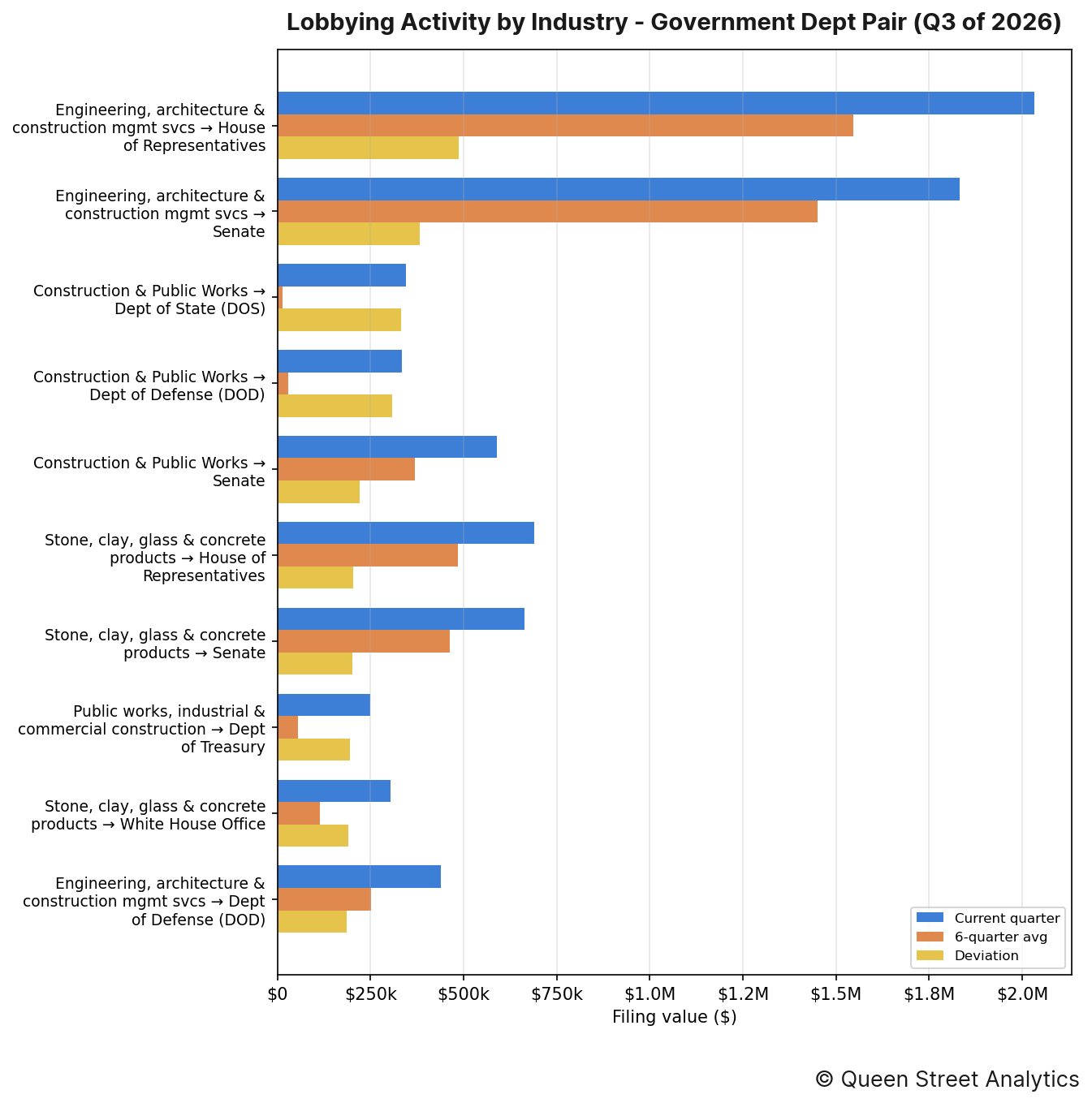
The industry–entity pairings that moved most this quarter were as follows:
↳ Engineering, architecture & construction mgmt svcs directed $2.0M of lobbying toward House of Representatives, 31% higher than the recent quarterly average of $1.5M.
↳ Engineering, architecture & construction mgmt svcs directed $1.8M of lobbying toward Senate, 26% higher than the recent quarterly average of $1.5M.
↳ Construction & Public Works directed $346k of lobbying toward Dept of State (DOS), 2576% higher than the recent quarterly average of $13k.
By organization
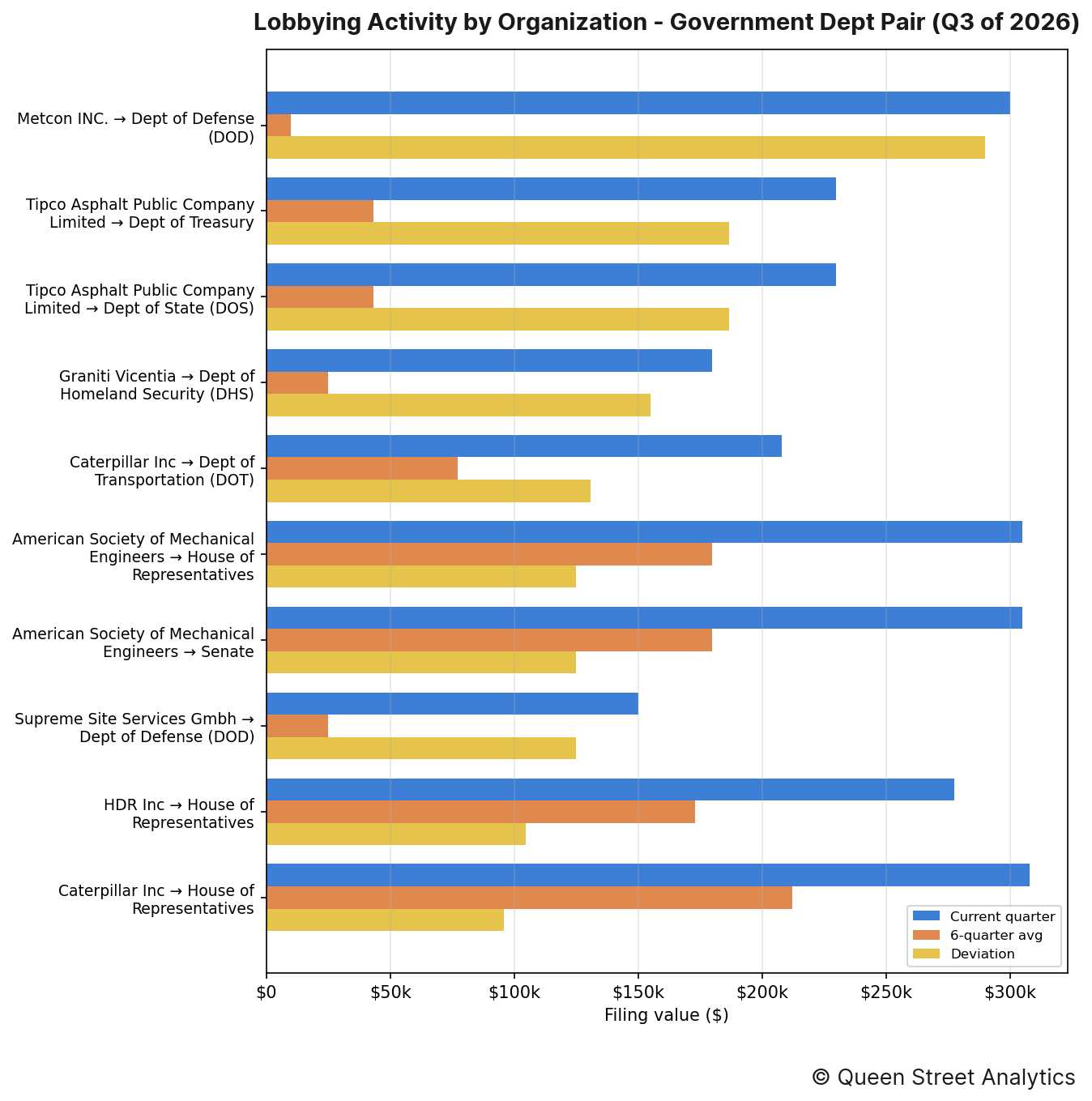
The organization–entity pairings that moved most this quarter were as follows:
↳ Metcon INC. directed $300k of lobbying toward Dept of Defense (DOD), 2900% higher than the recent quarterly average of $10k.
↳ Tipco Asphalt Public Company Limited directed $230k of lobbying toward Dept of Treasury, 431% higher than the recent quarterly average of $43k.
↳ Tipco Asphalt Public Company Limited directed $230k of lobbying toward Dept of State (DOS), 431% higher than the recent quarterly average of $43k.
Section E: Lobbying Issues
This section documents this quarter's most lobbied-on issues.
By industry
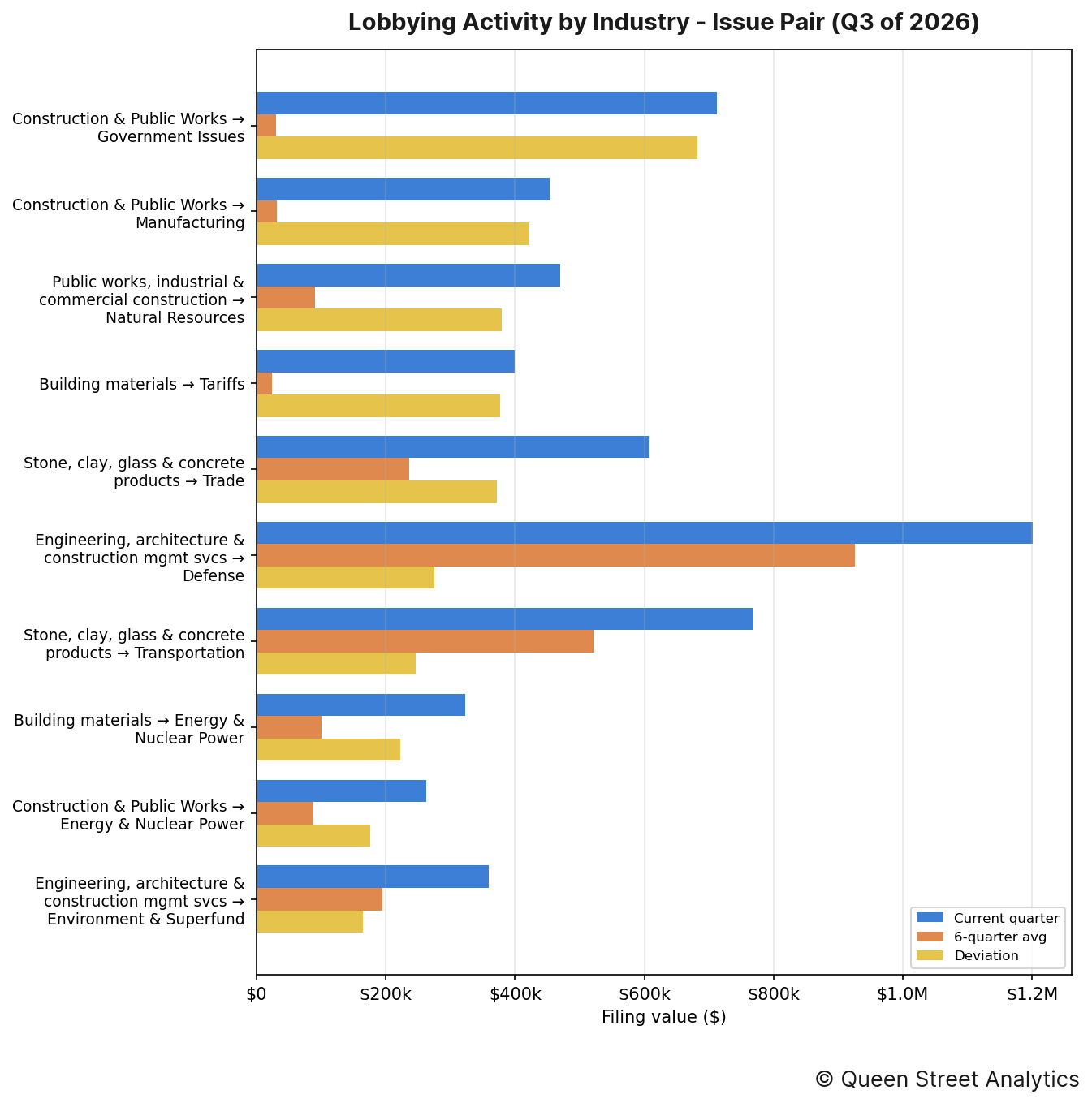
The industry–issue pairings that moved most this quarter were as follows:
↳ Construction & Public Works put $712k toward lobbying on Government Issues, 2268% higher than the recent quarterly average of $30k.
↳ Construction & Public Works put $453k toward lobbying on Manufacturing, 1332% higher than the recent quarterly average of $32k.
↳ Public works, industrial & commercial construction put $470k toward lobbying on Natural Resources, 422% higher than the recent quarterly average of $90k.
By organization
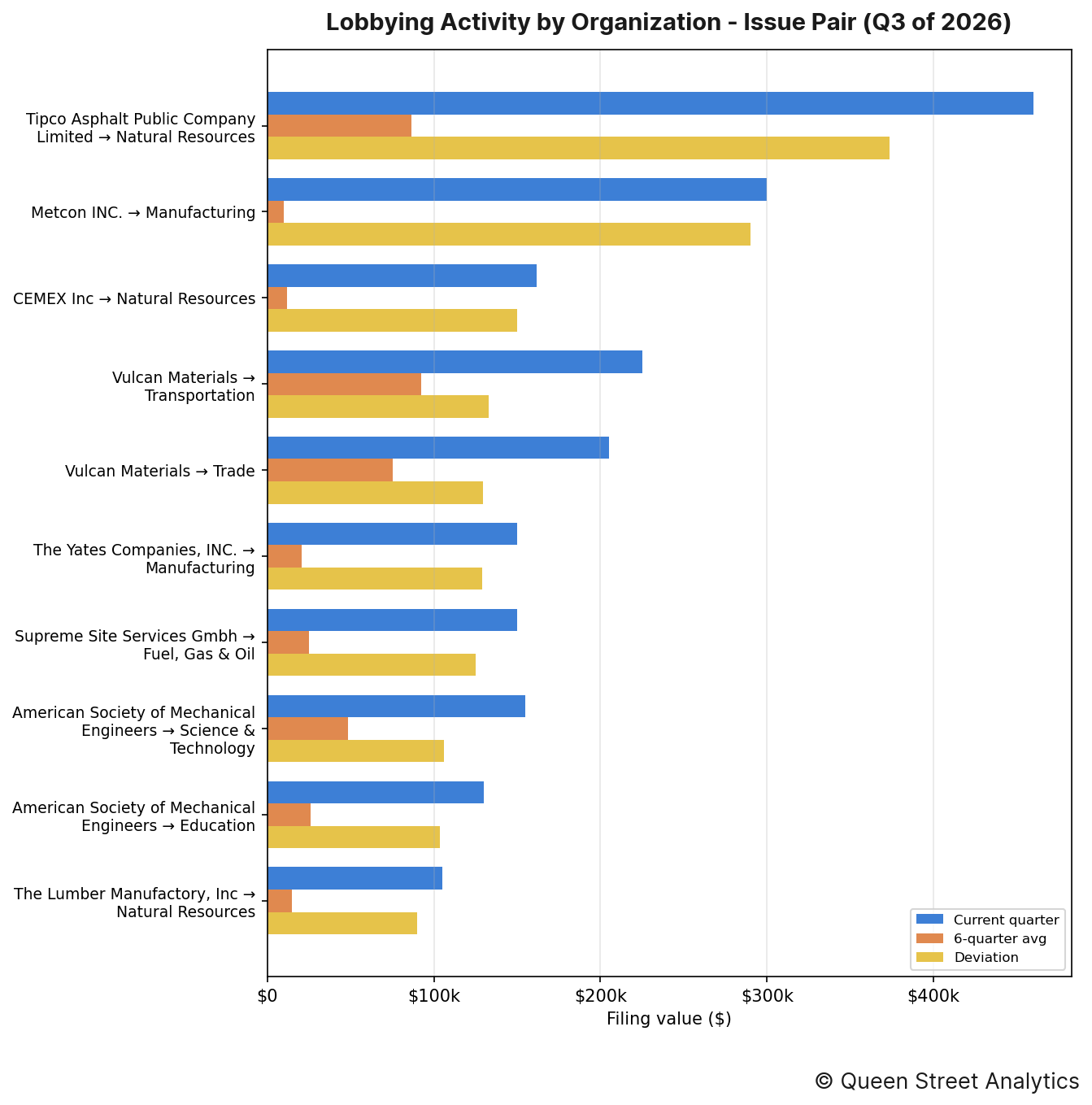
The organization–issue pairings that moved most this quarter were as follows:
↳ Tipco Asphalt Public Company Limited put $460k toward lobbying on Natural Resources, 431% higher than the recent quarterly average of $87k.
↳ Metcon INC. put $300k toward lobbying on Manufacturing, 2900% higher than the recent quarterly average of $10k.
↳ CEMEX Inc put $162k toward lobbying on Natural Resources, 1286% higher than the recent quarterly average of $12k.
Section F: Most-Active Lobbyists
The figure below lists the lobbyists who managed the most imputed lobbying value this quarter, alongside their firm or organization. Because a filing's value is split evenly across the lobbyists it names, these dollar figures are imputed rather than directly disclosed.
No lobbyist activity to report this quarter.
Section G: Organization Network
The header image for this edition maps how this channel's organizations (neutral nodes) connect to the federal entities they lobbied (colored nodes) this quarter. A link's weight is the filing value directed to that entity, and node size reflects total value; the House and Senate are excluded (nearly every organization lobbies them) so the specialized targets stand out.
The most widely lobbied entity this quarter was White House Office, which was lobbied by 10 organizations.
Methodology
Every figure in this report starts from one number: the disclosed value of each lobbying filing, which we take as the income a registrant reported plus any in-house expenses (income + expenses) on its quarterly US Senate and House LDA disclosure. Before totalling anything we clean the filings — applying each amendment over the original it replaces, removing duplicates, and setting aside non-standard records such as registrations and terminations — and map every filing to a lobbying channel and industry using the organization's CRP industry code.
How the money is divided. A filing's full value counts once toward the organization that paid it and that organization's industry, so the industry and organization rankings (Sections A–C) reflect whole dollars. But a single filing usually names several government entities, several issue areas, and several lobbyists at once, and the disclosure never says how the fee was split among them. Rather than credit the full amount to each — which would count the same dollars over and over — we divide a filing's value evenly across the distinct items it names. So a $200,000 filing that lists four agencies contributes $50,000 to each in Section D, and the same even split is applied across issues in Section E and across lobbyists in Section F. That way every section's totals trace back to the same underlying money without double-counting.
Reading the movements. A “deviation” compares the quarter's value to the average of the prior six quarters, so a rise or fall is measured against an entity's own recent norm rather than against the rest of the field. Section B takes the wider view: it sums every industry into one channel total and plots it quarter by quarter, with a fitted line showing the overall direction of travel. Source: US Senate and House LDA disclosures.


