USA Lobbying on Construction & Housing - Washington (Q1 2026)





National Association of Home Builders, Fluor Corporation, and Caterpillar Inc were unusually active lobbyists this quarter.
View the interactive network in Queen Street Analytics →
Each quarter we track movements in US federal lobbying, channel by channel. This edition covers Construction & Housing for Q1 of 2026, ranking the organizations, government entities, issues, and lobbyists whose disclosed spend moved most.
Central Themes in this Quarter’s Lobby Data
Sweeping Federal Housing Law Prompts Surge in Industry Engagement
The enactment of the 21st Century ROAD to Housing Act in July has spurred significant lobbying activity among builders associations and construction firms, including the National Multifamily Housing Council Inc and the Manufactured Housing Institute. The law’s broad reforms—including expanded support for housing development, streamlined permitting, and restrictions on bulk home purchases by institutional investors—have elevated the sector’s engagement with federal entities such as the Dept of Housing & Urban Development (HUD) and the Federal Housing Finance Agency (FHFA) on lending standards, federal grants, and local zoning reforms.
📎 H.R.6644 - 21st Century ROAD to Housing Act - Congress.gov · Inside the Deal: What’s in the Final 21st Century ROAD to Housing Act · The United States Enacts Sweeping Housing Reform Legislation to Expand ...
White House Order Seeks to Speed Up Construction Projects
A new executive order issued in March directs federal agencies, including those lobbied by Siff & Associates, Pllc (Obo the Mechanical Contractors Association of America) and the Power & Communication Contractors Association, to streamline housing-related regulations, specifically those impacting permitting and environmental reviews. These actions could reduce delays and costs for builders, with lobbying trends suggesting major construction firms and materials suppliers—such as the American Pipeline Contractors Association, which has engaged the White House Office—are closely tracking these regulatory shifts.
📎 Removing Regulatory Barriers to Affordable Home Construction · What’s in the 21st Century ROAD to Housing Act?
Housing Shortage and Soaring Prices Drive Federal Focus
Escalating home prices and a multi-million unit supply deficit have contributed to aggressive Congressional action and increased lobbying spend this quarter, with the National Multifamily Housing Council Inc and the Manufactured Housing Institute both directing sustained lobbying efforts toward the House of Representatives, the Senate, and the Department of Housing & Urban Development (HUD). Industry groups such as these highlight the urgent need for new housing construction, expanded affordability initiatives, and reforms to programs like FHA and LIHTC, with these market conditions cited as motivating factors behind recent legislative and lobbying efforts.
📎 What 21st Century ROAD to Housing Act means for homebuyers and ... - CNBC · What Is in the Housing Bill? A Complete Breakdown of the 2026 ... · 2026 Federal Housing Policy Preview - Terner Center
Federal Dollars Flow to Infrastructure and Defense Construction
Rising appropriations for defense, transportation, and water infrastructure projects are drawing sustained lobbying from leading public works firms and engineering contractors such as Aecom, the Ductile Iron Pipe Research Association, and Associated Builders and Contractors Inc, who have engaged with both the House of Representatives and the Senate. The focus on military, airport, and water systems funding dovetails with a spike in lobbying—especially by Aecom—directed at appropriations and infrastructure committees this quarter.
📎 Congress.gov: legislative activity on FY27 National Defense Authorization Act · Section-by-Section: THE 21ST CENTURY ROAD TO HOUSING ACT · The United States Enacts Sweeping Housing Reform Legislation to Expand ...
Federal Incentives Spur Local Zoning and ADU Expansion Efforts
New grant programs and guidance are encouraging cities to reform zoning rules—making it easier to build duplexes, triplexes, and accessory dwelling units (ADUs)—and to repurpose underutilized land for multifamily housing. Such incentives are referenced in lobbying filings by the National Multifamily Housing Council Inc and the Manufactured Housing Institute, who have engaged the Dept of Housing & Urban Development (HUD) and the Federal Housing Finance Agency (FHFA), seeking more flexible land use regulations.
📎 21st Century ROAD to Housing Act of 2026 Explainer · Inside the Deal: What’s in the Final 21st Century ROAD to Housing Act · The United States Enacts Sweeping Housing Reform Legislation to Expand ...

Section A: Lobbying Spend by Industry
How much each industry in this channel spent on federal lobbying in Q1 of 2026, compared with its average over the prior six quarters.
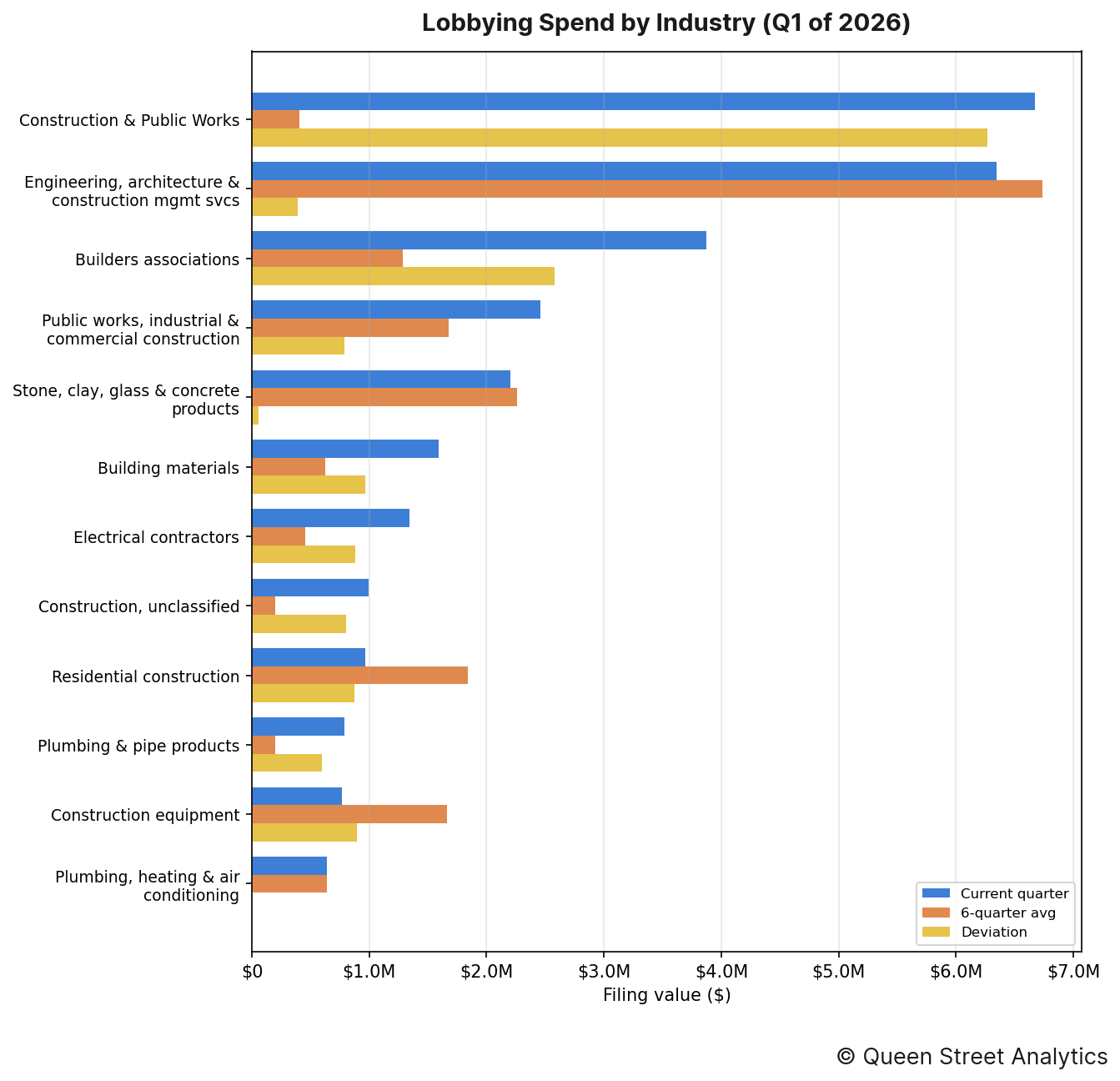
In Q1 of 2026, there was $31.9M worth of disclosed lobbying activity on Construction & Housing, 56% higher than the recent quarterly average of $20.5M. This activity can be broken down by industry as follows:
↳ There was $6.7M worth of Construction & Public Works lobbying, 1544% higher than the recent quarterly average of $406k.
↳ There was $6.3M worth of Engineering, architecture & construction mgmt svcs lobbying, roughly in line with the recent quarterly average of $6.7M.
↳ There was $3.9M worth of Builders associations lobbying, 200% higher than the recent quarterly average of $1.3M.
↳ There was $2.5M worth of Public works, industrial & commercial construction lobbying, 47% higher than the recent quarterly average of $1.7M.
↳ There was $2.2M worth of Stone, clay, glass & concrete products lobbying, roughly in line with the recent quarterly average of $2.3M.
↳ There was $1.6M worth of Building materials lobbying, 154% higher than the recent quarterly average of $628k.
Section B: Lobbying Spend Trend
This channel's total disclosed lobbying spend across recent quarters, aggregated over all of its industries.
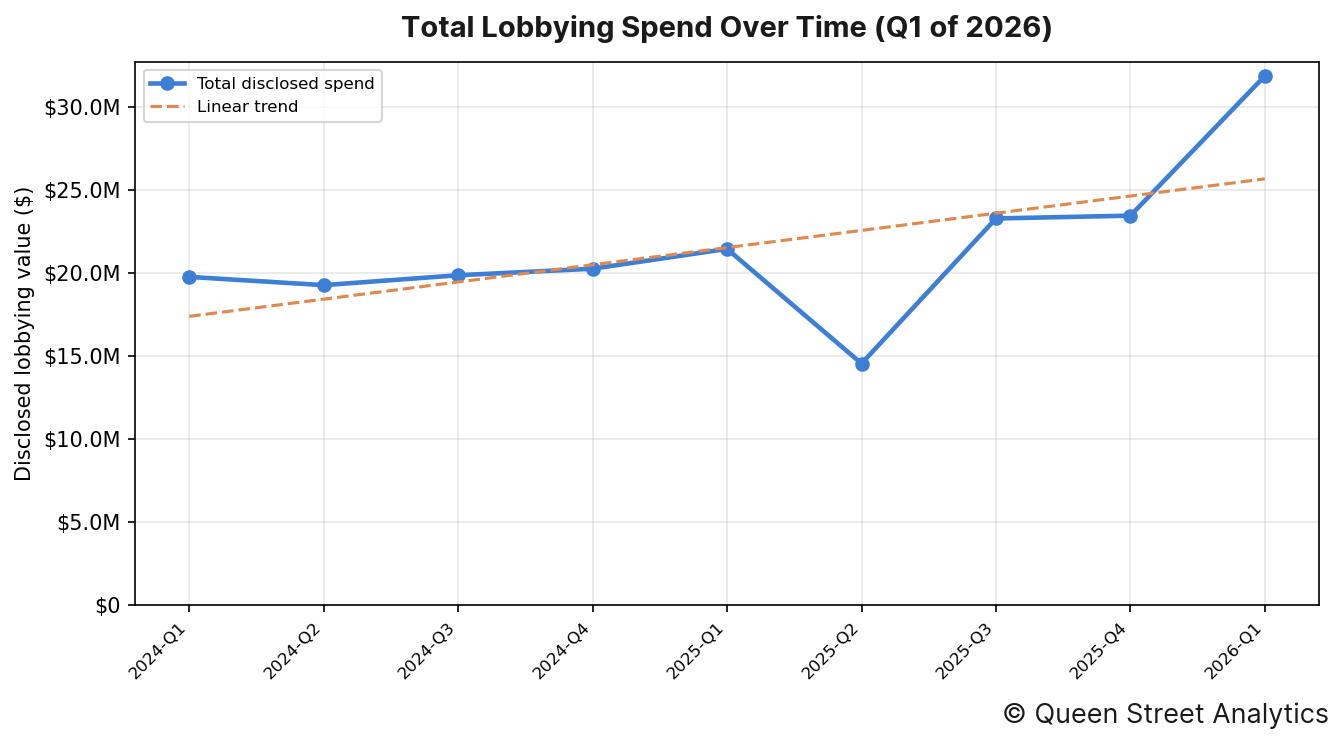
In Q1 of 2026, there was $31.9M worth of disclosed lobbying activity on Construction & Housing. Across the 9 quarters shown, the channel's total disclosed spend has risen over this period.
Organizations' Lobby Spend
The image below shows the organizations whose lobbying spend moved most from their six-quarter average.
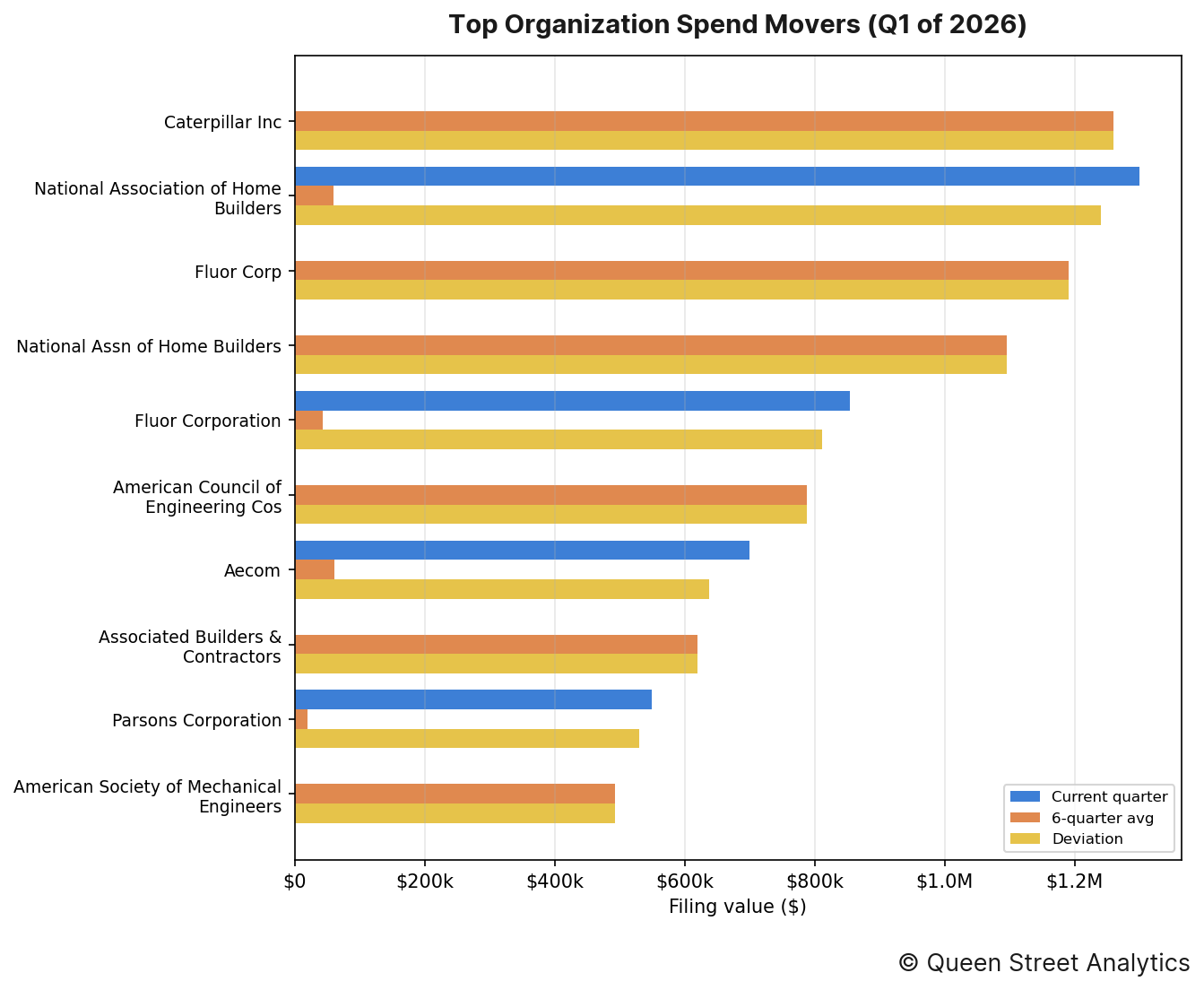
The organizations whose spending moved most from their own recent quarterly average were as follows:
↳ Caterpillar Inc accounted for $0 in disclosed lobbying, 100% lower than the recent quarterly average of $1.3M.
↳ National Association of Home Builders accounted for $1.3M in disclosed lobbying, 2067% higher than the recent quarterly average of $60k.
↳ Fluor Corp accounted for $0 in disclosed lobbying, 100% lower than the recent quarterly average of $1.2M.
↳ National Assn of Home Builders accounted for $0 in disclosed lobbying, 100% lower than the recent quarterly average of $1.1M.
↳ Fluor Corporation accounted for $854k in disclosed lobbying, 1910% higher than the recent quarterly average of $42k.
↳ American Council of Engineering Cos accounted for $0 in disclosed lobbying, 100% lower than the recent quarterly average of $788k.
Section D: Government Entities Lobbied
This section documents this quarter's most lobbied federal government departments.
By industry
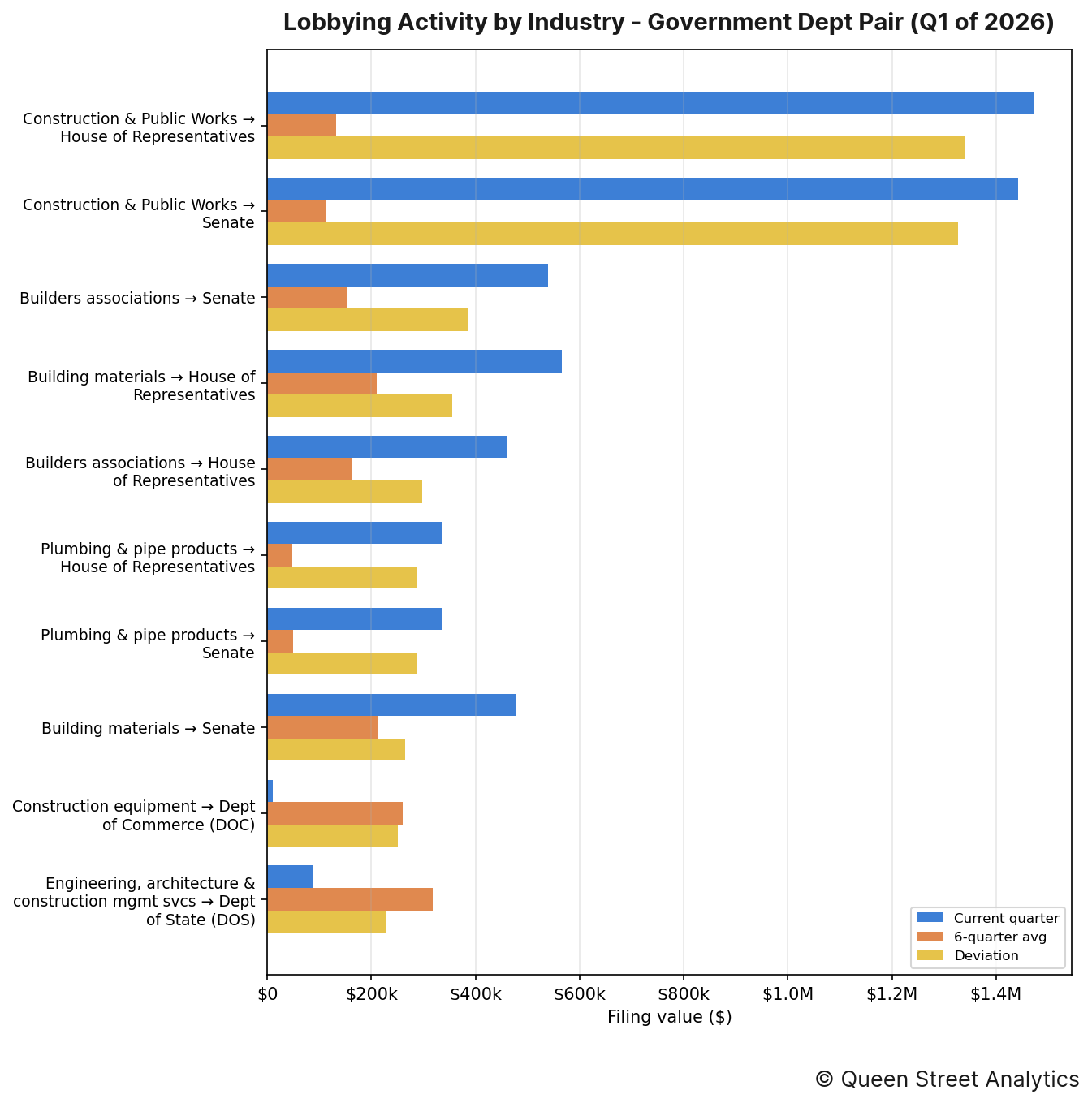
The industry–entity pairings that moved most this quarter were as follows:
↳ Construction & Public Works directed $1.5M of lobbying toward House of Representatives, 1011% higher than the recent quarterly average of $133k.
↳ Construction & Public Works directed $1.4M of lobbying toward Senate, 1163% higher than the recent quarterly average of $114k.
↳ Builders associations directed $540k of lobbying toward Senate, 251% higher than the recent quarterly average of $154k.
By organization
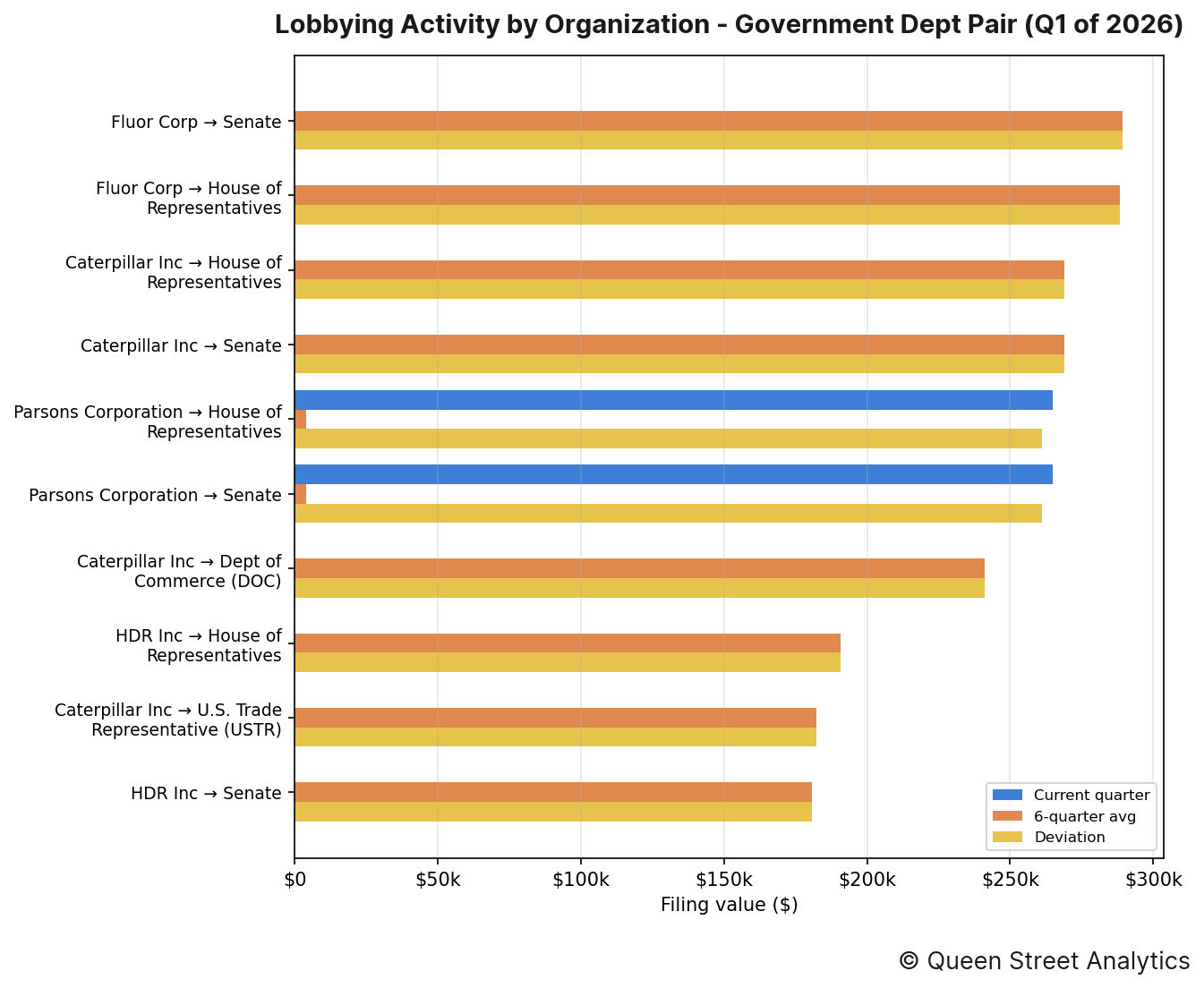
The organization–entity pairings that moved most this quarter were as follows:
↳ Fluor Corp directed $0 of lobbying toward Senate, 100% lower than the recent quarterly average of $289k.
↳ Fluor Corp directed $0 of lobbying toward House of Representatives, 100% lower than the recent quarterly average of $288k.
↳ Caterpillar Inc directed $0 of lobbying toward House of Representatives, 100% lower than the recent quarterly average of $269k.
Section E: Lobbying Issues
This section documents this quarter's most lobbied-on issues.
By industry
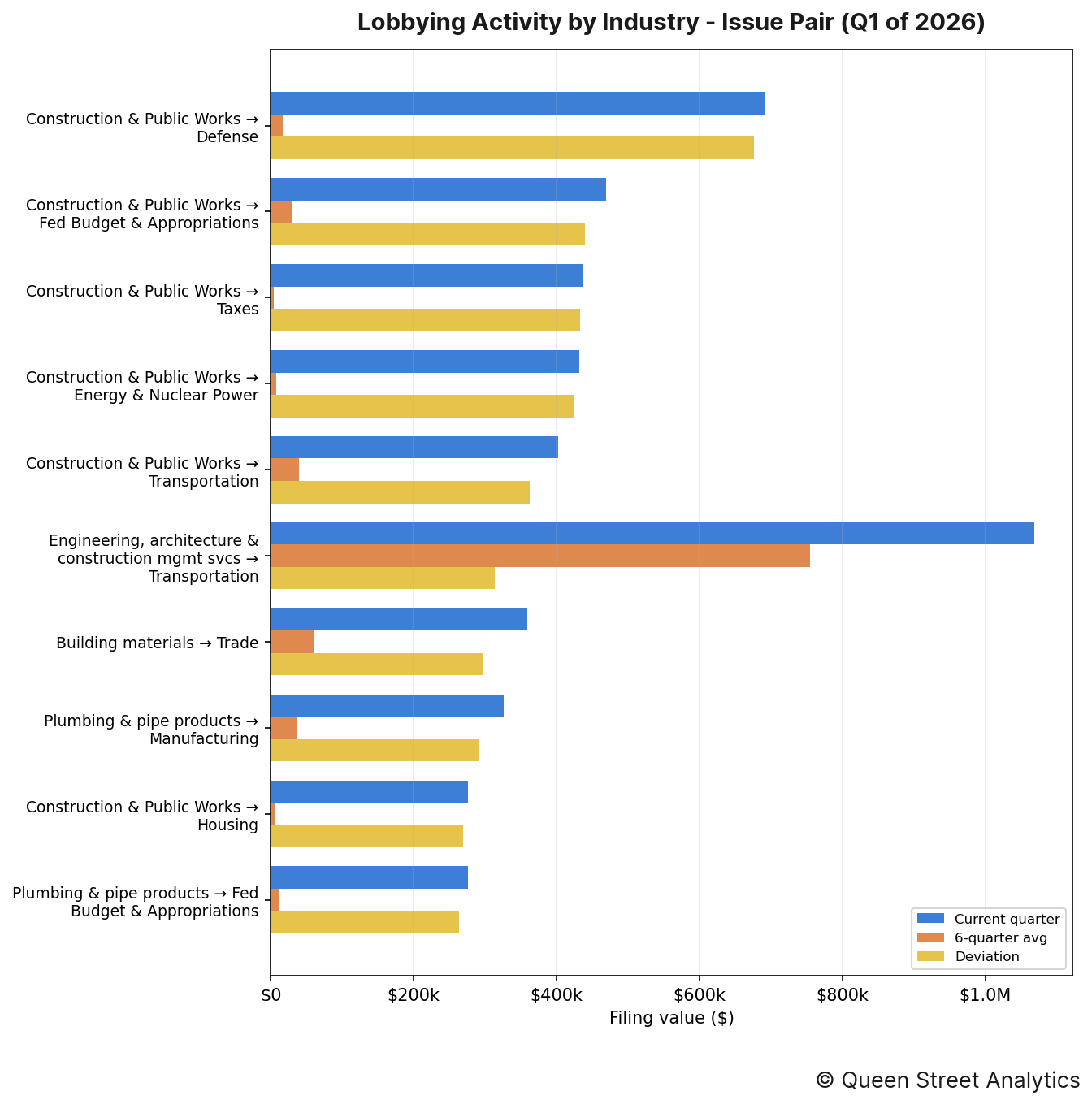
The industry–issue pairings that moved most this quarter were as follows:
↳ Construction & Public Works put $692k toward lobbying on Defense, 4110% higher than the recent quarterly average of $16k.
↳ Construction & Public Works put $470k toward lobbying on Fed Budget & Appropriations, 1467% higher than the recent quarterly average of $30k.
↳ Construction & Public Works put $437k toward lobbying on Taxes, 9055% higher than the recent quarterly average of $5k.
By organization
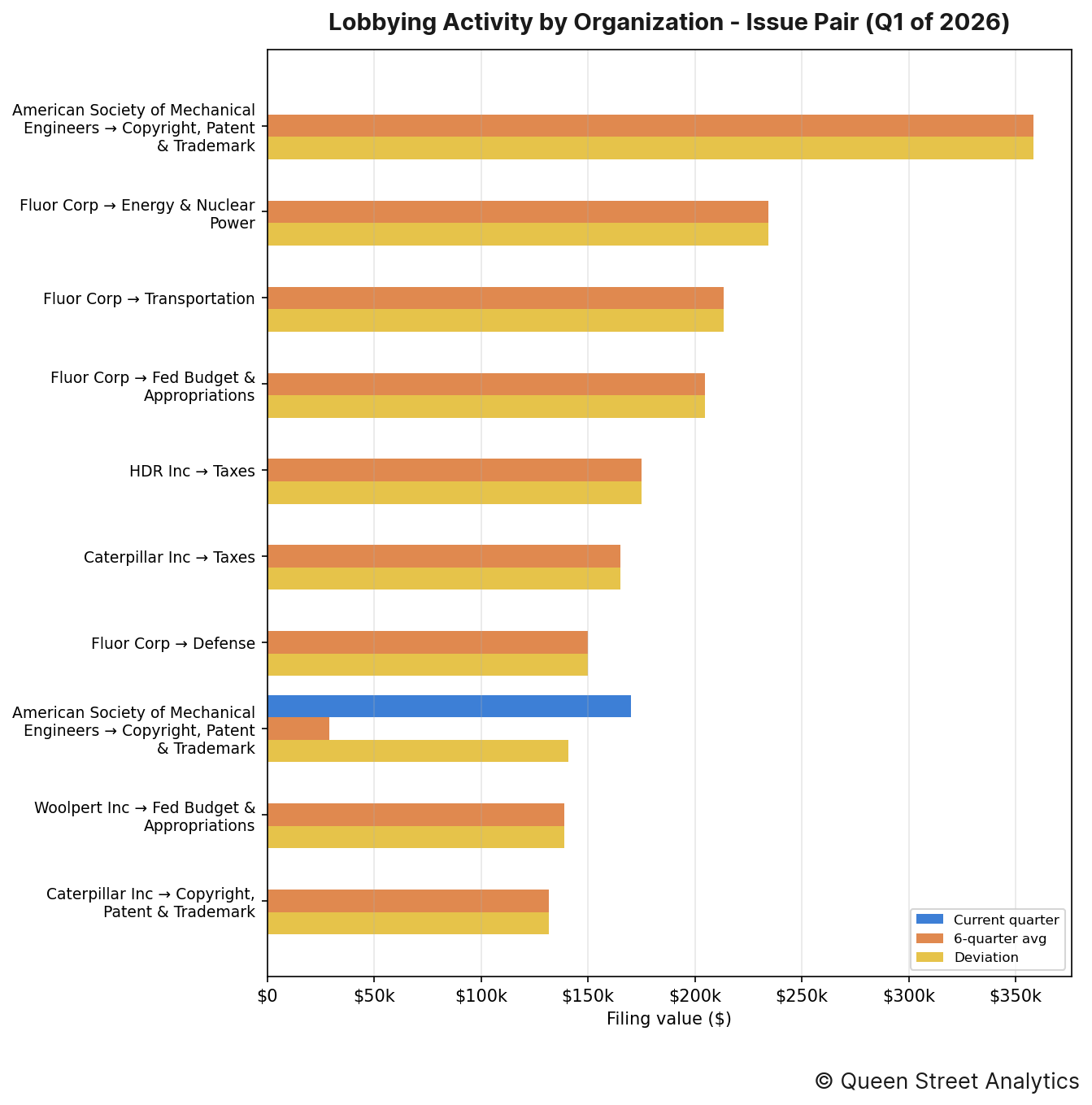
The organization–issue pairings that moved most this quarter were as follows:
↳ American Society of Mechanical Engineers put $0 toward lobbying on Copyright, Patent & Trademark, 100% lower than the recent quarterly average of $358k.
↳ Fluor Corp put $0 toward lobbying on Energy & Nuclear Power, 100% lower than the recent quarterly average of $234k.
↳ Fluor Corp put $0 toward lobbying on Transportation, 100% lower than the recent quarterly average of $213k.
Section F: Most-Active Lobbyists
The figure below lists the lobbyists who managed the most imputed lobbying value this quarter, alongside their firm or organization. Because a filing's value is split evenly across the lobbyists it names, these dollar figures are imputed rather than directly disclosed.
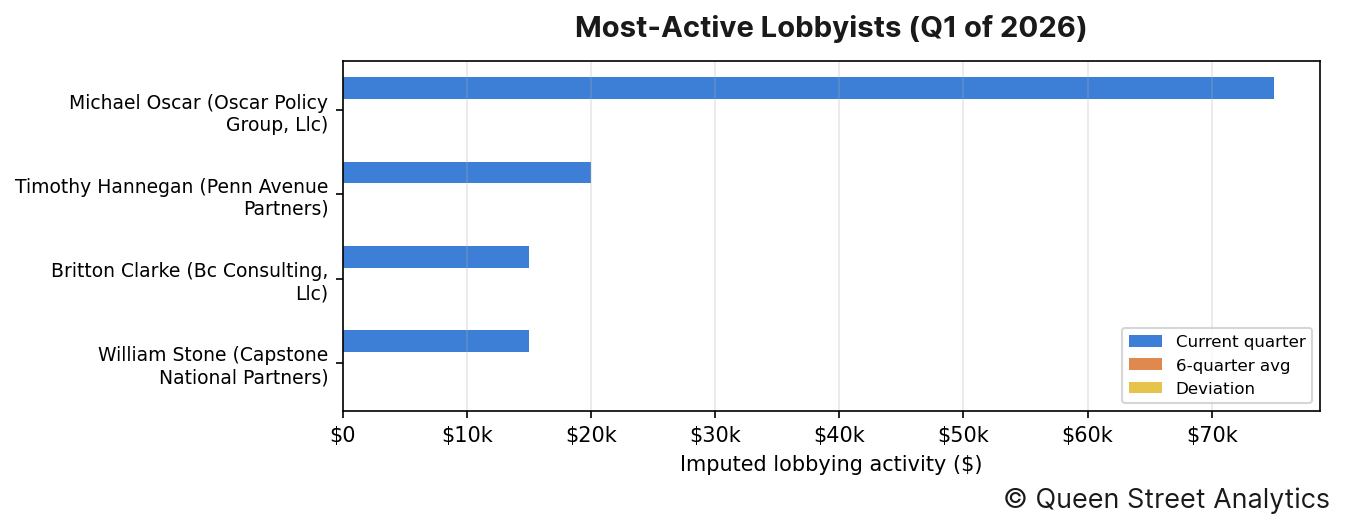
The lobbyists who managed the most imputed lobbying value this quarter were as follows:
↳ Michael Oscar (Oscar Policy Group, Llc) was credited with an imputed $75k in lobbying activity.
↳ Timothy Hannegan (Penn Avenue Partners) was credited with an imputed $20k in lobbying activity.
↳ Britton Clarke (Bc Consulting, Llc) was credited with an imputed $15k in lobbying activity.
↳ William Stone (Capstone National Partners) was credited with an imputed $15k in lobbying activity.
Section G: Organization Network
The header image for this edition maps how this channel's organizations (neutral nodes) connect to the federal entities they lobbied (colored nodes) this quarter. A link's weight is the filing value directed to that entity, and node size reflects total value; the House and Senate are excluded (nearly every organization lobbies them) so the specialized targets stand out.
The most widely lobbied entity this quarter was Dept of Energy, which was lobbied by 13 organizations.
Methodology
Every figure in this report starts from one number: the disclosed value of each lobbying filing, which we take as the income a registrant reported plus any in-house expenses (income + expenses) on its quarterly US Senate and House LDA disclosure. Before totalling anything we clean the filings — applying each amendment over the original it replaces, removing duplicates, and setting aside non-standard records such as registrations and terminations — and map every filing to a lobbying channel and industry using the organization's CRP industry code.
How the money is divided. A filing's full value counts once toward the organization that paid it and that organization's industry, so the industry and organization rankings (Sections A–C) reflect whole dollars. But a single filing usually names several government entities, several issue areas, and several lobbyists at once, and the disclosure never says how the fee was split among them. Rather than credit the full amount to each — which would count the same dollars over and over — we divide a filing's value evenly across the distinct items it names. So a $200,000 filing that lists four agencies contributes $50,000 to each in Section D, and the same even split is applied across issues in Section E and across lobbyists in Section F. That way every section's totals trace back to the same underlying money without double-counting.
Reading the movements. A “deviation” compares the quarter's value to the average of the prior six quarters, so a rise or fall is measured against an entity's own recent norm rather than against the rest of the field. Section B takes the wider view: it sums every industry into one channel total and plots it quarter by quarter, with a fitted line showing the overall direction of travel. Source: US Senate and House LDA disclosures.