This Week in Hospitality & Retail — Ottawa (#41, 2026)


Federal rollout of major workforce retention and retraining supports; Multi-million dollar investments in Indigenous tourism and economic development in Atlantic Canada; StatsCan data shows growth in cross-border travel and retail workforce changes; Ontario cuts WSIB premiums for 2027.

October 18, 2026 to October 24, 2026
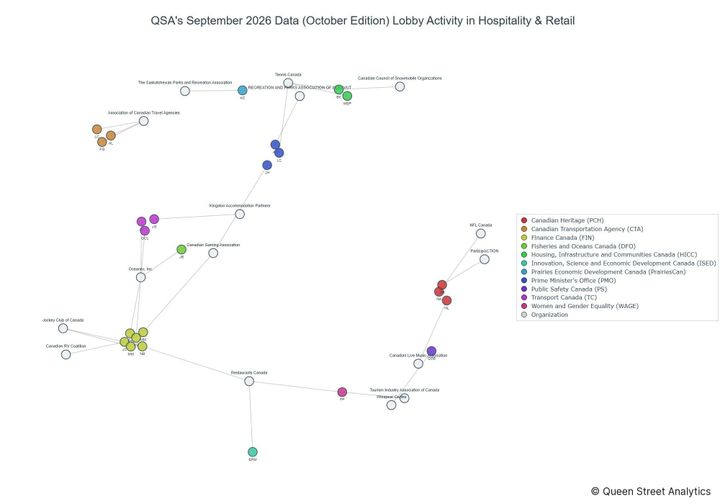
This is Queen Street Analytics' weekly digest of regulatory developments, legislative discussions and other government-related news concerning hotels, restaurants, casinos, gaming operations, event and sports venues, cruise lines, theme parks, ski resorts, outdoor spaces, RV and caravan parks, and all hospitality, travel and tourism professionals. Once a week, we break down the most important updates in this space in under five minutes.
Want to track GR news in adjacent industries related? Don’t miss this week’s updates in Arts & Culture. Also consider subscribing to our Hospitality & Retail - Washington edition covering critical GR news south of the border.
📋 In This Week's Newsletter
• 🏛️ This Week's Parliamentary Calendar
• 🇨🇦 Federal Government News
• 🗺️ Provincial Government News
• 📚 What We're Reading This Week
This Week's Parliamentary Calendar
- Citizenship and Immigration Committee discusses attracting and empowering global talent: On October 27, the House of Commons Citizenship and Immigration Committee will meet from 3:30 p.m. to 5:30 p.m. to hear witness testimony for its study on attracting and empowering global talent to strengthen Canada’s economy.
- Canadian Heritage Committee reviews Bill S-211 on sports betting advertising: The House of Commons Canadian Heritage Committee is scheduled to examine Bill S-211, An Act respecting a national framework on sports betting advertising, on October 29 from 11:00 a.m. to 1:00 p.m., with invited witnesses including Senators and MPs.
- Senate Committee on Agriculture and Forestry studies food security in Canada: On October 29 at 8:00 a.m., the Senate Standing Committee on Agriculture and Forestry will hold a videoconference to examine the role of the agriculture and agri-food sector in Canadian food security. Restaurants Canada and other food system organizations will provide witness testimony.
- Special Senate Committee on the Building Canada Strong Act to hear witness panels on Bill C-39: The Special Senate Committee on the Building Canada Strong Act will convene on October 26 at noon for hearings on Bill C-39, focusing on economic measures. Multiple panels will feature officials from Transport Canada, Natural Resources Canada, major labour unions, and Indigenous organizations.
Federal Government News
Federal Workforce Retention and Retraining Program launches to back employers through economic challenges
On October 22, Employment and Social Development Canada formally introduced the Workforce Retention and Retraining Program (WRRP) with an online application now live. Backed by $3.5 billion, the WRRP is intended to help employers keep skilled workers on payroll and support worker upskilling during reduced work hours. Targeting all sectors—including hospitality, retail, and tourism—the program provides up to $1,000 per participating employee for training and related costs, alongside income top-ups to employees as they train. Employers can select training ranging from digital skills to on-the-job learning and retain flexibility in distributing available hours. Up to 66,000 workers are expected to benefit, with support available until March 2028. Temporary Employment Insurance measures, including waivers and simplified eligibility, have also been extended to cover workers during transitions. The program is especially designed for firms adapting to tariff disruptions and market shifts, and it enables successive agreements for employers requiring continued adjustment periods. Businesses previously engaged in Work-Sharing or Worker Retention Grants are transitioned seamlessly. Broader measures include the Regional Tariff Response Initiative, supporting small and medium-sized firms facing tariff impacts.
Sources: www.canada.ca, www.canada.ca
Federal investment supports Indigenous-owned wellness tourism destination in New Brunswick
On October 22, the Atlantic Canada Opportunities Agency announced a $286,398 repayable federal contribution to Cedar & Stone Thermal Spa Inc. in Rusagonis, New Brunswick. The initiative will see the construction of an Indigenous-owned Nordic spa offering year-round wellness tourism experiences rooted in Wolastoqiyik culture. The project is designed to attract visitors to the Fredericton Capital Region with features such as saunas, hot tubs, cold plunge systems, and a welcome lodge. This investment supports regional tourism growth, creates opportunities for Indigenous entrepreneurship, and enables the sharing of cultural perspectives with visitors.
Sources: www.canada.ca
More than $3.3 million invested in Indigenous-led economic and tourism projects in Nova Scotia
The Atlantic Canada Opportunities Agency outlined on October 21 that over $3.3 million has been disbursed to support a range of Indigenous-led ventures in Nova Scotia. Projects include research capacity growth at the Atlantic Policy Congress of First Nation Chiefs Secretariat, certification and investment readiness initiatives for community-oriented businesses, and the expansion of the Mi’kmaw Native Friendship Society’s business program. Funding aids the development of interpretive plans and visitor programs for cultural centers, advances business financing, and facilitates the expansion of aquaculture with new technologies. These investments bolster tourism infrastructure, cultural programming, and workforce development within the region.
Sources: www.canada.ca
Federal funding advances Indigenous economic development and tourism in Prince Edward Island
On October 22, the federal government confirmed $309,000 to four Indigenous-led organizations in Prince Edward Island via the Atlantic Canada Opportunities Agency. Funding supports acquisition of specialized equipment for renewable energy, the planning of community-driven economic strategies, development of new Indigenous tourism experiences, and tourism growth planning in Lennox Island First Nation. The investments offer capacity growth, workforce opportunities, and new tourism products tailored to local culture and community priorities.
Sources: www.canada.ca
Law Commission of Canada examines legal implications of Canada-Québec Accord for immigration and student programs
The Law Commission of Canada released its first 'Beyond Tomorrow' report on October 19, titled 'Beyond Tomorrow on Immigration.' The report, authored by France Houle, scrutinizes the legal framework distinguishing federal and Québec jurisdiction over immigration, analyzing the evolution from a consultative approach to Québec’s active role in selecting economic immigrants. The publication details how this dual governance model has struggled with recent increases in temporary migration and includes an illustrative case study of the development and operational challenges associated with Quebec's International Student Program.
Sources: www.canada.ca
Government boosts support for National Sport Organizations with $156 million in new funding
The Department of Canadian Heritage announced over $156 million in federal funding for 62 National Sport Organizations for 2026–27, part of the government’s Sport Support Program. This includes $60 million in additional funds this year, intended to increase access, develop athlete pathways, and reinforce safe and high-integrity sport programming. The new funding forms part of a broader $1-billion generational investment in sport, encompassing stadium and field upgrades and support for event hosting.
Sources: www.canada.ca, www.canada.ca
StatsCan: Demographic changes and non-permanent resident reliance in retail trade
Statistics Canada published findings from 'Workforce insights: Demographics in the retail trade sector, 2017 to 2024' on October 21. The research finds the workforce in Canadian retail is predominantly young, but trending older, with a majority female composition and significant prevalence of part-time positions. The sector is increasingly supported by non-permanent residents, signaling shifts in the labor pool’s structure relevant to retail and hospitality operators.
Sources: www.statcan.gc.ca
StatsCan: Canadian cross-border travel increases in August 2026
According to Statistics Canada data released October 22, Canadian-resident return trips from the United States in August 2026 rose 9.3% year over year, while inbound US resident visits to Canada increased 4.3%. These trends suggest heightened travel activity, affecting a range of hospitality, accommodation, and travel service providers.
Sources: www.statcan.gc.ca
StatsCan: Cybercrime remains a risk for Canadian business
The most recent Canadian Survey of Cyber Security and Cybercrime details incident frequency, prevention efforts, and business-level repercussions since 2017. With businesses continuing to navigate a dynamic digital threat landscape, information security procedures remain relevant for operators across the hospitality and retail footprint.
Sources: www.statcan.gc.ca
StatsCan: Growth in Canadian trade of culture and sport products for 2024
StatCan reported on October 20 that both imports and exports of culture and sport products increased in 2024. This development points to robust international demand and export potential for businesses involved in destination experiences, event planning, and sport tourism.
Sources: www.statcan.gc.ca
Federal support for agri-food workforce development in southern Alberta
Prairies Economic Development Canada announced more than $3 million for Lethbridge Polytechnic on October 22 to implement new skilled trades programs for the food and beverage sector. The effort aims to address shortages of workers familiar with food-safe maintenance, sanitation protocols, and advanced equipment, minimizing on-the-job training requirements for specialized agri-food environments. The initiative supports food-processing growth, which impacts food service supply chains throughout hospitality venues.
Sources: www.canada.ca
Provincial Government News
Ontario announces reduction in WSIB premiums for 2027
The Ontario Ministry of Labour confirmed on October 22 a decrease in Workplace Safety and Insurance Board average premium rates from $1.23 to $1.18 per $100 of insurable payroll for 2027. The measure will benefit over 80% of premium-paying businesses, resulting in $160 million in savings.
Sources: news.ontario.ca
Ontario proposes legislative changes to speed up archaeological approvals
On October 20, Ontario outlined forthcoming legislative amendments aimed at reducing archaeological approval wait times by up to 80%, expanding sector capacity, and integrating new digital permitting tools. Implementation will begin in early 2027, affecting development timelines for hospitality and tourism projects.
Sources: news.ontario.ca
Nova Scotia highlights progress on red tape reduction for small business
Nova Scotia’s Office of Service Efficiency published an op-ed on October 21 centered on its 'Fewer Permits. Faster' initiative, which has improved more than half of all provincial permits and saved businesses notable administrative time, aiming to make government processes more responsive.
Sources: news.novascotia.ca
Ontario marks Small Business Week with expanded support initiatives
On October 19, the Ontario government detailed new investments in Small Business Advisory Centres, tax reductions, and grant funding for entrepreneur programs, with a focus on enhancing business competitiveness amid economic challenges and increased US tariffs.
Sources: news.ontario.ca
Ontario reports convictions under key provincial tax statutes affecting hospitality and retail
The Ontario Ministry of Finance published information on October 19 regarding enforcement actions under the Retail Sales Tax, Land Transfer Tax, and Employer Health Tax Acts. Recent convictions include hospitality establishments and require offenders to repay taxes along with fines.
Sources: news.ontario.ca

What We're Reading This Week
- Luxury hotel firm faces flak in an Ontario town’s debate over tourism and growth: A luxury hotel firm’s expansion plans prompt community debate in Elora, Ontario.
- SKYX Provides a Corporate Update as It Continues to Grow Its Market Penetration in the Builder and Hotel Segments: SKYX reports market expansion in builder and hospitality sectors.
- Cancelling your dinner reservation is hurting your favourite restaurant: Restaurant cancellation trends are affecting operators’ bottom lines.
- Hong Kong Tourism Board Presents “Hong Kong Wine & Dine Festival” and “Hong Kong Gourmet Month” Under the Theme “Taste the World’s Best”: Hong Kong showcases culinary tourism events to attract international visitors.
- How AI is making it harder to book on Airbnb; Is junk food bad for your brain?: CBC's Marketplace Cheat Sheet: CBC reviews how AI impacts booking experiences on digital travel platforms.
- A new hotel in Trelleborg, Sweden, makes a good ‘cool-cation’ base: Coverage of a Swedish hotel positioned for trend-driven travel.
- Human skulls? Custom hats? How these quirky Toronto stores found success selling just one thing: Toronto business owners succeed with single-focus retail concepts.