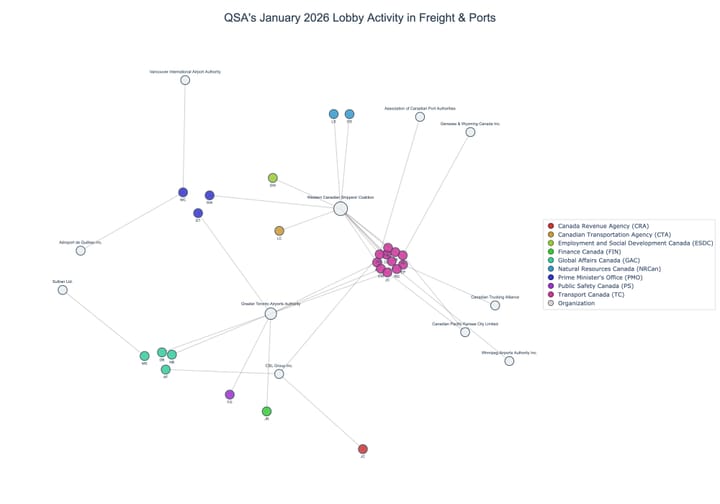
QSA's Week in Freight & Ports (#47, 2025)





Canada re-elected to IMO Council; Ottawa strengthens steel tariff enforcement; surge in CBSA drug seizures; electronic grain export certificates to Mexico; U.S. Coast Guard revises navigation regs; MARAD opens comments on ag cargo rates; new StatsCan freight indexes released
Good morning! This is Queen Street Analytics' weekly roundup of regulatory developments, legislative discussions, political announcements and other government-related news concerning trucking, rail, and shipping, ports, cargo terminals, international and interprovincial logistics. Every Monday, we break down the most important updates in this space in under five minutes.
Want to track the upstream and downstream forces affecting Freight & Ports? Don’t miss this week’s updates in Aviation and Oil & Gas.
Dates: 2025-11-23 to 2025-11-29
📋 In This Week's Newsletter
• 🏛️ This Week's Parliamentary Calendar
• 🇨🇦 Canadian Federal Government News
• 🗺️ Canadian Provincial Government News
• 📚 What We're Reading This Week
This Week's Parliamentary Calendar
- House of Commons Standing Committee on International Trade: Canada and the Forthcoming CUSMA Review: Scheduled for December 1, 2025, at 3:30–5:30 p.m., the committee will hear from Garaga, BC Lumber Trade Council, Ontario Chamber of Commerce, Nuvation Energy, and The Surrey & White Rock Board of Trade regarding Canada’s position in the upcoming CUSMA review.
- House of Commons Standing Committee on Fisheries and Oceans: Supplementary Estimates (B), 2025-26: Meeting on December 4, 2025, from 8:15–10:15 a.m., the committee will review Supplementary Estimates with Minister Joanne Thompson and officials from Fisheries and Oceans Canada, including financial and enforcement officers.
- Senate Standing Committee on Transport and Communications: Subject matter elements of Bill C-15 (Budget Implementation Act): Scheduled for December 2, 2025, at 9:00 a.m., the committee will conduct an in camera session on divisions of Bill C-15 relating to transport and communications. Witnesses to be announced.
- Senate Standing Committee on Fisheries and Oceans: Ocean carbon sequestration study: On December 4, 2025, at 8:30 a.m., the committee will examine draft report findings on ocean carbon sequestration and its use in Canada. Meeting will be held in camera.
Canadian Federal Government News
Canada re-elected to International Maritime Organization Council
Transport Canada announced Canada’s re-election to the International Maritime Organization (IMO) Council for 2026-27. With ports located on the Great Lakes, Saint Lawrence, Atlantic, Pacific, and Arctic coasts, Canada’s continued participation in the IMO ensures direct involvement in setting global standards for shipping safety, security, and environmental performance. Canada continues to observe conventions such as SOLAS and MARPOL and contributes to regulatory discussions on polar waters, pollution, and technological developments. The announcement affirms Ottawa's intention to maintain influence over international regulatory frameworks relevant to Canadian shipping interests.
Sources: www.canada.ca
CBSA’s Operation Meridian targets narcotics smuggling
CBSA concluded Operation Meridian, a 60-day surge focused on commercial shipments in Southern Ontario. Officers intercepted 108.6 kg of cocaine, 349.8 kg of methamphetamines, 266 kg of khat, opium, 8,267 kg of tobacco, 115,416 tins of nicotine, 14,400 vapourizers, nine firearms (including one stolen), 19 weapons, and US$93,100 in proceeds of crime. Approximately 90% of seizures were inbound to Canada, with 10% outbound. Five individuals were charged, and 16 investigations are ongoing. Arrests included attempts at Blue Water Bridge and Peace Bridge ports of entry. CBSA credited increased examinations, targeting centre referrals, and local police collaboration.
Sources: www.canada.ca
Canada launches electronic export certificates for grain exports to Mexico
The Canadian Food Inspection Agency (CFIA) now issues electronic phytosanitary export certificates for grain and grain products to Mexico, effective November 3, 2025. The secure digital process replaces paper delivery, reducing fraud risk and delivery times. Canada and Mexico will consider expanding this system to other agri-food products. The modernization follows Minister Heath MacDonald's recent trip to Mexico and builds on commitments under the Canada-Mexico Action Plan 2025-2028, with the CFIA continuing to expand online services for exporters.
Sources: www.canada.ca
Secretary of State Belanger announces new measures for Canadian steel industry
Secretary of State Buckley Belanger outlined a series of federal measures to support the steel sector, including tightening tariff rate quotas for steel from non–free trade partners (from 50% to 20% of 2024 levels) and reducing quotas for non-CUSMA FTA partners (from 100% to 75%). A 25% global tariff will be imposed on targeted steel-derivative imports. CBSA will receive new resources for compliance and detection of false declarations. Temporary remission of tariffs ends January 31, 2026. Interprovincial railway freight rates for steel will be reduced by 50% starting spring 2026, and all federal contracts above $25 million will prioritize Canadian materials. Over $100 million is allocated for training support in sectors with Work-Sharing agreements.
Sources: www.canada.ca
CBSA intercepts 218 kg of cannabis in Saint John port shipment
CBSA officers in Saint John, NB, seized 218 kg of cannabis from a marine container destined for the UK, declared as empty plastic bottles. The operation followed a Halifax referral and resulted in the transfer of evidence to RCMP Eastern Region Federal Policing. Despite cannabis legalization in Canada, cross-border movement without authorization remains a serious criminal offence under the Customs Act and Cannabis Act.
Sources: www.canada.ca
CBSA seizes over 200 kg of cocaine from ship arriving in Vancouver
CBSA Border Services Officers at Metro Vancouver Commercial Operations seized 204.5 kg of cocaine from a marine shipment originating in Panama. The drugs were concealed within containers of red liquid, declared as paint pigment, and discovered with assistance from the Detector Dog Team. The drugs were transferred to the RCMP for further investigation.
Sources: www.canada.ca
Malicious cyber activity targeting Canadian critical infrastructure
Communications Security Establishment Canada issued a backgrounder on increasing cyber threats to Canadian critical infrastructure sectors, including transportation. Threats such as ransomware, denial-of-service attacks, and supply chain compromises are growing in frequency and complexity, with recent alerts on hacktivists targeting internet-accessible industrial control systems. Operators are encouraged to maintain inventories of ICS devices, remove unnecessary connections, and separate IT and OT environments. The Cyber Centre continues to collaborate with industry and has published specific guidance for water utilities.
Sources: www.canada.ca
Government of Canada tables draft regulations on administrative monetary penalties for Official Languages Act
Minister Steven Guilbeault announced draft regulations enabling the Commissioner of Official Languages to impose administrative monetary penalties for non-compliance with language obligations in the passenger transportation sector. Once adopted, penalties will be based on violation severity, recurrence, corrective measures, and organization size. The rules aim to improve compliance and service delivery in both official languages for travellers.
Sources: www.canada.ca
Annual closure of Canadian Coast Guard’s seasonal Search and Rescue stations across Québec
The Canadian Coast Guard began closing its seasonal Search and Rescue stations in Québec, with closures scheduled at Kegaska (Nov. 26), Havre-Saint-Pierre (Nov. 27), Quebec (Nov. 28), Tadoussac and Rivière-au-Renard (Nov. 30), and Cap-aux-Meules (Dec. 30). Winter SAR operations will be carried out by icebreakers and other vessels, with continued support from auxiliary volunteers.
Sources: www.canada.ca
Canada launches Atlantic Economic Panel
Minister Sean Fraser announced the formation of the Atlantic Economic Panel, comprising seven regional business leaders. The panel will engage stakeholders throughout Atlantic Canada in 2026, guiding research and analysis for recommendations to be delivered by September 2026. Joyce Carter (Halifax International Airport Authority), Don Mills (Crane Cove Holdings), and others will participate. Findings are intended to inform federal economic policy for the region’s transportation and logistics sectors.
Sources: www.canada.ca
StatsCan releases new freight transport price indexes
Statistics Canada published the For-hire Motor Carrier Freight Services Price Index for Q3 2025, the Freight Rail Services Price Index for November, and the Couriers and Messengers Services Price Index for October. These datasets provide current pricing benchmarks for trucking, rail, and courier services, supporting cost analysis and contract negotiations in the freight sector.
Sources: www.statcan.gc.ca, www.statcan.gc.ca, www.statcan.gc.ca
Canadian Provincial Government News
Alberta introduces new driver experience record requirement for truckers
Alberta will require commercial carriers to provide driver experience records for Class 1 truck drivers starting December 1, with full compliance by June 1, 2026. The measure aims to track driver history across employers and improve hiring transparency.
Sources: www.alberta.ca
New Brunswick signs Mutual Recognition Agreement and interprovincial trucking MOU
New Brunswick government joined other provinces in signing the first Canadian Mutual Recognition Agreement on Sale of Goods and endorsed an MOU on trucking regulation alignment, aiming to reduce trade barriers and standardize equipment and safety requirements.
Sources: www2.gnb.ca
Large loads scheduled to impact travel in north central Alberta
From November 30 to December 5, oversized industrial loads will travel between Edmonton, Fort Saskatchewan, Lloydminster, and Fort McMurray at reduced speeds, affecting highway traffic and requiring police escorts for certain segments.
Sources: www.alberta.ca
What We're Reading This Week
- Ottawa to prioritize trade diversification with infrastructure fund, minister says: The federal government is preparing to use infrastructure investment to support trade diversification goals.
- Woodfibre LNG is halfway through its long journey to build its B.C. export terminal: Construction progress updates for the Woodfibre LNG export terminal project in British Columbia.
- Frustrated by missing mail, one American took the Postal Service to court: U.S. postal service reliability faces scrutiny following legal action by a customer.
- What you need to know about the oil tanker ban on B.C.’s coast: Overview of regulations affecting oil tanker operations along the British Columbia coast.