Lobbying on Manufacturing - Ottawa (April 2026 edition)





Evraz Inc. NA Canada; Mercer International Inc.; ArcelorMittal Dofasco G.P.; Element5; J.D. Irving, Limited were unusually active lobbyists last month.
Once a month, we partner up with LobbyIQ to update our readers on recent movements in the federal lobbying landscape in Ottawa. We provide separate coverage for each channel, defined by the most relevant industries, organizations, institutions, and subject matters.
Key Takeaways — Manufacturing
- Lobbying activity totalled 201 meetings in March 2026, down from a 12-month average of 224.2.
- The biggest moves were in Cement, concrete and building materials manufacturing and Wood and paper product manufacturing.
- Evraz Inc. NA Canada, Mercer International Inc. were more active than usual.

Section A: The Themes Hidden in March 2026 Data
Metal Sector Lobbying Rises Amid Ongoing US Tariffs
March 2026 saw heightened lobbying from Canadian metal manufacturers, including ArcelorMittal Dofasco G.P. and Algoma, seeking relief from US tariffs, as trade uncertainty continued to dampen export orders and erode confidence. Engagement with government officials such as those at the Prime Minister's Office (PMO) and Innovation, Science and Economic Development Canada (ISED) was focused on tariff remedies and efforts to counter demand weakness tied to these international measures, reflecting industry fears about long-term output stagnation. This lobbying uptick coincides with industry reports noting tariffs are a persistent drag on manufacturing activity.
📎 Canada Manufacturing Sector Activity Subdued in March ... - Morningstar
Push for 'Buy Canadian' Policies and Industrial Grants
Manufacturers, particularly from the metals sector, including Cenmax Group Inc. and Longboard Architectural Products Inc., increased lobbying around domestic procurement rules and funding programs in March, engaging with Public Services and Procurement Canada (PSPC) and the House of Commons. This coincided with federal efforts to roll out new 'Buy Canadian' requirements and expand grant opportunities for strategic innovation and productivity improvements. Lobbying sought to position Canadian firms as preferred suppliers for major projects, aligning closely with government initiatives to bolster national industrial capacity.
📎 Canada’s manufacturing growth pauses in March: S&P Global
Wood & Paper Lobbying Linked to Softwood Lumber Trade Uncertainties
Lobbying by wood and paper product manufacturers such as the Forest Products Association of Canada and the BC Lumber Trade Council surged in March, plausibly prompted by continued uncertainty in Canada–US softwood lumber negotiations. Industry actors engaged government officials at Global Affairs Canada and the House of Commons to influence Canada's stance as renewed bilateral discussions moved forward, reflecting ongoing concerns about market access and the risk of new US measures. This activity is part of a broader pattern of volatility and event-driven lobbying in these sectors.
📎 Canada Manufacturing Sector Activity Subdued in March ... - Morningstar
Manufacturing Shows Volatility Amid Global Disruptions
March saw contrasting trends across manufacturing sub-sectors: overall sales grew, but segments like chemicals and cement declined as supply chain disruptions and high input costs persisted. These pressures influenced lobbying, as companies like the Cement Association of Canada and J.D. Irving, Limited became more selective and event-driven in their policy engagement with the Intergovernmental Affairs Secretariat (IGA) and Innovation, Science and Economic Development Canada (ISED), focusing on acute external stresses from global conflicts and shipping delays. Sector-specific volatility shaped how and when firms such as Longboard Architectural Products Inc approached policymakers.
📎 Canada Factory Activity Stagnates in March - TRADING ECONOMICS
Middle East Conflict Drives Price Spikes, Spurs Chemicals Lobbying
Substantial lobbying activity from chemicals and petroleum product manufacturers such as NOVA Chemicals Corporation and J.D. Irving, Limited in March coincided with a surge in input costs triggered by war-related energy price volatility. Manufacturers held discussions with Innovation, Science and Economic Development Canada and Finance Canada, seeking federal support such as investment tax credits to offset financial burdens tied to disrupted supply chains. The direct link between global conflict and increased policy engagement highlights how external shocks can rapidly reshape lobbying priorities.
📎 S&P Global Canada Manufacturing PMI
Section B: Lobbying Activity by Industry
This section compares, by NAICS industry, the lobbying activity in Ottawa last month to its historical average.
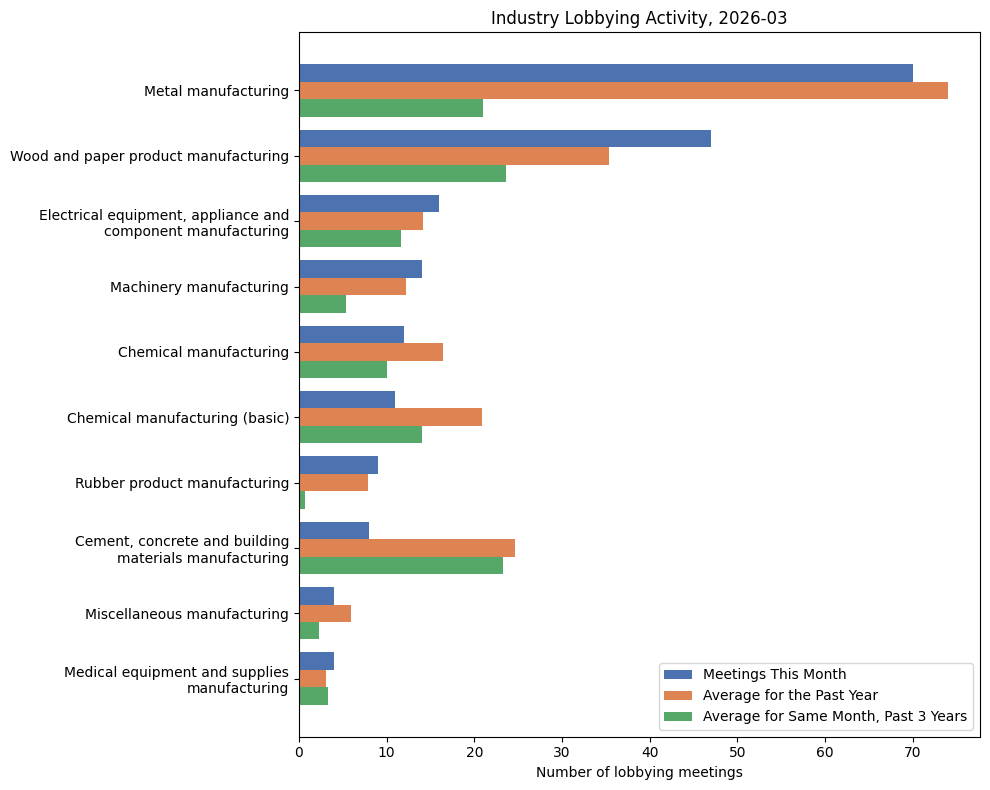
Lobbying activity across this channel totalled 201 meetings in March 2026, down from a 12-month average of 224. The most active industry was Metal manufacturing, while Cement, concrete and building materials manufacturing fell below its recent baseline.
The industries with the most notable increases in lobbying this month include Wood and paper product manufacturing logged 47 meetings, up from an average of 35, HVAC and refrigeration equipment manufacturing logged 3 meetings, up from an average of 2, and Medical equipment and supplies manufacturing logged 4 meetings, up from an average of 3.
On the quieter side, Apparel, leather and textile manufacturing had 1 meetings, down from an average of 4, Chemical manufacturing had 12 meetings, down from an average of 16, Cement, concrete and building materials manufacturing had 8 meetings, down from an average of 25, Furniture and related product manufacturing had no lobbying meetings this month, down from an average of 1, Miscellaneous manufacturing had 4 meetings, down from an average of 6, Chemical manufacturing (basic) had 11 meetings, down from an average of 21, and Cosmetics, cleaning compound and toiletries had no lobbying meetings this month, down from an average of 1.
Section C: Lobbying by Industry for the Past Year
To contextualize, we show each industry's lobbying activity over the past 12 months. The combined view from Section B and C shows you whether recent differences are persistent trends or a break from the norm.
Top Industry Residual Trends for 2026-03
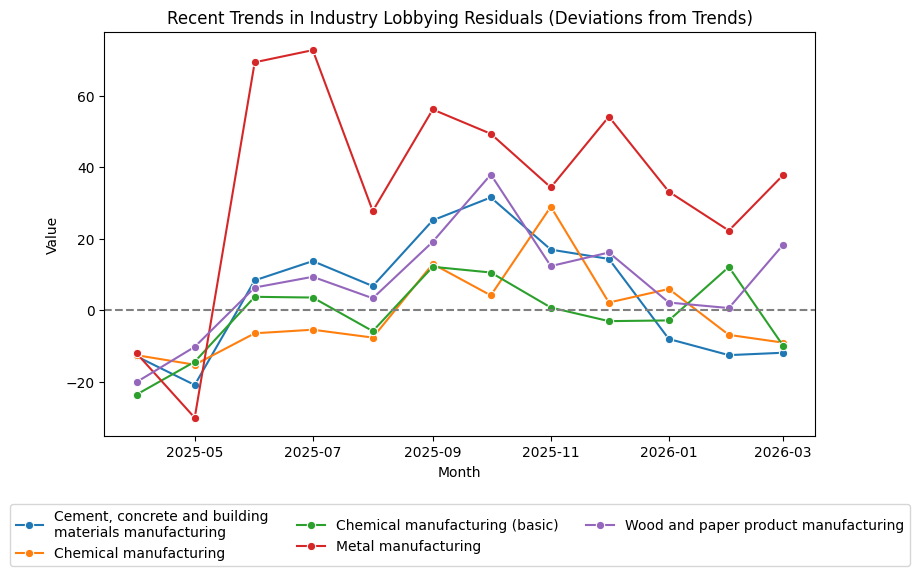
Metal manufacturing saw lobbying run notably above expected levels in March 2026.
↳ Metal manufacturing has been on a broadly upward trajectory in lobbying over the past year.
Wood and paper product manufacturing saw lobbying run notably above expected levels in March 2026.
↳ Wood and paper product manufacturing has been on a broadly upward trajectory in lobbying over the past year.
↳ Wood and paper product manufacturing displayed high volatility, suggesting irregular or event-driven engagement.
↳ Cement, concrete and building materials manufacturing displayed high volatility, suggesting irregular or event-driven engagement.
↳ Chemical manufacturing (basic) has been on a broadly upward trajectory in lobbying over the past year.
↳ Chemical manufacturing (basic) displayed high volatility, suggesting irregular or event-driven engagement.
↳ Chemical manufacturing has been on a broadly upward trajectory in lobbying over the past year.
↳ Chemical manufacturing displayed high volatility, suggesting irregular or event-driven engagement.
Section D: Lobbying Activity by Organization
In this section, we see the organizations with the most unusual lobbying behavior last month, defined by either unusually high or unusually low lobbying activity.
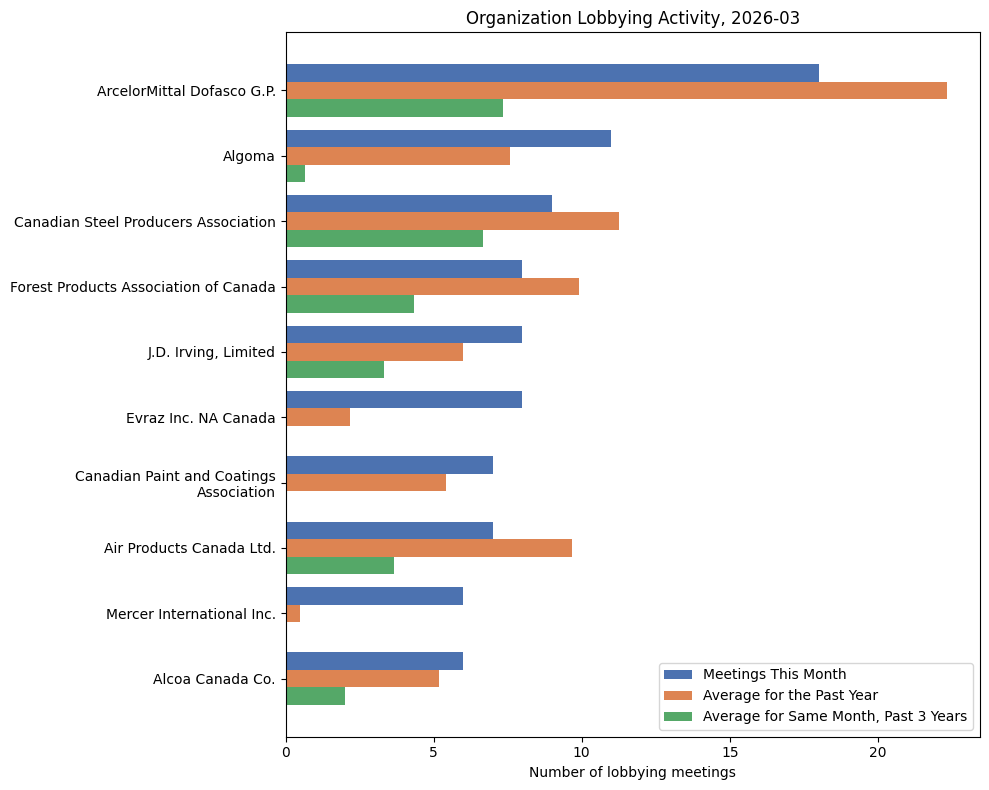
The organizations with the most notable increases in lobbying this month include Evraz Inc. NA Canada, and Mercer International Inc..
On the quieter side, Heidelberg Materials, and Chemistry Industry Association of Canada all pulled back from their usual pace.

Section E: Lobbying of Government Institutions in the Past Month
Every time an organization lobbies, there is a government official representing a government institution at the other side of the table. This section shows the industry-institutions pairs with the most unusual lobbying behavior last month, defined by either unusually high or unusually low lobbying activity. Below that, we show the corresponding organization-institution pairs.
Industries → Government Institutions
Organizations → Government Institutions
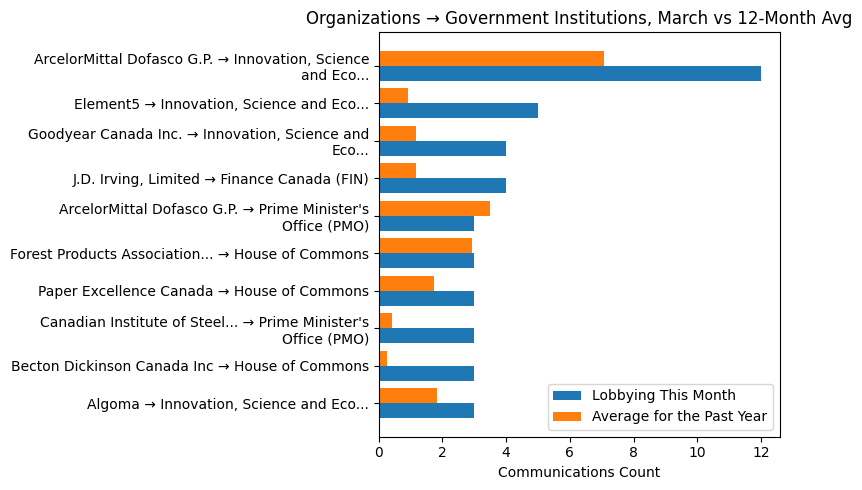
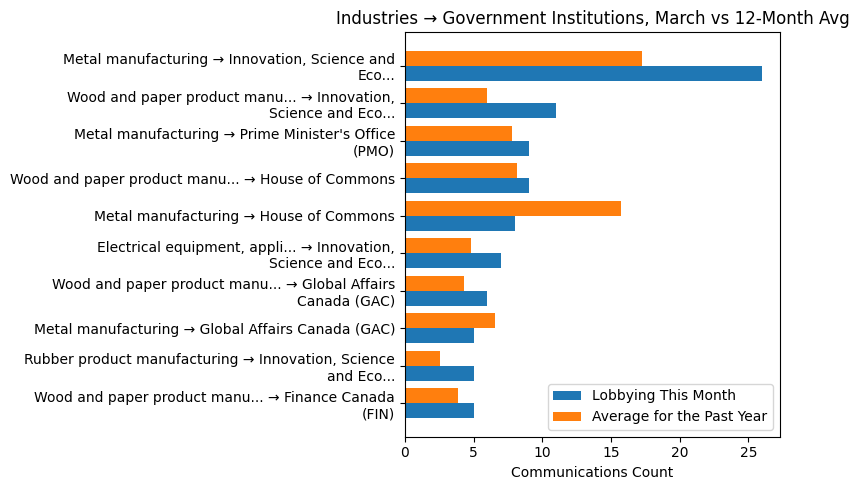
The busiest industry → institution corridors this month:
↳ Metal manufacturing → Innovation, Science and Economic Development Canada (ISED): 26 meetings (avg 17, +51%).
↳ Wood and paper product manufacturing → Innovation, Science and Economic Development Canada (ISED): 11 meetings (avg 6, +83%).
The busiest organization → institution corridors this month:
↳ ArcelorMittal Dofasco G.P. → Innovation, Science and Economic Development Canada (ISED): 12 meetings (avg 7, +69%).
↳ Element5 → Innovation, Science and Economic Development Canada (ISED): 5 meetings (avg 1, +445%).
↳ J.D. Irving, Limited → Finance Canada (FIN): 4 meetings (avg 1, +243%).
Section F: Industry and Organization Lobbying by Subject in the Past Month
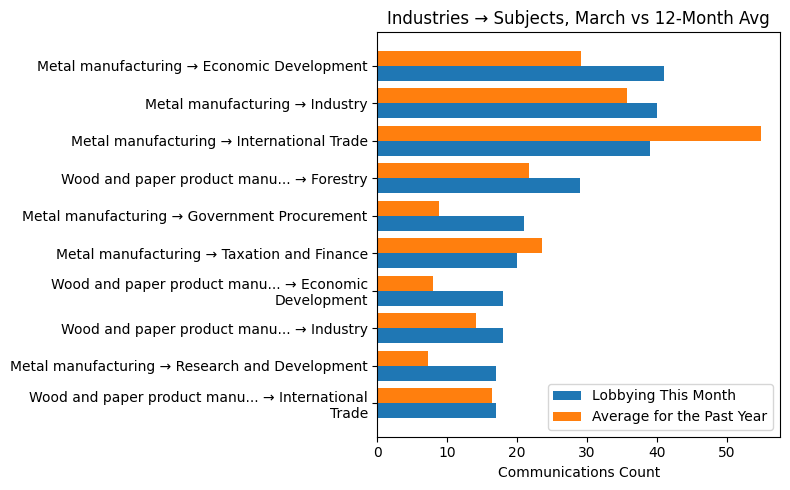
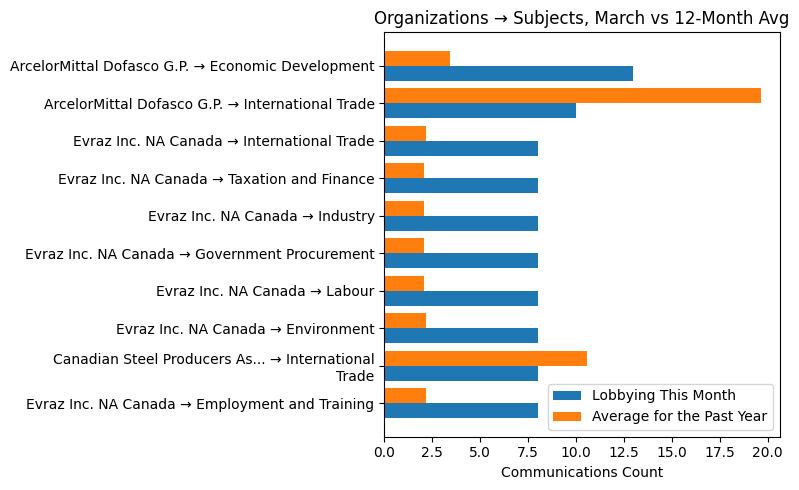
All lobbying activity is tagged with a "subject matter". This section shows the industry-subject pairs with the most unusual lobbying behavior last month, defined by either unusually high or unusually low lobbying activity, and below it the organization-subject pairs with the most unusual lobbying behavior last month.
Industries → Subjects
Organizations → Subjects
The busiest industry → subject corridors this month:
↳ Metal manufacturing → Economic Development: 41 meetings (avg 29, +41%).
↳ Metal manufacturing → International Trade: 39 meetings (avg 55, -29%).
The busiest organization → subject corridors this month:
↳ ArcelorMittal Dofasco G.P. → Economic Development: 13 meetings (avg 3, +280%).
↳ ArcelorMittal Dofasco G.P. → International Trade: 10 meetings (avg 20, -49%).
↳ Evraz Inc. NA Canada → Research and Development: 8 meetings (avg 2, +284%).
Section G: Last Month's Most Lobbied Politicians and Civil Servants
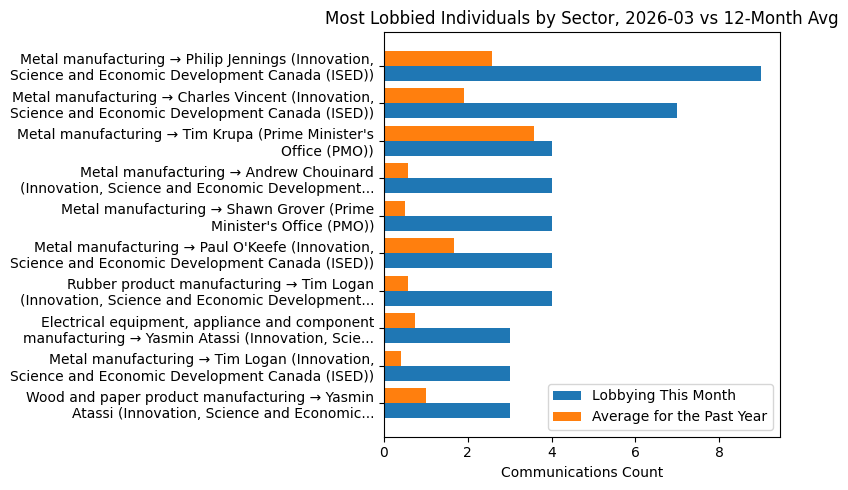
This section presents a list of the politicians and civil servants who took the most meetings with key industry players last month.
Most Lobbied Individuals by Sector
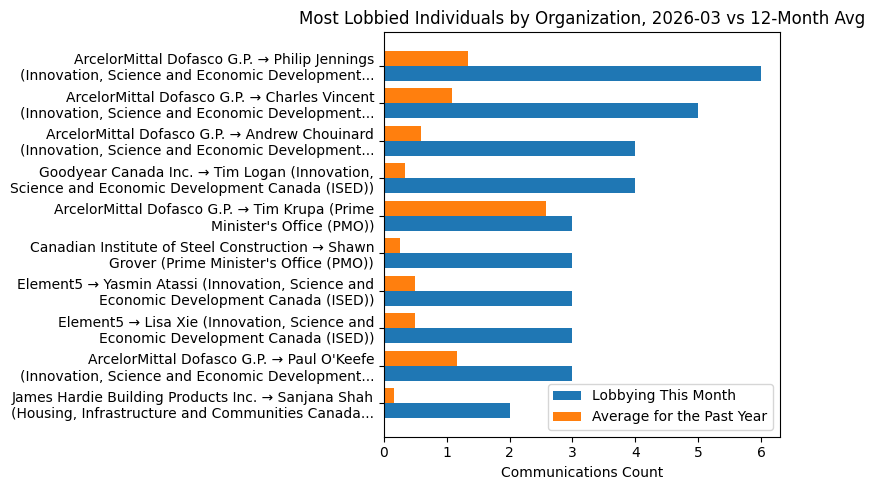
Most Lobbied Individuals by Organization
Among the individuals with the most notable meeting activity (by sector) this month were Metal manufacturing → Philip Jennings (Innovation, Science and Economic Development Canada (ISED)), Metal manufacturing → Charles Vincent (Innovation, Science and Economic Development Canada (ISED)) and Metal manufacturing → Tim Krupa (Prime Minister's Office (PMO)).
Among the individuals with the most notable meeting activity (by organization) this month were ArcelorMittal Dofasco G.P. → Philip Jennings (Innovation, Science and Economic Development Canada (ISED)), ArcelorMittal Dofasco G.P. → Charles Vincent (Innovation, Science and Economic Development Canada (ISED)) and Goodyear Canada Inc. → Tim Logan (Innovation, Science and Economic Development Canada (ISED)).