Lobbying on Indigenous Affairs - Ottawa (May 2026 edition)





Sturgeon Lake Cree Nation, Spuzzum First Nation, Nisga'a Nation, Cat Lake First Nation, K’awat’si Economic Development LP were unusually active lobbyists last month.
Once a month, we partner up with LobbyIQ to update our readers on recent movements in the federal lobbying landscape in Ottawa. We provide separate coverage for each channel, defined by the most relevant industries, organizations, institutions, and subject matters.
Key Takeaways — Indigenous Affairs
- Lobbying activity totalled 197 meetings in April 2026, up from a 12-month average of 96.
- The biggest moves were in Indigenous public administration and Indigenous advocacy organizations.
- Sturgeon Lake Cree Nation, Spuzzum First Nation were more active than usual.

Section A: The Themes Hidden in April 2026 Data
Federal Departments Outline Spending Cuts and Priorities
Spring 2026 saw the release of Departmental Plans for both Indigenous Services Canada and Crown-Indigenous Relations and Northern Affairs Canada, detailing major spending restraint alongside renewed attention to nation-to-nation relationships, self-determination, and economic development for Indigenous peoples. The timing of these plans coincides with a jump in lobbying by groups such as Sturgeon Lake Cree Nation, Fox Lake Cree Nation, Kitasoo Xai'xais Nation, and the Metis Nation of British Columbia targeting fiscal agreements, infrastructure, and economic development in conversations with Crown-Indigenous Relations and Northern Affairs Canada, suggesting organizations are proactively responding to anticipated changes in federal funding and strategic direction.
📎 Indigenous Services Canada 2026 27 Departmental Plan · Crown-Indigenous Relations and Northern Affairs Canada
Treaty Implementation and Governance Reform Draw Increased Lobbying
During April, a surge in advocacy by treaty nations such as the Nisga'a Nation, Wabigoon Lake Ojibway Nation, and Sturgeon Lake Cree Nation, in meetings with the Senate of Canada, Innovation, Science and Economic Development Canada, and Crown-Indigenous Relations and Northern Affairs Canada, aligns with ongoing federal efforts to modernize treaty implementation and enhance Indigenous governance. This uptick comes amid departmental plans that emphasize modern treaties, rights recognition, and structural reforms, underscoring a political moment when communities, including Metis Nation of British Columbia, are pushing for greater accountability and influence over treaty-related processes.
📎 Crown-Indigenous Relations and Northern Affairs Canada
Focus on Child & Family Services Fuels Advocacy Efforts
Lobbying records in April show organizations like Sturgeon Lake Cree Nation and Wabigoon Lake Ojibway Nation advocating to Crown-Indigenous Relations and Northern Affairs Canada (CIRNAC) and Indigenous Services Canada (ISC) for new funding agreements and jurisdiction over child and family services. These activities coincide with federal plans emphasizing the transition to First Nations-led child welfare, reflecting a policy environment in which fiscal and governance frameworks are actively under negotiation.
📎 Indigenous Services Canada 2026 27 Departmental Plan · Crown-Indigenous Relations and Northern Affairs Canada
Community Infrastructure and Socio-economic Gaps at Forefront
Many April lobbying meetings centered on infrastructure, stable housing, and economic opportunity—subjects prioritized in recent federal departmental plans and grant programs. This persistent focus mirrors Ottawa’s stated goal of closing housing, water, and infrastructure gaps for Indigenous peoples heading into 2026–27.
📎 Indigenous Services Canada 2026 27 Departmental Plan · Top 12 Funders for First Nations Community Programs in 2026
Section B: Lobbying Activity by Industry
This section compares, by NAICS industry, the lobbying activity in Ottawa last month to its historical average.
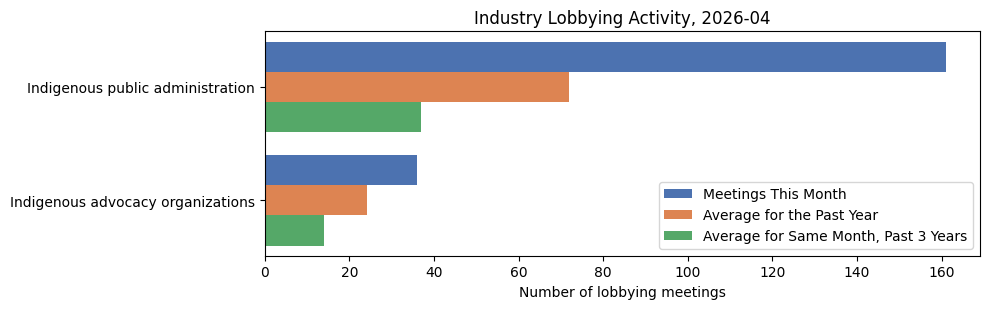
Lobbying activity across this channel totalled 197 meetings in April 2026, up from a 12-month average of 96. The most active industry was Indigenous public administration, while Indigenous advocacy organizations rose above its recent baseline.
The industries with the most notable increases in lobbying this month include Indigenous public administration logged 161 meetings, up from an average of 72, and Indigenous advocacy organizations logged 36 meetings, up from an average of 24.
Section C: Lobbying by Industry for the Past Year
To contextualize, we show each industry's lobbying activity over the past 12 months. The combined view from Section B and C shows you whether recent differences are persistent trends or a break from the norm.
Top Industry Residual Trends for 2026-04
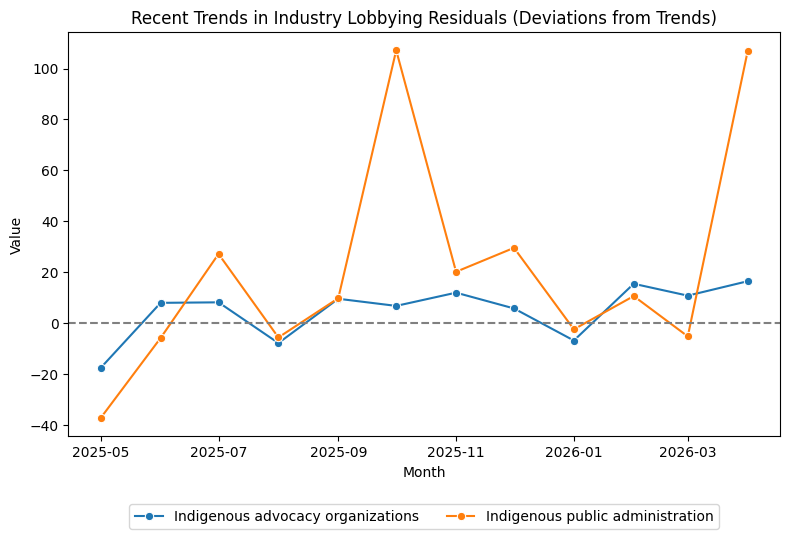
Indigenous public administration saw lobbying run notably above expected levels in April 2026.
↳ Indigenous public administration has been on a broadly upward trajectory in lobbying over the past year.
↳ Indigenous public administration displayed high volatility, suggesting irregular or event-driven engagement.
↳ Indigenous advocacy organizations has been on a broadly upward trajectory in lobbying over the past year.
Section D: Lobbying Activity by Organization
In this section, we see the organizations with the most unusual lobbying behavior last month, defined by either unusually high or unusually low lobbying activity.
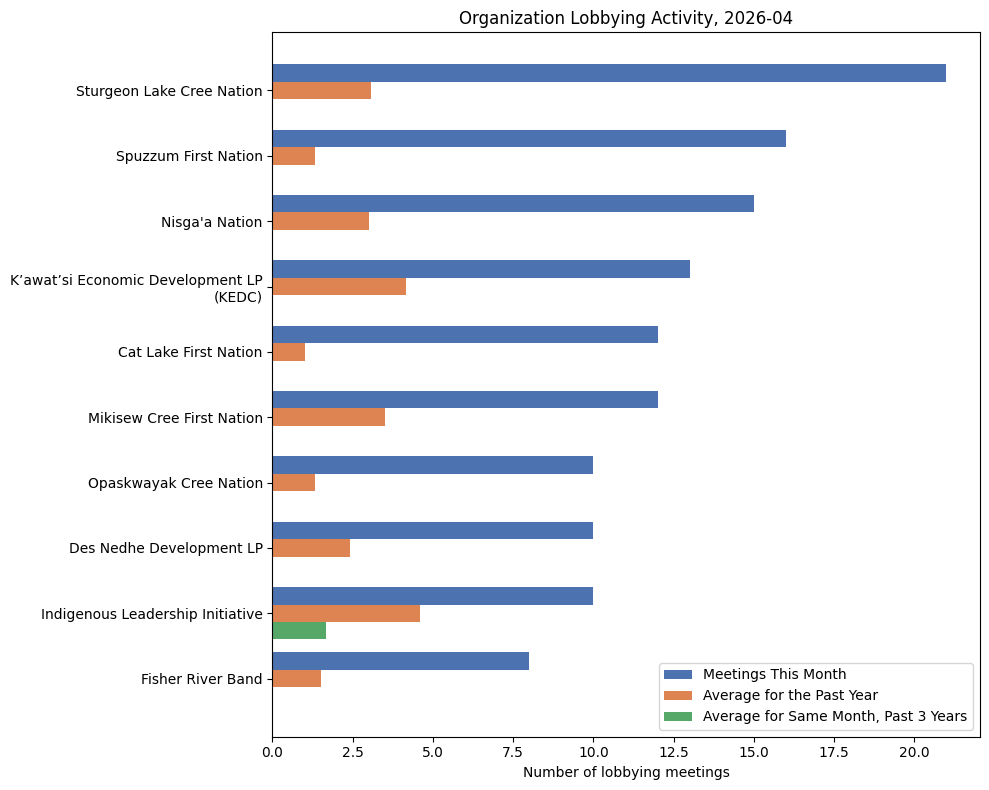
The organizations with the most notable increases in lobbying this month include Sturgeon Lake Cree Nation, Spuzzum First Nation, Nisga'a Nation, Cat Lake First Nation, and K’awat’si Economic Development LP (KEDC).
Section E: Lobbying of Government Institutions in the Past Month
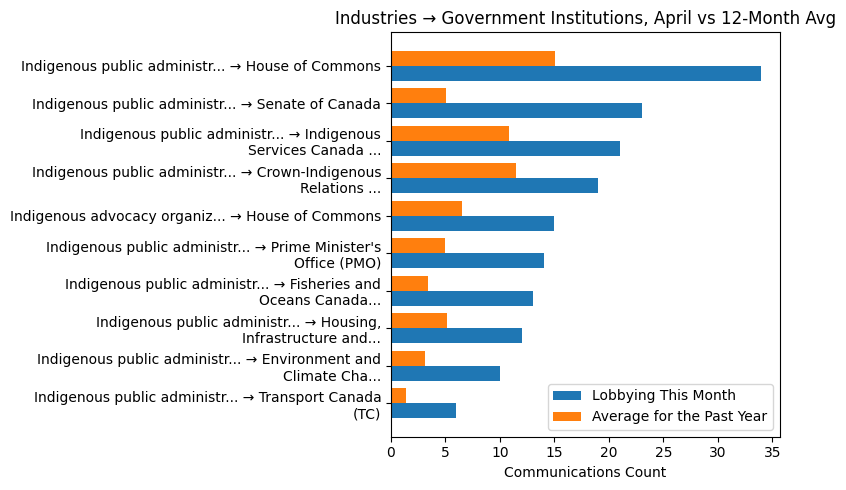
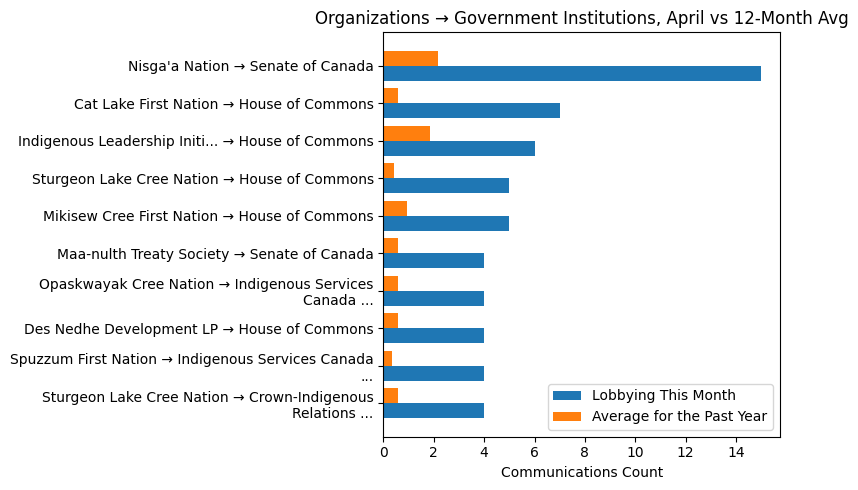
Every time an organization lobbies, there is a government official representing a government institution at the other side of the table. This section shows the industry-institutions pairs with the most unusual lobbying behavior last month, defined by either unusually high or unusually low lobbying activity. Below that, we show the corresponding organization-institution pairs.
Industries → Government Institutions
Organizations → Government Institutions
The busiest industry → institution corridors this month:
↳ Indigenous public administration → House of Commons: 34 meetings (avg 15, +125%).
↳ Indigenous public administration → Senate of Canada: 23 meetings (avg 5, +352%).
↳ Indigenous public administration → Indigenous Services Canada (ISC): 21 meetings (avg 11, +94%).
The busiest organization → institution corridors this month:
↳ Nisga'a Nation → Senate of Canada: 15 meetings (avg 2, +592%).
↳ Cat Lake First Nation → House of Commons: 7 meetings (avg 1, +1100%).
↳ Indigenous Leadership Initiative → House of Commons: 6 meetings (avg 2, +227%).
Section F: Industry and Organization Lobbying by Subject in the Past Month
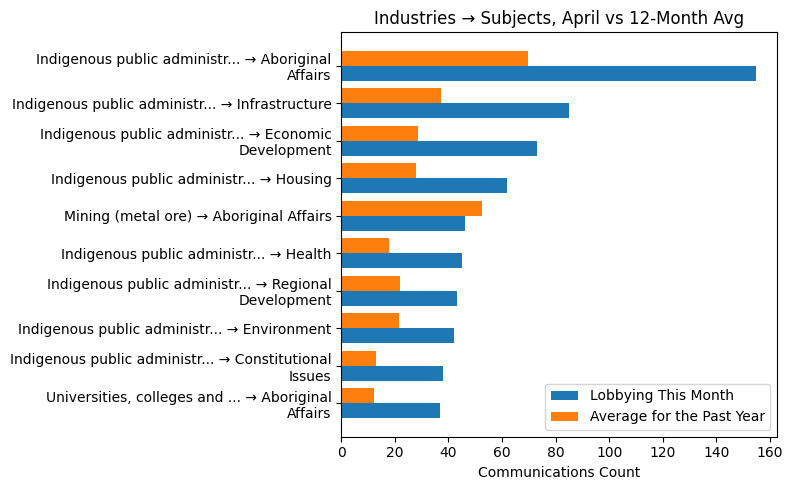
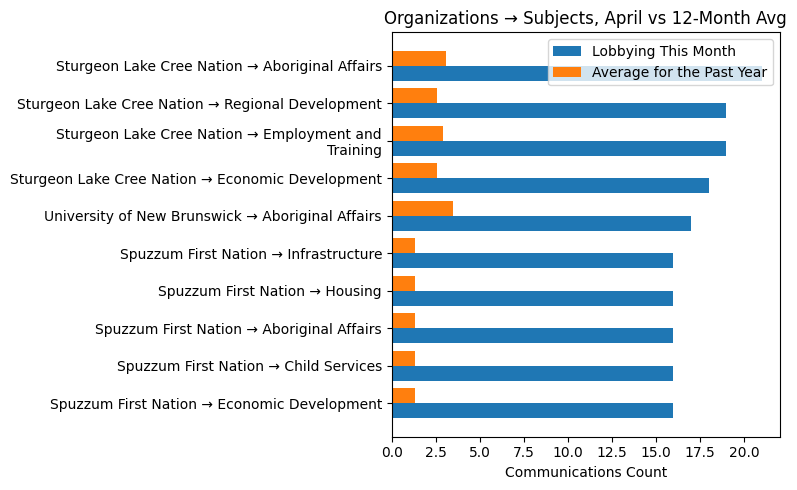
All lobbying activity is tagged with a "subject matter". This section shows the industry-subject pairs with the most unusual lobbying behavior last month, defined by either unusually high or unusually low lobbying activity, and below it the organization-subject pairs with the most unusual lobbying behavior last month.
Industries → Subjects
Organizations → Subjects
The busiest industry → subject corridors this month:
↳ Indigenous public administration → Aboriginal Affairs: 155 meetings (avg 70, +123%).
↳ Indigenous public administration → Infrastructure: 85 meetings (avg 37, +128%).
↳ Indigenous public administration → Economic Development: 73 meetings (avg 29, +155%).
The busiest organization → subject corridors this month:
↳ Sturgeon Lake Cree Nation → Aboriginal Affairs: 21 meetings (avg 3, +581%).
↳ Sturgeon Lake Cree Nation → Employment and Training: 19 meetings (avg 3, +551%).
↳ Sturgeon Lake Cree Nation → Regional Development: 19 meetings (avg 3, +635%).
Section G: Last Month's Most Lobbied Politicians and Civil Servants
This section presents a list of the politicians and civil servants who took the most meetings with key industry players last month.
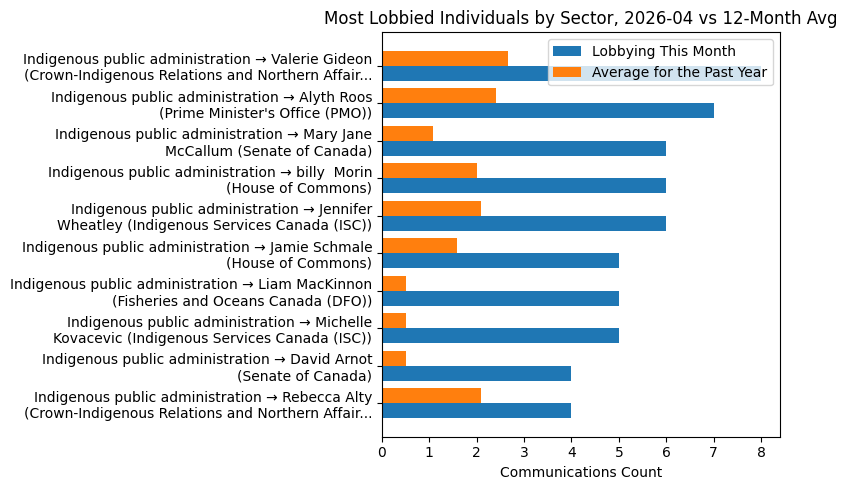
Most Lobbied Individuals by Sector
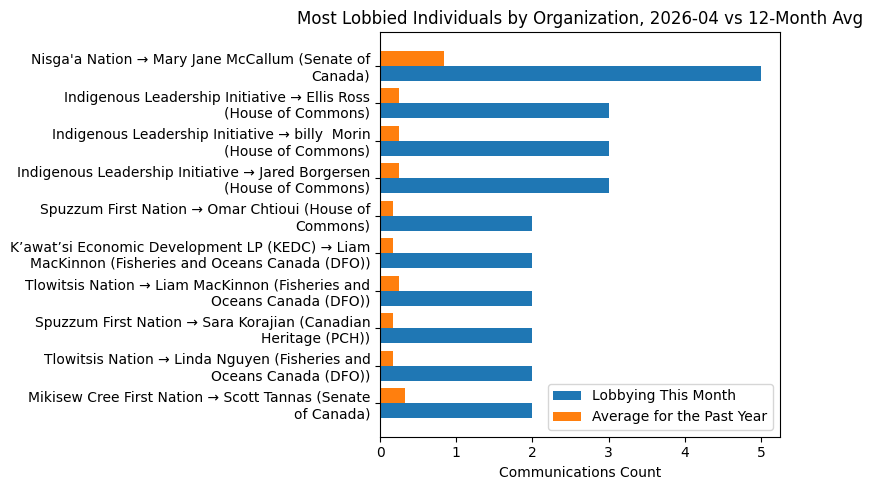
Most Lobbied Individuals by Organization
Among the individuals with the most notable meeting activity (by sector) this month were Indigenous public administration → Valerie Gideon (Crown-Indigenous Relations and Northern Affairs Canada (CIRNAC) ), Indigenous public administration → Alyth Roos (Prime Minister's Office (PMO)) and Indigenous public administration → Mary Jane McCallum (Senate of Canada).
Among the individuals with the most notable meeting activity (by organization) this month were Nisga'a Nation → Mary Jane McCallum (Senate of Canada), Indigenous Leadership Initiative → Jared Borgersen (House of Commons) and Indigenous Leadership Initiative → Ellis Ross (House of Commons).