Lobbying on Indigenous Affairs - Ottawa (March 2026 edition)





Semiahmoo First Nation, Indigenous Leadership Initiative, British Columbia Assembly of First Nations, and CANDO were unusually active lobbyists last month.
Once a month, we partner up with LobbyIQ to update our readers on recent movements in the federal lobbying landscape in Ottawa. We provide separate coverage for each channel, defined by the most relevant industries, organizations, institutions, and subject matters.
Key Takeaways — Indigenous Affairs
- Lobbying activity totalled 102 meetings in February 2026, up from a 12-month average of 77.2.
- The most notable shift was in Indigenous advocacy organizations.
- Semiahmoo First Nation, Indigenous Leadership Initiative were more active than usual.

Section A: The Themes Hidden in February 2026 Data
Federal Budget Delivers Major Indigenous Infrastructure Funding
The February 2026 lobbying surge by Indigenous public administration and advocacy groups, including Nishnawbe Aski Nation and the British Columbia Assembly of First Nations, coincides with the unveiling of a $2.3 billion five-year federal infrastructure package targeting water, housing, and broadband in Indigenous communities. Many recent lobbying meetings with Indigenous Services Canada and Housing, Infrastructure and Communities Canada sought increased support for housing and community infrastructure, reflecting a strong alignment with this federal initiative.
📎 Budget 2026 — $2.3B for Indigenous Infrastructure
Urban, Rural, and Northern Indigenous Housing Strategy Expansion
A notable spike in advocacy in February 2026, focused on housing finance and comprehensive strategies for stable Indigenous housing—led by groups such as the British Columbia Assembly of First Nations in meetings with Indigenous Services Canada and Crown-Indigenous Relations and Northern Affairs Canada, as well as Sturgeon Lake Cree Nation with the Prime Minister's Office—comes just ahead of the federal government's announcement of a new delivery model and major funding for the Urban, Rural, and Northern Indigenous Housing Strategy. The funding approach involves distinctions-based agreements and a dedicated flow to key Indigenous partners, including the Aboriginal Labour Force Development Circle engaging Finance Canada in support of strategy development.
📎 Urban, Rural and Northern Indigenous Housing Strategy
Treaty One Nations Secure Funding for Community-Led Housing Project
Several February 2026 lobbying records, including those from Semiahmoo First Nation engaging with Housing, Infrastructure and Communities Canada, and Nishnawbe Aski Nation meeting with Indigenous Services Canada, described efforts to secure support for large-scale, community-led projects aimed at addressing housing shortages. This aligns with the federal government’s March 2026 partnership with Treaty One Nations in Winnipeg, allocating $91 million for a new housing development, underscoring the practical impact of advocacy on resource flows.
📎 Urban, Rural and Northern Indigenous Housing Strategy
Indigenous Organizations Press for Broader Economic and Infrastructure Opportunities
Lobbying activity in February 2026 frequently touched on economic development, opportunities in federal infrastructure, and ownership interests in assets such as the Trans Mountain pipeline, as organizations like Athabasca Chipewyan First Nation and Indigenous Leadership Initiative engaged with interlocutors including Crown-Indigenous Relations and Northern Affairs Canada and the House of Commons. While recent funding was focused on housing and infrastructure, these advocacy efforts coincide with broad federal moves to support Indigenous economic participation and community-led development, highlighting a wider policy trend.
📎 Budget 2026 — $2.3B for Indigenous Infrastructure
Section B: Lobbying Activity by Industry
This section compares, by NAICS industry, the lobbying activity in Ottawa last month to its historical average.
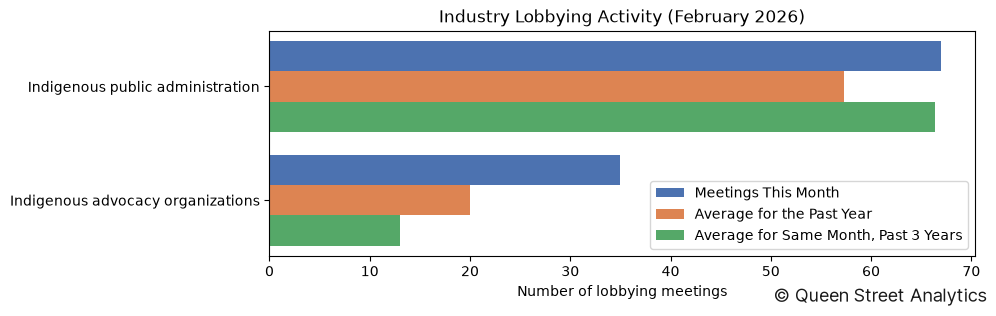
Lobbying activity across this channel totalled 102 meetings in February 2026, up from a 12-month average of 77. The most active industry was Indigenous public administration, while Indigenous advocacy organizations rose above its recent baseline.
Indigenous advocacy organizations logged 35 meetings, up from an average of 20.
Section C: Lobbying by Industry for the Past Year
To contextualize, we show each industry's lobbying activity over the past 12 months. The combined view from Section B and C shows you whether recent differences are persistent trends or a break from the norm.
Top Industry Residual Trends for 2026-02
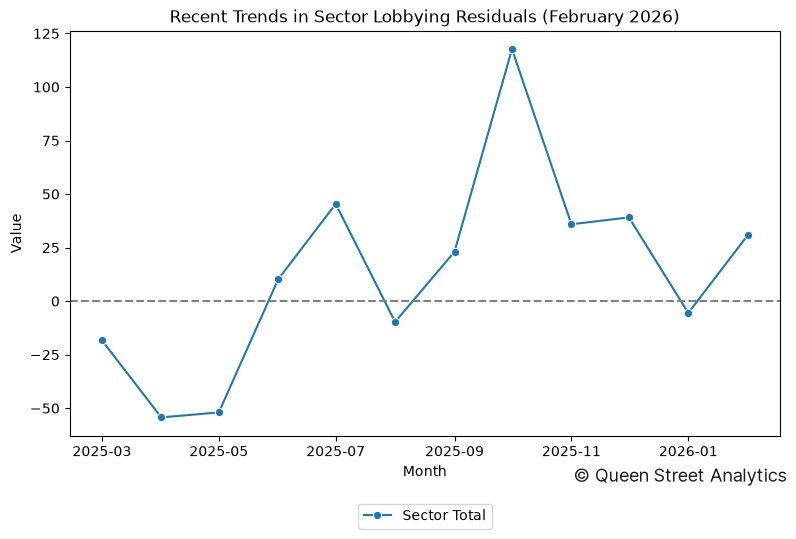
↳ Indigenous advocacy organizations has been on a broadly upward trajectory in lobbying over the past year.
↳ Indigenous advocacy organizations displayed high volatility, suggesting irregular or event-driven engagement.
↳ Indigenous public administration has been on a broadly upward trajectory in lobbying over the past year.
↳ Indigenous public administration displayed high volatility, suggesting irregular or event-driven engagement.
Section D: Lobbying Activity by Organization
In this section, we see the organizations with the most unusual lobbying behavior last month, defined by either unusually high or unusually low lobbying activity.
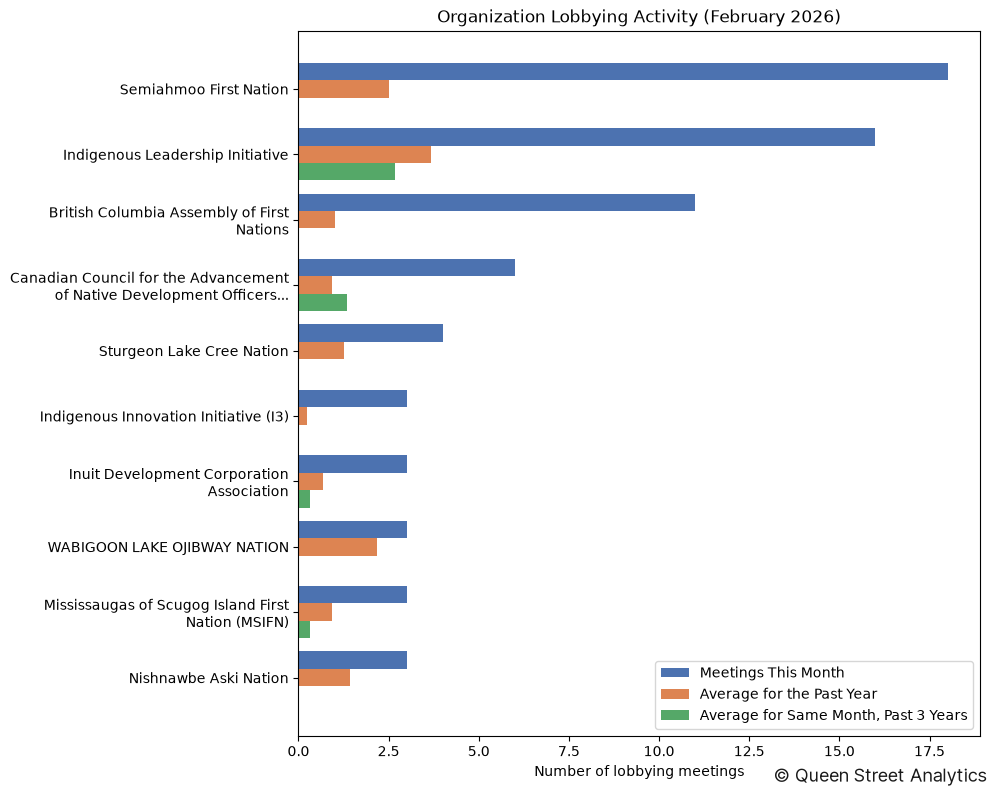
The organizations with the most notable increases in lobbying this month include Semiahmoo First Nation, Indigenous Leadership Initiative, British Columbia Assembly of First Nations, and Canadian Council for the Advancement of Native Development Officers (CANDO).
On the quieter side, K’awat’si Economic Development LP (KEDC) pulled back from its usual pace.
Section E: Lobbying of Government Institutions in the Past Month
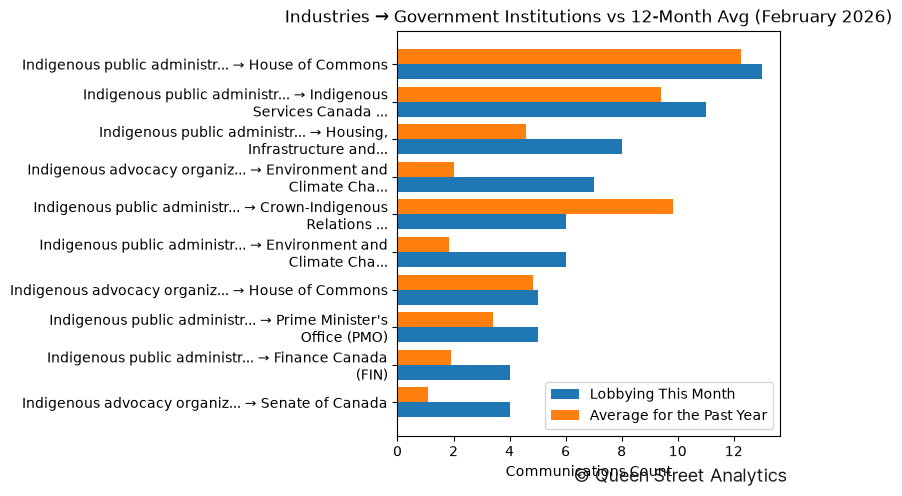
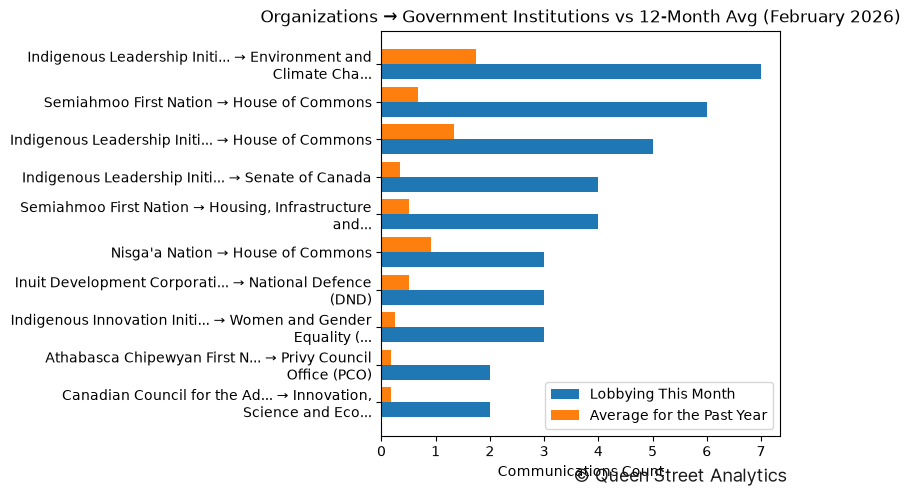
Every time an organization lobbies, there is a government official representing a government institution at the other side of the table. This section shows the industry-institutions pairs with the most unusual lobbying behavior last month, defined by either unusually high or unusually low lobbying activity. Below that, we show the corresponding organization-institution pairs.
Industries → Government Institutions
Organizations → Government Institutions
The busiest industry → institution corridors this month:
↳ Indigenous public administration → Housing, Infrastructure and Communities Canada (HICC): 8 meetings (avg 5, +75%).
The busiest organization → institution corridors this month:
↳ Indigenous Leadership Initiative → Environment and Climate Change Canada (ECCC): 7 meetings (avg 2, +300%).
↳ Semiahmoo First Nation → House of Commons: 6 meetings (avg 1, +800%).
↳ Indigenous Leadership Initiative → House of Commons: 5 meetings (avg 1, +275%).
Section F: Industry and Organization Lobbying by Subject in the Past Month
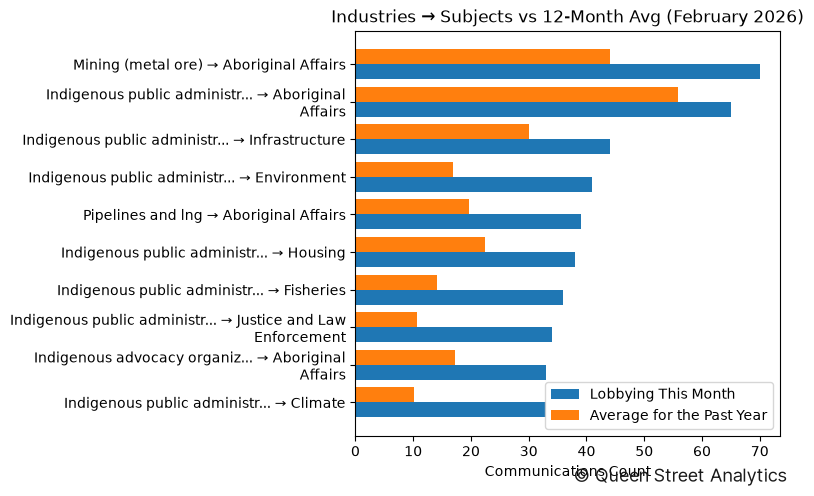
All lobbying activity is tagged with a "subject matter". This section shows the industry-subject pairs with the most unusual lobbying behavior last month, defined by either unusually high or unusually low lobbying activity, and below it the organization-subject pairs with the most unusual lobbying behavior last month.
Industries → Subjects
Organizations → Subjects
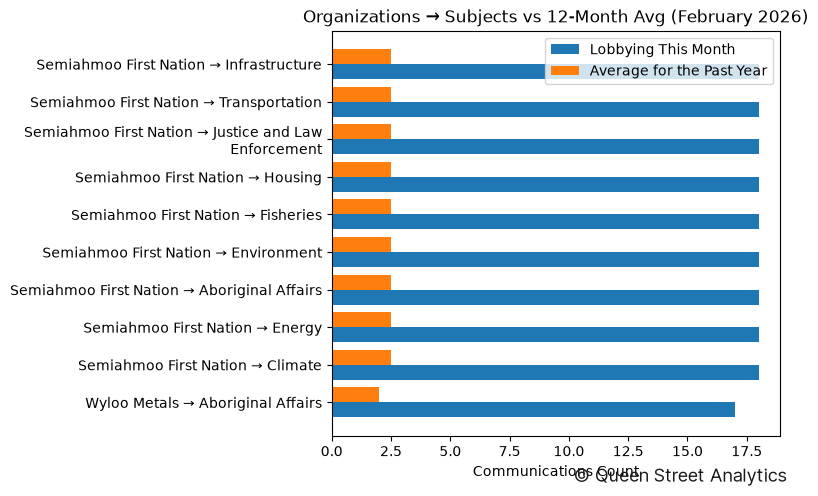
The busiest industry → subject corridors this month:
↳ Mining (metal ore) → Aboriginal Affairs: 70 meetings (avg 44, +59%).
↳ Indigenous public administration → Infrastructure: 44 meetings (avg 30, +46%).
The busiest organization → subject corridors this month:
↳ Semiahmoo First Nation → Infrastructure: 18 meetings (avg 2, +620%).
↳ Semiahmoo First Nation → Transportation: 18 meetings (avg 2, +620%).
↳ Semiahmoo First Nation → Justice and Law Enforcement: 18 meetings (avg 2, +620%).
Section G: Last Month's Most Lobbied Politicians and Civil Servants
This section presents a list of the politicians and civil servants who took the most meetings with key industry players last month.
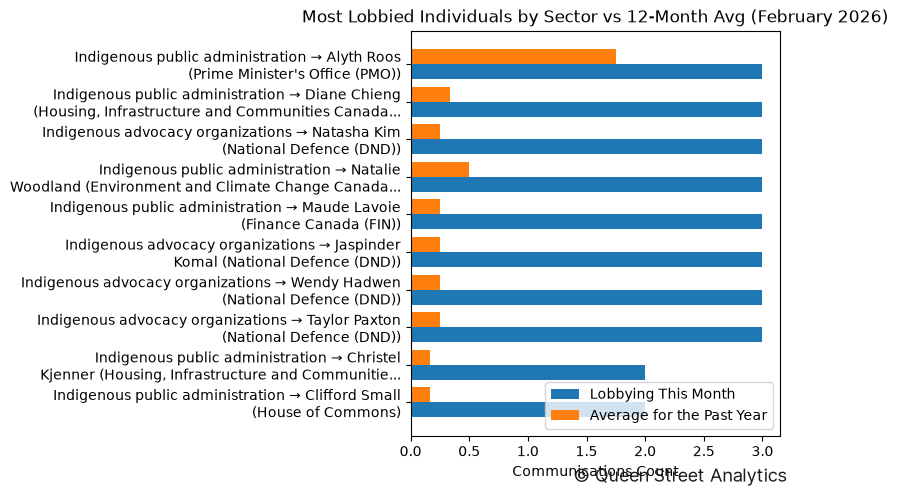
Most Lobbied Individuals by Sector
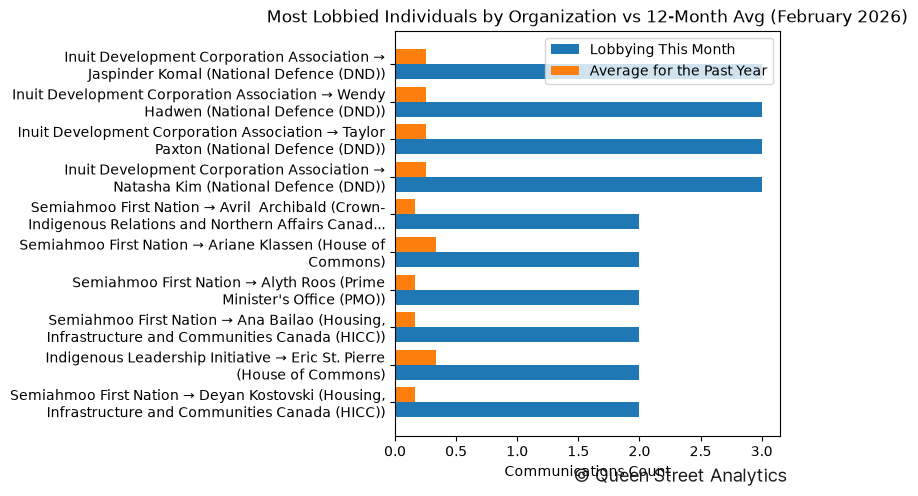
Most Lobbied Individuals by Organization
Among the individuals with the most notable meeting activity (by sector) this month were Indigenous public administration → Alyth Roos (Prime Minister's Office (PMO)), Indigenous public administration → Diane Chieng (Housing, Infrastructure and Communities Canada (HICC)) and Indigenous advocacy organizations → Natasha Kim (National Defence (DND)).
Among the individuals with the most notable meeting activity (by organization) this month were Inuit Development Corporation Association → Jaspinder Komal (National Defence (DND)), Inuit Development Corporation Association → Wendy Hadwen (National Defence (DND)) and Inuit Development Corporation Association → Taylor Paxton (National Defence (DND)).