Lobbying on Higher Ed - Ottawa (May 2026 edition)





National Association of Career Colleges, Capilano Students' Union, University of New Brunswick, Memorial University of Newfoundland, and NorQuest College were unusually active lobbyists last month.
Once a month, we partner up with LobbyIQ to update our readers on recent movements in the federal lobbying landscape in Ottawa. We provide separate coverage for each channel, defined by the most relevant industries, organizations, institutions, and subject matters.
Key Takeaways — Higher Ed
- Lobbying activity totalled 329 meetings in April 2026, up from a 12-month average of 245.8.
- The biggest moves were in Universities, colleges and research institutes and Educational services.
- National Association of Career Colleges, Capilano Students' Union were more active than usual.

Section A: The Themes Hidden in April 2026 Data
Federal Cap on International Student Permits Triggers Budget Strain and Lobbying Surge
In April 2026, a dramatic federal reduction to international student permit allocations coincided with a sharp spike in lobbying from Canadian universities and colleges, including The University of British Columbia and the Canadian Alliance of Student Associations. Institutions, facing acute financial pressure due to the cap, increased advocacy—such as UBC’s meetings with the Natural Sciences and Engineering Research Council (NSERC) and the Public Health Agency of Canada (PHAC)—for expanded research funding and grant council support, as evidenced by numerous meetings referencing the tri-agency councils and research mobilization. These developments align with media coverage highlighting how the government exempted graduate students from permit cuts and earmarked substantial funding to recruit international research talent.
📎 Canada’s rules are shaping study choices for international students · Canada seeks star academics from abroad, but stable funding for higher ...
Extension of Student Financial Support Aligns with Advocacy on Skills and Workforce Training
The government's March 2026 decision to prolong key financial supports for post-secondary students coincides with notable lobbying efforts from colleges and student associations, including NorQuest College and Capilano Students' Union in discussions with the House of Commons and Employment and Social Development Canada (ESDC). These efforts focused on expanding workforce-aligned programs, settlement services, and bridging initiatives for marginalized groups such as veterans—reflecting the sector’s push for enhanced labour market and educational integration amidst shifting policy priorities, with Polytechnics Canada also engaging ESDC to advocate for targeted funding and equipment to support training in high-demand fields.
📎 Canada’s rules are shaping study choices for international students
Stricter Study Permit Framework Drives Increased Lobbying on Curricular Innovation
New rules linking study permit eligibility to programs aligned with in-demand occupations have reinforced a pattern of intensive advocacy from colleges and universities, including NorQuest College, Polytechnics Canada, and the Capilano Students' Union. These institutions, through lobbying efforts with Employment and Social Development Canada (ESDC) and the House of Commons, are adapting curricula and lobbying for greater program funding and improved processes to support work-integrated learning and skills training, reflecting federal priorities for labour market alignment.
📎 Canada’s rules are shaping study choices for international students
Push to Attract Elite International Researchers Highlights Unstable Research Funding Climate
Federal initiatives to recruit ‘star academics’ from abroad have been accompanied by institutional concerns regarding the instability of core research funding. While there is new money targeting top international talent and research excellence, university officials at McMaster University and The University of British Columbia have increased lobbying activities with Innovation, Science and Economic Development Canada (ISED) and Natural Sciences and Engineering Research Council (NSERC) focused on shoring up basic research support and advancing commercialization efforts, coinciding with the sector’s heightened policy uncertainty.
📎 Canada seeks star academics from abroad, but stable funding for higher ...
Section B: Lobbying Activity by Industry
This section compares, by NAICS industry, the lobbying activity in Ottawa last month to its historical average.
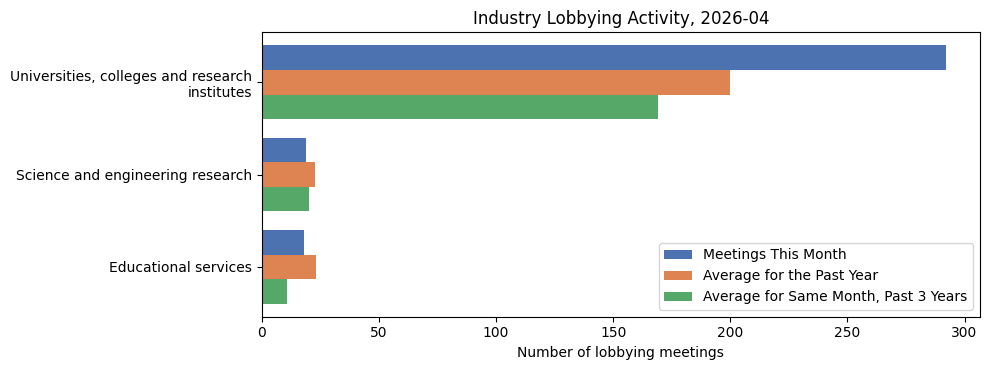
Lobbying activity across this channel totalled 329 meetings in April 2026, up from a 12-month average of 246. The most active industry was Universities, colleges and research institutes, while Science and engineering research rose above its recent baseline.
Universities, colleges and research institutes logged 292 meetings, up from an average of 200.
Educational services had 18 meetings, down from an average of 23.
Section C: Lobbying by Industry for the Past Year
To contextualize, we show each industry's lobbying activity over the past 12 months. The combined view from Section B and C shows you whether recent differences are persistent trends or a break from the norm.
Top Industry Residual Trends for 2026-04
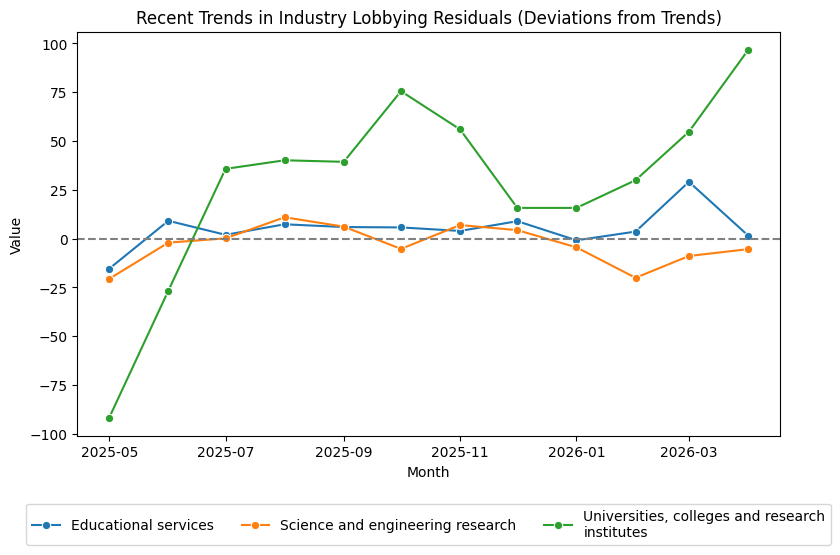
Universities, colleges and research institutes saw lobbying run notably above expected levels in April 2026.
↳ Universities, colleges and research institutes has been on a broadly upward trajectory in lobbying over the past year.
↳ Universities, colleges and research institutes displayed high volatility, suggesting irregular or event-driven engagement.
↳ Educational services has been on a broadly upward trajectory in lobbying over the past year.
↳ Educational services displayed high volatility, suggesting irregular or event-driven engagement.
↳ Science and engineering research has been trending downward in lobbying over the past year.
↳ Science and engineering research displayed high volatility, suggesting irregular or event-driven engagement.
Section D: Lobbying Activity by Organization
In this section, we see the organizations with the most unusual lobbying behavior last month, defined by either unusually high or unusually low lobbying activity.
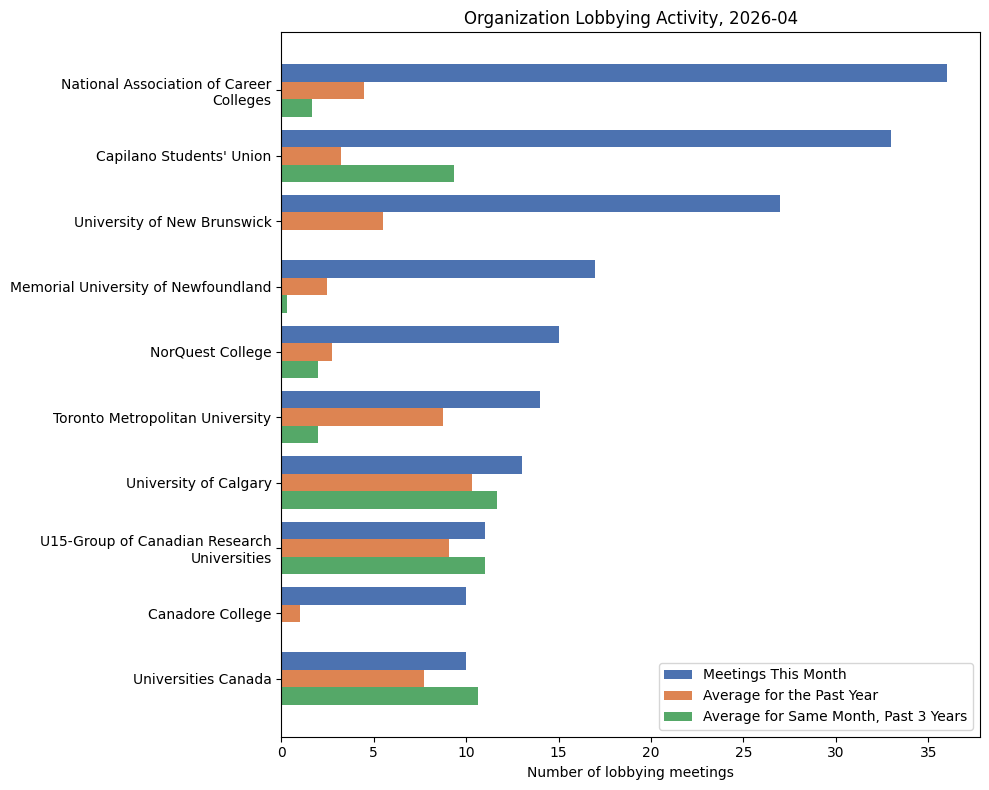
The organizations with the most notable increases in lobbying this month include National Association of Career Colleges, Capilano Students' Union, University of New Brunswick, Memorial University of Newfoundland, and NorQuest College.
Section E: Lobbying of Government Institutions in the Past Month
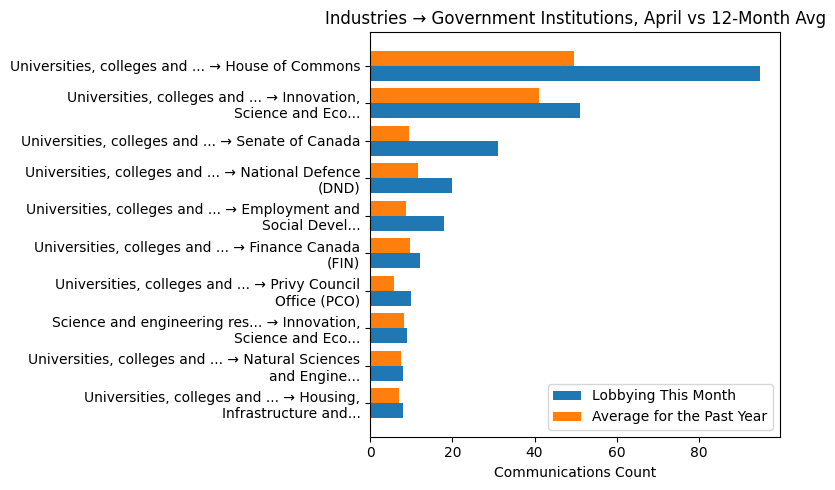
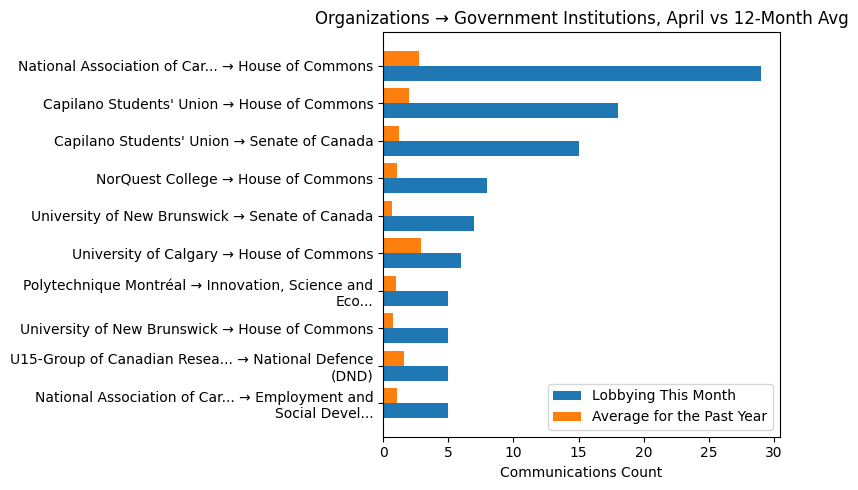
Every time an organization lobbies, there is a government official representing a government institution at the other side of the table. This section shows the industry-institutions pairs with the most unusual lobbying behavior last month, defined by either unusually high or unusually low lobbying activity. Below that, we show the corresponding organization-institution pairs.
Industries → Government Institutions
Organizations → Government Institutions
The busiest industry → institution corridors this month:
↳ Universities, colleges and research institutes → House of Commons: 95 meetings (avg 50, +91%).
↳ Universities, colleges and research institutes → Innovation, Science and Economic Development Canada (ISED): 51 meetings (avg 41, +24%).
↳ Universities, colleges and research institutes → Senate of Canada: 31 meetings (avg 10, +226%).
The busiest organization → institution corridors this month:
↳ National Association of Career Colleges → House of Commons: 29 meetings (avg 3, +955%).
↳ Capilano Students' Union → House of Commons: 18 meetings (avg 2, +800%).
↳ Capilano Students' Union → Senate of Canada: 15 meetings (avg 1, +1100%).
Section F: Industry and Organization Lobbying by Subject in the Past Month
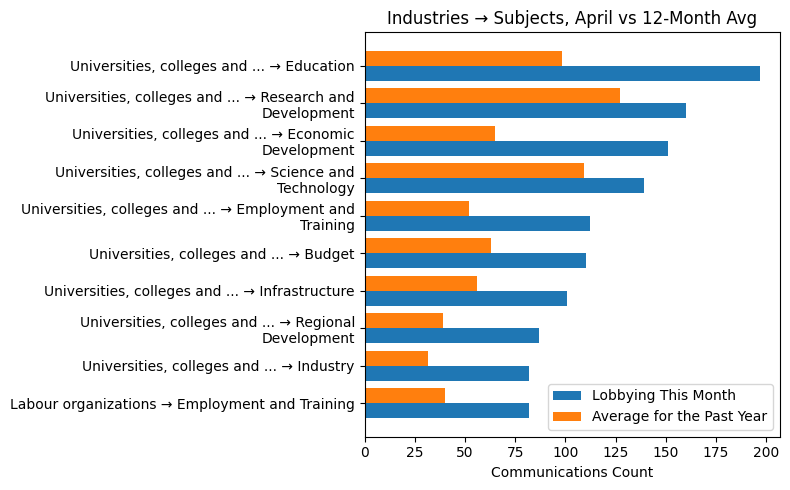
All lobbying activity is tagged with a "subject matter". This section shows the industry-subject pairs with the most unusual lobbying behavior last month, defined by either unusually high or unusually low lobbying activity, and below it the organization-subject pairs with the most unusual lobbying behavior last month.
Industries → Subjects
Organizations → Subjects
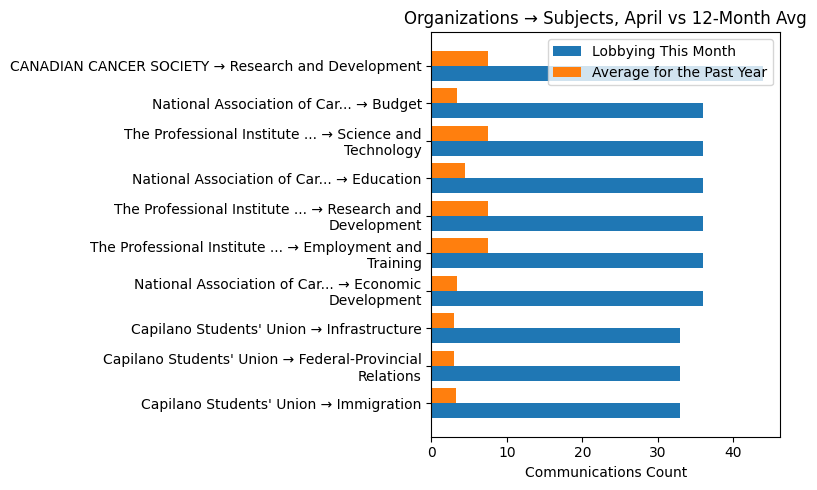
The busiest industry → subject corridors this month:
↳ Universities, colleges and research institutes → Education: 197 meetings (avg 99, +100%).
↳ Universities, colleges and research institutes → Research and Development: 160 meetings (avg 127, +26%).
↳ Universities, colleges and research institutes → Economic Development: 151 meetings (avg 65, +133%).
The busiest organization → subject corridors this month:
↳ CANADIAN CANCER SOCIETY → Research and Development: 44 meetings (avg 8, +487%).
↳ National Association of Career Colleges → Budget: 36 meetings (avg 3, +954%).
↳ National Association of Career Colleges → Economic Development: 36 meetings (avg 3, +980%).
Section G: Last Month's Most Lobbied Politicians and Civil Servants
This section presents a list of the politicians and civil servants who took the most meetings with key industry players last month.
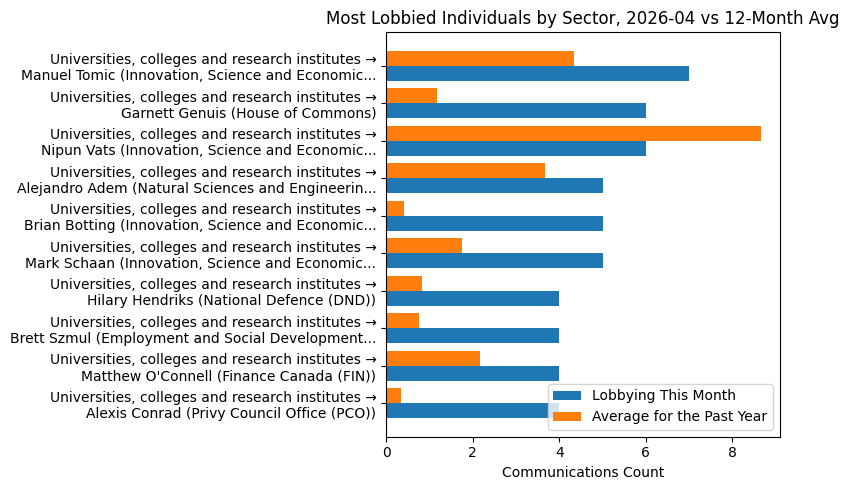
Most Lobbied Individuals by Sector
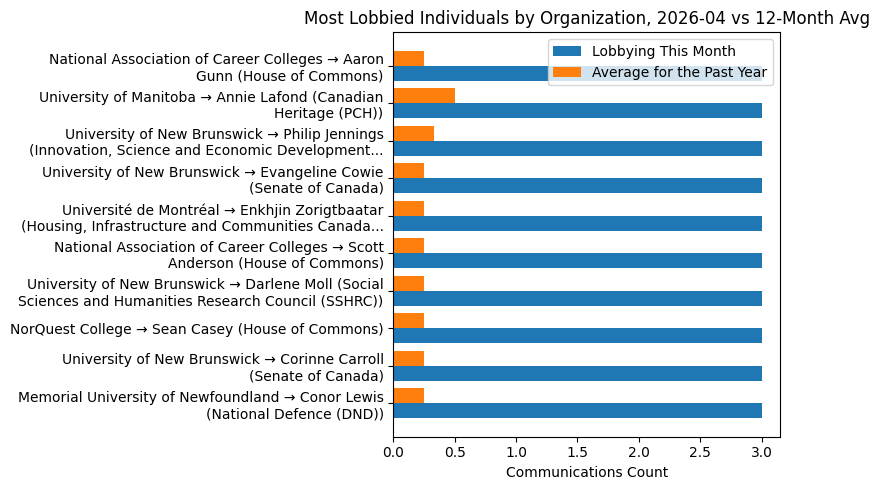
Most Lobbied Individuals by Organization
Among the individuals with the most notable meeting activity (by sector) this month were Universities, colleges and research institutes → Manuel Tomic (Innovation, Science and Economic Development Canada (ISED)), Universities, colleges and research institutes → Nipun Vats (Innovation, Science and Economic Development Canada (ISED)) and Universities, colleges and research institutes → Garnett Genuis (House of Commons).
Among the individuals with the most notable meeting activity (by organization) this month were National Association of Career Colleges → Aaron Gunn (House of Commons), National Association of Career Colleges → Sukhman Gill (House of Commons) and National Association of Career Colleges → Scott Anderson (House of Commons).