Lobbying on Higher Ed - Ottawa (March 2026 edition)





University of Saskatchewan, British Columbia Institute of Technology, University of Alberta, University of Manitoba, and Toronto Metropolitan University were unusually active lobbyists last month.
Once a month, we partner up with LobbyIQ to update our readers on recent movements in the federal lobbying landscape in Ottawa. We provide separate coverage for each channel, defined by the most relevant industries, organizations, institutions, and subject matters.
Key Takeaways — Higher Ed
- Lobbying activity totalled 271 meetings in February 2026, up from a 12-month average of 207.7.
- The biggest moves were in Universities, colleges and research institutes and Science and engineering research.
- University of Saskatchewan, British Columbia Institute of Technology were more active than usual.

Section A: The Themes Hidden in February 2026 Data
Surge in Higher Ed Lobbying Amid Major Federal Research Funding
Universities and colleges, including The University of British Columbia, The University of Western Ontario, Polytechnics Canada, and the U15-Group of Canadian Research Universities, significantly increased lobbying efforts in February 2026, a pattern that coincides with imminent federal commitments of over $168 million to research infrastructure and new Canada Research Chairs. This activity, which prominently involved meetings with Innovation, Science and Economic Development Canada (ISED) and the Natural Sciences and Engineering Research Council (NSERC), appears to align with sector advocacy for increased funding for granting councils and research talent, positioning institutions to benefit from the anticipated spring and summer allocations.
📎 Canada Federal Research Priorities 2026: University Funding
Lobbying for Innovation Ecosystems Mirrors March Infrastructure Announcements
February’s uptick in advocacy around commercialization and innovation support from universities, including meetings between the University of Alberta and Innovation, Science and Economic Development Canada (ISED), as well as the University of Manitoba with Crown-Indigenous Relations and Northern Affairs Canada (CIRNAC), coincides with federal plans for a $552 million investment in research infrastructure announced in March 2026. This alignment suggests lobbying was driven by institutions such as The University of British Columbia and Tech-Access Canada, aiming to secure strategic advantages in AI, climate resilience, and tech infrastructure as new funding opportunities emerged.
📎 Major research infrastructure investment positions Canada to lead on ...
Push on AI and Skills Development Reflects Ottawa’s 2026 Priorities
Communications from higher education advocates, including Polytechnics Canada and the University of Alberta, pressing for AI skills funding and talent pipelines correspond with new federal priorities that emphasize support for AI, quantum computing, and collaborative partnerships, as discussed with Innovation, Science and Economic Development Canada (ISED). This advocacy, also reflected in meetings between the Deans Council - Agriculture, Food & Veterinary Medicine (Deans Council AFVM) and both ISED and Prairies Economic Development Canada (PrairiesCan), highlights how institutions sought to shape the rapid expansion initiatives central to government policy in 2026.
📎 Canada Federal Research Priorities 2026: University Funding
Regional Collaboration Lobbying Aligns with June Calls for Proposals
Efforts to integrate university assets with regional development plans—such as the use of the Churchill Marine Observatory—coincide with fresh federal calls for proposals supporting regional and community innovation in June 2026. Engagements by the University of Manitoba with Crown-Indigenous Relations and Northern Affairs Canada (CIRNAC) and Prairies Economic Development Canada (PrairiesCan), as well as by MacEwan University with Prairies Economic Development Canada (PrairiesCan), underscore this alignment. The timing suggests institutions were preparing to leverage new partnerships and infrastructure opportunities driven by evolving government programs.
📎 List of Government of Canada and Non-federal calls for proposals and ...
Environmental and Health Research Advocacy Precedes Major Federal Grants
Lobbying focused on research support for health, environmental resilience, and emerging technologies in February 2026—such as advocacy efforts by the Deans Council - Agriculture, Food & Veterinary Medicine (Deans Council AFVM) with Agriculture and Agri-Food Canada (AAFC), and by Queen's University with the Canadian Institutes of Health Research (CIHR)—anticipated the federal government’s July announcement of over $22 million for related projects. This pattern reflects proactive sector mobilization to influence or respond to funding decisions in strategically important scientific areas, as also seen in meetings involving Simon Fraser University and the National Research Council (NRC).
📎 More Than $22M in Federal Funding to Support Environmental Resilience ...
Section B: Lobbying Activity by Industry
This section compares, by NAICS industry, the lobbying activity in Ottawa last month to its historical average.
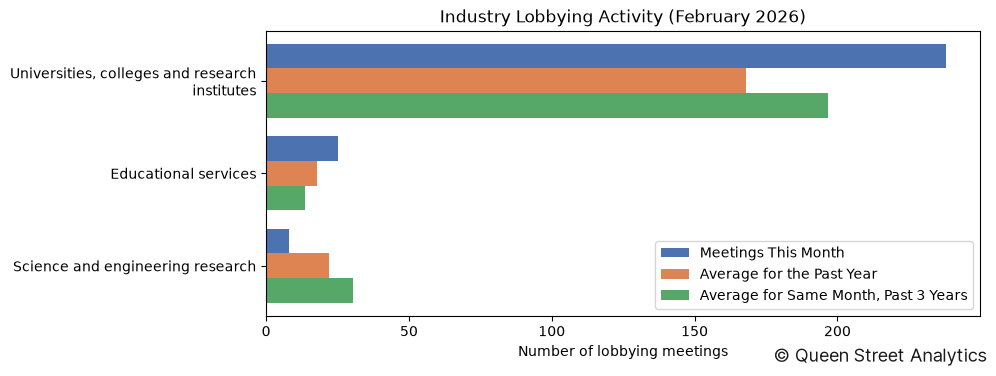
Lobbying activity across this channel totalled 271 meetings in February 2026, up from a 12-month average of 208. The most active industry was Universities, colleges and research institutes, while Educational services rose above its recent baseline.
The industries with the most notable increases in lobbying this month include Educational services logged 25 meetings, up from an average of 18, and Universities, colleges and research institutes logged 238 meetings, up from an average of 168.
Science and engineering research had 8 meetings, down from an average of 22.
Section C: Lobbying by Industry for the Past Year
To contextualize, we show each industry's lobbying activity over the past 12 months. The combined view from Section B and C shows you whether recent differences are persistent trends or a break from the norm.
Top Industry Residual Trends for 2026-02
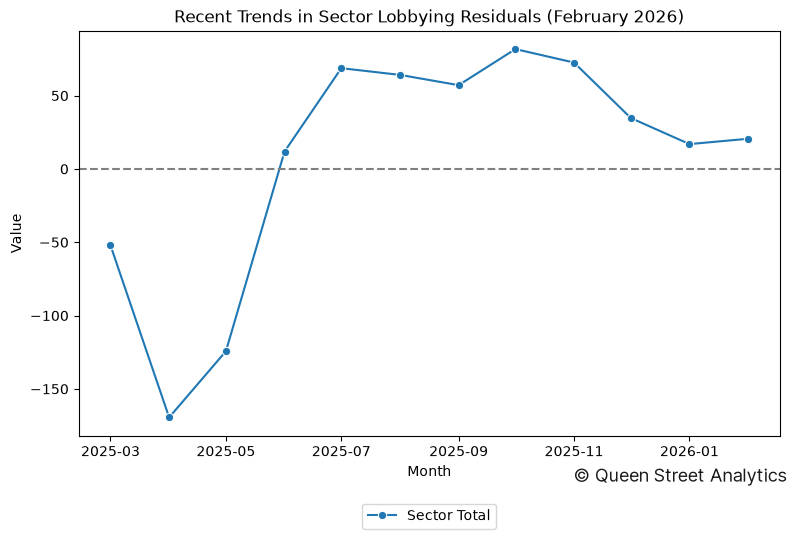
Universities, colleges and research institutes saw lobbying run notably above expected levels in February 2026.
↳ Universities, colleges and research institutes has been on a broadly upward trajectory in lobbying over the past year.
↳ Universities, colleges and research institutes displayed high volatility, suggesting irregular or event-driven engagement.
↳ Science and engineering research has been on a broadly upward trajectory in lobbying over the past year.
↳ Science and engineering research displayed high volatility, suggesting irregular or event-driven engagement.
↳ Educational services has been on a broadly upward trajectory in lobbying over the past year.
↳ Educational services displayed high volatility, suggesting irregular or event-driven engagement.
Section D: Lobbying Activity by Organization
In this section, we see the organizations with the most unusual lobbying behavior last month, defined by either unusually high or unusually low lobbying activity.
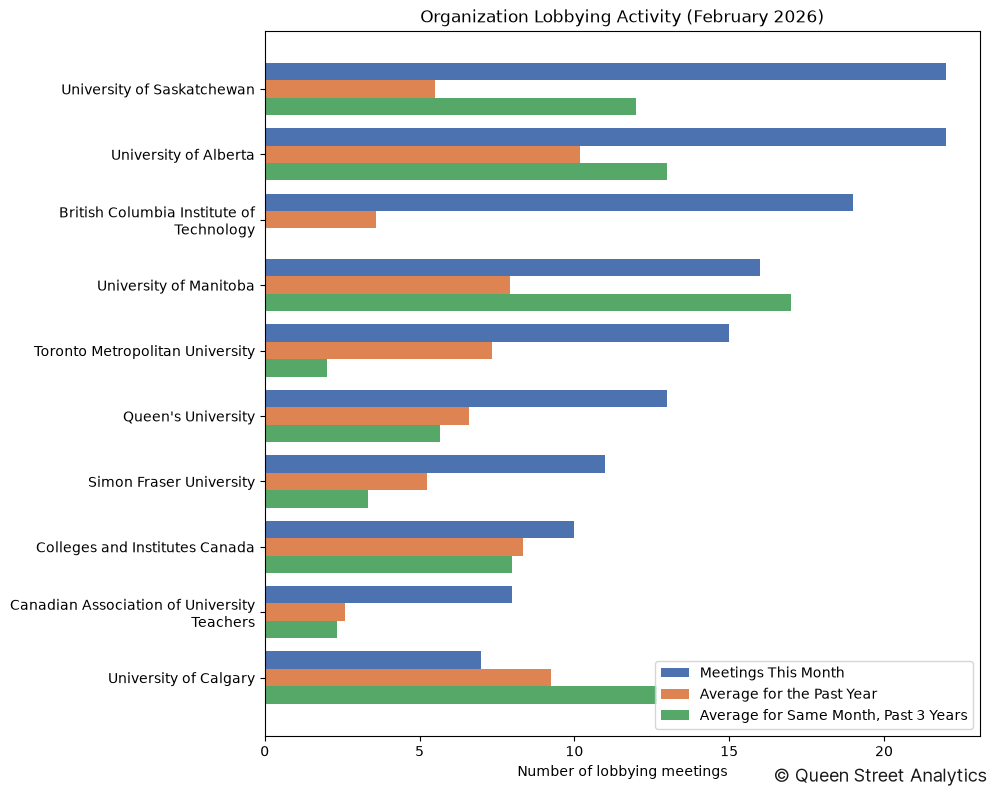
The organizations with the most notable increases in lobbying this month include University of Saskatchewan, British Columbia Institute of Technology, University of Alberta, University of Manitoba, and Toronto Metropolitan University.
Section E: Lobbying of Government Institutions in the Past Month
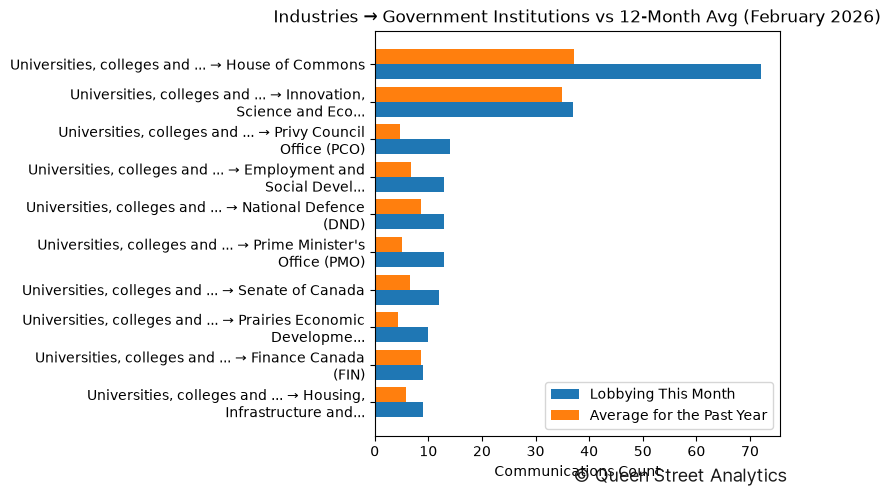
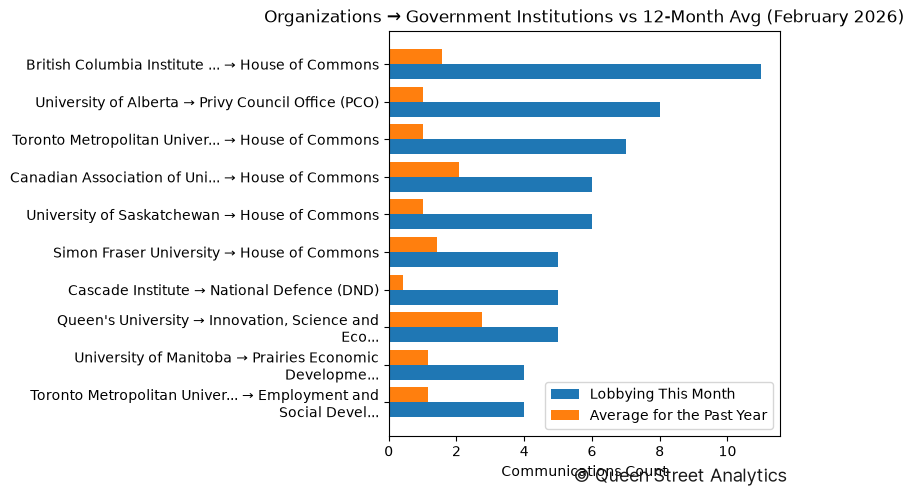
Every time an organization lobbies, there is a government official representing a government institution at the other side of the table. This section shows the industry-institutions pairs with the most unusual lobbying behavior last month, defined by either unusually high or unusually low lobbying activity. Below that, we show the corresponding organization-institution pairs.
Industries → Government Institutions
Organizations → Government Institutions
The busiest industry → institution corridors this month:
↳ Universities, colleges and research institutes → House of Commons: 72 meetings (avg 37, +94%).
↳ Universities, colleges and research institutes → Privy Council Office (PCO): 14 meetings (avg 5, +200%).
The busiest organization → institution corridors this month:
↳ British Columbia Institute of Technology → House of Commons: 11 meetings (avg 2, +595%).
↳ University of Alberta → Privy Council Office (PCO): 8 meetings (avg 1, +700%).
↳ Toronto Metropolitan University → House of Commons: 7 meetings (avg 1, +600%).
Section F: Industry and Organization Lobbying by Subject in the Past Month
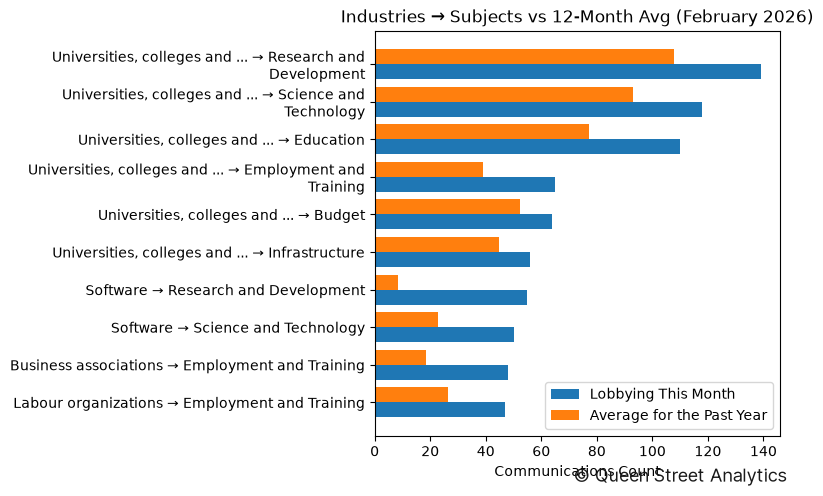
All lobbying activity is tagged with a "subject matter". This section shows the industry-subject pairs with the most unusual lobbying behavior last month, defined by either unusually high or unusually low lobbying activity, and below it the organization-subject pairs with the most unusual lobbying behavior last month.
Industries → Subjects
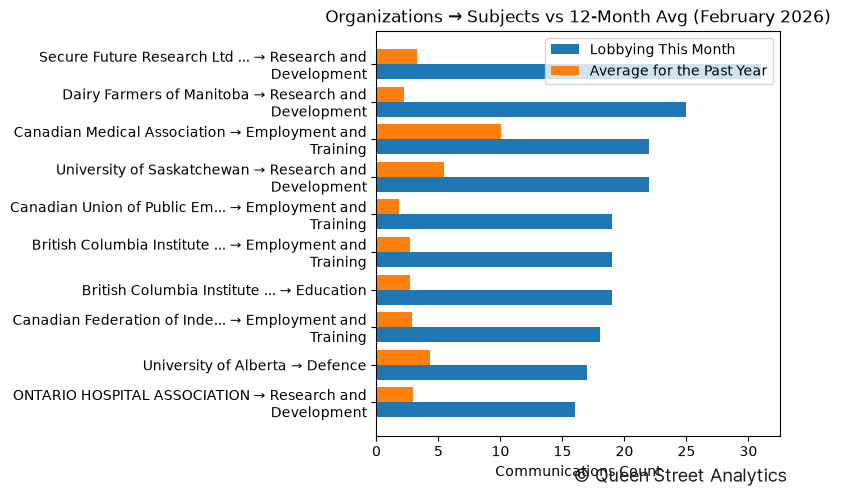
Organizations → Subjects
The busiest industry → subject corridors this month:
↳ Universities, colleges and research institutes → Research and Development: 139 meetings (avg 108, +29%).
↳ Universities, colleges and research institutes → Science and Technology: 118 meetings (avg 93, +27%).
↳ Universities, colleges and research institutes → Education: 110 meetings (avg 77, +43%).
The busiest organization → subject corridors this month:
↳ Secure Future Research Ltd DBA ControlAI → Research and Development: 31 meetings (avg 3, +854%).
↳ Dairy Farmers of Manitoba → Research and Development: 25 meetings (avg 2, +1011%).
↳ Canadian Medical Association → Employment and Training: 22 meetings (avg 10, +118%).
Section G: Last Month's Most Lobbied Politicians and Civil Servants
This section presents a list of the politicians and civil servants who took the most meetings with key industry players last month.
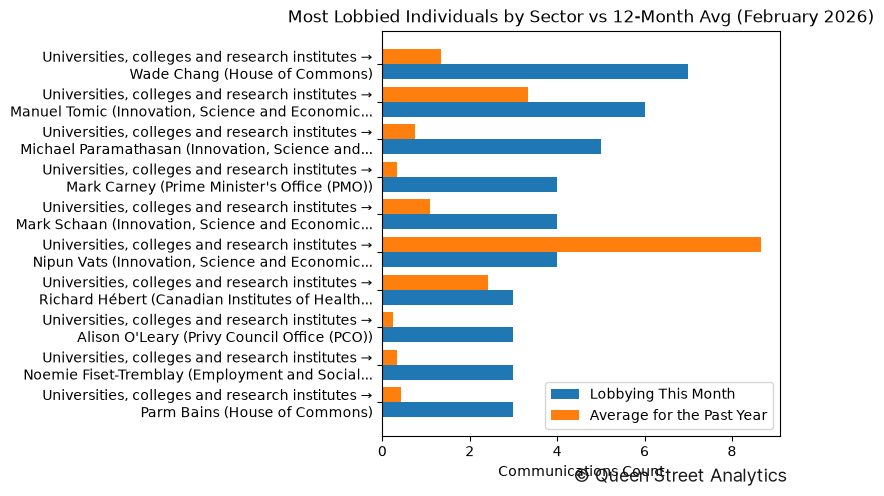
Most Lobbied Individuals by Sector
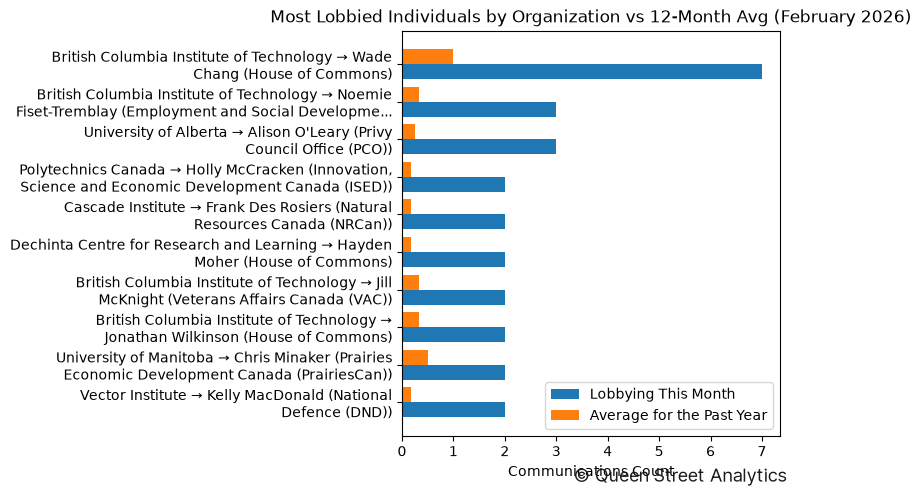
Most Lobbied Individuals by Organization
Among the individuals with the most notable meeting activity (by sector) this month were Universities, colleges and research institutes → Wade Chang (House of Commons), Universities, colleges and research institutes → Manuel Tomic (Innovation, Science and Economic Development Canada (ISED)) and Universities, colleges and research institutes → Michael Paramathasan (Innovation, Science and Economic Development Canada (ISED)).
Among the individuals with the most notable meeting activity (by organization) this month were British Columbia Institute of Technology → Wade Chang (House of Commons), British Columbia Institute of Technology → Noemie Fiset-Tremblay (Employment and Social Development Canada (ESDC)) and University of Alberta → Alison O'Leary (Privy Council Office (PCO)).