Lobbying on Higher Ed - Ottawa (April 2026 edition)





The University of British Columbia, Siksika Board of Education, University of Victoria, Colleges and Institutes Canada, and University of Alberta were unusually active lobbyists last month.
Once a month, we partner up with LobbyIQ to update our readers on recent movements in the federal lobbying landscape in Ottawa. We provide separate coverage for each channel, defined by the most relevant industries, organizations, institutions, and subject matters.
Key Takeaways — Higher Ed
- Lobbying activity totalled 295 meetings in March 2026, up from a 12-month average of 223.2.
- The biggest moves were in Universities, colleges and research institutes and Educational services.
- The University of British Columbia, Siksika Board of Education were more active than usual.

Section A: The Themes Hidden in March 2026 Data
Student Aid Expansion Matches Sector Pressure
The federal extension of enhanced Canada Student Grants and increased student loan caps in March 2026 aligns with active lobbying by Polytechnics Canada and the Canadian Alliance of Student Associations at Employment and Social Development Canada (ESDC), as well as The University of British Columbia at Innovation, Science and Economic Development Canada (ISED), for stronger financial supports. This move follows a surge in advocacy calling for relief on affordability and improved access for learners amid rising tuition and cost-of-living challenges, including efforts by the Canadian Federation of Students at the House of Commons.
📎 Canada Student Loan Increase 2026: Higher Limits, Bigger Grants, and ...
Research Funding Surge Echoes Advocacy
The government’s March announcement of major new research funding streams, including infrastructure and targeted chair programs, coincides with intensified university lobbying by The University of British Columbia, University of Alberta, and the U15-Group of Canadian Research Universities to Innovation, Science and Economic Development Canada for increased grants and science and technology investment. Universities specifically pressed granting councils such as the National Research Council and key departments to expand funding as part of a broader push for research sector stability.
📎 Canada Federal Research Priorities 2026: University Funding
Volatile Grant Landscape Spurs Advocacy
March 2026 saw heightened advocacy campaigns over uncertainty surrounding the future of federal student grants, with groups such as the Canadian Alliance of Student Associations urging Employment and Social Development Canada and the House of Commons to increase per-student, need-based funding, and The University of British Columbia and the University of Alberta emphasizing student supports in discussions with Innovation, Science and Economic Development Canada and the Senate of Canada. Many caution that access could suffer if Covid-era enhancements end as scheduled. This push occurs alongside a jump in lobbying meetings with MPs and government staff, reflecting leaders’ concerns about the potential impact on student access and institutional revenue.
📎 Federal cuts rise alongside tuition - The Gauntlet
Skills and Workforce Policy in the Spotlight
Policy attention to work-integrated learning and upskilling in 2026 is mirrored by lobbying records from Polytechnics Canada and Colleges and Institutes Canada, whose meetings with Employment and Social Development Canada (ESDC) and Natural Resources Canada highlight skills training, workforce development, and pathways to employment as top priorities for higher education organizations. The sector’s emphasis on these themes comes amid federal commitments to expand job and training opportunities for youth.
📎 Canada Student Loan Increase 2026: Higher Limits, Bigger Grants, and ...
Section B: Lobbying Activity by Industry
This section compares, by NAICS industry, the lobbying activity in Ottawa last month to its historical average.
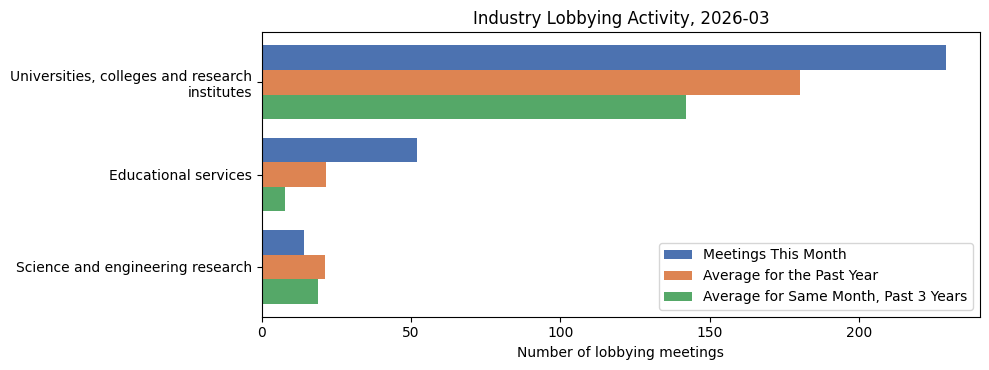
Lobbying activity across this channel totalled 295 meetings in March 2026, up from a 12-month average of 223. The most active industry was Universities, colleges and research institutes, while Educational services rose above its recent baseline.
The industries with the most notable increases in lobbying this month include Educational services logged 52 meetings, up from an average of 22, and Universities, colleges and research institutes logged 229 meetings, up from an average of 180.
Science and engineering research had 14 meetings, down from an average of 21.
Section C: Lobbying by Industry for the Past Year
To contextualize, we show each industry's lobbying activity over the past 12 months. The combined view from Section B and C shows you whether recent differences are persistent trends or a break from the norm.
Top Industry Residual Trends for 2026-03
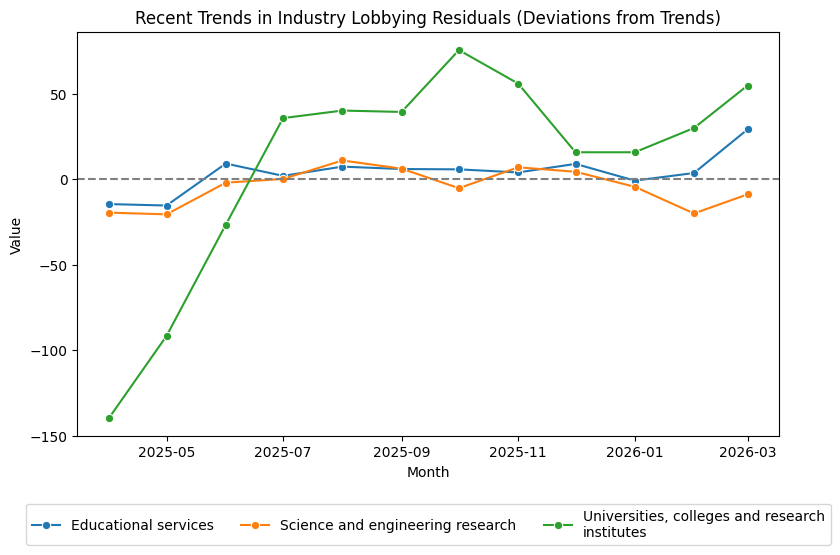
Universities, colleges and research institutes saw lobbying run notably above expected levels in March 2026.
↳ Universities, colleges and research institutes has been on a broadly upward trajectory in lobbying over the past year.
↳ Universities, colleges and research institutes displayed high volatility, suggesting irregular or event-driven engagement.
Educational services saw lobbying run notably above expected levels in March 2026.
↳ Educational services has been on a broadly upward trajectory in lobbying over the past year.
↳ Educational services displayed high volatility, suggesting irregular or event-driven engagement.
↳ Science and engineering research displayed high volatility, suggesting irregular or event-driven engagement.
Section D: Lobbying Activity by Organization
In this section, we see the organizations with the most unusual lobbying behavior last month, defined by either unusually high or unusually low lobbying activity.
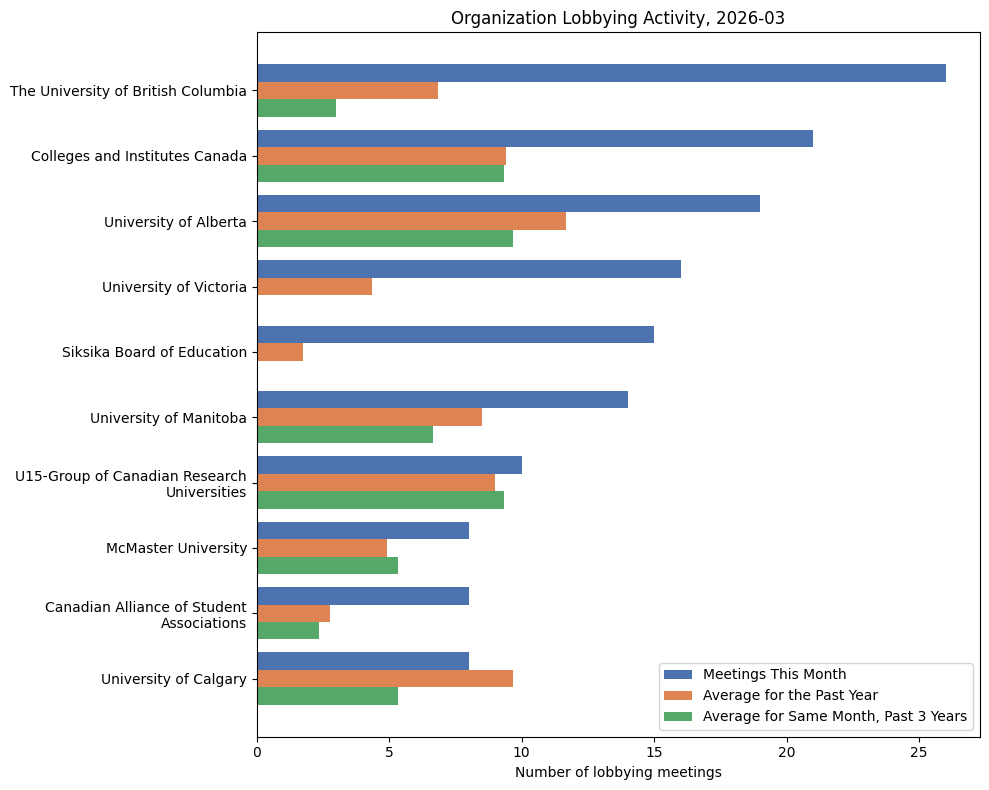
The organizations with the most notable increases in lobbying this month include The University of British Columbia, Siksika Board of Education, University of Victoria, Colleges and Institutes Canada, and University of Alberta.
Section E: Lobbying of Government Institutions in the Past Month
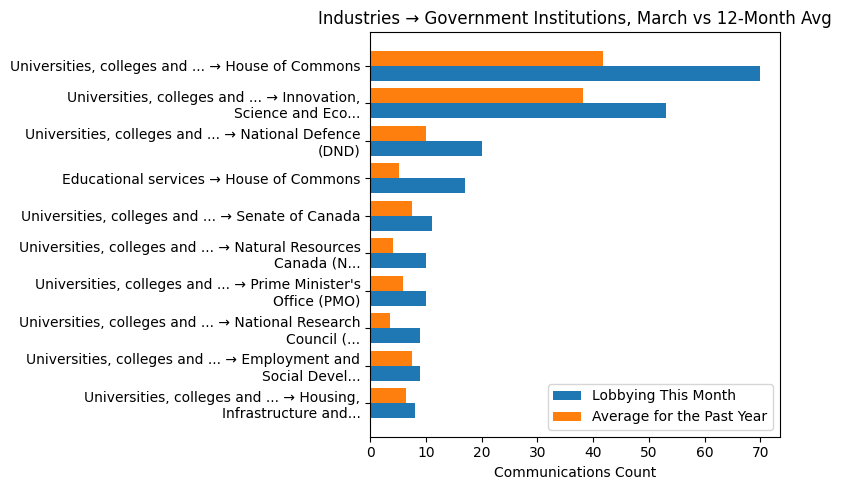
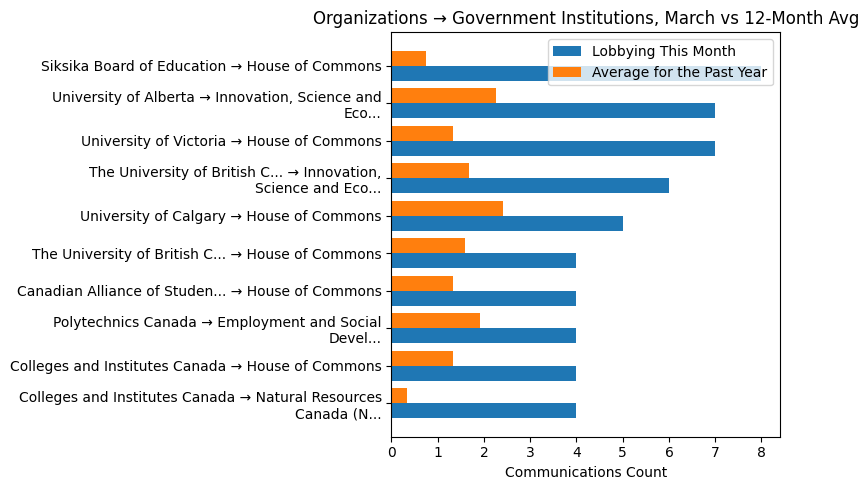
Every time an organization lobbies, there is a government official representing a government institution at the other side of the table. This section shows the industry-institutions pairs with the most unusual lobbying behavior last month, defined by either unusually high or unusually low lobbying activity. Below that, we show the corresponding organization-institution pairs.
Industries → Government Institutions
Organizations → Government Institutions
The busiest industry → institution corridors this month:
↳ Universities, colleges and research institutes → House of Commons: 70 meetings (avg 42, +67%).
↳ Universities, colleges and research institutes → Innovation, Science and Economic Development Canada (ISED): 53 meetings (avg 38, +39%).
↳ Universities, colleges and research institutes → National Defence (DND): 20 meetings (avg 10, +98%).
The busiest organization → institution corridors this month:
↳ Siksika Board of Education → House of Commons: 8 meetings (avg 1, +967%).
↳ University of Alberta → Innovation, Science and Economic Development Canada (ISED): 7 meetings (avg 2, +211%).
↳ University of Victoria → House of Commons: 7 meetings (avg 1, +425%).
Section F: Industry and Organization Lobbying by Subject in the Past Month
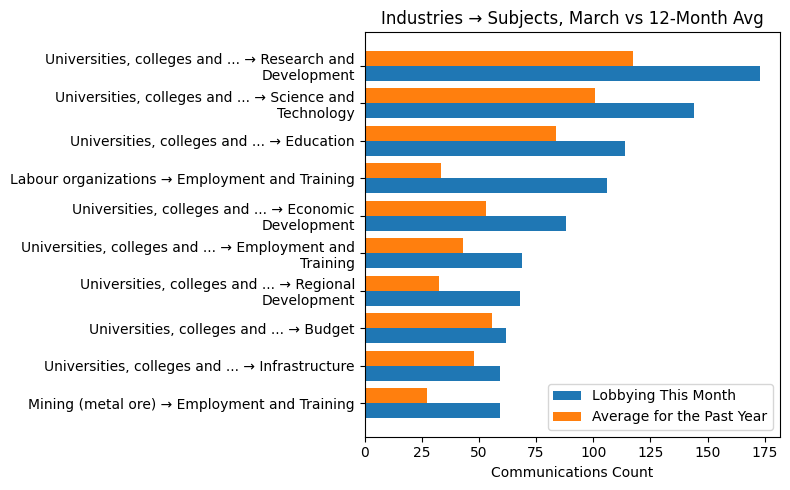
All lobbying activity is tagged with a "subject matter". This section shows the industry-subject pairs with the most unusual lobbying behavior last month, defined by either unusually high or unusually low lobbying activity, and below it the organization-subject pairs with the most unusual lobbying behavior last month.
Industries → Subjects
Organizations → Subjects
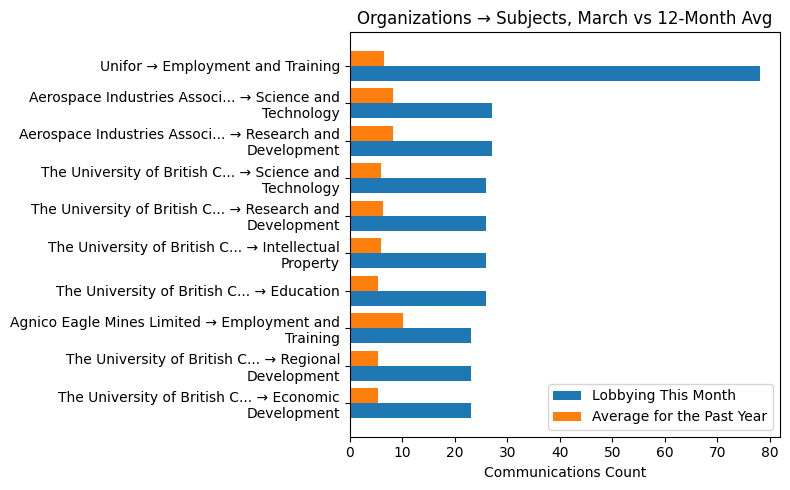
The busiest industry → subject corridors this month:
↳ Universities, colleges and research institutes → Research and Development: 173 meetings (avg 117, +47%).
↳ Universities, colleges and research institutes → Science and Technology: 144 meetings (avg 101, +43%).
↳ Universities, colleges and research institutes → Education: 114 meetings (avg 84, +36%).
The busiest organization → subject corridors this month:
↳ Unifor → Employment and Training: 78 meetings (avg 7, +1085%).
↳ Aerospace Industries Association of Canada → Science and Technology: 27 meetings (avg 8, +227%).
↳ Aerospace Industries Association of Canada → Research and Development: 27 meetings (avg 8, +227%).
Section G: Last Month's Most Lobbied Politicians and Civil Servants
This section presents a list of the politicians and civil servants who took the most meetings with key industry players last month.
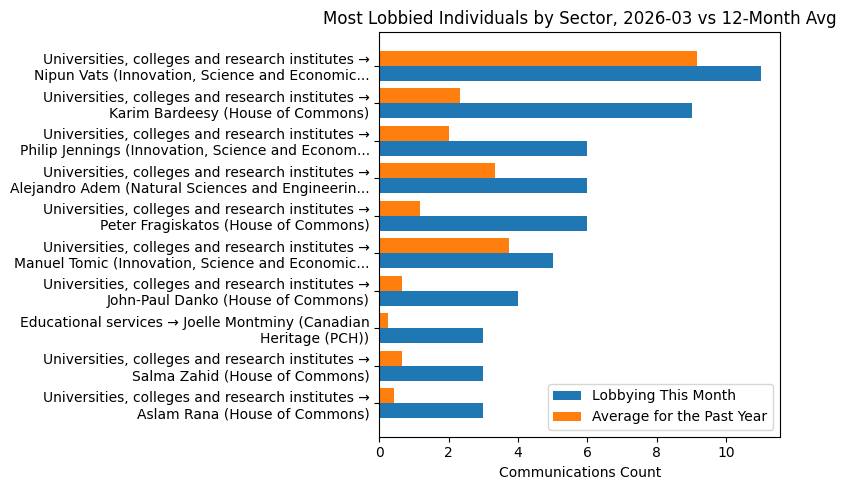
Most Lobbied Individuals by Sector
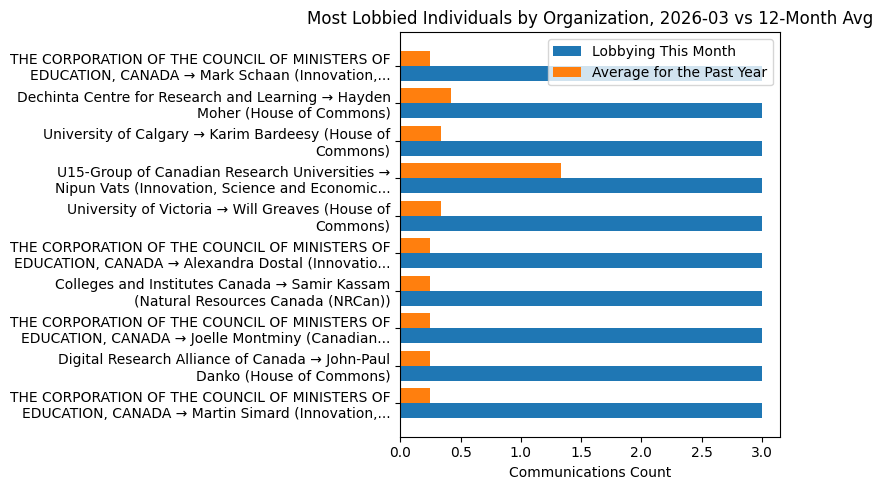
Most Lobbied Individuals by Organization
Among the individuals with the most notable meeting activity (by sector) this month were Universities, colleges and research institutes → Nipun Vats (Innovation, Science and Economic Development Canada (ISED)), Universities, colleges and research institutes → Karim Bardeesy (House of Commons) and Universities, colleges and research institutes → Peter Fragiskatos (House of Commons).
Among the individuals with the most notable meeting activity (by organization) this month were University of Calgary → Karim Bardeesy (House of Commons), THE CORPORATION OF THE COUNCIL OF MINISTERS OF EDUCATION, CANADA → Alexandra Dostal (Innovation, Science and Economic Development Canada (ISED)) and THE CORPORATION OF THE COUNCIL OF MINISTERS OF EDUCATION, CANADA → Mark Schaan (Innovation, Science and Economic Development Canada (ISED)).