Lobbying on Healthcare - Ottawa (June 2026 edition)





Juvenile Diabetes Research Foundation, Canadian Association of Optometrists, and Canadian Cancer Society were unusually active lobbyists last month.
Once a month, we partner up with LobbyIQ to update our readers on recent movements in the federal lobbying landscape in Ottawa. We provide separate coverage for each channel, defined by the most relevant industries, organizations, institutions, and subject matters.
Key Takeaways — Healthcare
- Lobbying activity totalled 175 meetings in May 2026, up from a 12-month average of 161.2.
- The biggest moves were in Health care charities and organizations and Medical professional associations.
- Juvenile Diabetes Research Foundation, Canadian Association of Optometrists were more active than usual.

Section A: The Themes Hidden in May 2026 Data
Canada Health Act Broadens Coverage for Nurse Practitioners, Pharmacists, and Midwives
A surge in lobbying activity by healthcare charities and organizations, including the CANADIAN CANCER SOCIETY engaging with the House of Commons and Justice Canada (JC), and the National Council of Indigenous Midwives meeting with the Senate of Canada in May 2026 closely coincided with a landmark expansion of the Canada Health Act. Provinces are now required to cover medically necessary services provided by nurse practitioners, pharmacists, and midwives, reflecting calls to modernize access and address workforce shortages. This aligns with lobbying records from groups such as the Canadian Medical Association with the Canada Revenue Agency (CRA), focused on regulatory frameworks and expanded roles for health professionals.
📎 Canada Health Act Update April 2026 | The Health Insider · Public health plans to cover primary care by nurse practitioners and ...
Regulatory Pathways for Medical Devices and Hearing Aid Accessibility
Lobbying for regulatory modernization, including new frameworks for over-the-counter hearing aids, as advocated by Speech-Language & Audiology Canada in meetings with the Senate of Canada, coincides with Health Canada's efforts to enable risk-based regulatory processes and support access to medical devices, a focus also advanced by the Canadian Organization for Rare Disorders in discussions with Health Canada. These policy priorities, reflected in departmental planning documents, are likely influencing targeted advocacy around medical device approvals by the Alzheimer Society of Canada in the Senate of Canada, clinical trial funding and innovation in healthcare as championed by HealthCareCAN with the Canadian Institutes of Health Research.
📎 The Public Health Agency of Canada 2026–27 Departmental Plan
Federal Focus and Lobbying Surge for Mental Health and Youth Services
Above-average lobbying by healthcare charities such as the Canadian Mental Health Association and Children's Healthcare Canada in May 2026 coincided with renewed federal commitments to mental health, including funding for Integrated Youth Services programs and new provincial agreements on addiction support. Government releases and lobbying records, including meetings with Health Canada and the House of Commons, reflect parallel advocacy around targeted funding for mental health and youth care during this period.
📎 Health Canada (HC) Press Releases | Cision - Newswire
Child Health Advocacy Linked to Strategic Science Fund Allocations
Intense lobbying for the Strategic Science Fund in May 2026—particularly by Kids Brain Health Network and Children's Healthcare Canada in meetings with Innovation, Science and Economic Development Canada—emphasized research and innovation for children’s health, neurodevelopmental disabilities, and brain health. This activity overlaps with ongoing federal prioritization of these areas for the next funding cycle, as outlined in departmental plans and policy submission channels.
📎 Policy Documents and Submissions - HealthCareCAN · The Public Health Agency of Canada 2026–27 Departmental Plan
Section B: Lobbying Activity by Industry
This section compares, by NAICS industry, the lobbying activity in Ottawa last month to its historical average.
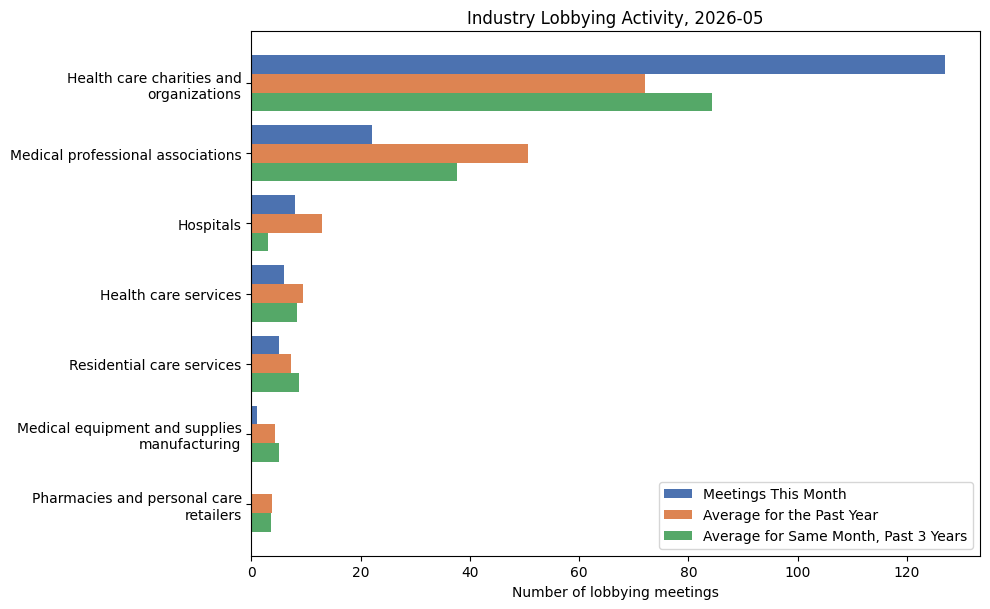
Lobbying activity across this channel totalled 175 meetings in May 2026, up from a 12-month average of 161. The most active industry was Health care charities and organizations, while Medical professional associations rose above its recent baseline.
Health care charities and organizations logged 132 meetings, up from an average of 73.
On the quieter side, Pharmacies and personal care retailers had no lobbying meetings this month, down from an average of 4, Health care services had 6 meetings, down from an average of 9, Hospitals had 8 meetings, down from an average of 13, Medical equipment and supplies manufacturing had 1 meetings, down from an average of 4, and Medical professional associations had 22 meetings, down from an average of 51.
Section C: Lobbying by Industry for the Past Year
To contextualize, we show each industry's lobbying activity over the past 12 months. The combined view from Section B and C shows you whether recent differences are persistent trends or a break from the norm.
Top Industry Residual Trends for 2026-05
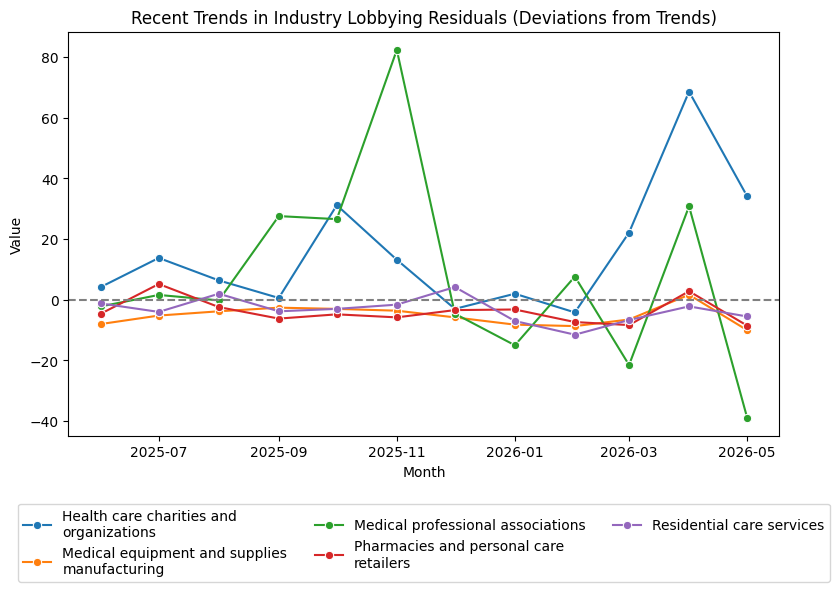
Health care charities and organizations saw lobbying run notably above expected levels in May 2026.
↳ Health care charities and organizations has been on a broadly upward trajectory in lobbying over the past year.
↳ Health care charities and organizations displayed high volatility, suggesting irregular or event-driven engagement.
Medical professional associations saw lobbying run notably below expected levels in May 2026.
↳ Medical professional associations has been trending downward in lobbying over the past year.
↳ Medical professional associations displayed high volatility, suggesting irregular or event-driven engagement.
↳ Pharmacies and personal care retailers displayed high volatility, suggesting irregular or event-driven engagement.
↳ Health care services displayed high volatility, suggesting irregular or event-driven engagement.
Section D: Lobbying Activity by Organization
In this section, we see the organizations with the most unusual lobbying behavior last month, defined by either unusually high or unusually low lobbying activity.
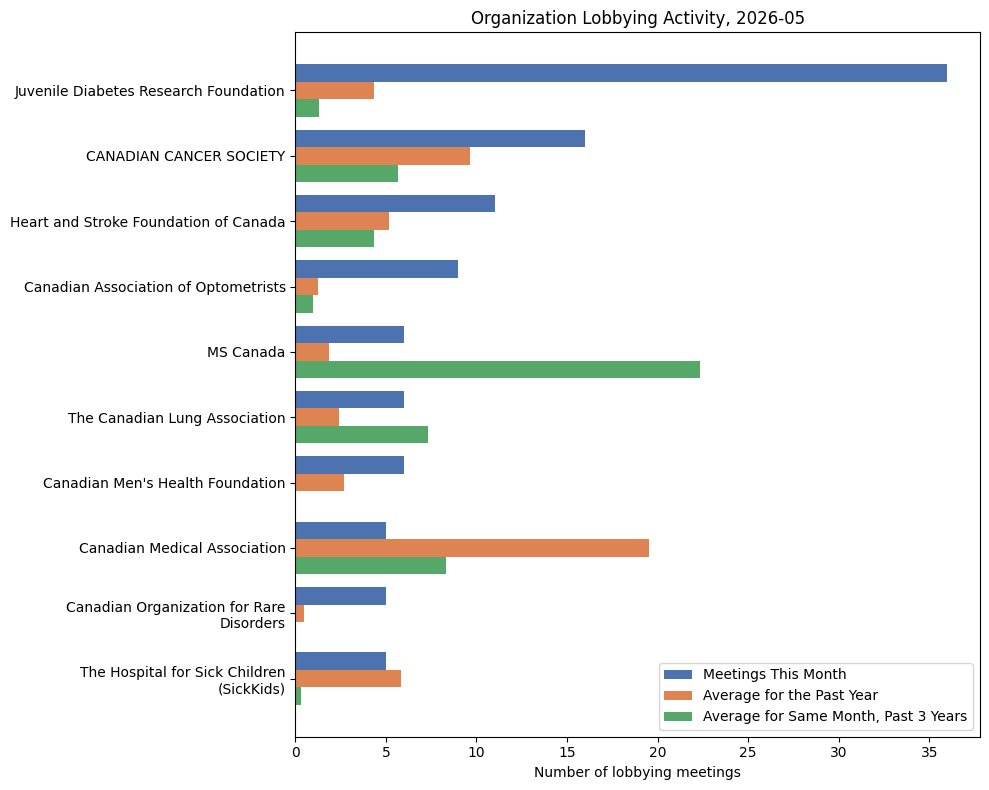
The organizations with the most notable increases in lobbying this month include Juvenile Diabetes Research Foundation, Canadian Association of Optometrists, and CANADIAN CANCER SOCIETY.
On the quieter side, Canadian Medical Association, and Canadian Dental Association all pulled back from their usual pace.
Section E: Lobbying of Government Institutions in the Past Month
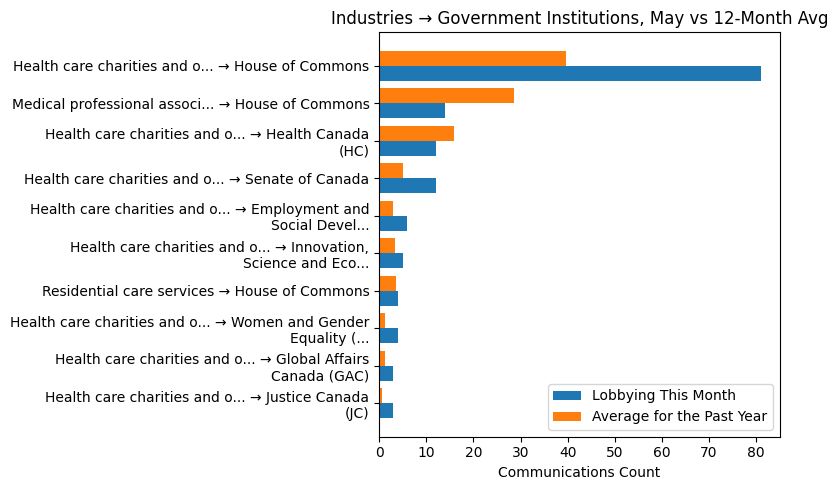
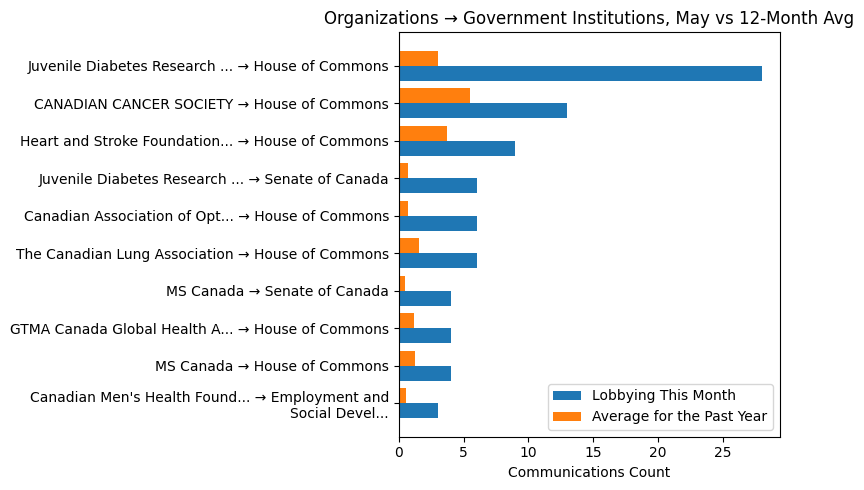
Every time an organization lobbies, there is a government official representing a government institution at the other side of the table. This section shows the industry-institutions pairs with the most unusual lobbying behavior last month, defined by either unusually high or unusually low lobbying activity. Below that, we show the corresponding organization-institution pairs.
Industries → Government Institutions
Organizations → Government Institutions
The busiest industry → institution corridors this month:
↳ Health care charities and organizations → House of Commons: 84 meetings (avg 40, +110%).
↳ Medical professional associations → House of Commons: 14 meetings (avg 29, -51%).
↳ Health care charities and organizations → Senate of Canada: 13 meetings (avg 5, +152%).
The busiest organization → institution corridors this month:
↳ Juvenile Diabetes Research Foundation → House of Commons: 28 meetings (avg 3, +833%).
↳ CANADIAN CANCER SOCIETY → House of Commons: 13 meetings (avg 6, +136%).
↳ Heart and Stroke Foundation of Canada → House of Commons: 9 meetings (avg 4, +140%).
Section F: Industry and Organization Lobbying by Subject in the Past Month
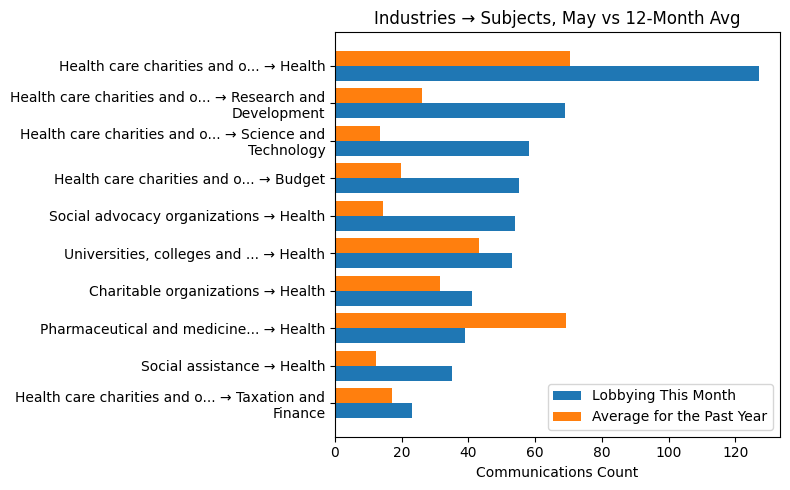
All lobbying activity is tagged with a "subject matter". This section shows the industry-subject pairs with the most unusual lobbying behavior last month, defined by either unusually high or unusually low lobbying activity, and below it the organization-subject pairs with the most unusual lobbying behavior last month.
Industries → Subjects
Organizations → Subjects
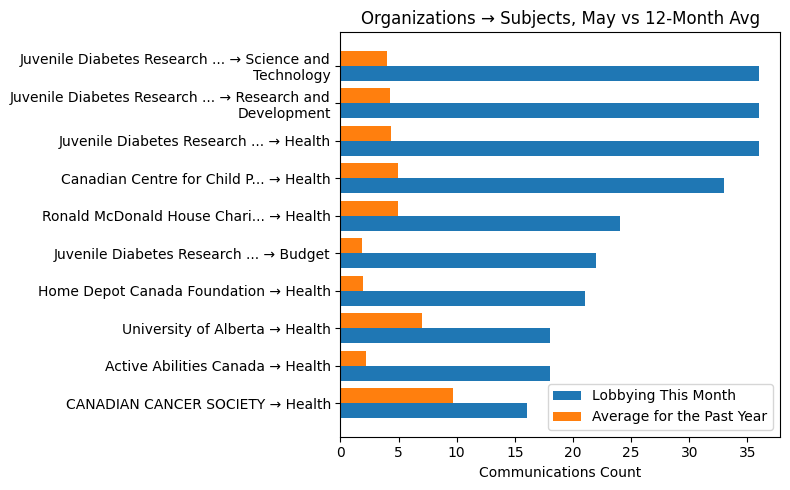
The busiest industry → subject corridors this month:
↳ Health care charities and organizations → Health: 131 meetings (avg 71, +85%).
↳ Health care charities and organizations → Research and Development: 69 meetings (avg 26, +164%).
↳ Health care charities and organizations → Science and Technology: 58 meetings (avg 13, +332%).
The busiest organization → subject corridors this month:
↳ Juvenile Diabetes Research Foundation → Health: 36 meetings (avg 4, +731%).
↳ Juvenile Diabetes Research Foundation → Research and Development: 36 meetings (avg 4, +747%).
↳ Juvenile Diabetes Research Foundation → Science and Technology: 36 meetings (avg 4, +800%).
Section G: Last Month's Most Lobbied Politicians and Civil Servants
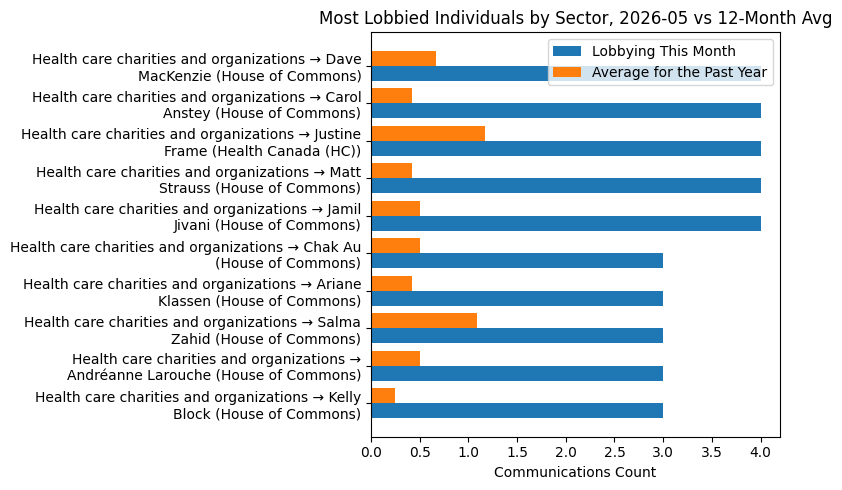
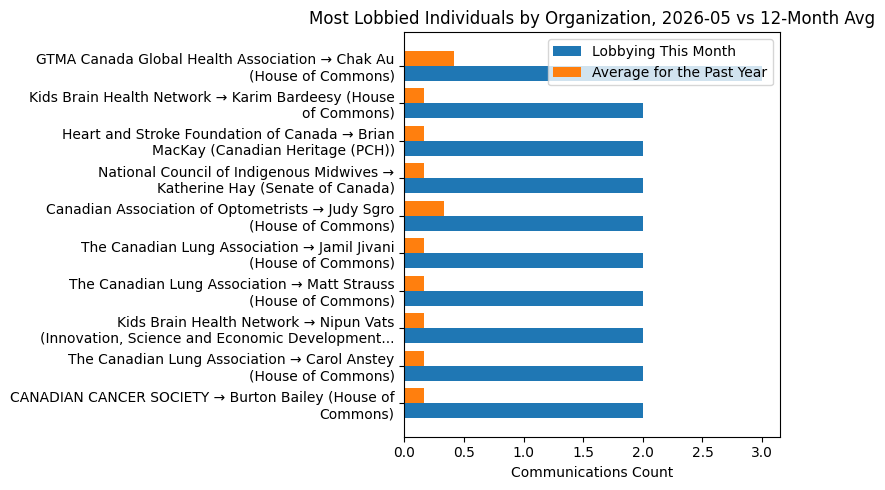
This section presents a list of the politicians and civil servants who took the most meetings with key industry players last month.
Most Lobbied Individuals by Sector
Most Lobbied Individuals by Organization
Among the individuals with the most notable meeting activity (by sector) this month were Health care charities and organizations → Carol Anstey (House of Commons), Health care charities and organizations → Dave MacKenzie (House of Commons) and Health care charities and organizations → Jamil Jivani (House of Commons).
Among the individuals with the most notable meeting activity (by organization) this month were GTMA Canada Global Health Association → Chak Au (House of Commons), Canadian Association of Optometrists → Judy Sgro (House of Commons) and The Canadian Lung Association → Dave MacKenzie (House of Commons).