Lobbying on Healthcare - Ottawa (April 2026 edition)





Heart and Stroke Foundation of Canada, Canadian Cancer Society, The Centre for Sexuality, Easter Seals Canada, Agnico Eagle Mines Limited, The Professional Institute for the Public Service of Canada were unusually active lobbyists last month.
Once a month, we partner up with LobbyIQ to update our readers on recent movements in the federal lobbying landscape in Ottawa. We provide separate coverage for each channel, defined by the most relevant industries, organizations, institutions, and subject matters.
Key Takeaways — Healthcare
- Lobbying activity totalled 127 meetings in March 2026, roughly in line with its 12-month average of 123.9.
- The biggest moves were in Health care charities and organizations and Medical professional associations.
- Heart and Stroke Foundation of Canada, CANADIAN CANCER SOCIETY were more active than usual.

Section A: The Themes Hidden in March 2026 Data
Expansion of Public Coverage for Non-Physician Healthcare
The April 2026 Canada Health Act revision mandates provincial coverage for medically necessary care by nurse practitioners, pharmacists, and midwives, matching the coverage already given to physician-delivered services. This major policy change aligns with sustained lobbying from charities and professional associations such as the Canadian Medical Association, Ontario Medical Association (OMA), and The College of Family Physicians of Canada, seeking solutions to family doctor shortages and administrative burden, as well as ongoing discussions with Health Canada and the House of Commons. The move comes during a notable uptick in advocacy for enhanced primary care access and system modernization.
📎 Canada Health Act Update April 2026 | The Health Insider · Public health plans to cover primary care by nurse practitioners and ...
Administrative Burden Relief Gains New Urgency
Lobbying by the Canadian Medical Association, the Ontario Medical Association (OMA), and The College of Family Physicians of Canada for reduced administrative workload for frontline healthcare professionals has intensified, coinciding with federal moves by Health Canada and the House of Commons to prioritize family physician retention and streamline credential recognition for internationally trained doctors. The aim is to reduce time spent on paperwork so clinicians can focus on patient care, reflecting widespread calls for government action in the wake of recent policy updates.
📎 Canada Health Act Update April 2026 | The Health Insider
Federal Plan Targets Antimicrobial Resistance
The Public Health Agency of Canada’s new departmental plan places reducing antimicrobial resistance (AMR) at the forefront, with commitments to research funding and stewardship promotion, a policy focus that parallels lobbying efforts by the Canadian Nurses Association with Health Canada for increased support for nursing research, including indigenous nursing, and by MS Canada in partnership with the House of Commons for federal investments in health research. These efforts advocating for investments in AMR pilot projects and measures to broaden access to anti-infective therapies underline a timely alignment between advocacy and federal initiative.
📎 The Public Health Agency of Canada 2026–27 Departmental Plan
Surge in Charity and Advocacy Group Lobbying
March 2026 saw a significant increase in lobbying by health charities and organizations, with activity notably above the annual average. This surge, led by groups like the Heart and Stroke Foundation of Canada, the Canadian Cancer Society, and Breast Cancer Canada, included meetings with Health Canada and the House of Commons, and coincides with high-profile policy shifts in coverage, access, and health workforce support, suggesting that these organizations are intensifying their advocacy to shape implementation and funding priorities.
📎 Canada Health Act Update April 2026 | The Health Insider
Departmental Plan Reflects Lobbying Focus on Equitable Access
The 2026–27 Public Health Agency plan highlights government priorities on oral health access, including issues raised by the Canadian Dental Association and CANADIAN DENTAL HYGIENISTS ASSOCIATION with Health Canada, funding for clinical research such as MS Canada’s advocacy with the House of Commons, support for mental health, and wider drug coverage. These budget aims closely mirror lobbying disclosures by the Canadian Medical Association to the House of Commons calling for expanded funding for primary care, innovative research, and equitable access to virtual and pharmaceutical services.
📎 The Public Health Agency of Canada 2026–27 Departmental Plan
Section B: Lobbying Activity by Industry
This section compares, by NAICS industry, the lobbying activity in Ottawa last month to its historical average.
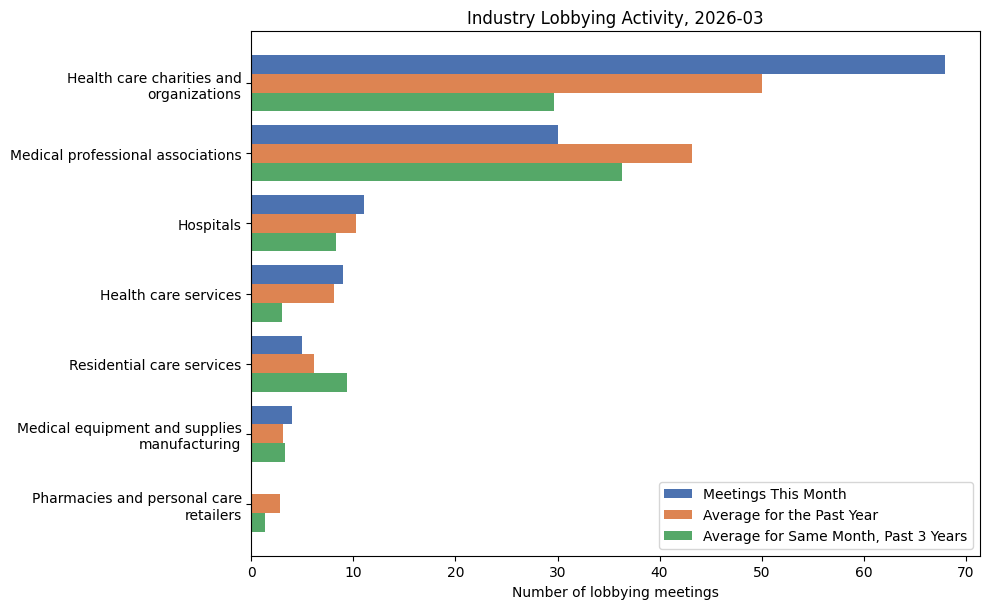
Lobbying activity across this channel totalled 127 meetings in March 2026, roughly in line with its 12-month average of 124. The most active industry was Health care charities and organizations, while Medical professional associations rose above its recent baseline.
The industries with the most notable increases in lobbying this month include Medical equipment and supplies manufacturing logged 4 meetings, up from an average of 3, and Health care charities and organizations logged 68 meetings, up from an average of 50.
On the quieter side, Pharmacies and personal care retailers had no lobbying meetings this month, down from an average of 3, and Medical professional associations had 30 meetings, down from an average of 43.
Section C: Lobbying by Industry for the Past Year
To contextualize, we show each industry's lobbying activity over the past 12 months. The combined view from Section B and C shows you whether recent differences are persistent trends or a break from the norm.
Top Industry Residual Trends for 2026-03
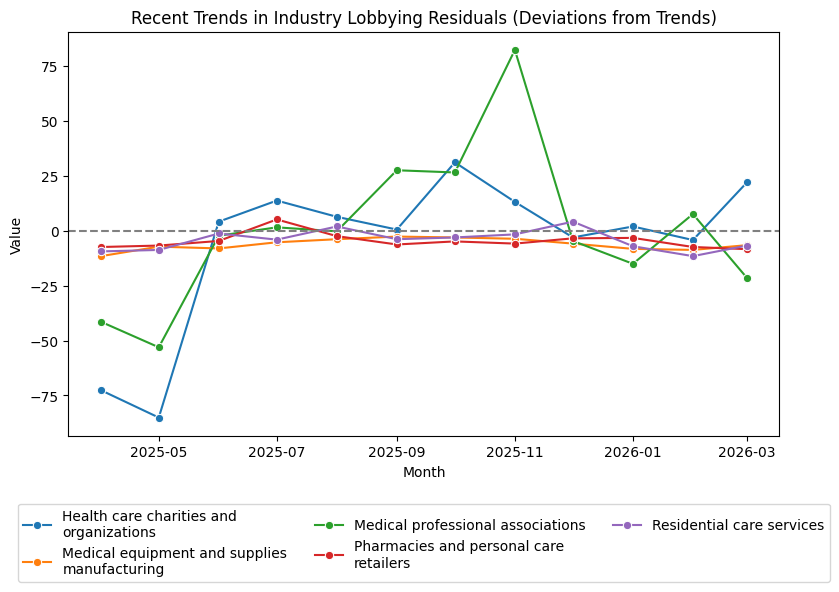
Health care charities and organizations saw lobbying run notably above expected levels in March 2026.
↳ Health care charities and organizations has been on a broadly upward trajectory in lobbying over the past year.
↳ Health care charities and organizations displayed high volatility, suggesting irregular or event-driven engagement.
↳ Medical professional associations has been on a broadly upward trajectory in lobbying over the past year.
↳ Medical professional associations displayed high volatility, suggesting irregular or event-driven engagement.
↳ Pharmacies and personal care retailers displayed high volatility, suggesting irregular or event-driven engagement.
↳ Residential care services displayed high volatility, suggesting irregular or event-driven engagement.
Section D: Lobbying Activity by Organization
In this section, we see the organizations with the most unusual lobbying behavior last month, defined by either unusually high or unusually low lobbying activity.
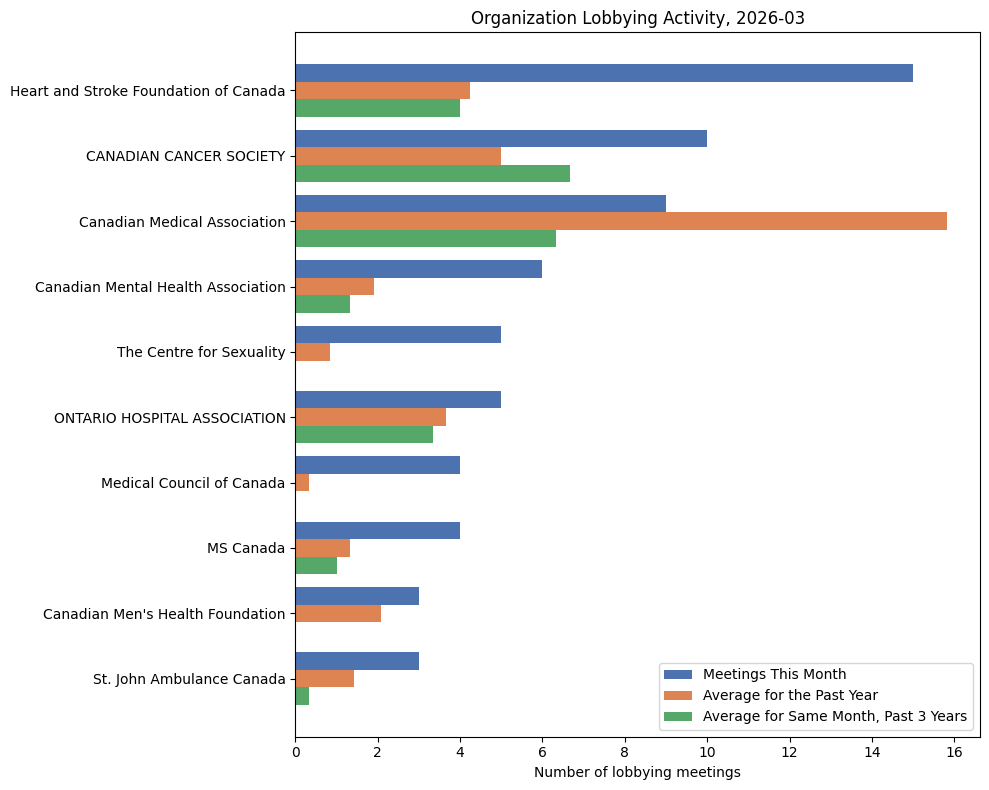
The organizations with the most notable increases in lobbying this month include Heart and Stroke Foundation of Canada, CANADIAN CANCER SOCIETY, and The Centre for Sexuality.
On the quieter side, Canadian Medical Association, and Canadian Dental Association all pulled back from their usual pace.
Section E: Lobbying of Government Institutions in the Past Month
Every time an organization lobbies, there is a government official representing a government institution at the other side of the table. This section shows the industry-institutions pairs with the most unusual lobbying behavior last month, defined by either unusually high or unusually low lobbying activity. Below that, we show the corresponding organization-institution pairs.
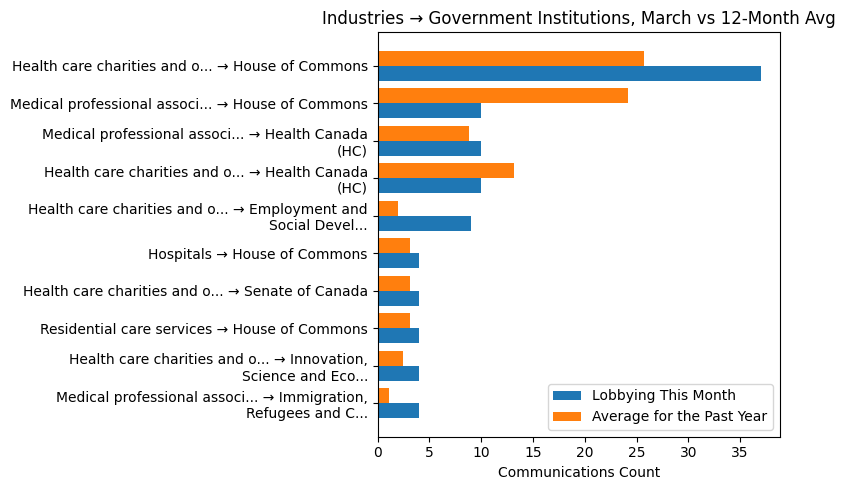
Industries → Government Institutions
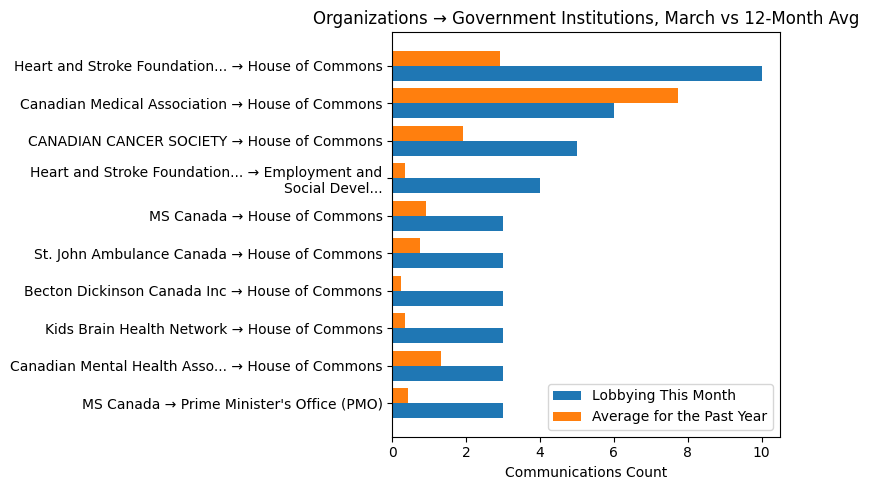
Organizations → Government Institutions
The busiest industry → institution corridors this month:
↳ Health care charities and organizations → House of Commons: 37 meetings (avg 26, +43%).
↳ Health care charities and organizations → Health Canada (HC): 10 meetings (avg 13, -25%).
↳ Medical professional associations → House of Commons: 10 meetings (avg 24, -59%).
The busiest organization → institution corridors this month:
↳ Heart and Stroke Foundation of Canada → House of Commons: 10 meetings (avg 3, +243%).
↳ Canadian Medical Association → House of Commons: 6 meetings (avg 8, -23%).
↳ CANADIAN CANCER SOCIETY → House of Commons: 5 meetings (avg 2, +161%).
Section F: Industry and Organization Lobbying by Subject in the Past Month
All lobbying activity is tagged with a "subject matter". This section shows the industry-subject pairs with the most unusual lobbying behavior last month, defined by either unusually high or unusually low lobbying activity, and below it the organization-subject pairs with the most unusual lobbying behavior last month.
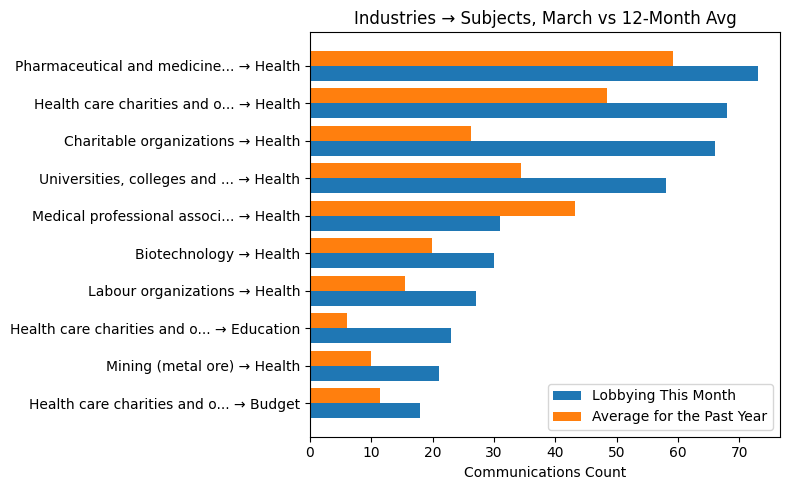
Industries → Subjects
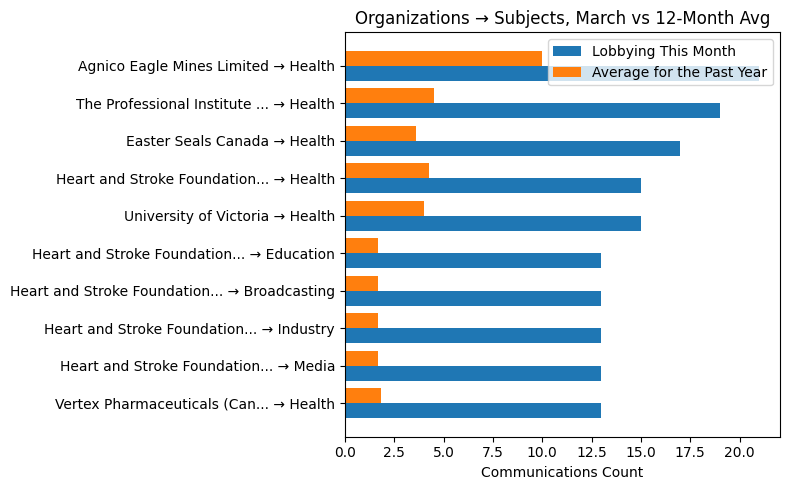
Organizations → Subjects
The busiest industry → subject corridors this month:
↳ Pharmaceutical and medicine manufacturing → Health: 73 meetings (avg 59, +23%).
↳ Health care charities and organizations → Health: 68 meetings (avg 49, +39%).
↳ Charitable organizations → Health: 66 meetings (avg 26, +151%).
The busiest organization → subject corridors this month:
↳ Agnico Eagle Mines Limited → Health: 21 meetings (avg 10, +110%).
↳ The Professional Institute for the Public Service of Canada → Health: 19 meetings (avg 4, +322%).
↳ Easter Seals Canada → Health: 17 meetings (avg 4, +374%).
Section G: Last Month's Most Lobbied Politicians and Civil Servants
This section presents a list of the politicians and civil servants who took the most meetings with key industry players last month.
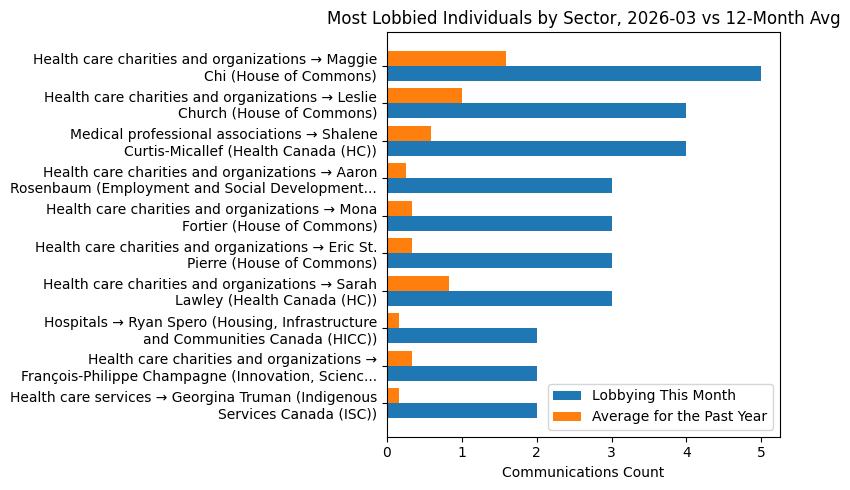
Most Lobbied Individuals by Sector
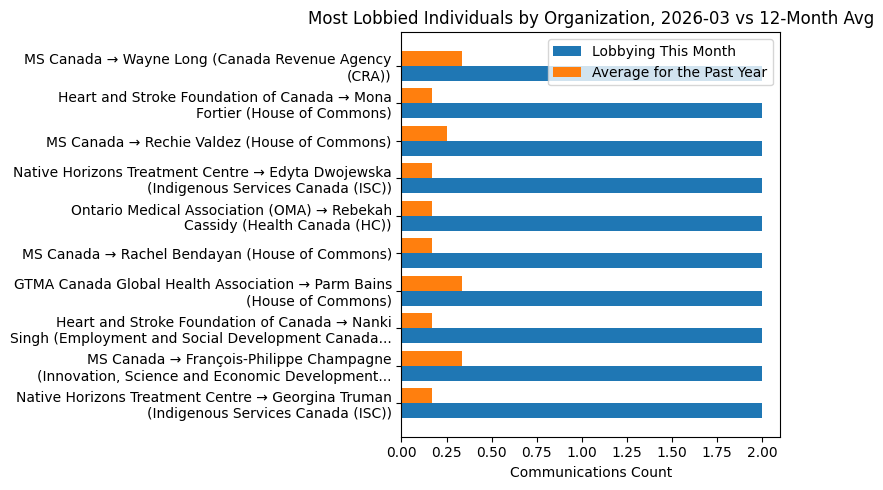
Most Lobbied Individuals by Organization
Among the individuals with the most notable meeting activity (by sector) this month were Health care charities and organizations → Maggie Chi (House of Commons), Health care charities and organizations → Leslie Church (House of Commons) and Medical professional associations → Shalene Curtis-Micallef (Health Canada (HC)).
Among the individuals with the most notable meeting activity (by organization) this month were Heart and Stroke Foundation of Canada → Aaron Rosenbaum (Employment and Social Development Canada (ESDC)), Heart and Stroke Foundation of Canada → Anna Gainey (Employment and Social Development Canada (ESDC)) and MS Canada → Annie Koutrakis (House of Commons).