Lobbying on Environment - Ottawa (September 2026 edition)





Invasive Species Centre, Canadian Agri-food Automation and Intelligence Network, Vale Canada Limited, Ecojustice Canada, and PEMBINA INSTITUTE were unusually active lobbyists last month.
Once a month, we partner up with LobbyIQ to update our readers on recent movements in the federal lobbying landscape in Ottawa. We provide separate coverage for each channel, defined by the most relevant industries, organizations, institutions, and subject matters.
Key Takeaways — Environment
- Lobbying activity totalled 117 meetings in August 2026, down from a 12-month average of 185.9.
- The biggest moves were in Environment and wildlife organizations and Environment and waste services.
- Invasive Species Centre was more active than usual.

Section A: The Themes Hidden in August 2026 Data
New Chemicals Reporting Requirements Spark Transparency Debate
On August 29, 2026, the Canadian government mandated extensive reporting on chemicals under the Chemicals Management Plan, following meetings between The Nature Conservancy of Canada and the House of Commons, as well as the David Suzuki Foundation with House of Commons officials. This comes amid lobbying by environmental and wildlife groups, such as Nature United engaging with Environment and Climate Change Canada (ECCC), seeking more stringent regulation and investment in land conservation. Organizations are now adjusting strategies in response to heightened transparency and regulatory scrutiny.
📎 Canada Gazette, Part 1, Volume 160, Number 35: GOVERNMENT NOTICES
Federal Support for Climate Adaptation Projects Aligns With Lobbyist Demands
August 2026 saw the federal government, including Environment and Climate Change Canada (ECCC) and the House of Commons, direct $34 million toward climate change adaptation programs in 128 communities, targeting flood resilience, urban cooling, and habitat restoration. This funding coincides with lobbying efforts by organisations such as the Alliance of Canadian Land Trusts, The Nature Conservancy of Canada, and Climate Caucus Council for greater investment in nature-based solutions and conservation, reflecting policymakers’ responsiveness to calls for enhanced local climate resilience.
📎 Feds throw $34 million at climate change adaptation programs
Proposed Soil Vapour Guidelines Reflect Event-Driven Lobbying
The Canadian Council of Ministers of the Environment released draft guidelines for soil vapour in late August 2026, responding to advocacy for stronger environmental review and pollution prevention from groups such as Ecojustice Canada and Environmental Defence Canada in meetings with Environment and Climate Change Canada. The regulatory climate appears increasingly shaped by recent lobbying from wildlife and waste services organizations, including the Canadian Association of Physicians for the Environment and the Canadian Wildlife Federation, pushing for updates that address environmental health risks.
📎 Canadian Council of Ministers of the Environment | Le Conseil canadien ...
Section B: Lobbying Activity by Industry
This section compares, by NAICS industry, the lobbying activity in Ottawa last month to its historical average.
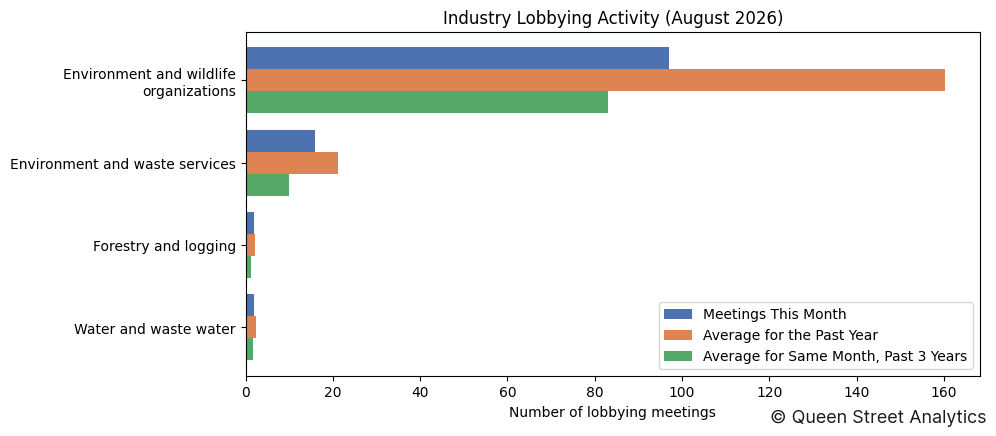
Lobbying activity across this channel totalled 117 meetings in August 2026, down from a 12-month average of 186. The most active industry was Environment and wildlife organizations, while Environment and waste services fell below its recent baseline.
On the quieter side, Environment and waste services had 16 meetings, down from an average of 21, and Environment and wildlife organizations had 97 meetings, down from an average of 160.
Section C: Lobbying by Industry for the Past Year
To contextualize, we show each industry's lobbying activity over the past 12 months. The combined view from Section B and C shows you whether recent differences are persistent trends or a break from the norm.
Top Industry Residual Trends for 2026-08
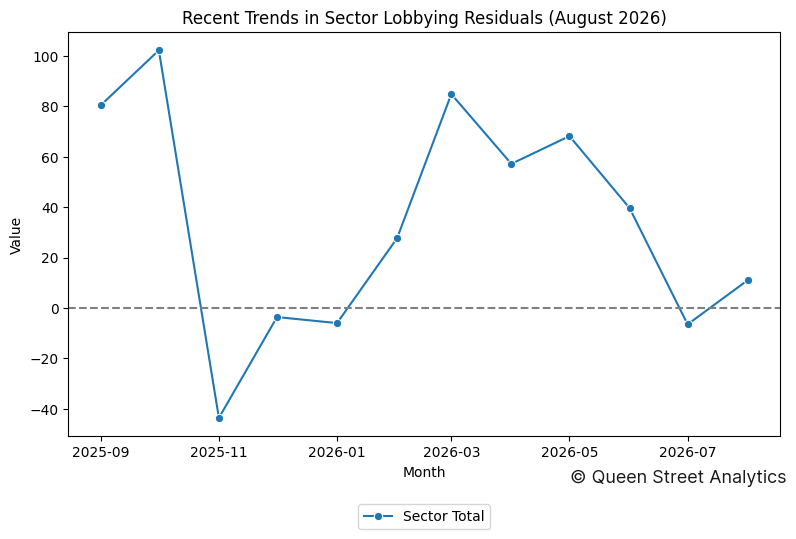
↳ Environment and wildlife organizations has been trending downward in lobbying over the past year.
↳ Environment and wildlife organizations displayed high volatility, suggesting irregular or event-driven engagement.
↳ Water and waste water has been trending downward in lobbying over the past year.
↳ Environment and waste services displayed high volatility, suggesting irregular or event-driven engagement.
Section D: Lobbying Activity by Organization
In this section, we see the organizations with the most unusual lobbying behavior last month, defined by either unusually high or unusually low lobbying activity.
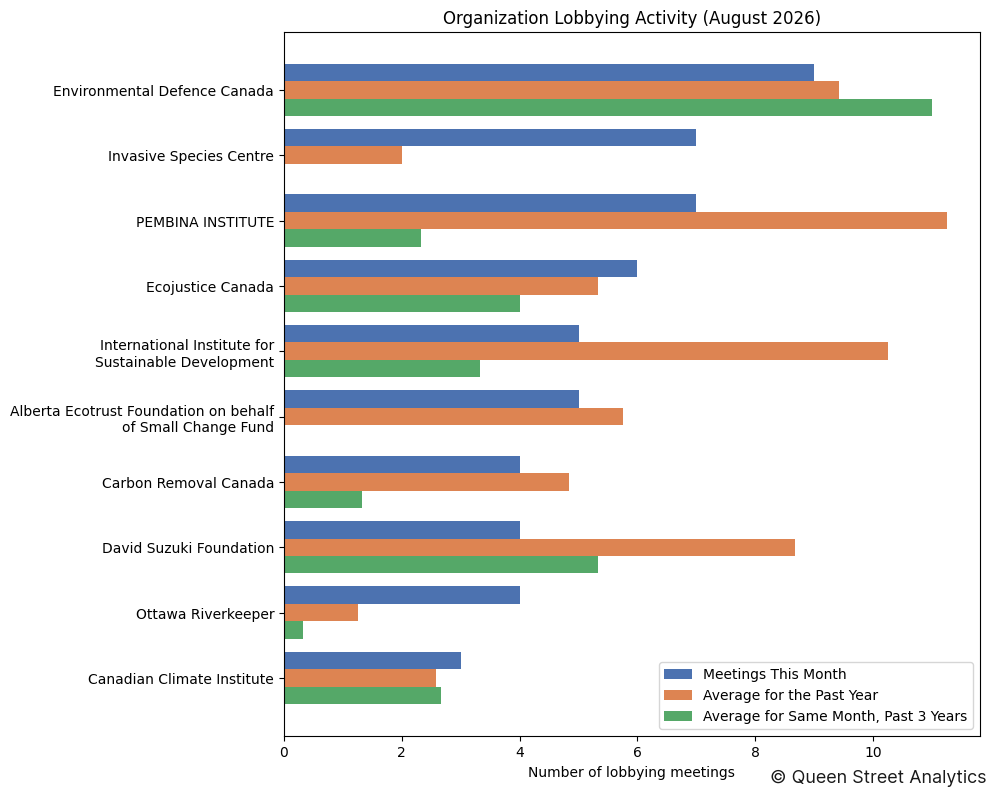
The organization with the most notable increase in lobbying this month was Invasive Species Centre.
On the quieter side, Canadian Parks and Wilderness Society, International Institute for Sustainable Development, David Suzuki Foundation, and PEMBINA INSTITUTE all pulled back from their usual pace.
Section E: Lobbying of Government Institutions in the Past Month
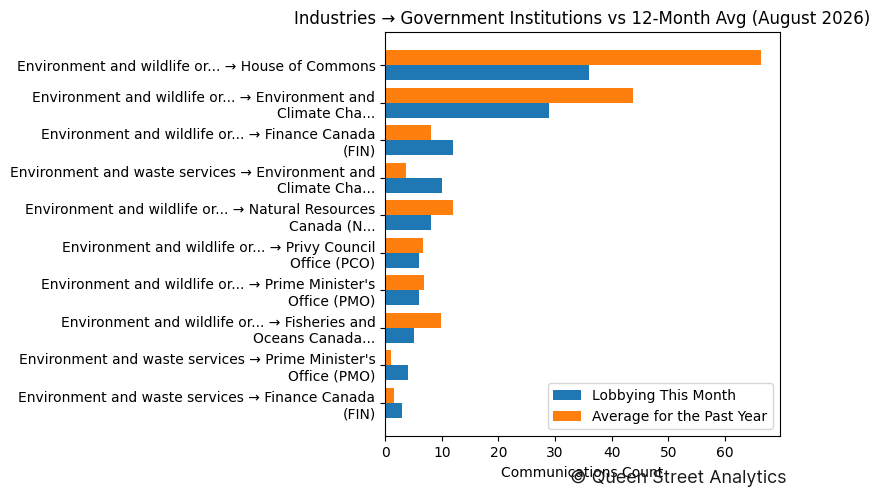
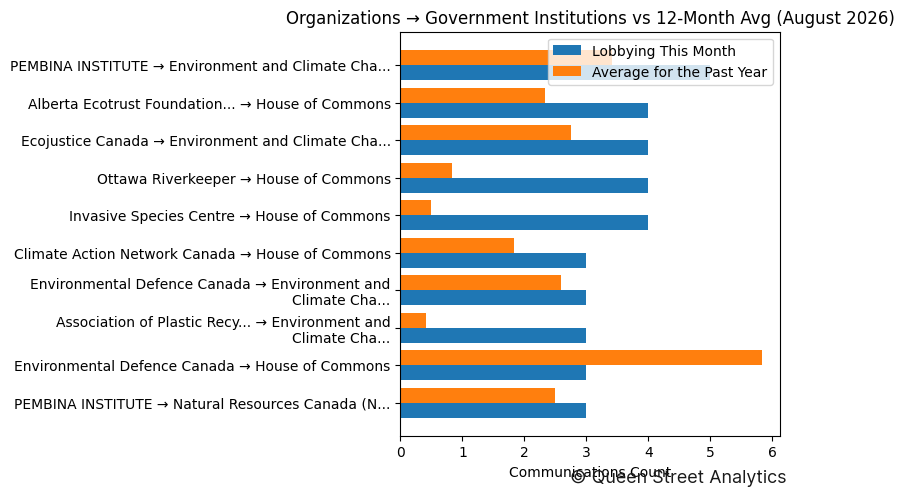
Every time an organization lobbies, there is a government official representing a government institution at the other side of the table. This section shows the industry-institutions pairs with the most unusual lobbying behavior last month, defined by either unusually high or unusually low lobbying activity. Below that, we show the corresponding organization-institution pairs.
Industries → Government Institutions
Organizations → Government Institutions
The busiest industry → institution corridors this month:
↳ Environment and wildlife organizations → House of Commons: 36 meetings (avg 66, -46%).
↳ Environment and wildlife organizations → Environment and Climate Change Canada (ECCC): 29 meetings (avg 44, -34%).
↳ Environment and wildlife organizations → Finance Canada (FIN): 12 meetings (avg 8, +47%).
The busiest organization → institution corridors this month:
↳ PEMBINA INSTITUTE → Environment and Climate Change Canada (ECCC): 5 meetings (avg 3, +46%).
↳ Alberta Ecotrust Foundation on behalf of Small Change Fund → House of Commons: 4 meetings (avg 2, +71%).
↳ Ecojustice Canada → Environment and Climate Change Canada (ECCC): 4 meetings (avg 3, +45%).
Section F: Industry and Organization Lobbying by Subject in the Past Month
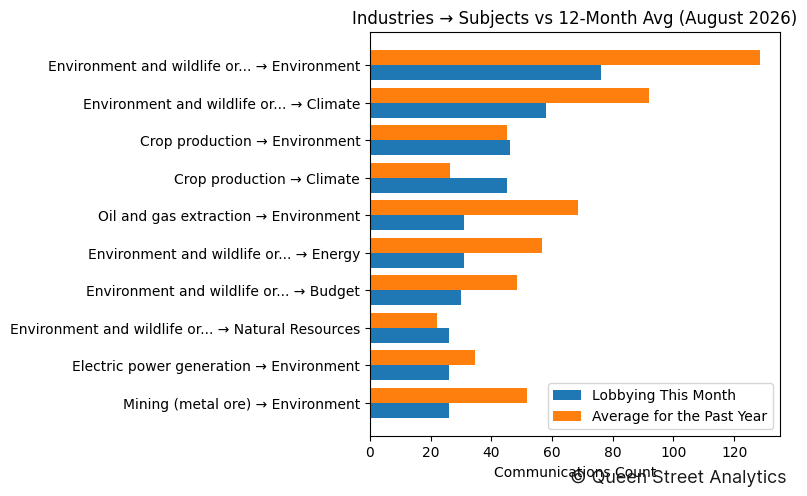
All lobbying activity is tagged with a "subject matter". This section shows the industry-subject pairs with the most unusual lobbying behavior last month, defined by either unusually high or unusually low lobbying activity, and below it the organization-subject pairs with the most unusual lobbying behavior last month.
Industries → Subjects
Organizations → Subjects
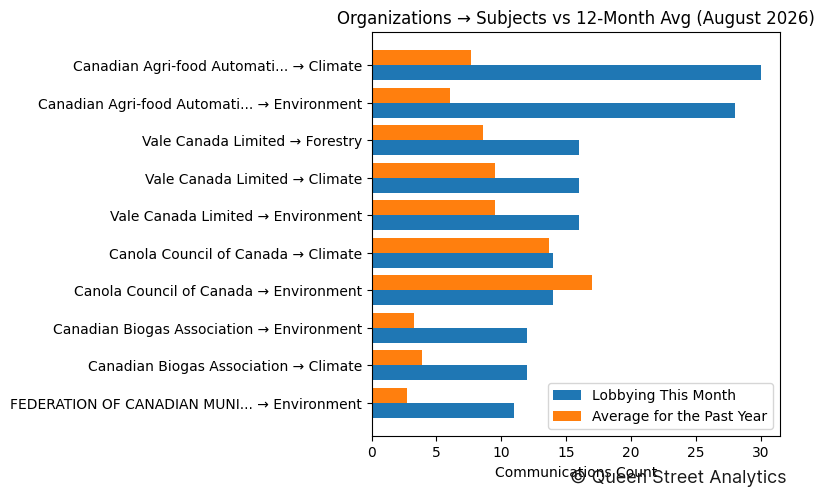
The busiest industry → subject corridors this month:
↳ Environment and wildlife organizations → Environment: 76 meetings (avg 129, -41%).
↳ Environment and wildlife organizations → Climate: 58 meetings (avg 92, -37%).
The busiest organization → subject corridors this month:
↳ Canadian Agri-food Automation and Intelligence Network (CAAIN) → Climate: 30 meetings (avg 8, +291%).
↳ Canadian Agri-food Automation and Intelligence Network (CAAIN) → Environment: 28 meetings (avg 6, +360%).
↳ Vale Canada Limited → Forestry: 16 meetings (avg 9, +86%).
Section G: Last Month's Most Lobbied Politicians and Civil Servants
This section presents a list of the politicians and civil servants who took the most meetings with key industry players last month.
Most Lobbied Individuals by Sector
Most Lobbied Individuals by Organization
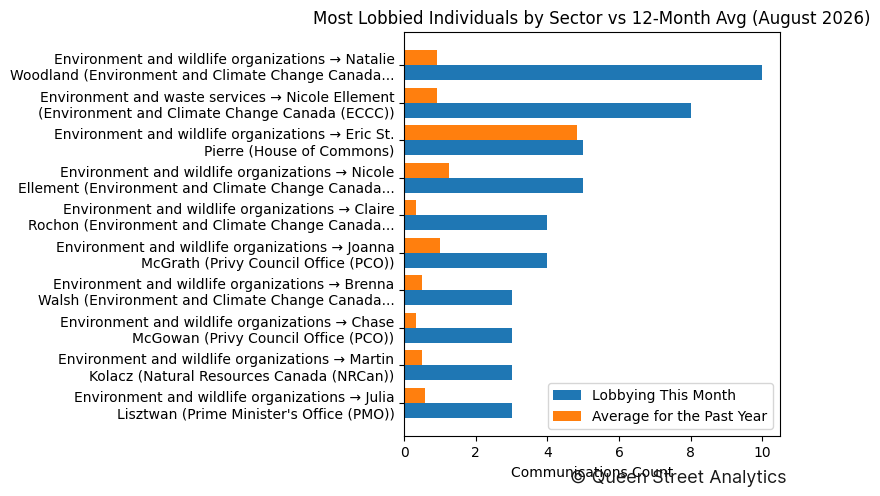
Among the individuals with the most notable meeting activity (by sector) this month were Environment and wildlife organizations → Natalie Woodland (Environment and Climate Change Canada (ECCC)), Environment and waste services → Nicole Ellement (Environment and Climate Change Canada (ECCC)) and Environment and wildlife organizations → Eric St. Pierre (House of Commons).
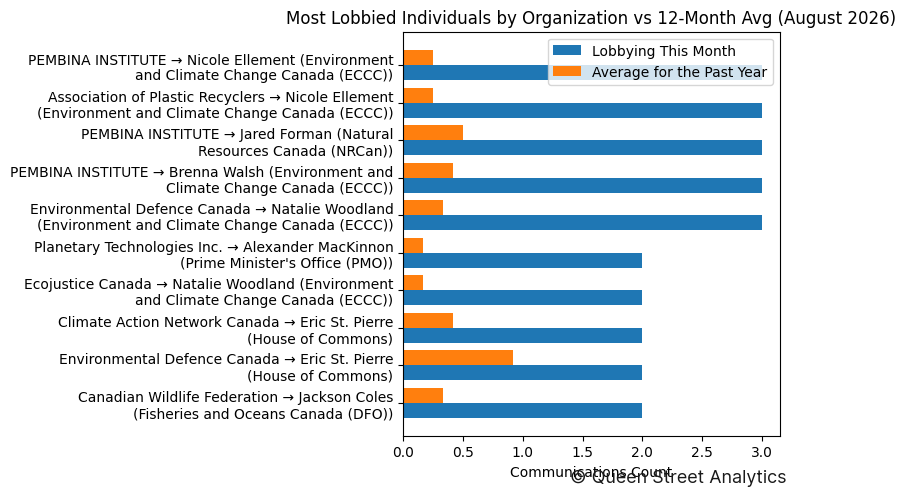
Among the individuals with the most notable meeting activity (by organization) this month were PEMBINA INSTITUTE → Nicole Ellement (Environment and Climate Change Canada (ECCC)), Association of Plastic Recyclers → Nicole Ellement (Environment and Climate Change Canada (ECCC)) and PEMBINA INSTITUTE → Jared Forman (Natural Resources Canada (NRCan)).