Lobbying on Automotive - Brussels (April 2026 edition)





Association des Constructeurs Europeens d'Automobiles; Daimler Truck AG; Scania AB (publ); Ferrari; TRATON Group; Roam Electric AB were unusually active lobbyists last month.
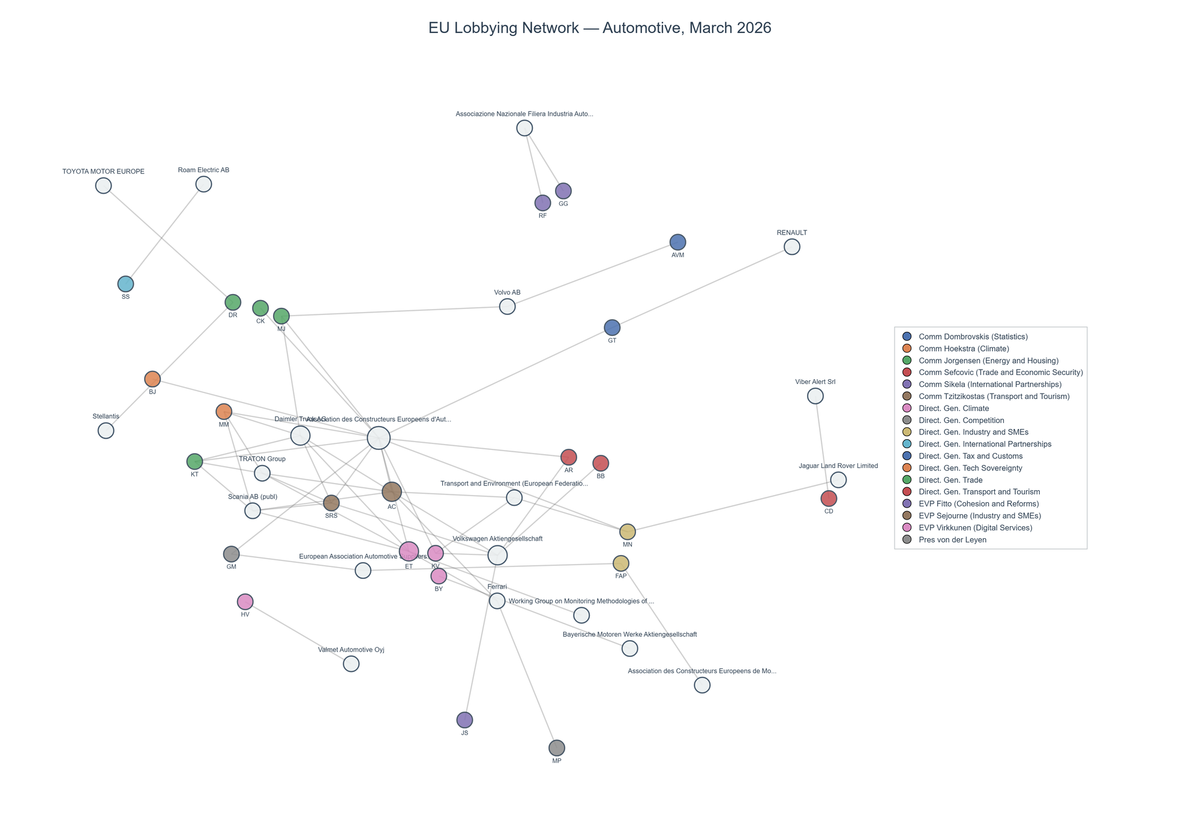
March 2026 Data (April Edition)
Section A: The Themes Hidden in March's Lobbying Data
PFAS Ban Advances, Intensifying Industry Concerns
March 2026 marked a pivotal moment for the EU’s PFAS restriction process, as two key ECHA committees advanced opinions that push the EU closer to a far-reaching chemical ban. This coincides with a flurry of industry lobbying, including meetings between the European Association Automotive Suppliers and Direct. Gen. Industry and SMEs, as well as discussions involving Association des Constructeurs Europeens de Motocycles and the same Commission interlocutor, reflecting deep concerns from automotive suppliers over compliance and supply chain disruptions due to PFAS use in essential vehicle components. The move signals increasing regulatory pressure that manufacturers must quickly address.
📎 Certivo summary — EU PFAS restriction under REACH: What the 2026 ECHA Opinions mean for global manufacturers · ECHA publishes updated PFAS restriction proposal
EU Automotive Package Responds to Industry Calls for Flexibility
The European Commission’s unveiling of the Automotive Package in early 2026 coincided with a surge in lobbying by vehicle manufacturers such as the Association des Constructeurs Europeens d'Automobiles and Volkswagen Aktiengesellschaft, highlighting demands for more pragmatic emission targets and industrial support. The package proposes relaxed CO2 standards, incentives for domestic EVs, and simplified regulations—directly addressing industry concerns surfaced in recent meetings with Direct. Gen. Climate and Direct. Gen. Industry and SMEs. Legislative debate continues around balancing environmental goals with industrial competitiveness.
📎 Action plan for the future of the automotive sector: Automotive Package · The EU Automotive Package: An Impact Analysis
CO₂ Compliance Flexibility for Heavy Vehicles Adopted
March saw the Council adopt regulatory flexibilities enabling heavy-duty vehicle manufacturers, including Association des Constructeurs Europeens d'Automobiles and Daimler Truck AG, to earn more emission credits ahead of 2030, a shift closely mirroring lobbying efforts targeting CO2 rules with Direct. Gen. Climate and Comm Hoekstra (Climate). These changes ease compliance for truck makers as infrastructure ramps up, and are viewed as an interim measure to address the sector’s transition challenges. The revision offers manufacturers breathing space while maintaining the EU’s long-term decarbonization trajectory.
📎 EU Council adopts relaxed CO₂ targets for HGV manufacturers
Industrial Accelerator Act Proposed to Safeguard Auto Supply Chains
The European Commission published the Industrial Accelerator Act proposal in March 2026, aiming to boost EU-made strategic technologies and ease permitting—a move that comes amid lobbying from Jaguar Land Rover Limited and the Association des Constructeurs Europeens d'Automobiles for greater supply chain resilience in recent discussions with the Directorate-General for Industry and SMEs. The proposed act would facilitate procurement for local automotive components and reinforce requirements for EU-made products, reflecting industry concerns about global competition and supply security raised in meetings with Commissioner Sefcovic and Valmet Automotive Oyj.
📎 Industrial Accelerator Act - Internal Market, Industry ...
Regulatory Review Raises Data Access Concerns for Car Repair
The Commission’s evaluation of the Motor Vehicle Block Exemption Regulation (MVBER), released in June 2026, highlights persistent competition issues in car repair—particularly around access to technical and vehicle-generated data, a subject raised in recent meetings between Association des Constructeurs Europeens d'Automobiles, European Association Automotive Suppliers, and Direct. Gen. Competition. The report’s findings, coinciding with industry lobbying campaigns on the issue, including exchanges with Associazione Nazionale Filiera Industria Automobilistica and EVP Fitto (Cohesion and Reforms), signal that further reforms are under consideration to ensure fair competition in the evolving digital and electric mobility landscape.
📎 Review of the Motor Vehicle Block Exemption Regulation · EU report highlights growing risks for car repair competition in digital era

Section B: Lobbying Activity by Industry
This section compares, by industry, the lobbying activity with the European Commission last month to its historical average.
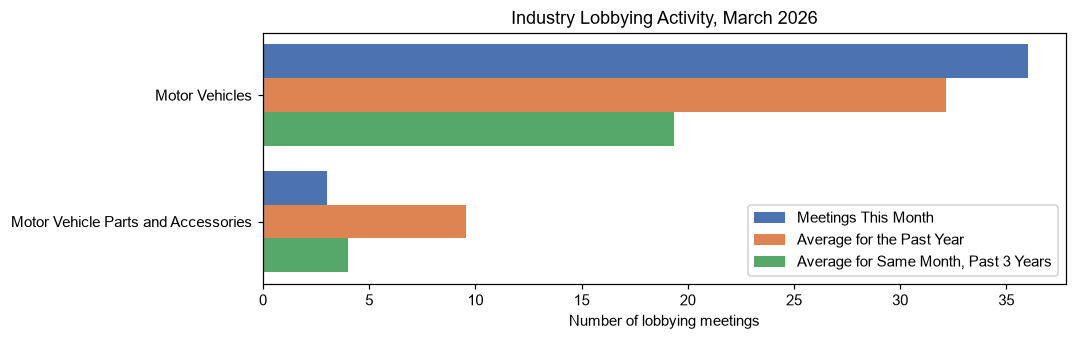
Industry Lobbying Activity, March 2026
In March 2026, 2 industries from this sector were active in lobbying meetings with the European Commission, led by Motor Vehicles.
Industries running notably above their historical average this month include Motor Vehicles.
On the quieter side, Motor Vehicle Parts and Accessories saw notably less lobbying activity than their historical average.
Section C: Lobbying by Industry for the Past Year
To contextualize Section B, this chart shows the residual trajectory of the same top industries from Section B over the past 12 months — the deviation from what would be expected after accounting for seasonal patterns and the overall trend. Persistent above-zero values indicate sustained over-activity; persistent below-zero values indicate sustained quiet periods.
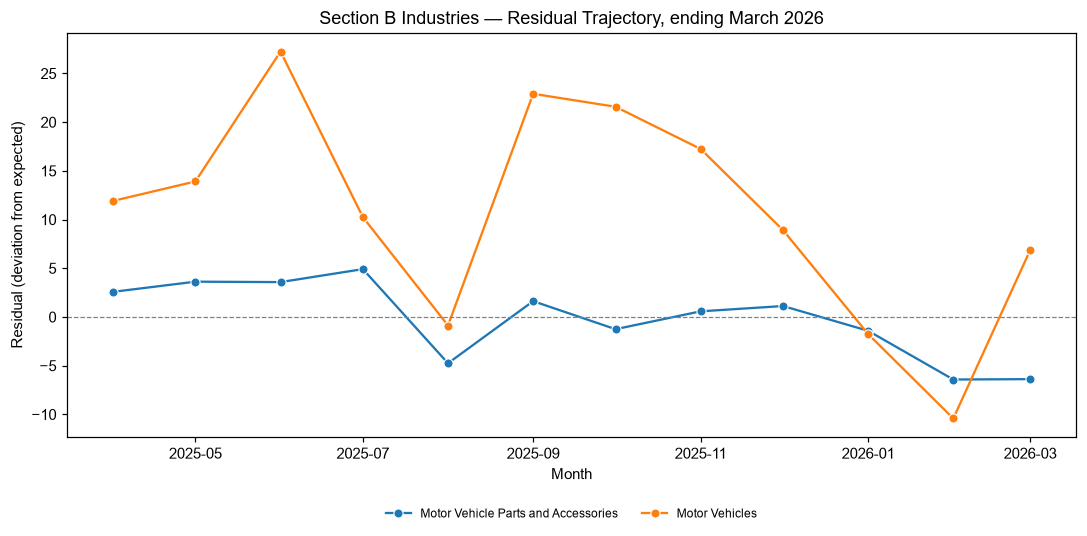
Industry Lobbying Residuals, March 2026
This chart shows the 2 industries in this sector with the largest deviations from expected lobbying activity in March 2026. Positive values run above their seasonal trend, negative values below.
Motor Vehicles saw lobbying notably above expected levels this month.
Motor Vehicle Parts and Accessories saw lobbying notably below expected levels this month.
Section D: Lobbying Activity by Organization
In this section, we see the organizations with the most unusual lobbying behavior last month, defined by either unusually high or unusually low lobbying activity.
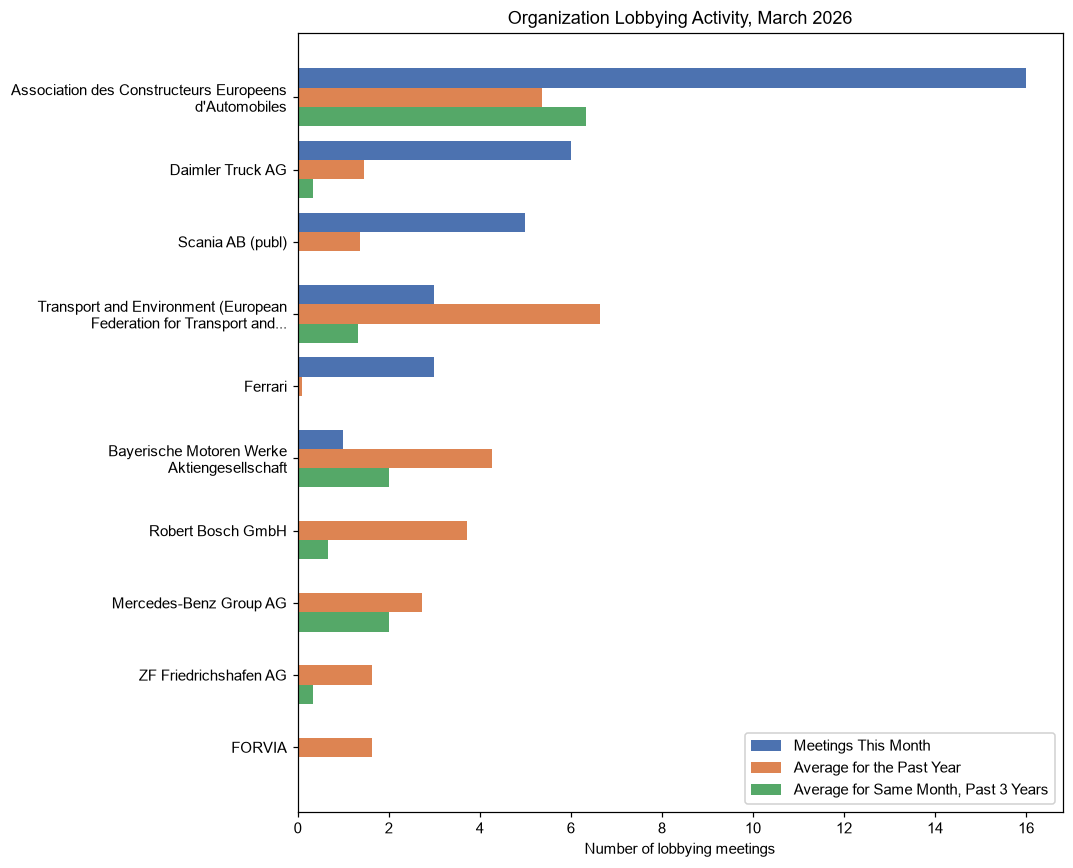
Organization Lobbying Activity, March 2026
In March 2026, 21 organizations from this sector took part in 41 lobbying meetings with the European Commission.
The organizations with the most notable increases in lobbying activity this month include Association des Constructeurs Europeens d'Automobiles, Daimler Truck AG, Scania AB (publ), and Ferrari.
On the quieter side, Robert Bosch GmbH, Transport and Environment (European Federation for Transport and Environment), Bayerische Motoren Werke Aktiengesellschaft, Mercedes-Benz Group AG, and ZF Friedrichshafen AG saw notably less lobbying activity than usual.
New to the sector's lobbying records this month: TRATON Group, Roam Electric AB, Associazione Nazionale Filiera Industria Automobilistica, Valmet Automotive Oyj, and Viber Alert Srl.
Section E: Lobbying of Government Institutions in the Past Month
Every lobbying meeting takes place with one of two types of European Commission body: a Commissioner's cabinet (political staff) or a Directorate-General (the civil service). This section shows the organisation-to-institution pairings with the most unusual lobbying activity last month, defined by the largest absolute difference between this month's meeting count and the pair's 12-month rolling average.
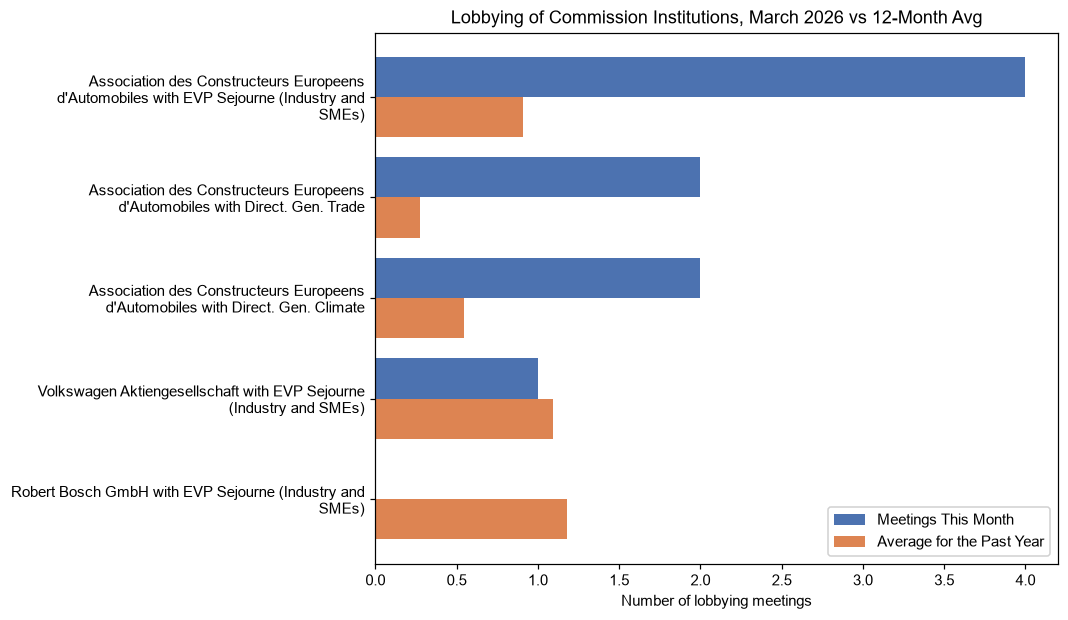
Lobbying of Commission Institutions, March 2026 vs 12-Month Avg
In March 2026, 21 organisations from this sector met with 20 Commission bodies across 41 meetings — split across 11 Commissioner cabinets and 9 Directorates-General.
Notable increases in lobbying activity this month include Association des Constructeurs Europeens d'Automobiles with EVP Sejourne (Industry and SMEs), Association des Constructeurs Europeens d'Automobiles with Direct. Gen. Trade, and Association des Constructeurs Europeens d'Automobiles with Direct. Gen. Climate.
On the quieter side, Robert Bosch GmbH with EVP Sejourne (Industry and SMEs) and Volkswagen Aktiengesellschaft with EVP Sejourne (Industry and SMEs) saw notably less lobbying activity than their historical average.
Section F: Organization Lobbying by Subject in the Past Month
This section shows the organisation-to-subject pairings with the most unusual lobbying activity last month. Subjects are classified from each meeting's title text into one of 19 EU policy areas. A meeting covering multiple topics counts toward each of them.
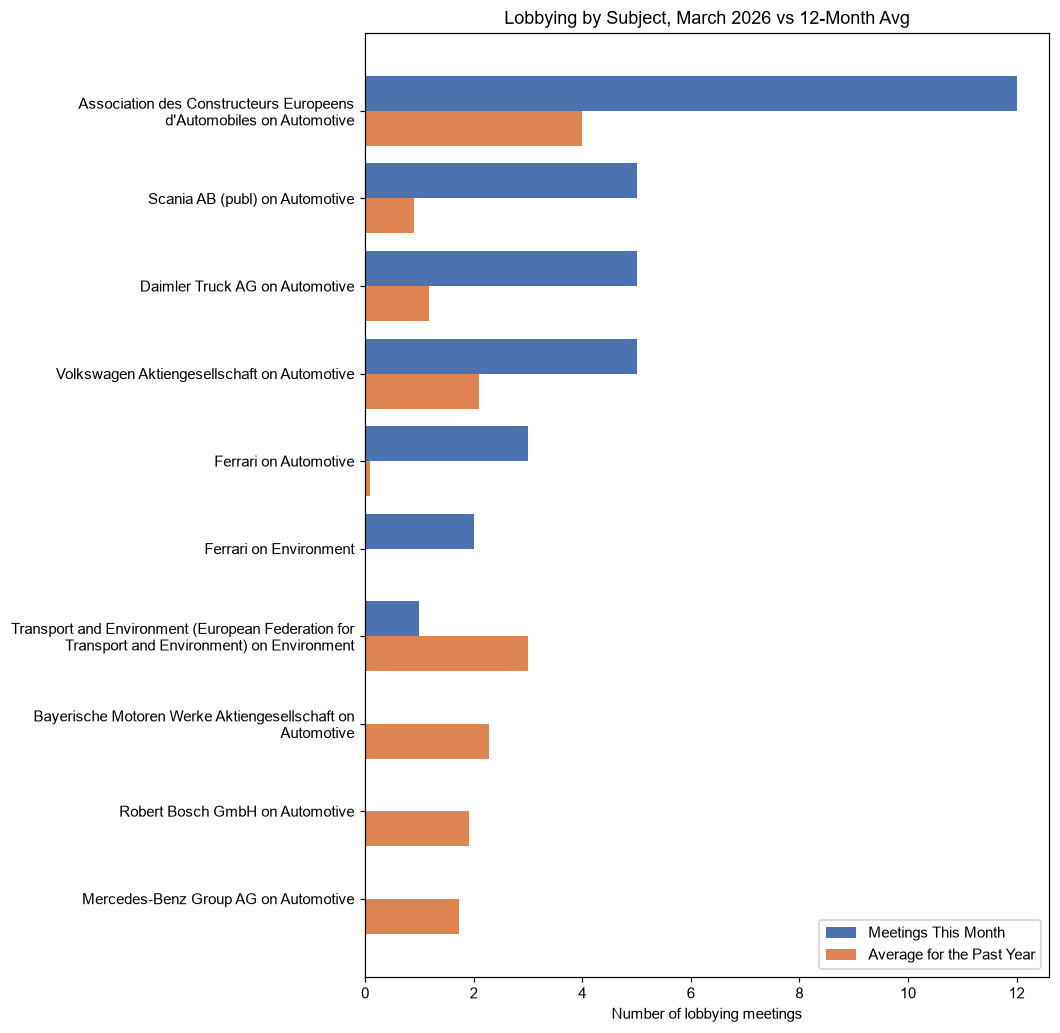
Lobbying by Subject, March 2026 vs 12-Month Avg
In March 2026, 20 organisations from this sector lobbied on 7 policy topics across 41 meetings. Meetings may touch multiple topics, so subject totals can exceed total meetings.
Topics with notably elevated lobbying activity this month include Association des Constructeurs Europeens d'Automobiles on Automotive, Scania AB (publ) on Automotive, Daimler Truck AG on Automotive, Volkswagen Aktiengesellschaft on Automotive, and Ferrari on Automotive.
On the quieter side, Bayerische Motoren Werke Aktiengesellschaft on Automotive, Transport and Environment (European Federation for Transport and Environment) on Environment, Robert Bosch GmbH on Automotive, and Mercedes-Benz Group AG on Automotive saw notably less lobbying activity than their historical average.
Section G: Most-Lobbied Officials
This section lists the most-frequent lobbying touchpoints between this sector's organisations and individual European Commission officials last month, compared to each pairing's average over the past year.
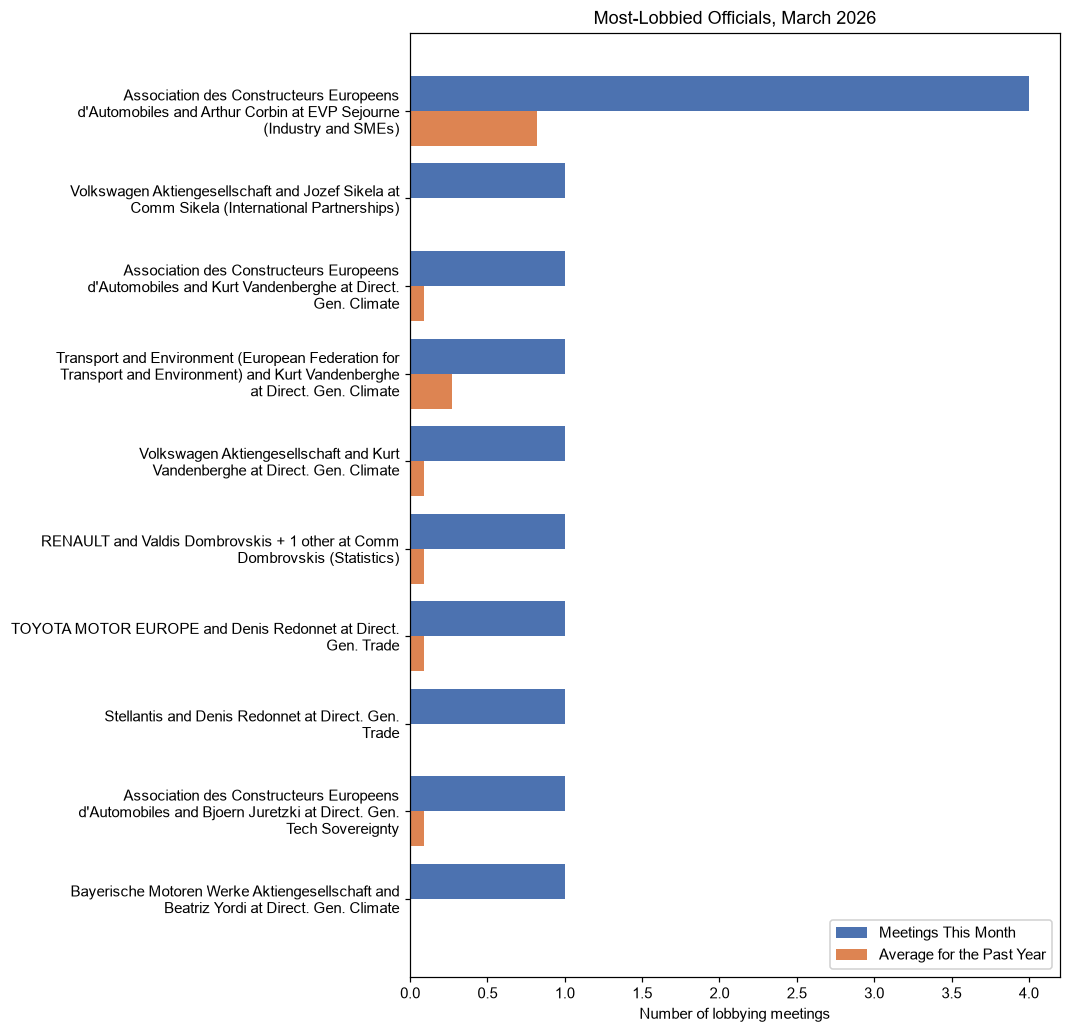
Most-Lobbied Officials, March 2026
In March 2026, 31 European Commission officials took part in 41 meetings with this sector's lobbyists.
The most-frequent meetings this month were Association des Constructeurs Europeens d'Automobiles and Arthur Corbin at EVP Sejourne (Industry and SMEs), Volkswagen Aktiengesellschaft and Jozef Sikela at Comm Sikela (International Partnerships), Association des Constructeurs Europeens d'Automobiles and Kurt Vandenberghe at Direct. Gen. Climate, Transport and Environment (European Federation for Transport and Environment) and Kurt Vandenberghe at Direct. Gen. Climate, and Volkswagen Aktiengesellschaft and Kurt Vandenberghe at Direct. Gen. Climate.
Most activity came from Cabinet members (32 meetings), followed by Head of Unit (18) and Acting Director (3).


